

Omar Cooper announced today that he will forego his final season of eligibility and enter the NFL Draft process. Given this news, I wanted to re-release a BSB I published before the 2025 season, which sought to project (in a very elementary fashion) what the 2025 season might look like for Cooper.
First, though, Cooper ends his career with 115 catches, 1,798 yards (15.6 yards/reception), and 22 TDs (with 2 additional rushing TDs). His career reception TD total finishes just behind Elijah Sarratt for 4th in program history, and his single-season receiving TD total in 2025 ranks 3rd in program history. He most likely would’ve challenged James Hardy’s massive 36 career TD mark if he had returned for 2026. Cooper’s 207-yard, 4-TD performance against Indiana State is also one of the greatest receiving performances in program history, as the single-game yardage ranks 7th and the single-game TDs ties Hardy for the most.
You will read below how unusual his 2024 season was, and I also made some projections for his 2025 season, based on the profiles of other receivers who had recorded similar profiles in previous seasons. In 16 games (more than I would’ve anticipated), he out-performed all of the projections I made:
81 targets (he had 91)
19% target share (24%)
54 receptions (69)
858 yards (937)
Comparing the projections to his first 13 games (replacing Ohio State with Alabama to account for his injury), it’s much closer:
81 targets (he had 78)
19% target share (25%)
54 receptions (61)
858 yards (883)
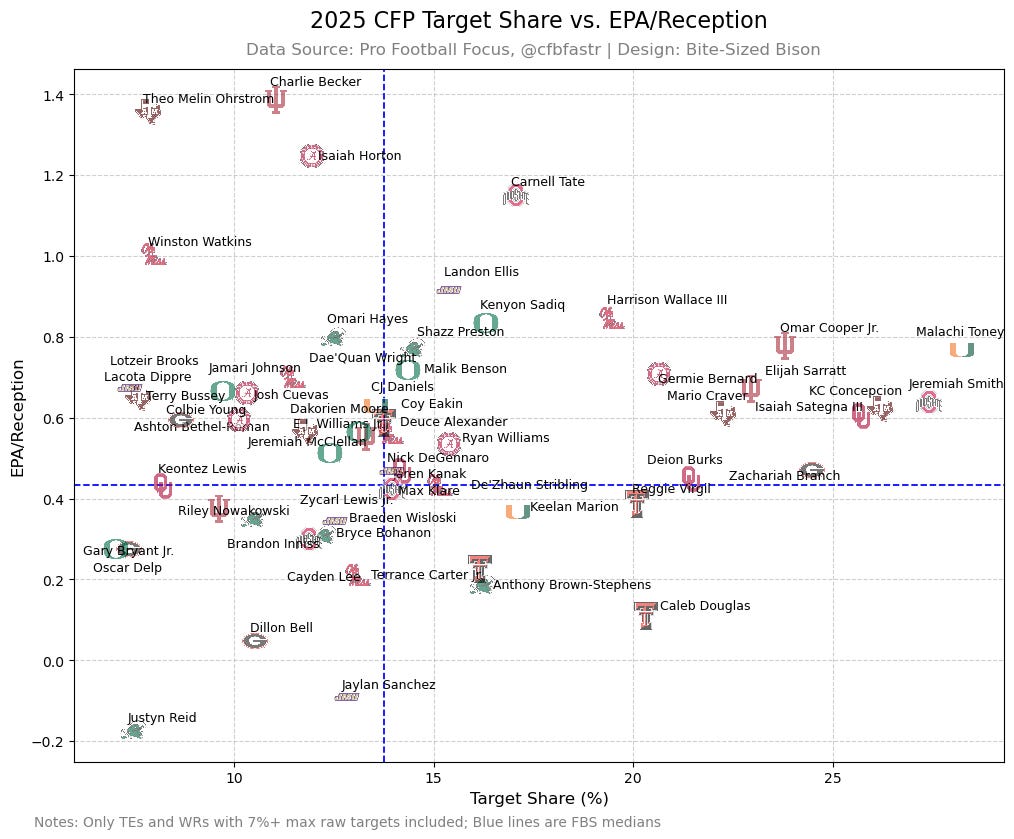
What we also know about Cooper is that he is phenomenal after the catch. You’ll see below that his 7.5 YAC/reception was significant in 2024, and yet, even with his increased usage in 2025, he remained at 7.2 YAC/reception. That ranks 10th nationally — just behind Miami’s Malachi Toney — among WRs with 90th targets (27th nationally among WRs with 50+ targets). That contributed to his season-long EPA/play, as shown in the chart below:
Cooper also finished ranked 18th among starting FBS WRs in PFF’s run-blocking grade.
He did all of this while playing an unprecedented 83% of snaps at slot (where he’d never specialized before 2025) because anticipated starting slot WR Tyler Morris suffered a season-ending injury before the season. He played 324 snaps at slot in 2025, compared to just 45 in his two previous seasons.
Cooper will go down as one of the greatest Hoosiers in Indiana Football history, and it’s not just the stats or the insane moments he provided — like the incredible catch to beat Penn State in Happy Valley and every moment included in this clip from the Kirkwood & Dunn Podcast. It’s also because he stayed at Indiana after Tom Allen’s departure. He stayed after not only playing on a 3-9 team in 2023 but also redshirting on a 4-8 team in 2022. Cooper committed in July 2021 out of Lawrence North as a four-star prospect — a top-300 recruit in the 2022 class — to a program that had not yet fallen from its 2020 graces, and he, of all of the signees from that class, had much to lose by sticking with Indiana. But he stayed in Bloomington, through two Allen seasons and the transition into the Curt Cignetti Era, and he leaves a national champion.
The consensus projection for Cooper by many NFL Draft folks is that he will be drafted in the second round in April, which I would not have anticipated before publishing this original BSB before the season. But while watching him during his two seasons with Mike Shanahan, I think he’s one of the more rare cases where he could be even more effective in the NFL than he was in college, simply because he played in an offense where he wasn’t foregrounded, as Indiana sought to achieve balance and had multiple NFL-caliber receivers (as we’ll see in the next couple of drafts).
Now, on to the re-released BSB, titled “What does 2025 have in store for Omar Cooper?”
Omar Cooper was one of the more confounding contributors to Indiana’s 2024 season. Of Indiana’s top-50 plays during the 2024 season (by EPA), the former top-300 recruit out of Lawrence North created the second-most big plays among Indiana pass-catchers – Elijah Sarratt 11, Cooper 8. Yet, he was targeted just 48 times (4th on the team, 34th in the Big Ten).
Part of Cooper’s success was due to OC Mike Shanahan setting up the climate for Cooper’s number, but it often left Indiana fans considering what Cooper could have done with more targets (and more routes run, where he ranked 420th in the FBS, just behind Miles Cross!). We might discover the possibility this season, as Cooper appears to be a key cog in the Shanahan passing scheme for 2025.
That creates quite a bit of anticipation for the redshirt junior, after the rare feat he pulled off in this offense a year ago.
Only two Power 4 wide receivers (30+ targets) – Cooper and Tennessee’s Dont’e Thornton – recorded receiving seasons that met the following parameters:
Fewer than 250 routes ran
Average depth of target 16+ yards
7+ yards after catch per reception
17.0 yards per reception
These are big-play catalysts. They’re targeted deeper downfield and make plays after the catch. Thornton (25.5) was second in the Power 4 in yards per catch and Cooper (21.2) was fifth, while Cooper was fifth and Thornton was 30th in EPA/play when either caught the ball.
Thornton was drafted in the 4th Round of this year’s NFL Draft by the Las Vegas Raiders.
To perform as consistently as those two did in those roles relies on the offensive coordinator setting up the heat checks for these big-play receivers, but to do it this often and this consistently is rare. Over the previous 10 seasons (2015-2024), only 12 Power 4 receivers (30+ targets) recorded season-long performances that met the parameters noted above. Those receivers are:
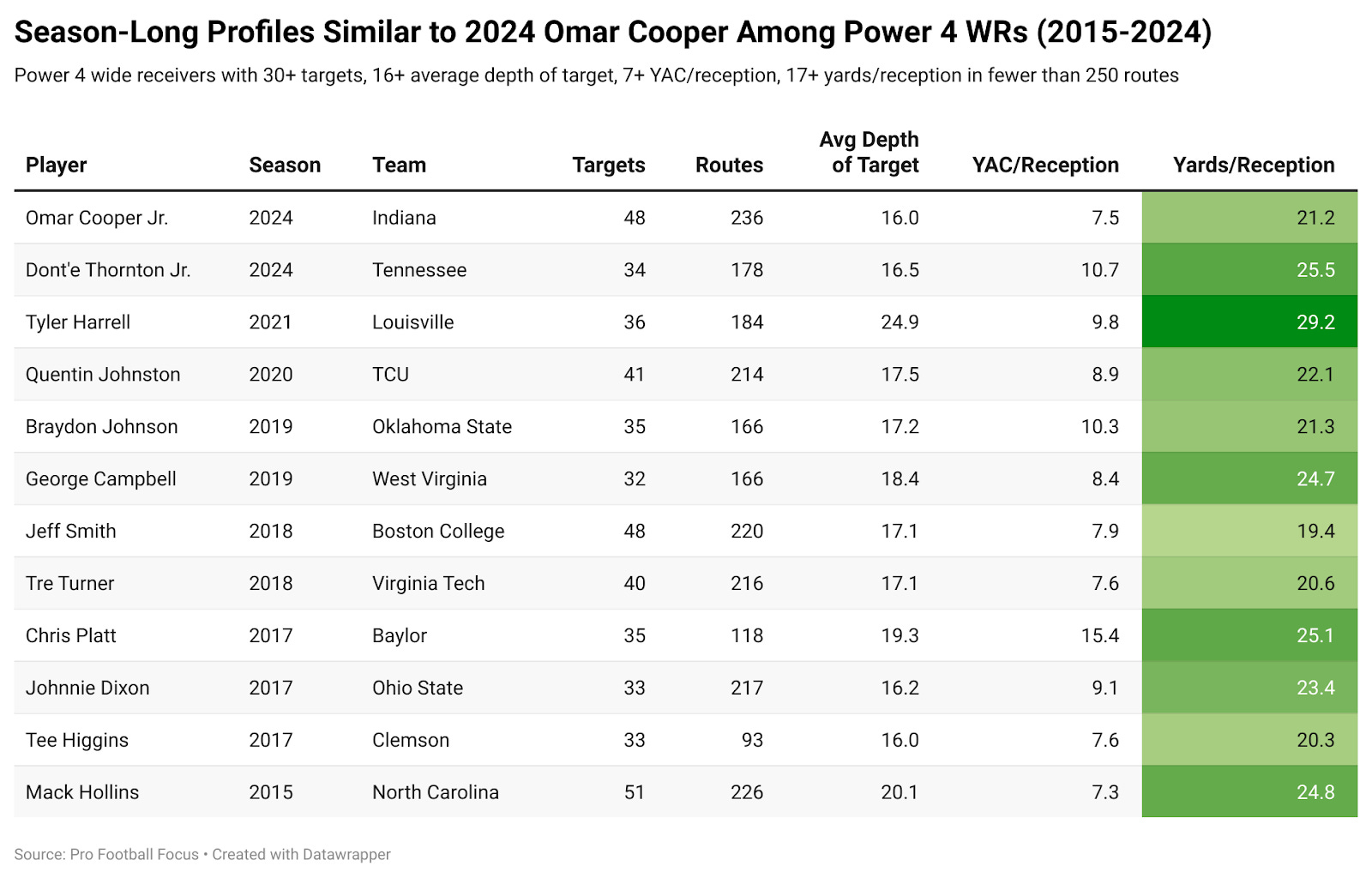
Four receivers on this list were drafted into the NFL: Mack Hollins, Tee Higgins, Quentin Johnston, and Thornton. All of the others were given opportunities in the NFL after the draft, except Cooper, who is the only active college receiver to achieve this season-long profile. It should be noted here that the drafted receivers are all much larger than Cooper (6-foot-1). None of the drafted receivers are below 6-foot-4.
Clearly, this sort of profile is not sustainable, or else these receivers would have sustained it for more than one season. And even within this particular profile, there are different roles inside of different offenses. There were true spark plugs in pass-heavy offenses – fewer than an 8% target share on the team – such as Higgins, Johnnie Dixon, Chris Platt, and George Campbell. Then there were the ones who were quite involved and built this profile through high-volume consistency, such as Johnston (15.0%), Jeff Smith (14.2%), and Hollins (12.5%). Cooper fits into the latter, with a 13.3% target share at Indiana in 2024 – the third-highest in this group.
What seems to be true most often with this crop of receivers is that these seasons occurred early in their careers. There were a few who went out like this – Smith, Campbell, and Thornton – and there were others whose careers took a tougher turn – Tyler Harrell and Braydon Johnson. But for many of the receivers here, these profiles were precursors for a hybrid of higher volume and dynamite plays in the coming seasons – Higgins, Dixon, and Johnston, most notably.
For those three, like Cooper, there was continuity within the play-calling for the following season. Higgins retained Clemson OC Tony Elliott (now HC at Virginia) going into 2018; Dixon maintained Ryan Day as the playcaller going into 2018; and Johnston had his position coach (Doug Meachem, now OC at Oklahoma State) promoted into OC after Sonny Cumbie (now HC at Louisiana Tech) was hired away by Texas Tech following the 2020 season.
This was the change between the Omar Cooper-like seasons and each receiver’s following season:
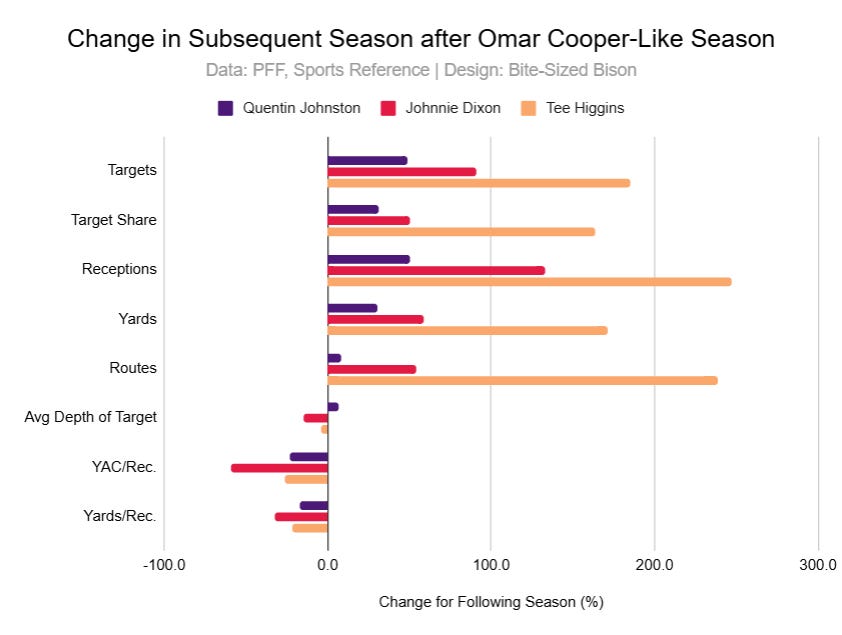
Of course, if Cooper was as dominant as Higgins, we’d know by now. Higgins’ Cooper-like season was his freshman year, and then, as shown in the chart above, he exploded during Clemson’s 2018 championship season (his second year on campus). But even Higgins saw dips in the bottom three metrics, showing a dip in explosives, which is to be expected when the target share increases.
Cooper is much more like Johnston and Dixon (still a great compliment), and if we apply the average percentage change of those two between their Cooper-like seasons and the following seasons, Cooper might improve to something like this in 2025:
236 routes to 310
48 targets to 82
13.3% target share to 18.7%
28 receptions to 54
594 yards to 858
Those estimations might be optimistic in this Indiana offense that has Sarratt and EJ Williams on the perimeter, Makai Jackson expected to fill a versatile Miles Cross-type role, and Jonathan Brady serving something closer to the slot role. But Cooper should be the No. 2 guy in that room, particularly out wide (where he’s played 88% of his career snaps) and with a bit more depth concern at receiver than in 2024, he might get close.
This reality also highlights something that differentiates Cooper from the other receivers on the list above: the transfer portal effect. Cooper and Thornton are the only two receivers on the list who recorded these profiles after the transfer boom. Harrell actually transferred to Alabama for 2022, was injured, transferred to Miami (FL) for 2023, and never found a starting role again. In 2025, Cooper welcomes two new receivers (three, if you count EJ Williams returning after redshirting), two new TEs (one of which will likely eat some targets), and a new QB into the Indiana offense. There isn’t much precedence for the progression of these exact types of receivers during the age of player movement.
With all of this said, Cooper is quite possibly the most explosive receiver on this roster, and the nature of the receiving corps seems to point toward him receiving a few more targets in 2025, and in a somewhat outsized role. What that looks like exactly is probably only known within the walls of Memorial Stadium.
Comments
Nothing yet. Say the first thing.
Sign in to join the conversation.