

Curt Cignetti and the Hoosiers have done it: Indiana is the national champion of college football, after defeating Miami — in its own venue, Hard Rock Stadium — 27-21.
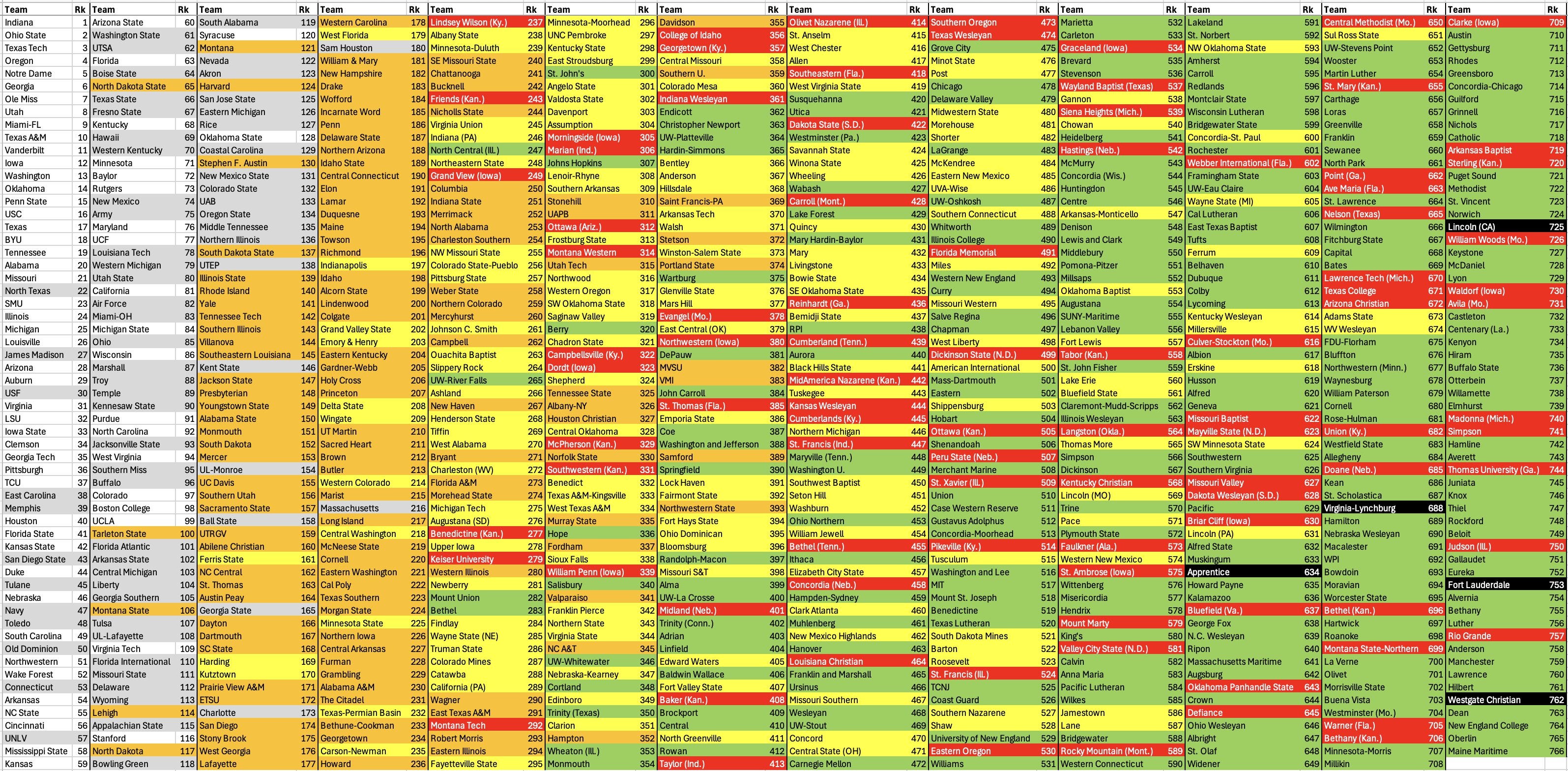
ESPN’s Bill Connelly — the founder of SP+ — does a college football-wide ranking within SP+, which takes all teams at all levels (FBS DI, FCS DI, DII, DIII, NAIA, etc.) and ranks them, even placing them into one graphic, all 766 teams. Indiana is No. 1 atop this chart.
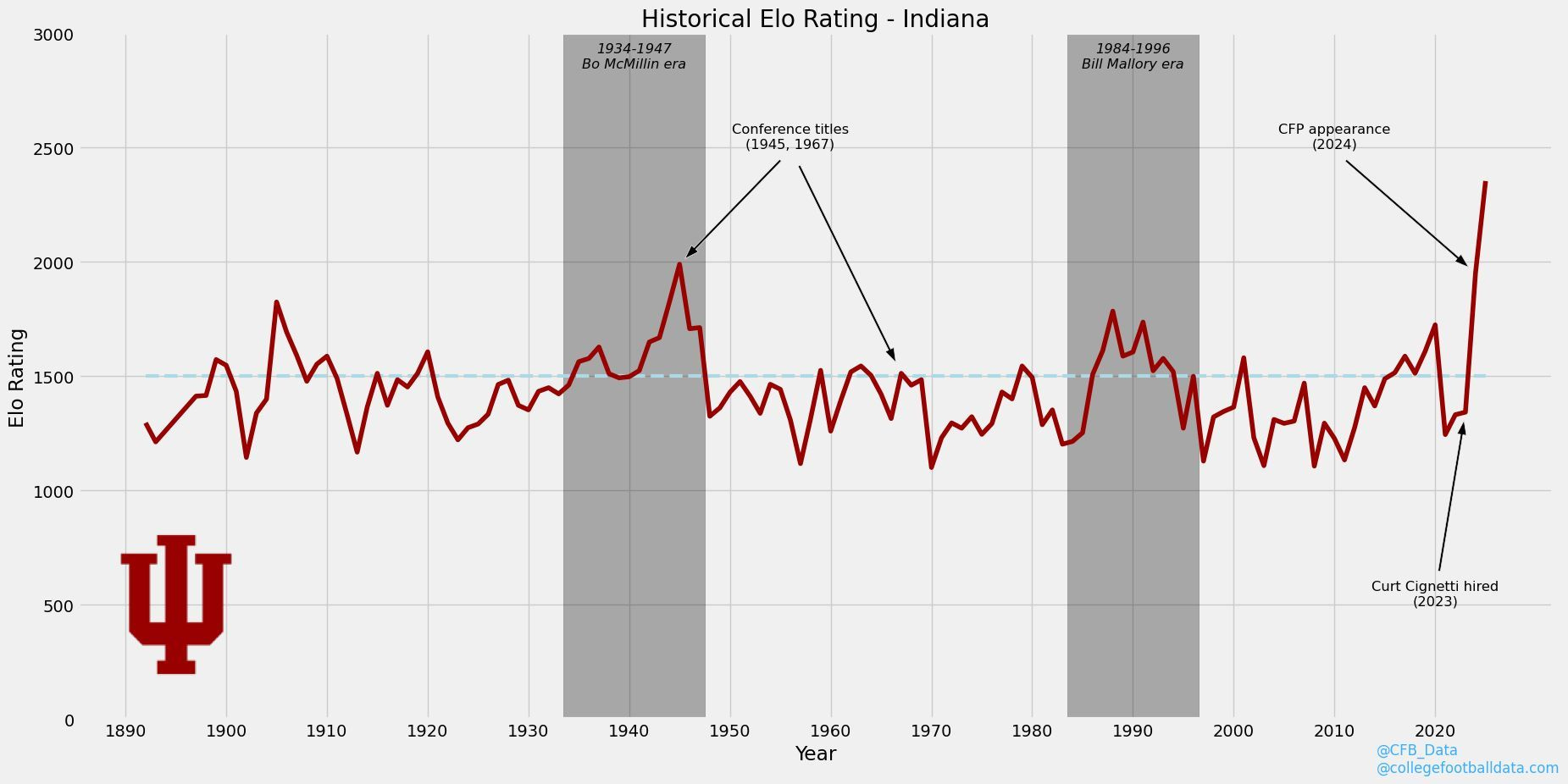
It may take some time to register exactly how massive the achievement truly is. It is not easy to process a change as sudden and as monumental as the change shown here by CollegeFootballData.com’s Bill Radjewski.
Many folks have tried to give words to this surrealism — many have done a great job in doing so (check out the CrimsonCast recap episode). I have struggled to.
There’s something about the IU Football program that binds the strongest of Indiana Hoosiers, the ones who tethered themselves to the once-losingest program in college football history for the love of their alma mater, or the love of their town, or the love of their family, or any number of reasons — all as deeply personal and meaningful as the next.
I was the first in my house to go off to and graduate from college. Not the first in my extended family — there are a few Hoosiers in there — but I do not come from a multi-generational chain of Indiana Football fans. In fact, I believe I am the first in my family to be a true Indiana Football fan. We were a Bob Knight-Lou Holtz family in Northeast Indiana, and, before college, I could count on one hand the total number of football games I attended that weren’t games I was playing in. I watched 99.9% of football games in front of a TV.
This is all to say that when I think of Indiana Football, I first think of Memorial Stadium — the one in Bloomington, Indiana, not to be lost in the conglomerate of stadiums named “Memorial Stadium.”
I arrived in Bloomington freshly 19 years old in 2014, and the first chance I got, I went to Memorial, for a Welcome Week activity. This was also the same week I stepped into Assembly Hall for the first time (big week for me), but I grew up a Peyton Manning-Marvin Harrison kid, so football was my jam. I’d begun watching Indiana the season before, since I’d been accepted to IU and knew my goal was to cover this program, not the basketball program, for the Indiana Daily Student as soon as possible. I couldn’t wait to watch Tevin Coleman on Week 1 of the 2014 season, and he didn’t disappoint, rushing for 247 yards against Indiana State (still the 6th-most rushing yards in a game in IU history). I was in the front row of the student section that day and never missed another game (and maybe just a handful total to this day). In fact, I probably should’ve spent a few more days in the tailgating fields with friends.
I just fell in love with Memorial Stadium and the Indiana Football program for what others saw as blemishes — the half-filled stadium, the modest facilities, the outdated press box, the disjointed traditions, the lack of blue-chip players, the “appearing in one bowl since 1991” of it all. It was mine — a football program placed there for people like me, handcrafted to go as far as I was willing to take it.
And I took it far. I learned to be a sports journalist in those walls and the walls of Ernie Pyle Hall and Franklin Hall — learning from the likes of Terry Hutchens, Zach Osterman, Mike Miller, Jon Blau, Galen Clavio, Don Fischer, and many others. When I decided sports journalism wasn’t the lifestyle I wanted to lead, I left a dream beat (covering Ohio State Football) to cover Indiana Football one more time in 2019, hoping it would change my mind (it didn’t). Then, I learned to be a data scientist thanks to the Luddy School of Informatics, Computing, and Engineering and thanks to analyzing Indiana Football through this newsletter (and some other projects). Through it all, I got to know people within the program on personal levels — coaches, players, staffers, media, fans — to the point where the program took on new tiers of meaning. There have been so few moments in my life since 2014 where Indiana Football wasn’t in close proximity. and in every chapter, I find myself entering the gates of Memorial Stadium. And that feeling of home never goes away.
What defines Memorial Stadium to me is the requirement of passion. Loving Indiana Football doesn’t come easily. There is so little winning involved, yet you can feel that passion on the grounds around E. 17th St., N. Dunn St., N. Fee Lane, the bypass and compressed in the air of the concourse. There’s a familiarity and a love for something unwanted by most others, soaked to the bone by repeated disappointment and unrelenting hope and loyalty. Indiana’s program-long winning percentage was 39% before Cignetti arrived, yet fans showed up every week — not by 100,000 but maybe by 40,000 — grasping for a moment. Sometimes, that moment was as simple as a breakaway TD by Tevin Coleman or an uncorked TD pass from Mike Penix to Ty Fryfogle. Other times, it was the possibility of opportunity, like pushing Michigan to double-OT, coming within a possession of a ranked Ohio State or Iowa, or finally beating Michigan State in 2016.
But any accomplishment by the Hoosiers was contained to Memorial Stadium. Winning the Pinstripe Bowl or the Gator Bowl (or even knocking off Michigan or Ohio State) wouldn’t have permeated a national stage or earned any sort of respect outside of what this community could offer on its own.
So when I think of the contrast between the reality before December 2023 and this newfound reality today — where Cignetti’s Hoosiers have demanded eyes on the undeniability of football in Bloomington — I think of the day when Indiana eventually unveils a banner (or whatever the university chooses to use). How strange it will seem for a national treasure to be hanging in our Memorial Stadium. When nothing is given and all is earned, it will still feel like Indiana stole something out there and brought it back to us proud Hoosiers.
I hope, every time I re-enter the gates of Memorial Stadium — next year and the years to come — I never lose that feeling.
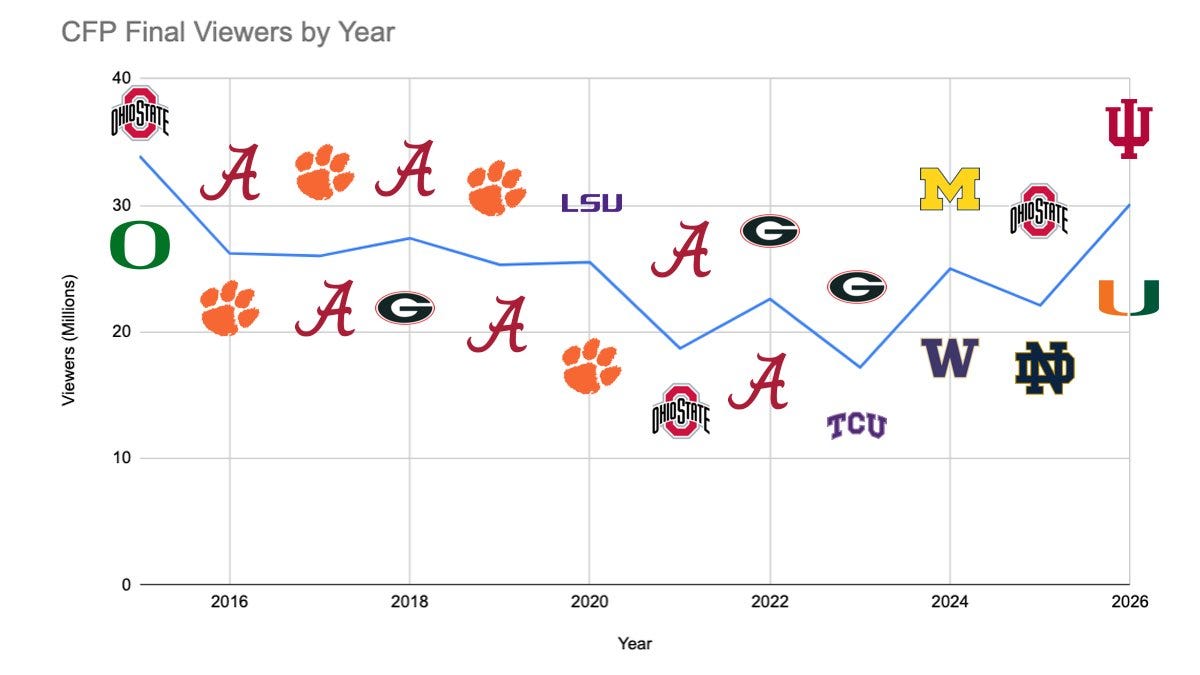
First of all, the National Championship Game was a massive success overall. ESPN announced that it was the most-watched non-NFL sporting event since Game 7 of the 2016 World Series. Here is how the 30.1 million viewers compared to previous NCGs (via @RedditCFB on Twitter).
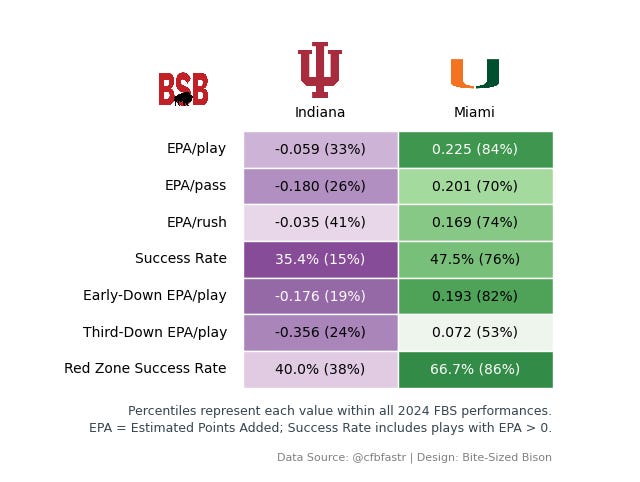
For Indiana, it was a fairly ugly game, statistically. Bill Connelly’s postgame win expectancy, which I’ve been using all season, gave Indiana just a 14% chance to win this game. The moments — Miami missed field goal in the second quarter, Mikail Kamara’s blocked punt, Cignetti putting the game on Miami’s offense late in the fourth quarter, Fernando Mendoza’s 4th-down run — and the game management — Indiana eating clock with its interior run game, costly penalties on both sides, schematic adjustments like Miami going tempo in the fourth quarter — really decided this game in ways that couldn’t be picked up by a postgame win expectancy model.
The statistical ugliness on defense has been unusual for the Hoosiers since 2024. Indiana struggled to get pressure on the backfield (1 sack, 1 TFL) and didn’t always respond well to Miami’s tempo late in the game, and it showed here:
Notes:
Perhaps the most effective phase of the game, between each team’s passing and rushing games, was surprisingly Miami’s passing game. On 52 plays, Carson Beck dropped back on 32 of them (62%), which is a rate higher than most games for Beck this season. He completed 19 passes for 232 yards (142 via YAC). Indiana struggled limiting YAC, as Miami’s 7.5 YAC/reception was its 4th-most of the season.
Miami’s rushing EPA is slightly deceiving because it scored two TDs via the rush, including an explosive 57-yarder. It wasn’t exactly moving the ball with the run, though. Without the 57-yard run, Indiana would have limited Miami to 2.7 yards/rush, rather than 5.2, which is why it needed to turn to the pass so often.
The pass rush really got to Indiana. Even Carter Smith allowed his first two sacks of the season, as Fernando Mendoza was sacked 3 times. Mendoza was somewhat quietly sacked 10 times in four postseason games. Miami’s 11 pressures were the most on Mendoza since Ohio State (13).
I noted this in the BSB Preview but didn’t realize Indiana would lean on it quite so heavily: the interior rushing attack was crucial. Miami’s DEs were wide all game, meaning the middle of the defense couldn’t collapse fast enough to prevent Indiana’s backs from gaining just enough yardage to keep drives alive. Shanahan called for interior runs on 26-of-38 rushes and gained 115 yards this way. The reason why Indiana was able to post a fairly lackluster performance by advanced stats standards and win was 1.) because of special teams play and 2.) because it was able to hold onto the ball for 36 minutes after jumping to an early lead. This interior rushing attack was just enough to make that happen.
Perhaps the most shocking element of this game was Indiana’s third-quarter performance. The most valuable quarter for any FBS team all season was Indiana’s third quarter (credit: Parker Fleming of CFB-graphs.com).
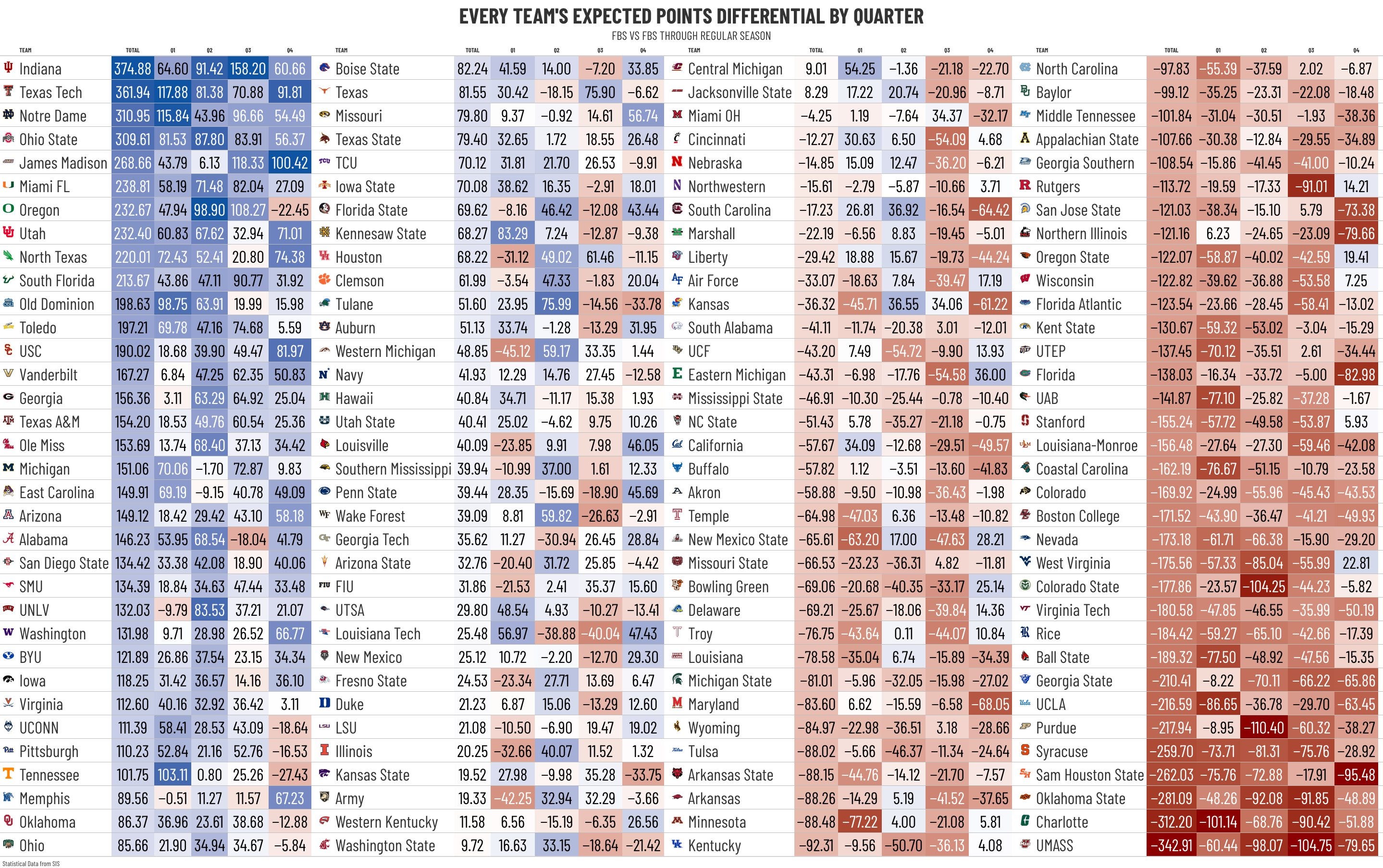
This wasn’t the case in the NCG. Indiana got the ball to start the second half, up 10-0, but punted after six plays. Then came the explosive score from Mark Fletcher to make it 10-7 Indiana. The teams traded punts until Mikail Kamara blocked Miami’s last punt of the quarter and Isaiah Jones recovered to extend the lead to 17-7. Even with relatively even time of possession, Indiana was out-gained in the third, 150-11, with two first downs (one via penalty), and 0-for-3 on third downs. Kamara’s blocked punt was incredibly significant because Indiana needed that two-score lead as both defenses began to hit “E” on the meter for the fourth quarter.
Some other notes:
Jamari Sharpe’s INT to end the game was his first since 2023, his redshirt freshman season, when he intercepted Katin Houser — who just transferred to Illinois from East Carolina, by the way — and then fumbled the ball back to Michigan State. This one went a bit better for Sharpe.
Indiana’s yards/play (4.4) were its lowest of the season. Miami DC Corey Hetherman called as good of a game as Indiana had seen all season.
This was just the second game this season that Fernando Mendoza was held to 0 passing TDs. The other was Old Dominion to start the season.
Kahlil Benson started this game at RT but graded extremely poorly in both phases (pass- and run-blocking). That side of the line, across from Rueben Bain, was a very tough matchup, but Adedemola Ajani was slotted in for the last 46 snaps and shored up that side a bit — still struggling in pass protection but faring much better on run-blocking snaps. If Indiana wants to move forward with Ajani at RT, this was a fairly promising showing, given how little development he’s received there to this point.
Indiana did not turn the ball over during the CFP. It won the turnover battle, 5-0. Expanding to all four postseason games, it won the turnover battle, 6-1.
With his two made field goals in this game, Nico Radicic ended the 2025 season with the highest single-season field goal percentage (94.7%) in program history. He hit 18, which is 3rd-most in a season, and his career percentage (93.5%) is far above the current record (82.1%, Logan Justus).
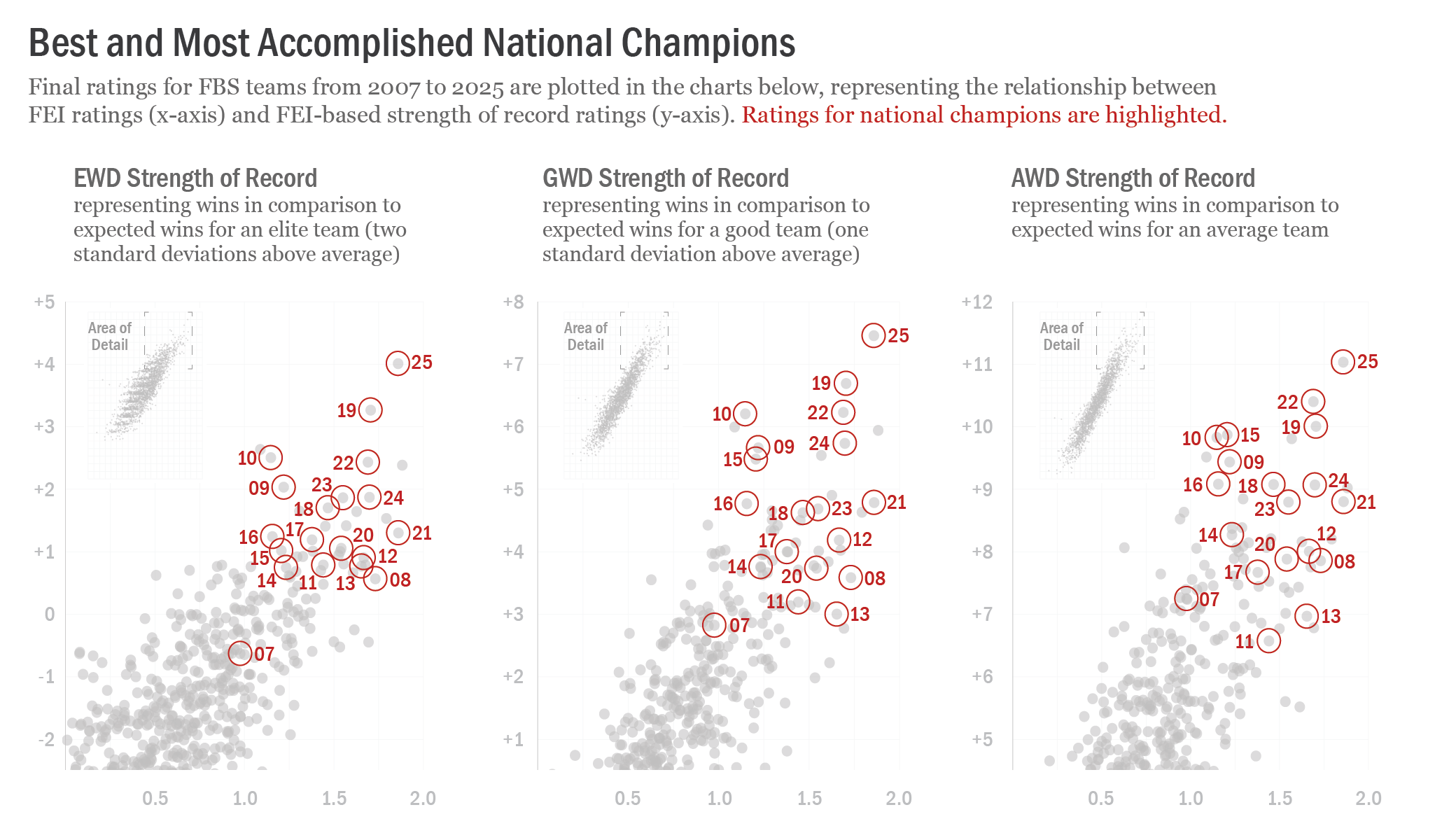
Lastly, this Indiana team is one of the best we’ve seen this century. Brian Fremeau — founder of FEI — noted that 2025 Indiana is one of just six teams since 2007 to post top-5 ratings in each category (overall, offense, defense, special teams). He posted a particular visualization (see below) that introduced what will surely be an ongoing endeavor in college football analytics after 2025: Who is the most accomplished national champion? He noted here that it might be this Indiana team: “Fifteen wins over FBS teams. Eight wins over FEI top-30 teams. Four wins over FEI top-5 teams. No losses. No matter how you slice the data, the 2025 Indiana Hoosiers are the most accomplished national champion to date.”
I can’t think of a more fitting way to end what is the last Bite-Sized Bison as an Indiana-focused publication.
I’ll miss this team and will cherish what it brought to me and to people I love. But I’ll be back in Memorial Stadium for 2026.
Comments
Nothing yet. Say the first thing.
Sign in to join the conversation.