

Bite-Sized Bison is back! Well…somewhat.
While this is the first BSB post since January 2026, I’m aiming to maintain a much more truncated version of what BSB has come to be known for — staying true to the “bite-sized” vision in lieu of the granular monstrosities that used to be delivered via 18-wheeler to your inboxes from 2022-2025. The goal is to develop a visualization or two, write a few paragraphs on them, and keep it light for all of us!
Some other changes I anticipate with this newsletter include:
Remaining free to all subscribers
Expanding outside of just the Indiana perspective
Sometimes expanding outside of college football
Staying relatively within the realm of data storytelling and less on roster construction and recruiting
Publishing on a fairly irregular basis, encouraging thought-provoking data exploration over content creation
The goal is for BSB to be lightweight while also remaining informative for readers and experimental for me.
Welcome back!
As many of you know by now, the NFL Draft took place last month in Pittsburgh. Fernando Mendoza was taken No. 1 overall by the Las Vegas Raiders, and it still feels surreal that Indiana’s QB went first overall.
This draft was particularly interesting because it foregrounded many ongoing changes developing in both the NFL and college football. One of those changes is how — in recent years — NFL teams have been taking more Power Conference draftees, electing to bring in Group-of-6 prospects via UDFA, or not at all.
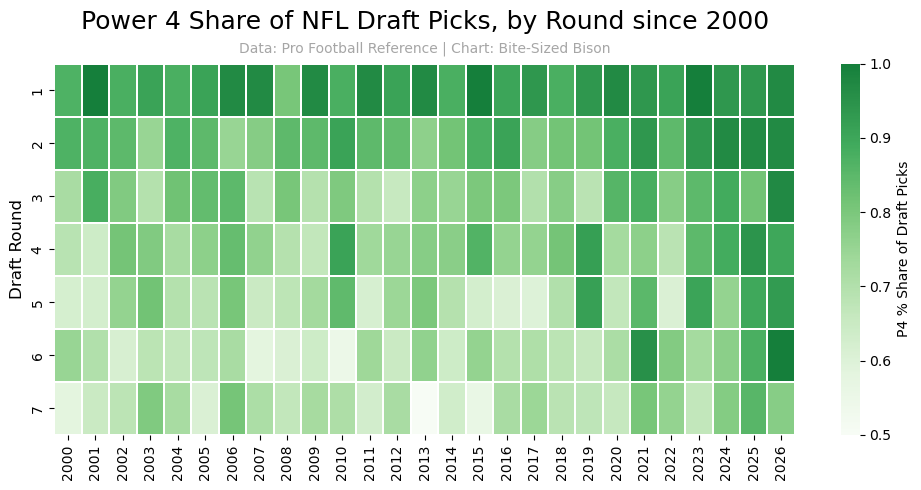
As can be seen in the chart, teams had already begun to look to the Power Conferences at an increased rate in the top three rounds beginning in roughly 2020, but in the last few years, that concept has spread to every round. In the 2026 draft, only 18 non-Power 4 prospects were drafted (14 G6, 4 FCS).
This is largely due to player movement. It’s not necessarily that non-Power 4 schools have less talent; it’s more that the talent is migrating up the ladder through the portal, which opened as we know it in 2021. Indiana is a prime example of this movement. The chart below shows that Indiana’s 2nd-, 3rd-, 4th-, and 7th-Round draftees were all from James Madison — a G6 school — but counted toward the Power 4 total among draftees in the chart above.
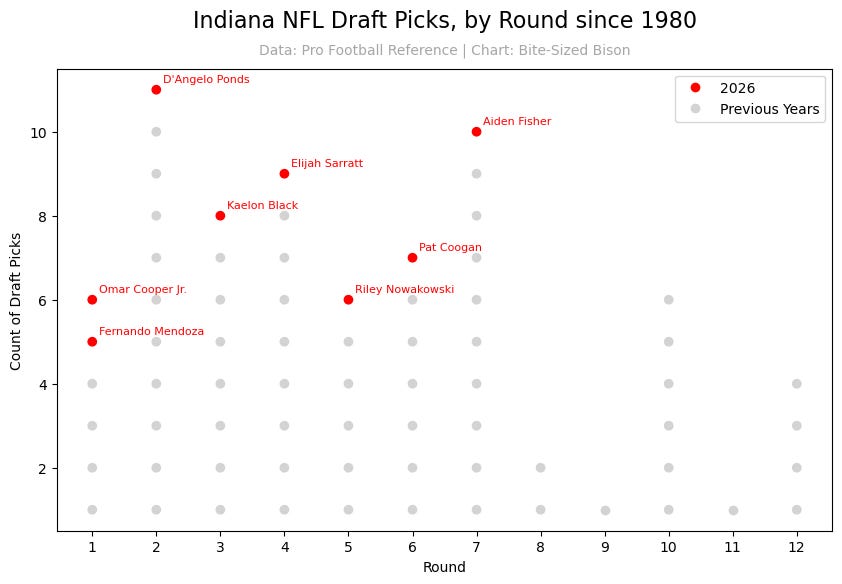
Another change this 2026 NFL Draft conveyed was that Indiana has talent the NFL covets. The chart above plots every Indiana draft pick since 1980, showing the proportion of picks this class represents for Indiana’s last 47 drafts.
Before Mendoza and Omar Cooper, Indiana hadn’t had a player drafted in the 1st Round since 1994 (WR Thomas Lewis). Lewis played four seasons for the New York Giants, peaking in 1996 when he recorded 53 catches for 694 yards and 4 TDs. The Hoosiers are still looking to get their first defender drafted in the 1st Round (since 1980).
What’s remarkable is Indiana’s history in the 10th Round — a round that hasn’t existed since 1992. Before 2026, the Hoosiers had more players drafted in the 10th Round than the 1st and 5th rounds. It also matched Indiana’s total for the 6th Round and was just one shy of the 3rd Round. The Hoosiers drafted in the 10th were Tim Clifford, Jimmy Thomas, Mark Smythe, Mike Pendleton, Bob Riley, and Eric Hickerson.
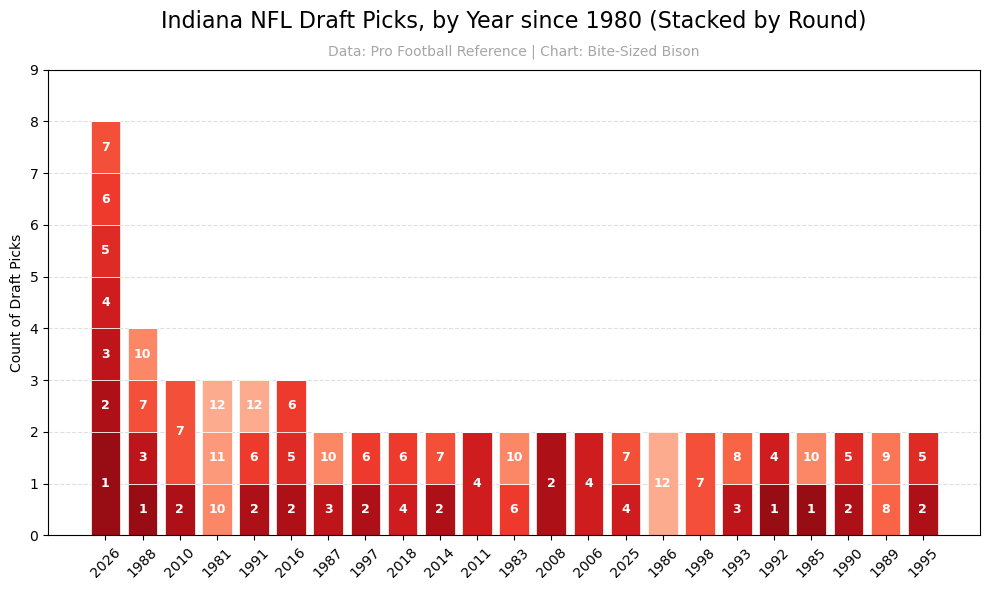
In terms of singular drafts, no previous year holds a candle to Indiana’s 2026 draft. The Hoosiers obviously stacked a massive number of picks (8), but they also had a draftee taken in each round — also a first for the program. While 1988 featured four picks, one could make the argument that Indiana’s 2016 draft class — Jason Spriggs (2nd), Jordan Howard (5th), and Nate Sudfeld (6th) — was the best showing Indiana had in a draft until 2026.
Following this draft class, Indiana is now up to 71 total draftees since 1980.
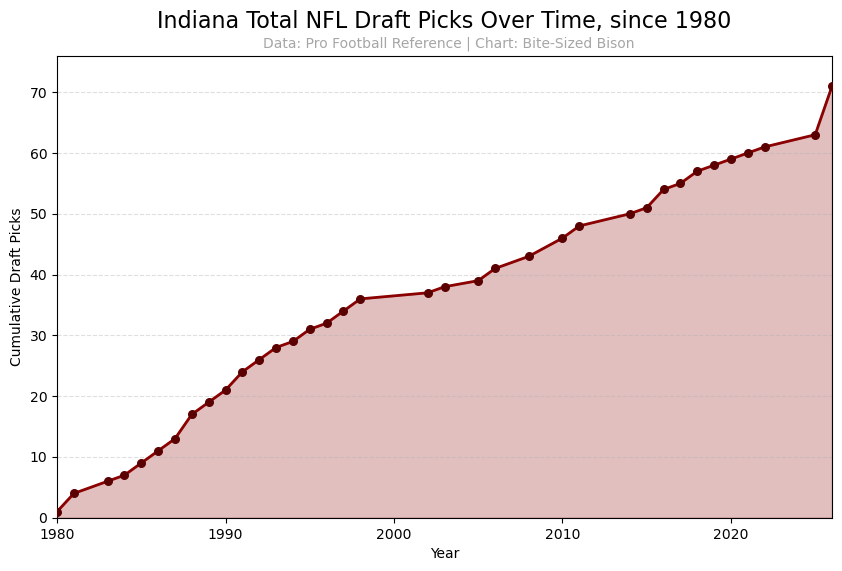
As the ‘80s progressed, Indiana was consistently adding anywhere between one and three draftees into the NFL, but after the 1998 draft, the Hoosiers fell out, going three drafts without a representative before Antwaan Randle El was taken by the Pittsburgh Steelers in 2002. From 1999-2009 (an 11-draft stretch), Indiana had just seven players drafted.
Since 2010, there have been four drafts without Hoosiers, including the two drafts (2022-23) immediately before Curt Cignetti coached a game in Bloomington. During the Cignetti Era, 10 Hoosiers have been drafted — 14% of the program’s draft picks since 1980.
That trend is set to continue in 2027, with carryovers like Charlie Becker (junior), Carter Smith, Tyrique Tucker, Isaiah Jones, Jamari Sharpe, Amare Ferrell, and Lee Beebe and newcomers such as Josh Hoover, Nick Marsh (junior), Shazz Preston, Joe Brunner, Preston Zachman, AJ Harris, Josh Burnham, Tobi Osunsanmi, and Joe Hjelle all capable of catching eyes with a good season in their final years of eligibility in 2026.
Comments
Nothing yet. Say the first thing.
Sign in to join the conversation.