

The National Championship Game is here, and Indiana is playing in it. The Hoosiers meet the Miami Hurricanes at Hard Rock Stadium in Miami on Monday, Jan. 19, for the College Football Playoff Final.
When Curt Cignetti arrived and was first introduced directly to the fans in Simon Skjodt Assembly Hall, he claimed that he “never took a backseat to anyone” and poked at not only Purdue but also Ohio State and Michigan. When he was introduced as Indiana’s head coach at his first Big Ten Media Days, he said Indiana would be playing for Big Ten Championships in Lucas Oil Stadium. Among college football fans at large, there was mockery, but among Indiana fans, there was mostly humored doubt, no matter how charged they were.
It’s true, Cignetti had won everywhere he’d coached (119-35 before Indiana), but Indiana fans had heard this from its new coaches before. This was Indiana — the program that was beaten up by the best in the business for decades. The only way to really advance from its position was, well, to beat the best in the business, and at the time, no FBS program had lost more games in the sport’s history (until Northwestern took back the title in 2025).
This is the same program that, just in front of my eyes:
lost to Bowling Green in 2014
led Indiana State just 21-10 going in the fourth quarter (with Tevin Coleman’s 247 rushing yards!) in 2014 during the first game I attended in-person
blew a 25-point lead to Rutgers in front of a Homecoming crowd in 2015
had a game-tying field goal attempt that looked good in person (and via camera angles) called no good to end the 2015 Pinstripe Bowl against Duke
lost to Wake Forest (shoutout Fort Wayne’s own Jessie Bates) and a Clayton Thorson-led Northwestern in 2016
blew a 22-9 fourth-quarter lead to Tennessee to lose the Gator Bowl and cap what was otherwise a strong 2019 season
went 2-2 against Purdue in games that decided bowl eligibility from 2015-18
was beaten by Ole Miss in the 2020 Outback Bowl after removing Big Ten logos from its jerseys in protest of its bowl assignment
lost Micah McFadden to a controversial targeting call against Luke Fickell’s 2021 Cincinnati team and eventually lost, sparking a bottoming out of the program that resulted in a Big Ten record of 3-24 from 2021-23.
beat Akron in 2023 with four overtime periods
repeatedly urged its fans to not leave games at halftime
had its recruiters from previous administrations boxed out by the blue-blood recruiters at various recruiting events
saw a beloved former assistant return to the program with his talented sons and then leave (as well as his sons, eventually) when the program spiraled a year later
That’s just in front of my eyes — as someone who started seriously watching the program in 2013. It’s not counting the numerous instances before, including a loving memory of Lee Corso calling a timeout in 1976 so his Indiana team could take a team photo in front of a scoreboard that read “Indiana 7, Ohio State 6” before the Buckeyes went on to win 47-7. You could ask 50 Indiana fans which lows stand out to them, and you might receive 50 different answers.
This story is more than The Reach by Mike Penix to beat Penn State during the 2020 season. It’s more than former OC Kalen DeBoer becoming head coach at Alabama, after leading Washington to the National Championship Game with Penix. It’s more than Antwaan Randle El’s famous trick play for the Steelers during the Super Bowl in 2006 or Tracy Porter’s game-sealing pick-six off of Peyton Manning during the Super Bowl in 2010. It’s more than vicarious living, and it’s more than what the national college football landscape witnesses and deems worthy of celebration.
The story, as I can best tell it, is being within one score of Ohio State in the fourth quarter four times from 2015-2020 before ultimately losing. It’s the four competitive losses to Michigan from 2015-18 (two in overtime). It’s, between 1991-2023, qualifying for six bowl games (four since 2015) and losing them all. It’s beating Michigan State in 2016 for the first time in 10 years and storming the field of Memorial Stadium, just for the Spartans to collapse to 3-9 as the season progressed. It’s backup QBs Zander Diamont (2014) and Dexter Williams (2022) leading Indiana to their fourth wins of those respective seasons over Purdue and Michigan State for no reason other than punching a Big Ten opponent in the mouth. It’s pounding against the Big Ten East over and over again for 10 years and never quite breaking through, as Tom Allen (bless his heart) continued to promise.
While it certainly couldn’t be told without them, it’s more than Curt Cignetti’s arrival and IU’s decision to fully invest in this program, leading to that elusive breakthrough. There were numerous minds and millions of hearts that went into laying a foundation for this program to build upon — few more lasting than the late Terry Hoeppner, who dared Indiana fans to dream of a Rose Bowl when he was named head coach in 2005. In addition to those hearts and minds, there were also a lot of backs — George Taliaferro, Donnie Thomas, Joe Norman, Willie Bates, Anthony Thompson, Vaughn Dunbar, Trent Green, Adewale Ogunleye, Levron Williams, Antwaan Randle El, Tracy Porter, James Hardy, Tevin Coleman, Jordan Howard, Nate Sudfeld, Tegray Scales, Micah McFadden, and a litany of others.
The same goes for Cignetti, who is the son of a Hall of Fame coach, a former assistant under Nick Saban at Alabama, a successful legacy at Indiana University (PA), and an usher of James Madison’s program to the FBS and the AP Top-25. Cignetti famously bet on himself as a head coach when he could have bridged his position at Alabama into another assistant position for another Power 5 program. He is one of the most respected coaches at this level.
Now, because of the marriage between what Cignetti built and brought to Bloomington and the history that prepared the program for Cignetti, the Hoosiers are 7.5-point favorites to win a national title.
The story of the rise of Indiana Football — not just since December 2023 — is one of the greatest stories in sports.
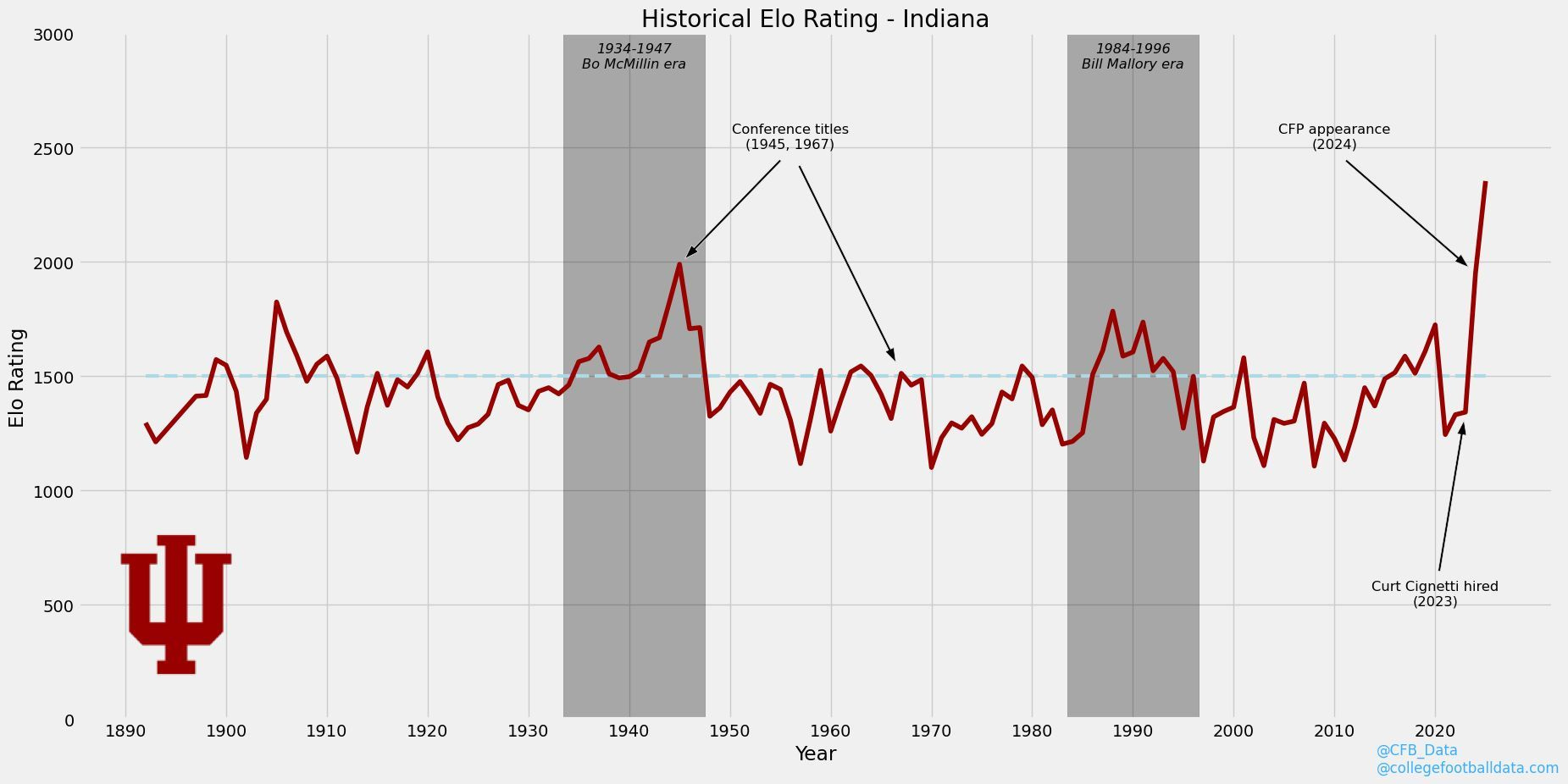
Source: Bill Radjewski of CollegeFootballData.com
Coming into the season, it was reasonable to expect some regression from Indiana’s program record 11-win season in 2024. Most metrics projected Indiana to peak at 8 or 9 wins this season, and BSB’s win probability model (using SP+ data) gave the Hoosiers a 0.2% chance to go 12-0, let alone 15-0. How could the Hoosiers actually improve upon that type of season in 2024, especially with a more difficult schedule in 2025? Well, only by positioning themselves to become the first 16-0 college football team since 1894, I suppose.
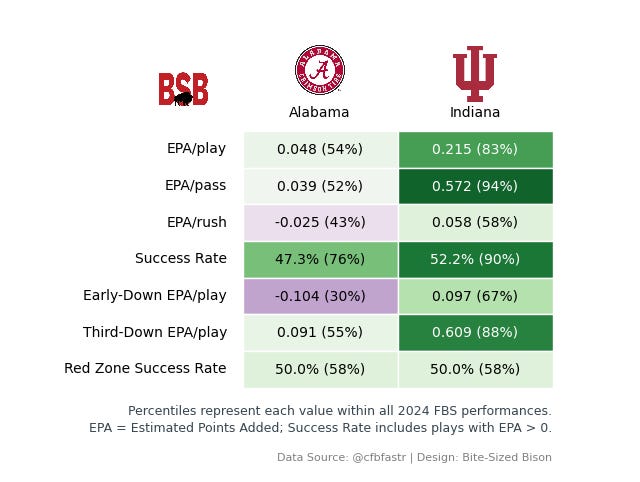
On the way, Indiana got its Rose Bowl (and first bowl win since Bill Mallory’s 1991 team) over Alabama, 38-3 — with a net success rate of +4.9% — to kick off its 2025 CFP run.
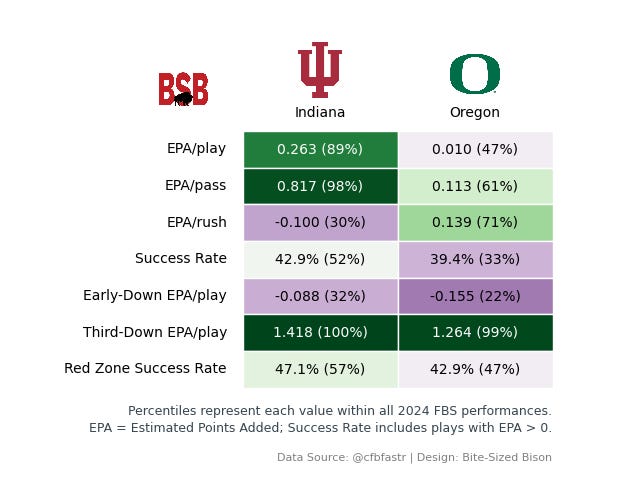
Then, it brought down Oregon, 56-22 — with a net success rate of +3.5% — in the Peach Bowl semifinal.
Now, the Hoosiers enter the National Championship Game as the second-most efficient team, when adjusted for opponent.
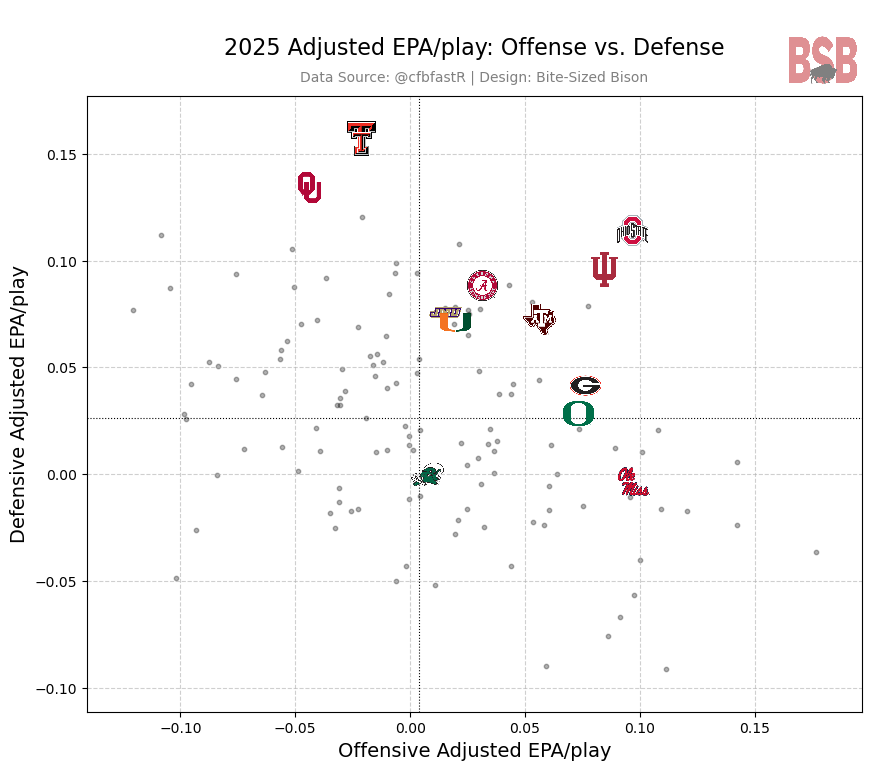
All signs seemed to be pointing toward a rematch of the Big Ten Championship Game — Indiana and Ohio State — until the Buckeyes were defeated, 24-14, by this Miami team, who also defeated Texas A&M (10-3) and Ole Miss (31-27), all games in which it was the underdog.
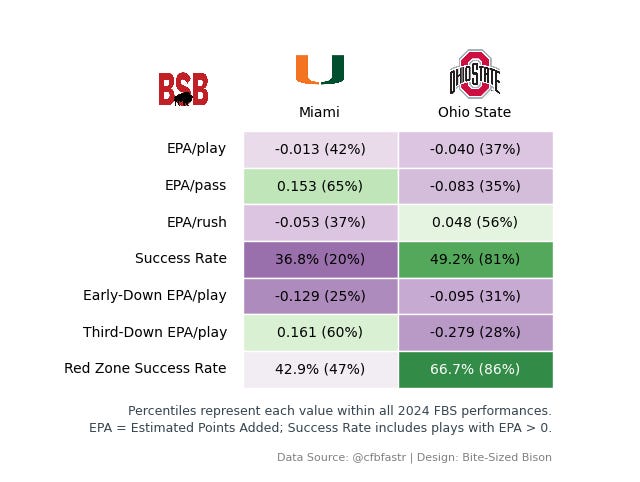
Miami owned just a 30% postgame win expectancy after this game and a net success rate of -12.4%, but a look at the game script shows Ohio State finding itself behind the 8-ball before halftime. Miami sewed together a 13-play drive to take the lead, 7-0, and followed that up with a pick-six and a 14-0 lead at the break. Ohio State ran the ball just 19 times and found itself at an average late-down distance of 8.1 yards, finishing 3-for-10 on third downs.
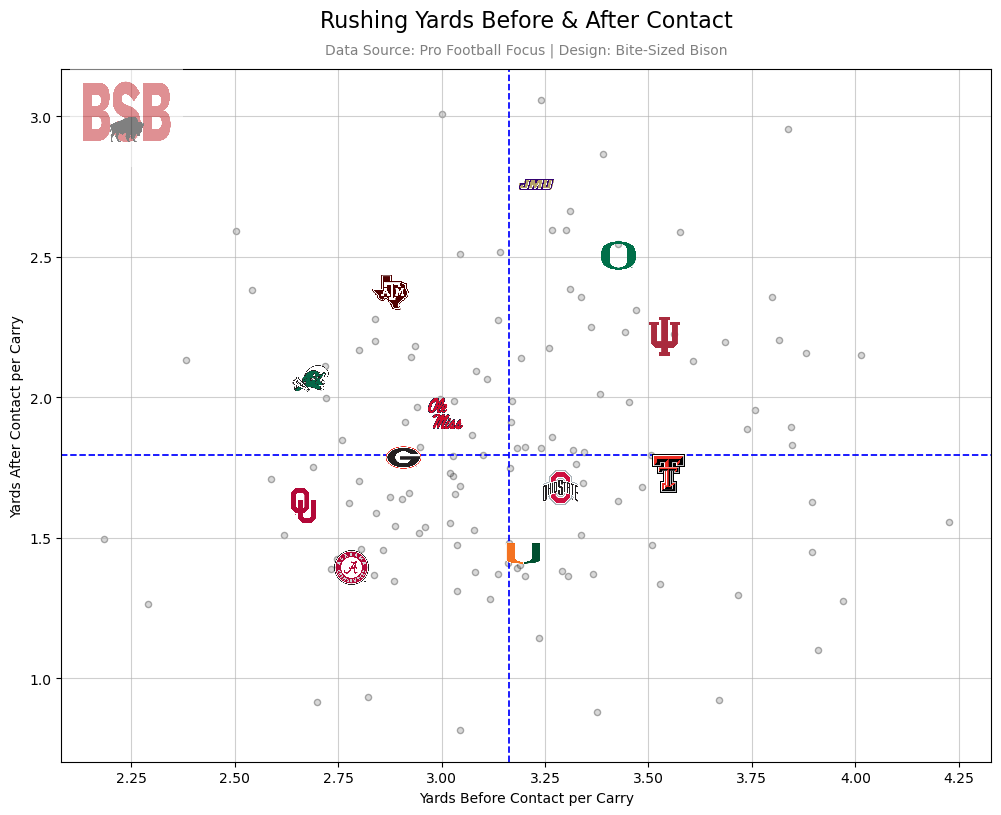
As you’ll see below, Ohio State limited Miami to its lowest collective rate of yards after contact/rush and YAC/reception, but Miami found just enough success on the ground (37th percentile in EPA/rush) to help its passing attack convert in late-down scenarios (passed on 11-of-14 late downs). Carson Beck’s arm converted two key third downs on the fourth-quarter TD drive that extend Miami’s lead to 24-14.
The Buckeyes rebounded a bit on offense in the second half, but the Canes rode Mark Fletcher — who actually finished with negative EPA and whose 68 yards after contact represented 44% of Miami’s rushing yardage — just enough to put Carson Beck in advantageous situations (finishing 19-for-26, 138 yards (5.3 yards/attempt and just a 7.4 average depth of target). 1 TD, 0 INTs).
Combine that with 0 penalties by Miami, a team that ranks 132nd in total penalties committed, and a missed field goal by Ohio State, and it resulted in a gutsy, opportunistic win for Miami. You’ll see why in the data enclosed.
This is a dangerous Miami team because it’s a team that is outperforming many of its season-long metrics, meaning it’s found an identity it can lean on against the best teams in the country — or the best team in the country.
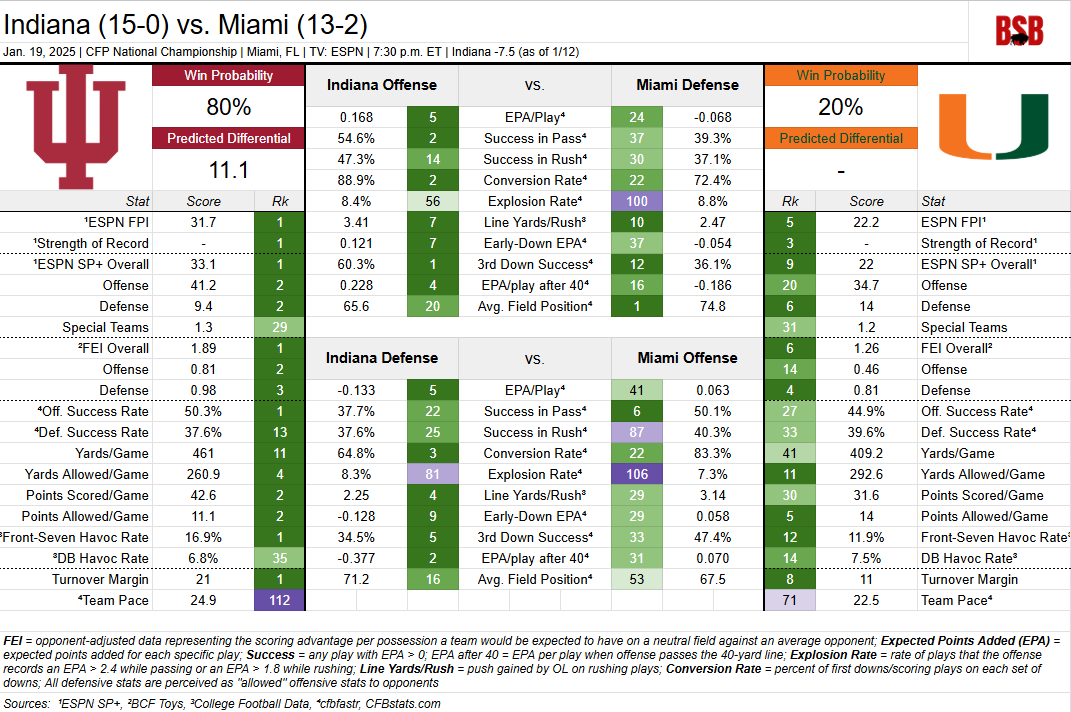
Notes:
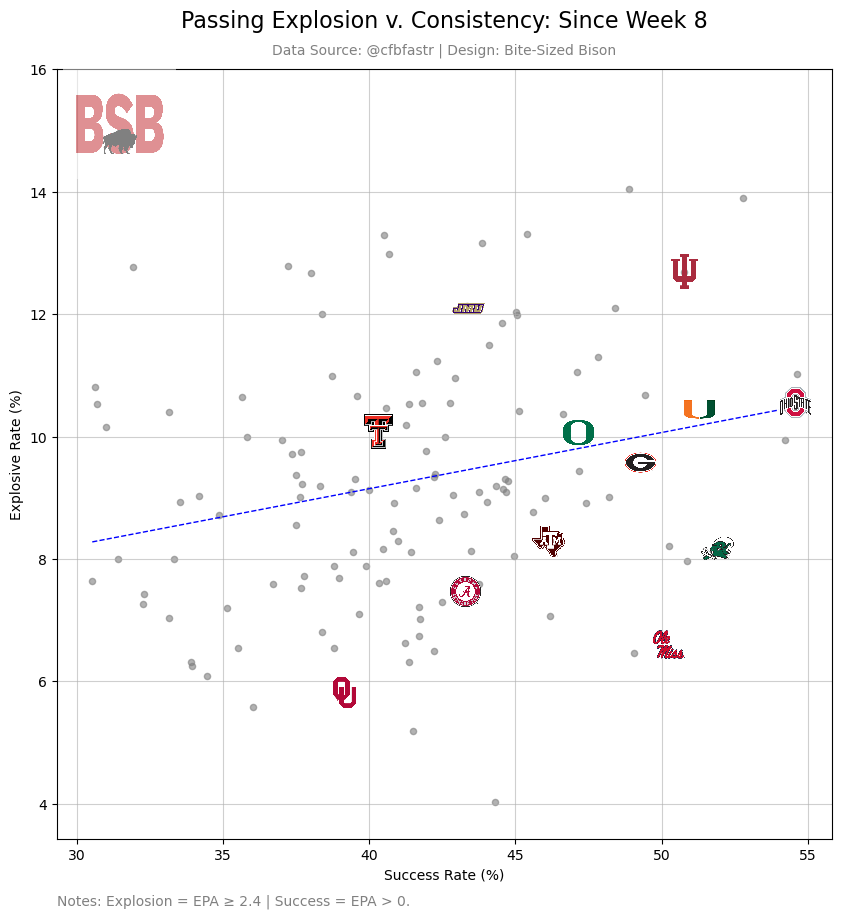
Miami’s Explosion Rates: This was somewhat surprising, given how strong Miami’s defense is and the existence of Malachi Toney, but the explosives haven’t really been there for the Hurricanes. They rank 54th in plays of 20+ yards (72nd for rushing, 26th for passing) offensively, and defensively, they rank 47th in plays of 20+ yards allowed (35th for rushing, 59th for passing). Carson Beck is graded 88th on deep passes (20+ air yards) by PFF and completes just 52% of passes longer than 9 yards; Fernando Mendoza is graded 5th on deep passes and completes 62% of passes longer than 9 yards. Miami is much more dependent on YAC for explosion in the passing game (noted later). Since Week 8 (the back-half of the season), Indiana has been the 10-most explosive passing team.
Miami Defensive Field Position: Miami’s defensive field position has been about as good as a team would hope for this season, averaging an opponent’s drive start at about the 25-yard line.
Miami Rushing Success Rate: Miami’s rushing attack ranks 87th in success rate over the course of the season, as the Hurricanes average 4.25 yards/carry (76th nationally). However, the Hurricanes run with serious volume (24th-most rushes nationally) and do so with power. They’re actually rushing at a lower success rate during the CFP (36.6%), but when paired with the short passing game, it’s been effective enough against defenses (more on this later).
Conversion Rates: These are two teams that move the ball well (and prevent movement defensively). Miami did this just effectively enough to maintain its early lead over Ohio State in the CFP Quarterfinal. But very few teams are better at this than Indiana.
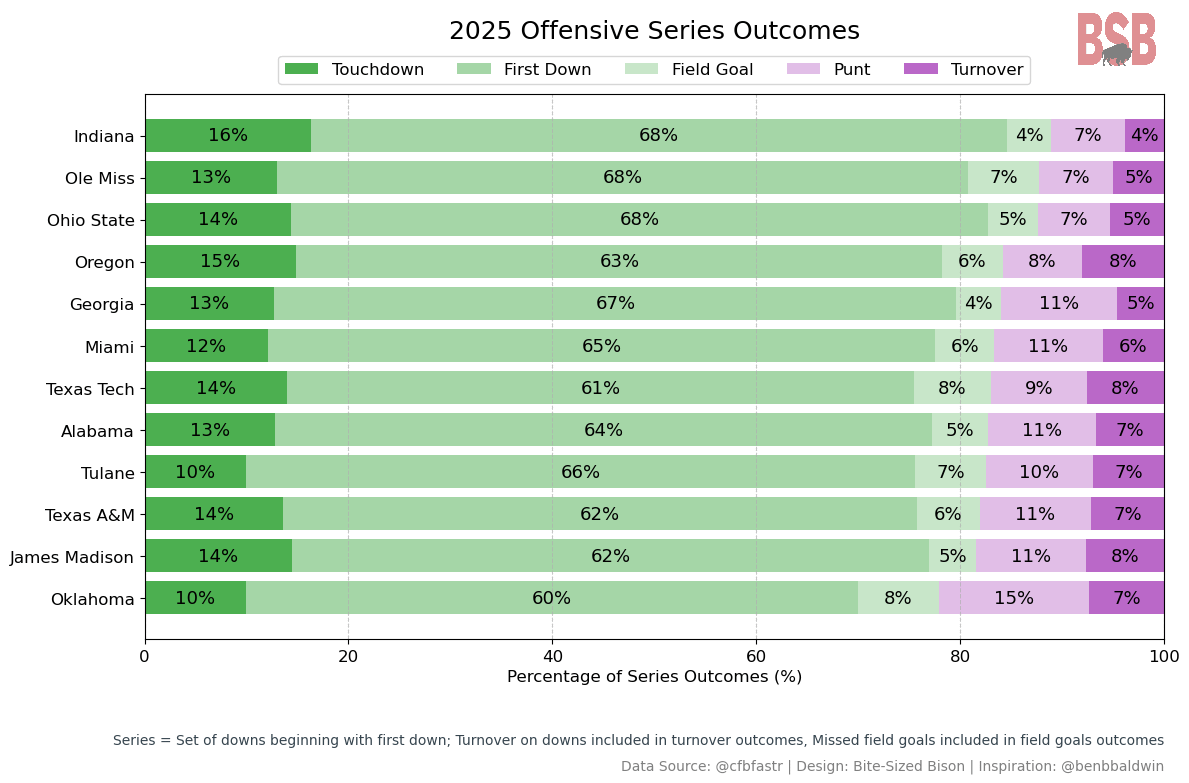
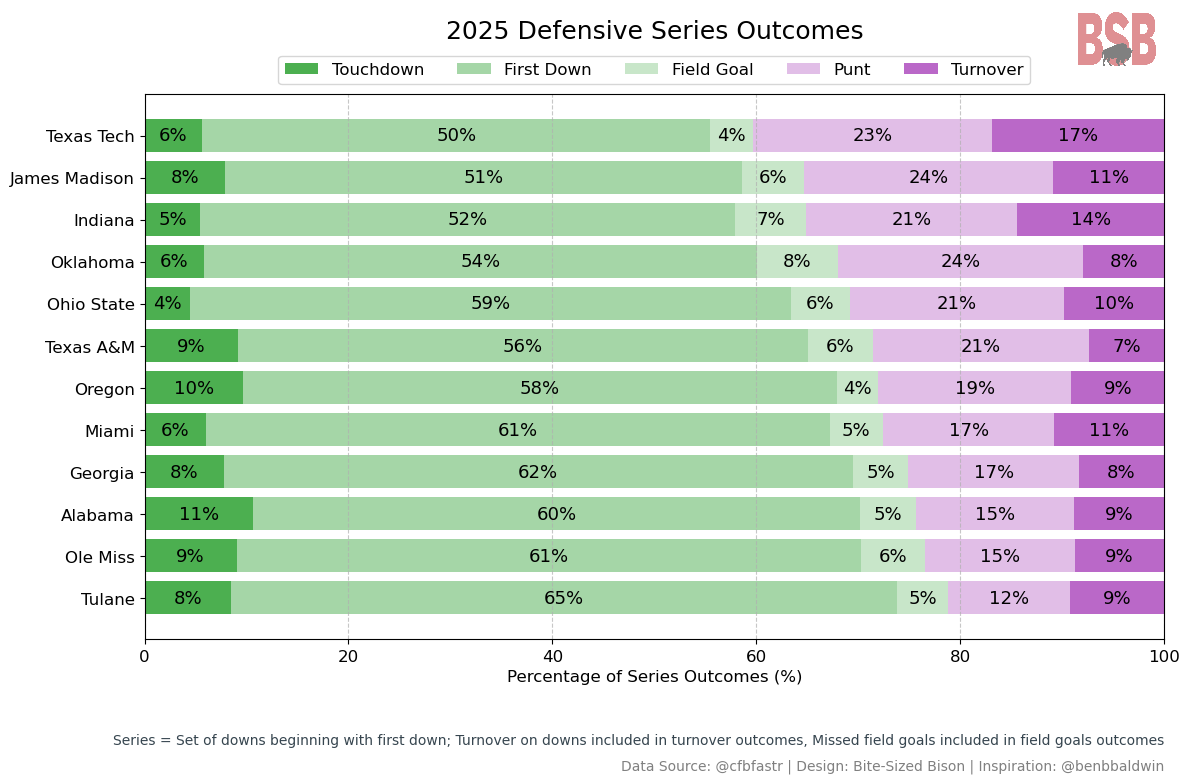
This is a phase of Indiana’s game I’ve been most impressed with since the College Football Playoff began.
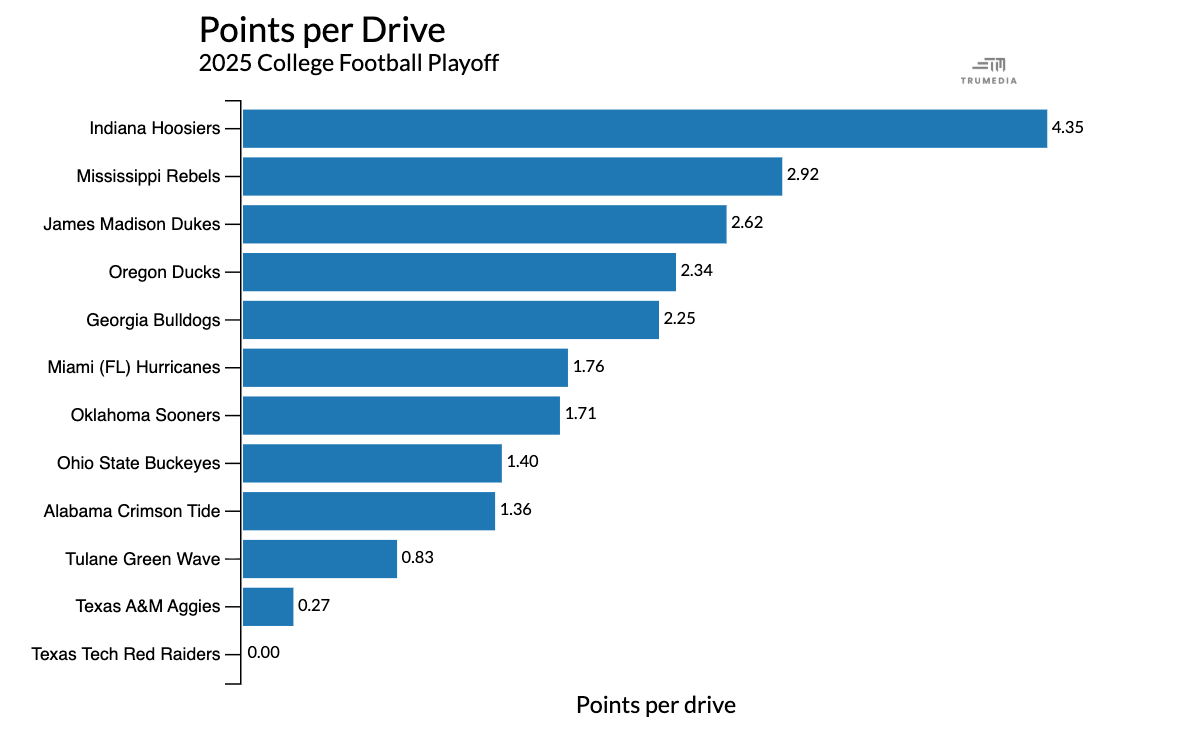
Indiana leans on its rushing attack to create balance offensively. It’s been finding a good amount of success during the CFP, which has led to the ridiculous offensive efficiency shown in the graphic below (credit: Tom Fornelli of CBS Sports).
Indiana has seen more season-long consistency (6th in rushing success rate) with this than Miami, but Miami’s backs, Mark Fletcher and CharMar Brown, have had some solid moments in recent games, particularly against Ohio State (4.1 yards/carry) and Texas A&M (6.3). For as much praise as Miami’s backs get for breaking tackles, Indiana has actually gained more yardage after contact (3.54 yards after contact/rush, 22nd nationally) than Miami (3.20, 60th).
I noted in the Peach Bowl Preview how Indiana has been stretching defenses vertically with the emergence of Charlie Becker as both a deep threat and a man-to-man cheat code, then meeting that stretching with heavier RPO and inside zone. But even that changed against Oregon, in terms of RPO.
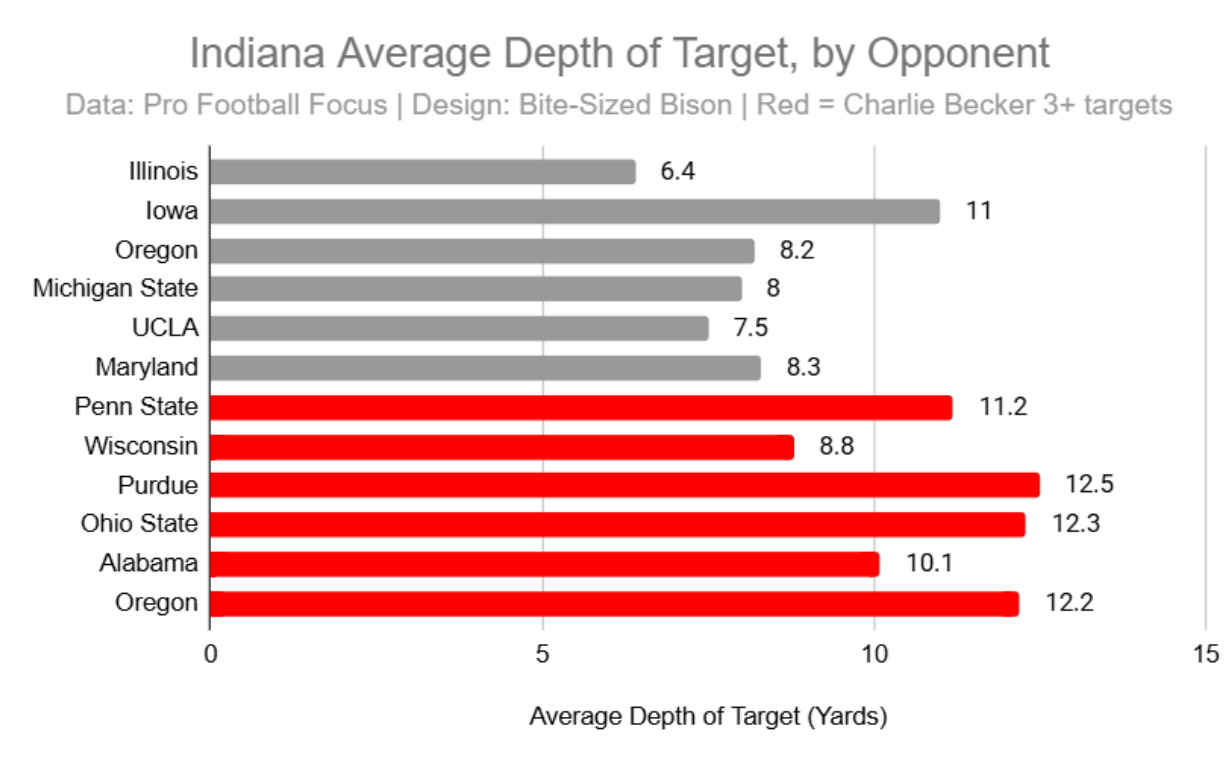
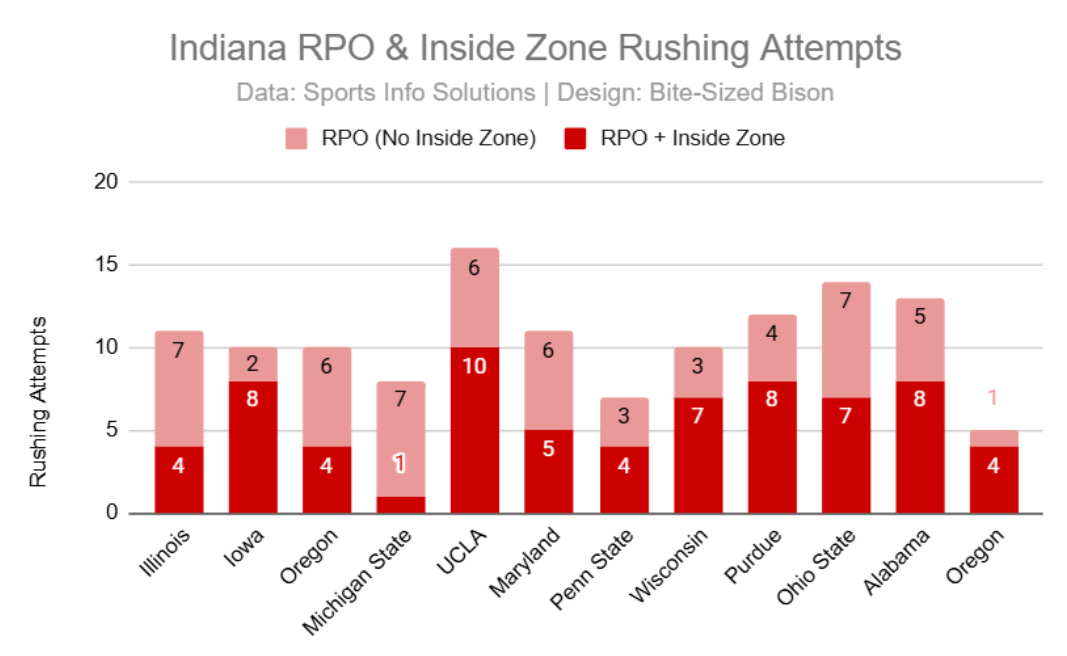
This opens up a lot of space in the running game by pulling the safeties away from the line of scrimmage, putting aggressive defensive fronts in conflict, and attacking the interior of the trenches. This could certainly be in the cards against an aggressive front like Miami’s.
Outside of RPO, Indiana has run its 4th- and 5th-highest rates of inside zone and duo rushes toward the interior, including back-to-back season-high duo rates.
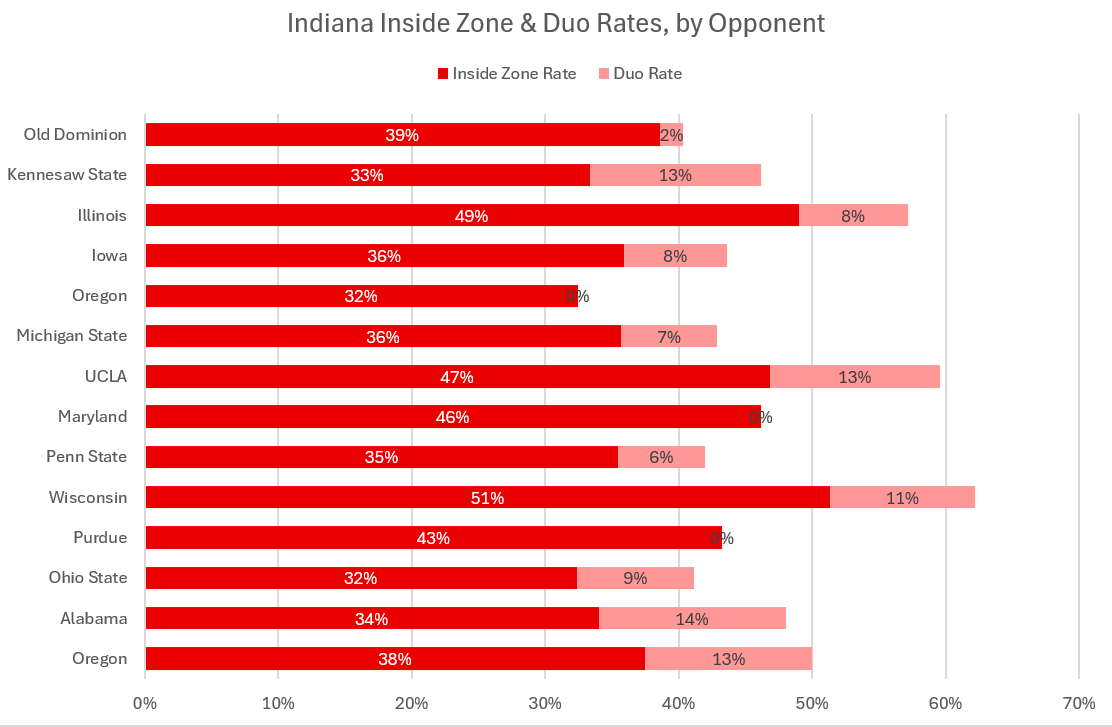
This vertical stretching — as well as 31 snaps with 6 offensive linemen (a new wrinkle in Mike Shanahan’s rushing scheme) — has stimulated Indiana’s rushing attack in a way that has given CFP opponents issues. The Hoosiers have run the ball 90 times in the CFP and are averaging 4.4 yards/carry. That’s been enough for Indiana to stay on schedule, as it ran the ball on 76% of early downs vs. Oregon.
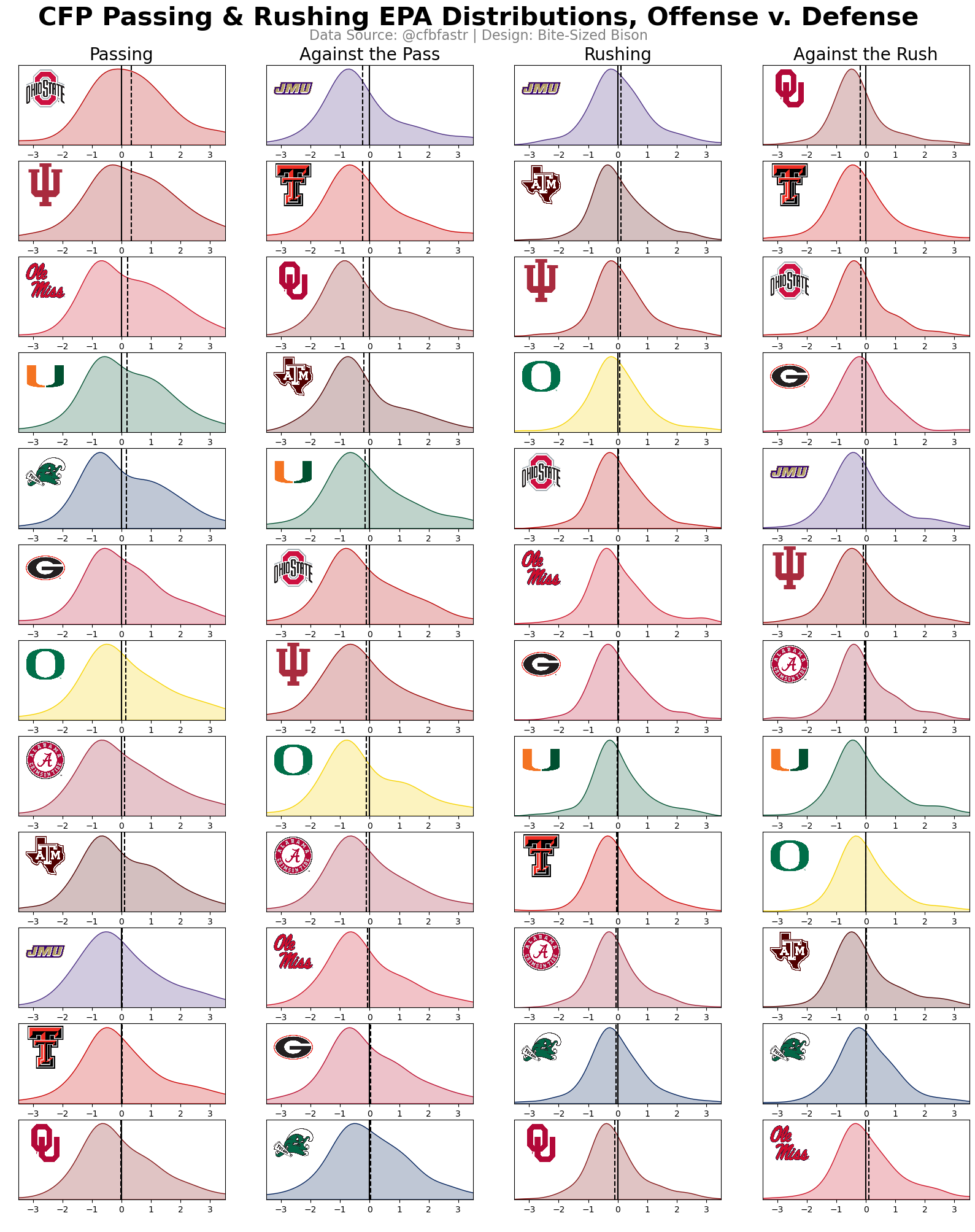
Miami, by raw numbers, allows very little on the ground (2.95 yards/rush, 10th nationally), but as the chart below shows, the Hurricanes are 8th in the CFP field in EPA/rush allowed, thanks to some allowed explosion (see the bump in the curve on the right side of their Against the Rush curve).
Indiana runs quite a bit of inside zone and duo concepts toward the interior of the line. Miami ranks 58th nationally against these rushing schemes, allowing 3.7 yards/carry. The Hurricanes also rank 37th, with 3.7 yards/carry, against draw concepts, which Indiana runs 3rd-most often among FBS teams.
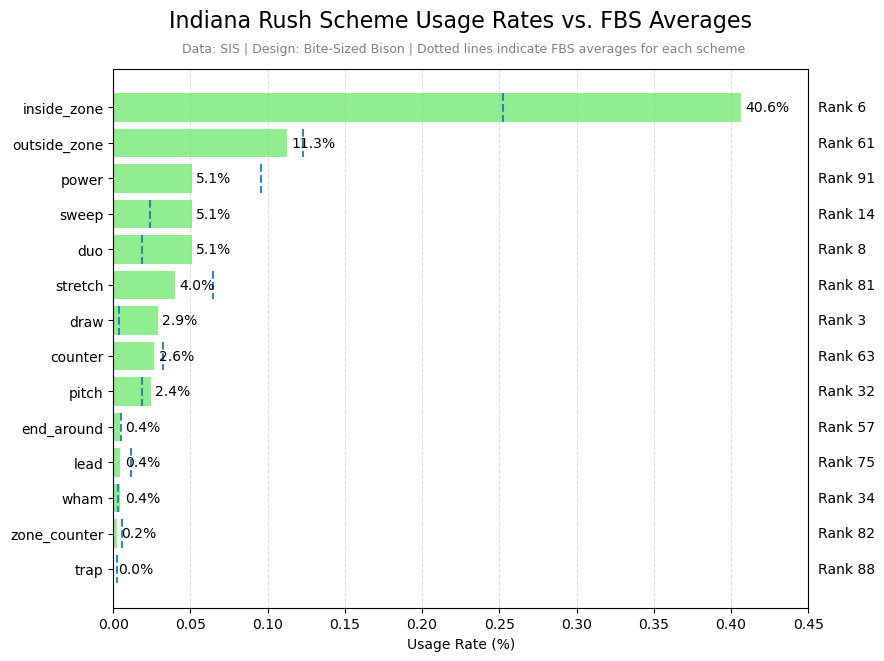
This is all to say that there should be ground for Indiana to gain against the Miami defense, which is not good news for the Hurricanes, whose main goal is going to be 1.) getting Indiana off schedule, and 2.) pressuring Fernando Mendoza. Both require stymying Indiana’s running game. They did this against Ohio State by getting an early lead on the Buckeyes.
This will be one hell of a matchup in the trenches.
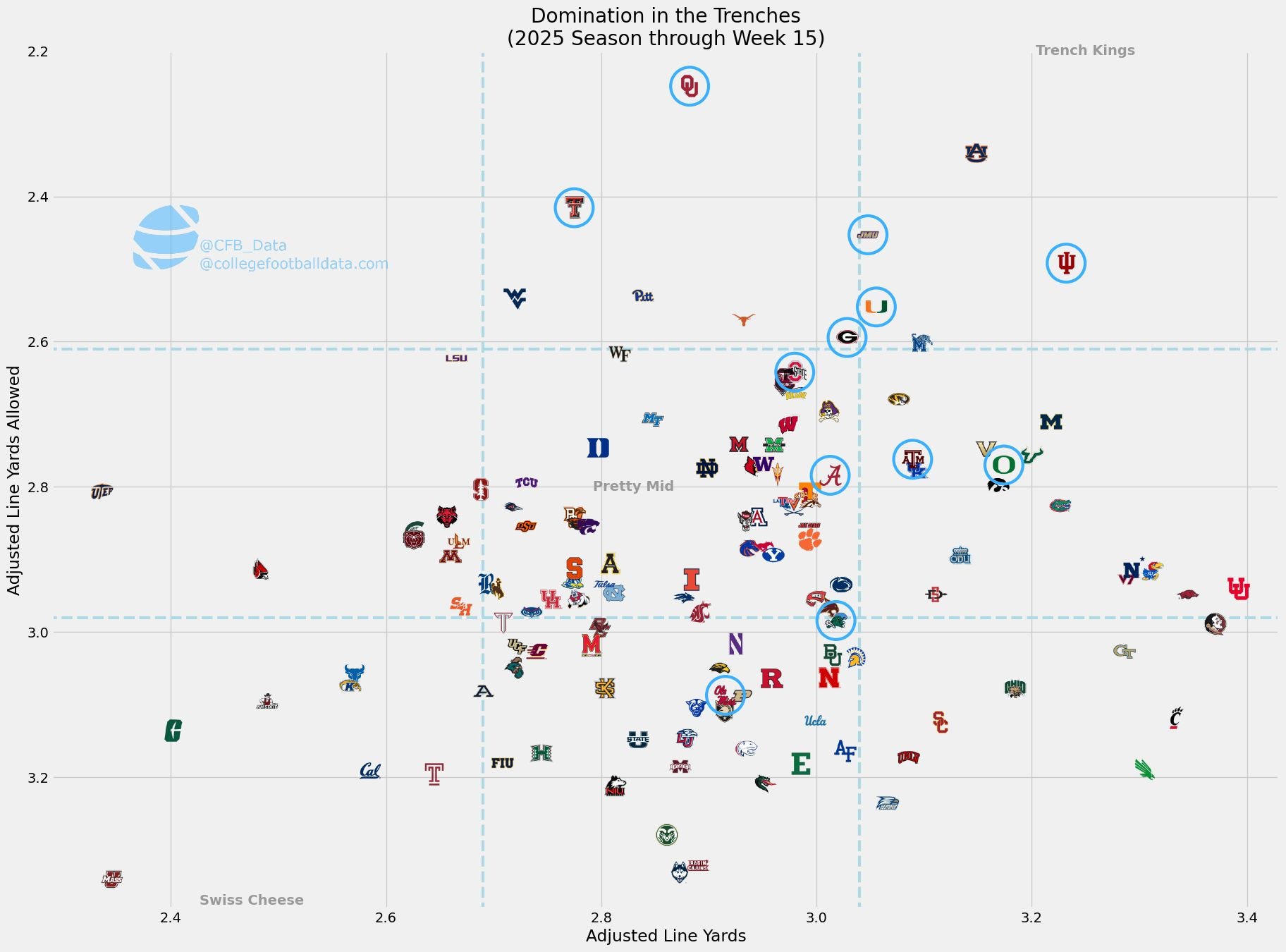
Source: Bill Radjewski of CollegeFootballData.com
It only makes sense that Miami DC Corey Hetherman would run a similar defensive philosophy to Indiana DC Bryant Haines, as Haines was a defensive assistant under Curt Cignetti at James Madison when Hetherman was the DC from 2019-2021. Hetherman attacks offensive fronts (12th-highest front-seven havoc rate) and pairs that with primarily zone coverage (29th-highest zone coverage rate).
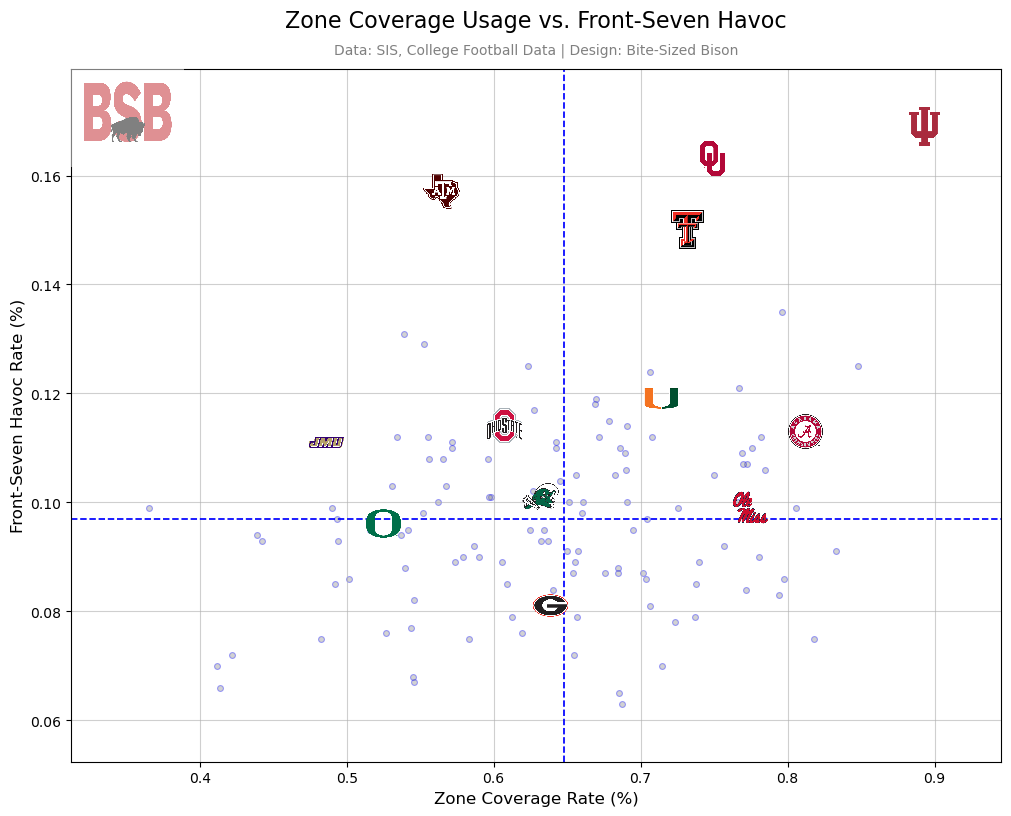
Indiana has seen its share of top-20 teams, in terms of front-seven havoc rate — Old Dominion (14th nationally), Ohio State (17th), and Alabama (19th) — but for all of the things Indiana has seen this season (just about everything), it hasn’t seen a defensive front like Miami’s yet. Miami ranks 12th in front-seven havoc rate, and the Hurricanes do it primarily with their defensive line.
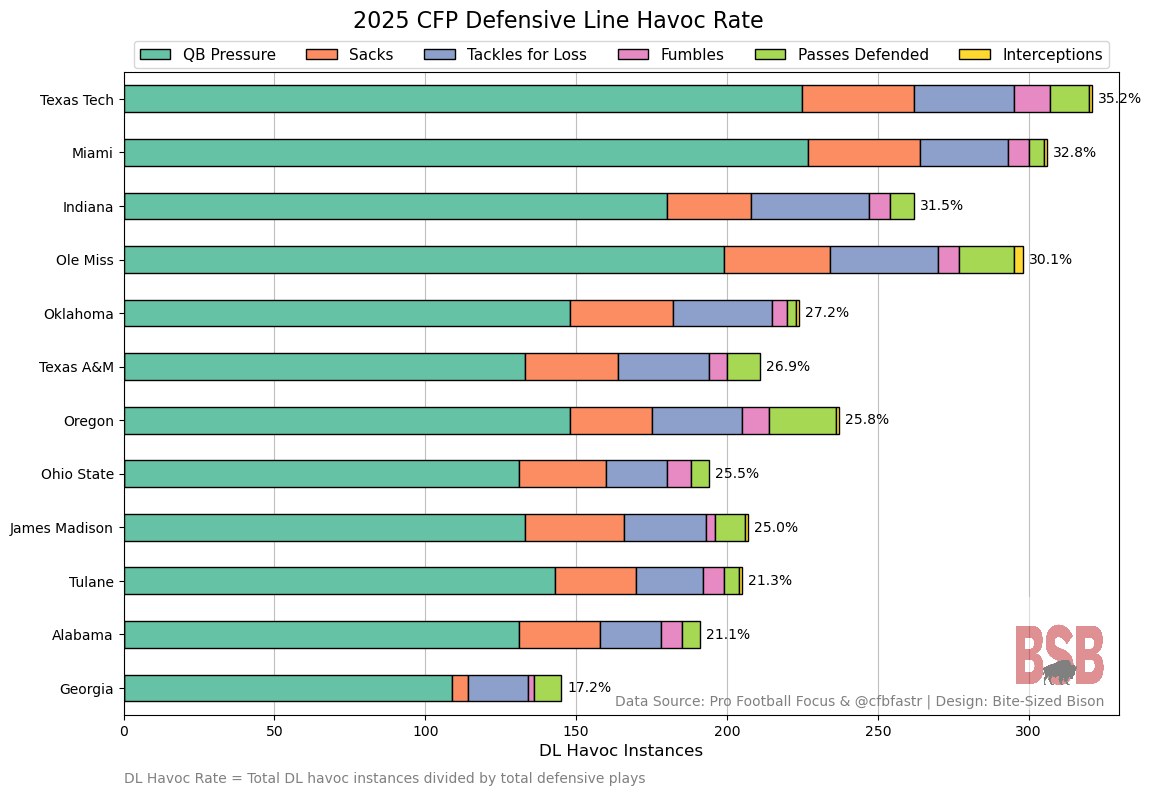
DEs Rueben Bain and Ahkeem Mesidor have been two of the best edge rushers in college football all season, ranking 2nd and 6th respectively in QB pressures (combining for 9.5 pressures/game). Armondo Blount (16th) and Ahmad Moten (26th) have also been two of the best pass rushers among FBS DTs. LT Carter Smith — graded as the 2nd-best pass-blocking FBS tackle and hasn’t allowed a sack this season — will be vital in fending off edge pressure, as will the combination of Kahlil Benson and Adedamola Ajani at RT.
On top of this, Corey Hetherman also calls for the 7th-most blitzes in the country with the 13th-highest pressure rate (51.7%) and the No. 1 sack rate (20%) on those blitzes.
As was noted in the Peach Bowl Preview, blocking and scheming against the blitz is an area Indiana has improved as the season has progressed (see chart below), since Fernando Mendoza is the 11th-most blitzed QB in the country. However, Mendoza still ranks 29th in pressure rate felt against the blitz. There will most likely be room for Miami to disrupt Indiana in that department, with a front as aggressive and productive as Miami’s.
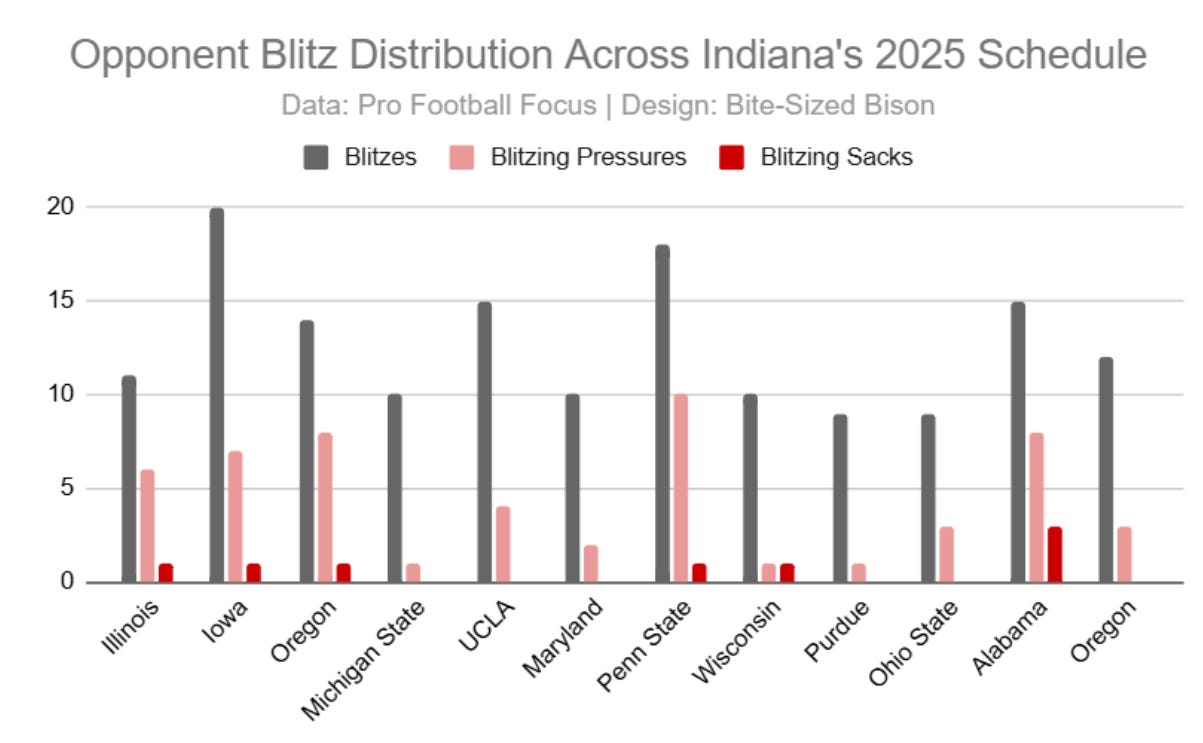
Mendoza has been incredible against the blitz, though, for as much as he’s seen them and as much pressure as he’s felt from them, especially during the postseason. During the season, Mendoza has graded 4th-best among FBS QBs against the blitz, completing 71% of his passes (8th nationally) at 9.8 yards/attempt (3rd) with 25 TDs (1st) and a 3.4% turnover-worthy play rate (60th). In the postseason alone, Mendoza has been blitzed on 51% of dropbacks, and he’s completed 80% of his passes at 12.9 yards/attempt with 6 TDs and 1 turnover-worthy play (2.7% rate).
Mendoza hasn’t thrown into zone coverage that often (112 times against P4 opponents is 66th-most nationally), let alone been under pressure against zone coverage — just 33 times, which ranks 131st-most often nationally. On those 33 pressured dropbacks, he’s been sacked at the 28th-highest rate (21.2%). When not sacked, he’s completed 54.5% of his passes (31st) for 9.6 yards/attempt (4th), 2 TDs (6.1% is 17th), and 0 INTs. His EPA/play is 6th-best in those scenarios.
Of course, any of Indiana’s trio of receivers — Elijah Sarratt, Charlie Becker, and Omar Cooper — are dangerous against any coverage scheme, but one receiver to watch against zone coverage is EJ Williams (Indiana’s 4th WR). He leads the team with 33 zone targets, which is 70% of his targets this season. This bleeds into Indiana’s games against P4 opponents too, where he leads Indiana pass-catchers with 23 zone targets. He is tied for 12th among P4 pass-catchers in yards/route run (3.0) against zone coverages by P4 opponents.
Mendoza may also need to get the ball out quicker this week. He’s capable of doing this, as he released the ball quickly against Illinois (2.26 seconds on average), Maryland (2.36), and Michigan State (2.42). But in the postseason, he’s been able to hold onto the ball longer — 3.38 against Ohio State, 2.88 against Alabama, and 2.85 against Oregon. Against Miami, Ole Miss’ Trinidad Chambliss was at 2.42 seconds (and still felt 17 pressures but just 1 sack), Ohio State’s Julian Sayin was at 2.85 seconds (and felt 17 pressures and 5 sacks because of it), and Texas A&M’s Marcel Reed was at 3.31 (and felt 18 pressures and 6 sacks because of it). It will depend on how Mike Shanahan decides to scheme against the pressure.
When looking at Carson Beck’s QB Profile, it becomes clear that yards after the catch are key to the Miami offense. YAC yardage represents 63% of Beck’s passing total, and the Hurricanes rank 16th in YAC/reception, with 6.7. The best season-long rate Indiana has seen so far is Penn State (44th, 6.1 YAC/reception), and against Oregon, the Hoosiers allowed 174 YAC.
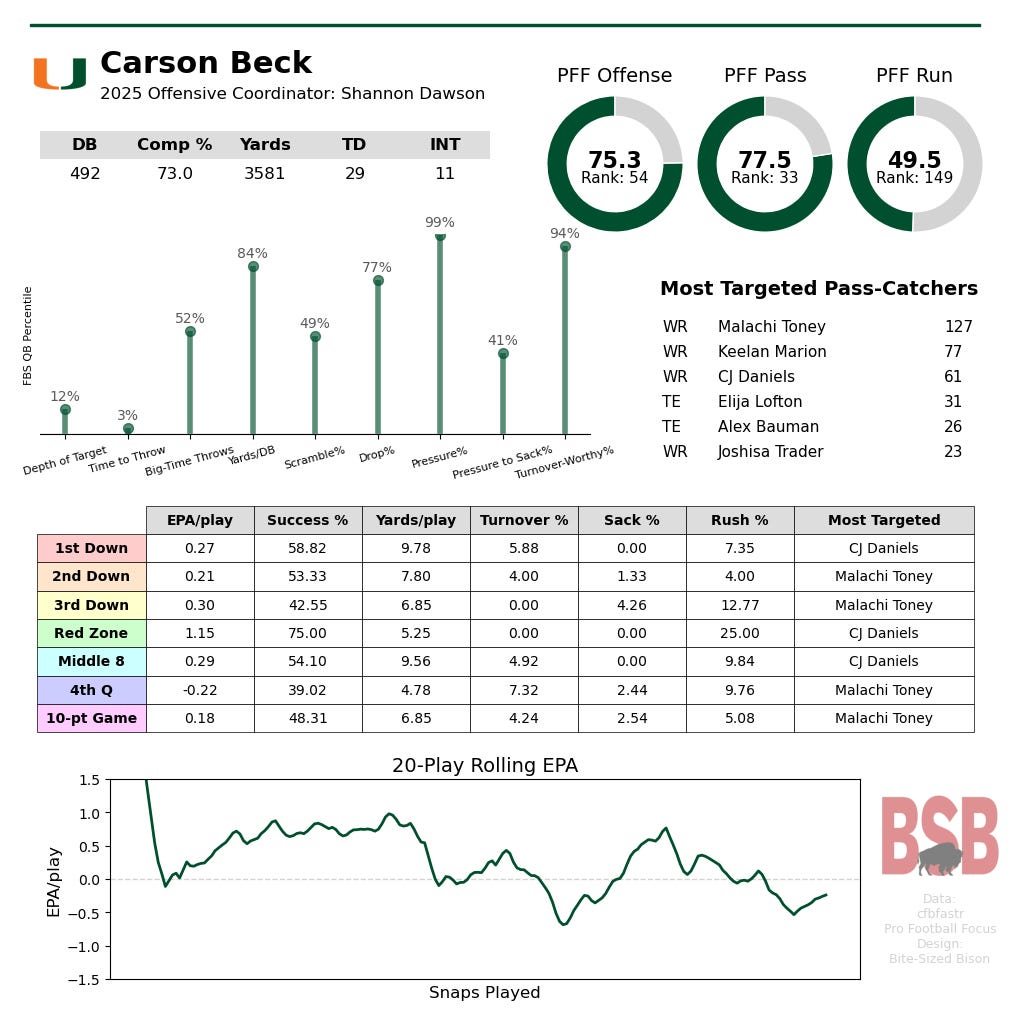
Note: Carson Beck gets the ball out in 2.38 seconds on average (3rd percentile among FBS QBs) and ranks 31st with 8.2 yards/attempt.
You may have guessed it already, but Shannon Dawson calls for a ton of screens. Nobody in the country has attempted more screens than Beck (118). He attempts a screen pass on 24% of his dropbacks (about 8 per game).
The primary beneficiary of these screens is true freshman phenom WR Malachi Toney, who leads Miami in screen targets (41) and is 3rd nationally. No one else on the team has more than 14. Toney screens represent 20% of all of Miami’s YAC against FBS opponents, and the Canes average 9.3 yards/play when targeting Toney on screens (6th-best nationally).
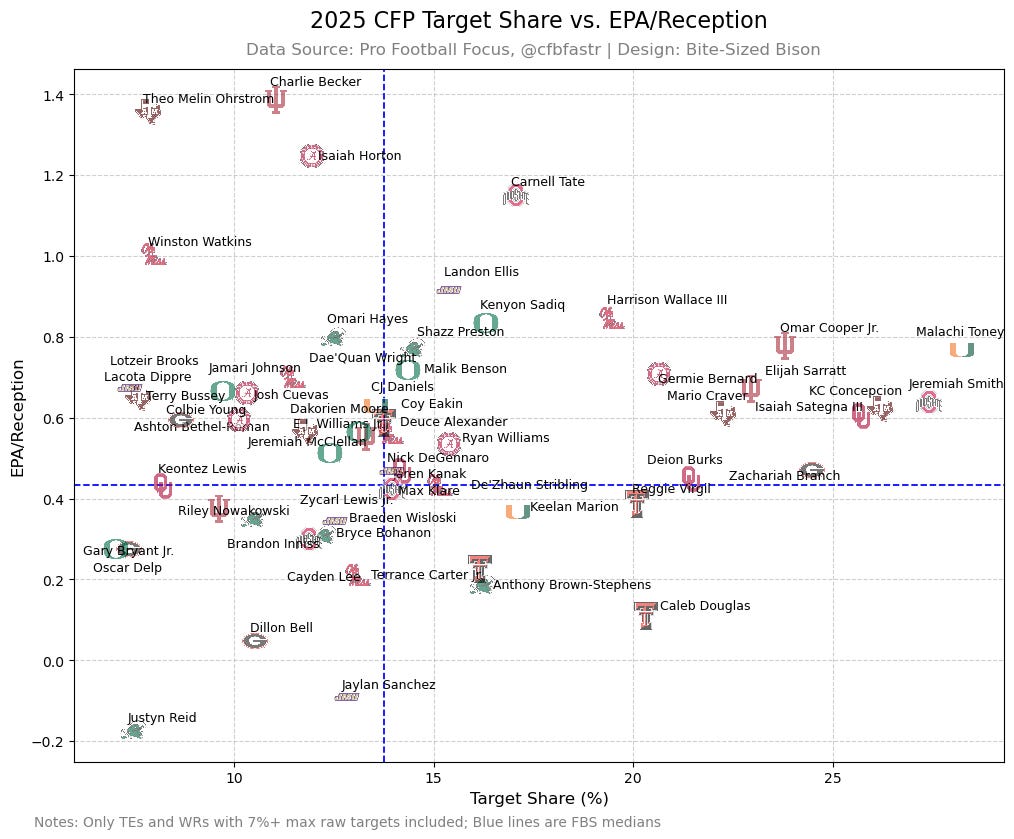
Note: Charlie Becker has been insane since Week 11.
It’s not simply screens, though. Dawson designs his pass plays to produce YAC opportunities broadly, and redshirt senior WR Keelan Marion is another YAC target. You may have read above that Indiana DC Bryant Haines runs the most zone coverage in the country; Marion ranks 14th among P4 pass-catchers against P4 zones for total YAC (162).
During the CFP, YAC yardage has represented 60% of Miami’s passing yardage (305-of-509 yards). Yes, that’s 509 yards in three games (170 passing yards/game).
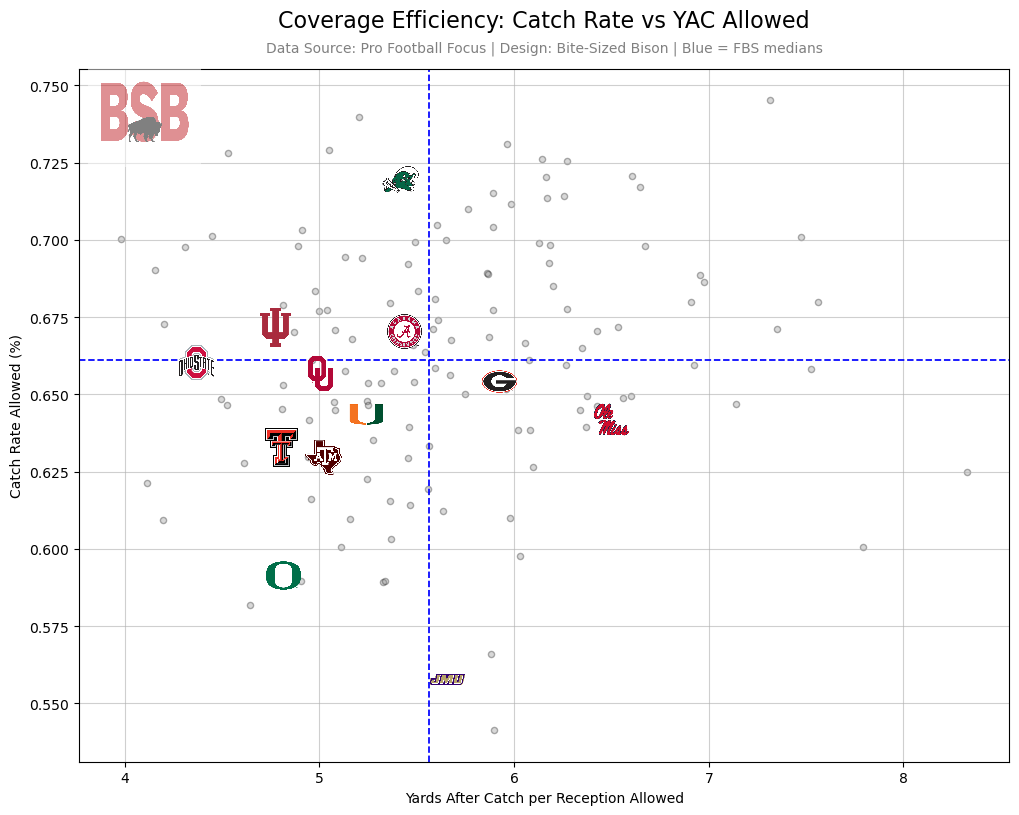
Haines’ defense is, of course, predicated on creating havoc to aid in pass defense, asking Indiana’s DBs — if the ball gets out — to swarm and bring receivers to the ground rather than focusing on stopping the reception at the point of the catch. The visualization shows this below: Indiana ranks 83rd in allowed catch rate (67.1%) but 14th in YAC allowed/catch (4.8).
Miami will then use these YAC designs to open opportunities in the run game (and vice versa), especially the interior run game, which is why the Hurricanes rank 10th in highest inside zone rate and 9th in duo rate — both interior zone concepts — as well as 35th in power — an interior gap scheme.
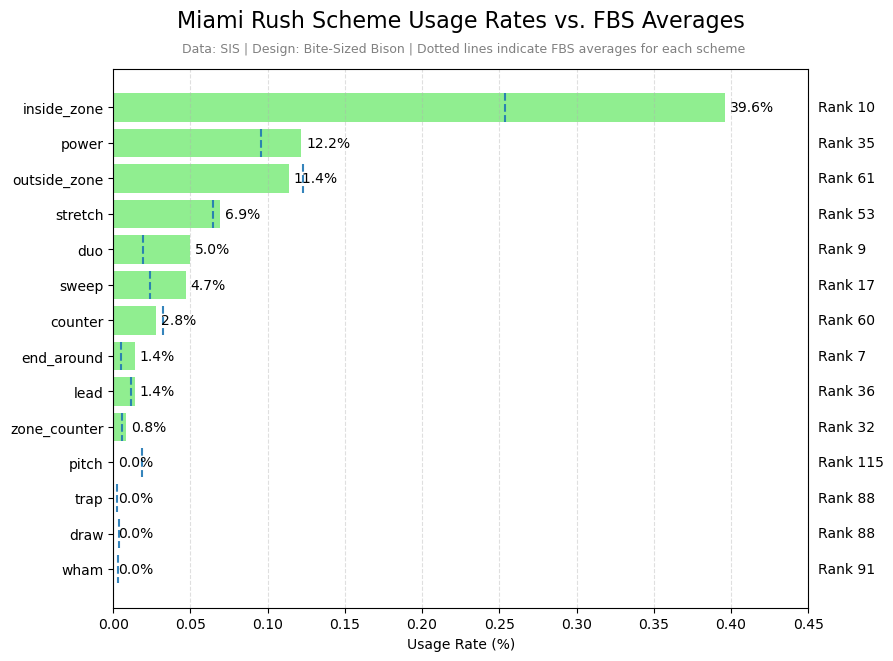
The combination between the horizontal, YAC-focused passing attack and an interior, ground-and-pound run game creates space in the trenches to earn yardage before contact and one-on-one tackling opportunities for Miami’s strong RBs — Mark Fletcher and CharMar Brown — to power through. Among FBS teams against P4 opponents, Miami ranks 10th in yards after contact (good for 70% of its rushing yardage) and is 5th in broken tackles. The Hurricanes run the ball the 24th-most times nationally, making them the 2nd-most run-heavy offense Indiana has played (behind Oregon), but they aren’t the most efficient, ranking 106th in EPA/rush and 87th in rushing success rate (40.5%). They also aren’t the most explosive rushing attack, ranking 112th in rushes of 20+ yards.
In the CFP, Miami has achieved an even lower rushing success rate (36.6%), even though it is averaging 4.5 yards/carry. This is largely because Miami only ran on late downs against Ole Miss (11 times). Against Texas A&M and Ohio State combined, it ran on late downs just 4 times. It uses the run on early downs to set up the passing game to convert.
50.2% of its CFP rushing yardage has come from Mark Fletcher after contact (261-of-519 yards), which is an over-performance, as Fletcher after contact has represented 32.9% of Miami’s rushing yardage over the full season.
The pairing of these two dynamics — catches in space and running physically in the interior — is difficult to blanket entirely. It’s more a matter of how much a team can limit either of them, which is how Miami’s offense has been able to stay afloat in the CFP — like using five fingers to plug six holes in a dam. When one phase isn’t gaining (4.9 yards/pass vs. Texas A&M, 3.7 yards/rush vs. Ole Miss), the other picks up the slack (6.3 yards/rush vs. Texas A&M, 7.2 yards/pass vs. Ole Miss).
The teams that gave themselves the best chances to beat Miami — Ohio State, Notre Dame, SMU, Louisville, Ole Miss (all above 60% postgame win expectancy against Miami) — limited yards after contact in particular. Only Texas A&M (lost to Miami, 10-3) really got away with allowing yards after contact to Miami, but it limited the Hurricanes to 5.3 YAC/reception.
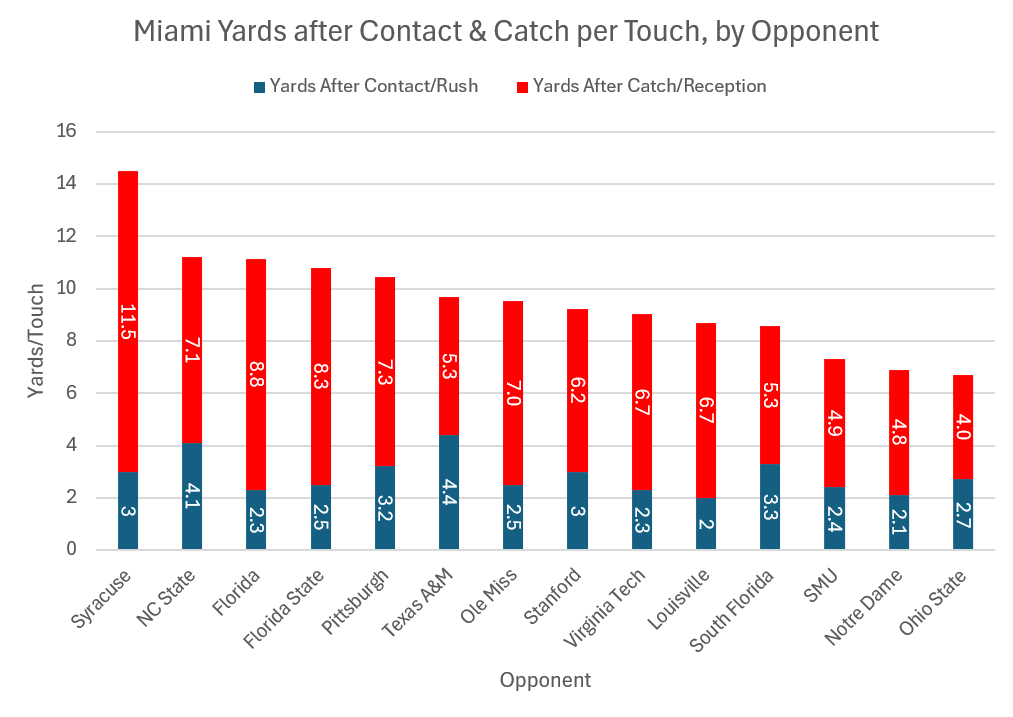
Note: Among FBS teams, Indiana ranks 14th in Yards After Catch/Reception allowed (4.8) and 24th in Yards After Contact/Rush allowed (2.7).
Limiting yards after contact isn’t enough, though, as shown by Florida, Florida State, and Virginia Tech. Surrendering too much YAC through the air in conjunction could still cost a defense.
Ultimately, Indiana must tackle well in this game if it wants to limit the Miami offense. The Hoosiers are 2nd nationally in fewest missed tackles/game (6.2), trailing only Ohio State (5.9). The Buckeyes limited Miami to its 2nd-fewest yards/play of the season (4.6).
Tackling from defensive backs, in particular, will be important so the front seven can blanket the interior. Indiana has the fewest total missed tackles by DBs in the FBS (32) despite playing five DBs in its base defense and playing 15 games. During the CFP, Miami posted negative EPA (-0.148) against defensive sets with five DBs. Nickelback Devan Boykin will be significant factor in this one.
As noted above, Miami isn’t the most explosive team (ranked 106th in offensive explosion rate), but that doesn’t mean it can’t find explosion. After all, it was a 56-yard run that helped lift the Hurricanes past Texas A&M, a 72-yard interception return TD that extended an early lead over Ohio State, and a 52-yard TD pass to Keelan Marion and a 36-yard TD pass to Malachi Toney that gave Miami the lead twice over Ole Miss. Miami has stayed alive thanks to its explosive plays.
It might need them more than ever against Indiana. The Hoosiers are the best team overall in the red zone, but more specifically, they are the best defensive team in the red zone. Indiana leads the nation in lowest TD rate allowed in the red zone (34.6%).
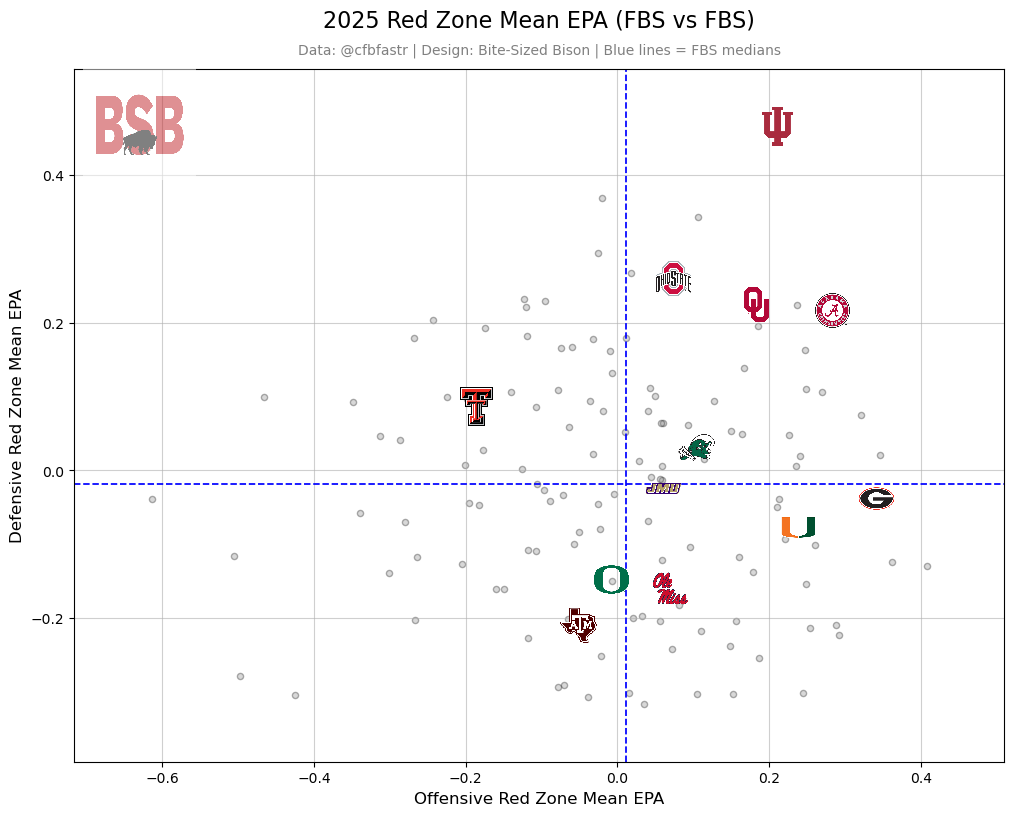
What you might also notice from the chart is that Miami is fairly strong in the red zone offensively. Miami ranks 29th in TD rate, which is the 4th-best Indiana will have seen to this point. This particular matchup will be decisive in this game, given how each team likes to churn its way downfield, rather than chunk.
I wrote this in the Peach Bowl Preview too, and it proved to be significant, as Indiana won the turnover battle, 3-0, over Oregon, scoring 21 points off of those turnovers to jump to a 35-7 lead by halftime. The Hoosiers also blocked a punt, forced two turnovers on downs, and surrendered just 23 yards via penalty.
They have been one of the premier mistake-free football teams through 15 games.
The Hoosiers lead the nation in turnover margin (+21), thanks in part to losing just 8 turnovers (3rd-lowest nationally).
Miami forces the 9th-most turnovers (25) but has lost 14, which is 34th nationally.
They have the second-fewest fumbles (6) and the fewest fumbles lost (1). They’re also tied for the 23rd-fewest INTs (7).
Miami has fumbled the ball 11 times (28th) and lost just 3 (7th). They’ve thrown 11 INTs (82nd).
They lead the country in third-down conversion rate (56.5%), which has aided them to the 4th-best conversion rate. They also score on 91.2% of red zone possessions (17th nationally).
Miami is 18th in third-down conversion rate (47.1%) as part of he 22nd-best conversion rate. Miami scores on 88.7% of red zone trips (36th).
They rank 8th in net drive starting field possession, according to bcftoys.com.
Miami ranks 4th in net starting field position.
Nico Radicic owns the 3rd-best field goal percentage nationally (94.1%%) — currently tied with 2015 Griffin Oakes for the best rate in an Indiana season — and still has yet to miss an extra-point attempt (153-for-153) during the Cignetti Era.
Miami is 76th in field goal percentage (75%), going 18-for-24 this season.
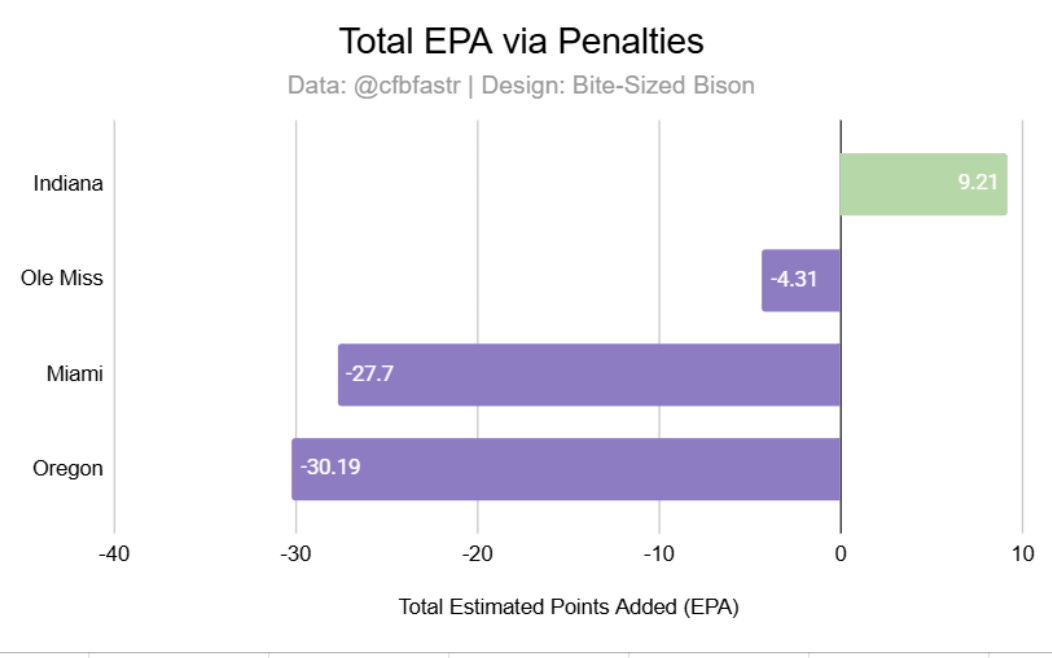
But what really pops is how Indiana has avoided costly penalties. The Hoosiers have committed just 55 penalties as a team (ranked 10th nationally), and just 11 (!) of those are defensive. Below is how the CFP Semifinal field shakes out with penalties:
Indiana: 55 for 403 yards lost
Ole Miss: 83 for 786 yards lost
Oregon: 76 for 746 yards lost
Miami: 105 (132nd) for 856 yards lost
Putting the penalties into the context of games, this is how much penalties have helped or hurt just the semifinal teams this season:
While there has been skepticism by conspiracy theorists around Indiana’s defense against scripted drives, Bryant Haines’ defense has actually started somewhat slowly when compared to other FBS defenses.
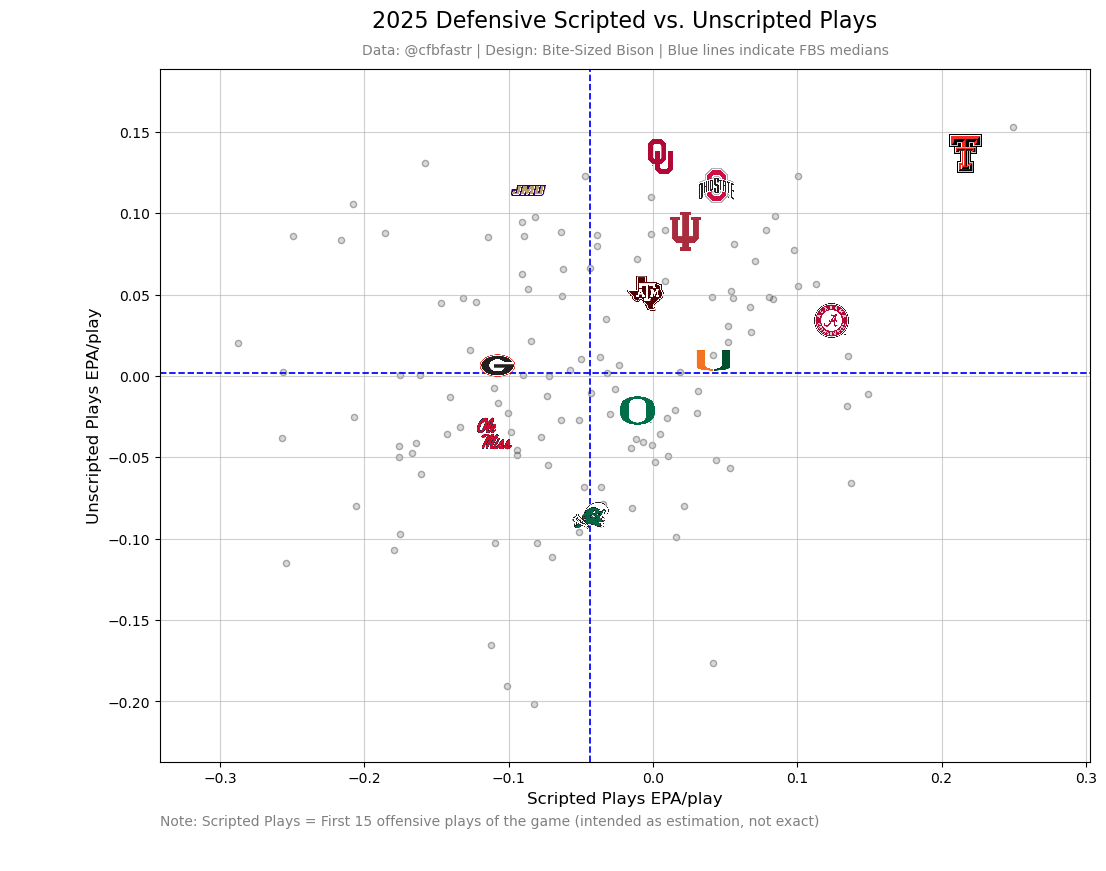
Indiana, both offensively and defensively, has gotten better as games progress, thanks to in-game adjustments by the staff. This is particularly obvious in the third quarter, where Indiana has been more analytically productive than any FBS team in any quarter.
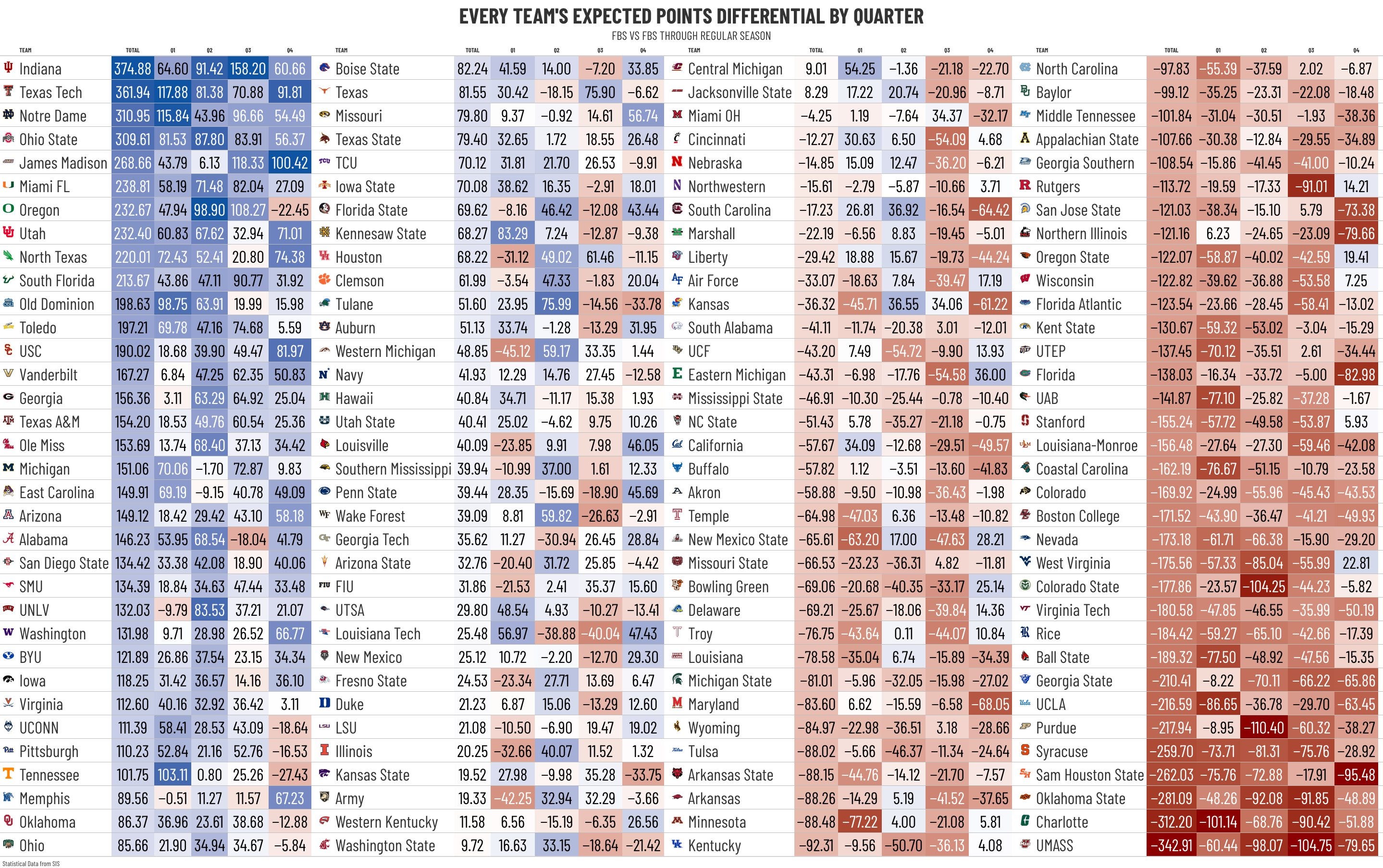
Source: Parker Fleming of CFB-graphs.com (12/9/25)
In the CFP, Miami started strongly against both Ohio State and Ole Miss — an 8-play, 42-yard drive that ended in a red-zone fumble against Ohio State (after a quick 3-and-out to start); a 13-play, 44-yard drive that ended in a field goal against Ole Miss. While those drives weren’t the most productive drives for scoring points, they showed an ability of Shannon Dawson to script ball movement with this version of his offense, and if Indiana gets into a game script where it must prioritize the pass, it plays into Miami’s ideal scenario.
Comments
Nothing yet. Say the first thing.
Sign in to join the conversation.