
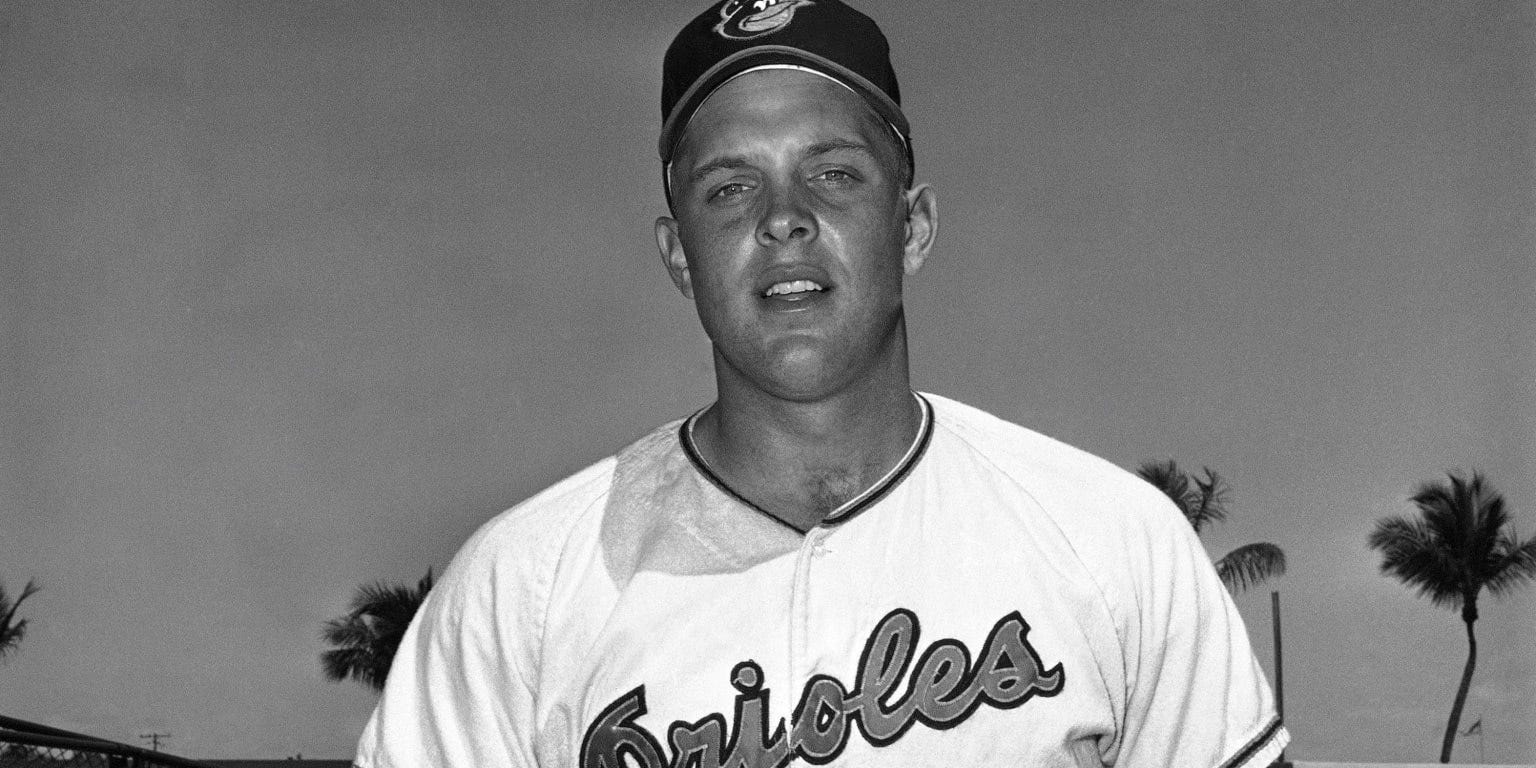
One version of the question headlining this post is easily answered. What happened to Merv Rettenmund? There’s biographical information all over the Internet. You can look it up.
A slender and athletic Michigan native, Rettenmund was a two-sport star in high school and college, and adept enough as a football halfback for Ball State that the Dallas Cowboys drafted him. But he signed with the Orioles in 1964 and reached the majors by 1968. An outfielder, he spent six seasons in Baltimore, two with the Reds, three with the Padres and two with the Angels. After retiring as a player, he was a respected hitting coach for two decades.
Although he was a journeyman more than a frontline player, averaging just 47 starts per season during his 13-year major league career, he played in four World Series, coached in three more and enjoyed a long life in the game. When he died at age 81 in 2024, fans in Baltimore fondly recalled him.
That’s what happened to Merv Rettenmund.
But I’m searching for a different answer to the same question here, and it’s an answer not as easily discerned. What happened to Rettenmund after he appeared set to take off as a major star for the Orioles in the early ‘70s? That is a bit of mystery.
He arrived in Baltimore at an auspicious moment, when the Orioles were dominating the American League, winning 100-plus games a year, with a powerhouse lineup featuring Frank Robinson in right field, Paul Blair in center field and Don Buford in left field. It appeared there was no playing time available, but Rettenmund was too good to sit on the bench. As the fourth outfielder in 1970, he had the highest batting average on the team (.322) and started nearly half of the games. The Orioles won the World Series.
The next year, Rettenmund was close to an everyday player. His .318 average was the highest on the team and third-highest in the entire league. Add in the 87 walks he drew and his on-base percentage was a whopping .422. He received votes for Most Valuable Player and started six of the seven games in the World Series.
The Orioles traded Frank Robinson after the 1971 season with the thought that they needed to clear a place in the outfield for Don Baylor, but Rettenmund was the immediate beneficiary. He became the everyday right fielder, and coming off two outstanding seasons, appeared poised to become a significant contributor.
But he didn’t launch.
Coming off three straight seasons of 100-plus wins, the Orioles were a major disappointment in 1972, dropping to 80 wins and a third-place finish. Buford, in his Bird Tapes interview, blamed it on everyone trying too hard to make up for the fact that Robinson was gone, leaving a power void that needed to be filled. No one had a harder time than Rettenmund. Although he’d hit a combined 29 home runs in 1970 and 1971, he was a line-drive hitter at heart, and when manager Earl Weaver asked him to hit for more power, his average plummeted to .233 — an 85-point drop.
He dealt with shoulder and abdominal injuries during the season along with Weaver’s demands, but in an interview years later, he blamed his falloff on other factors.
“You cause these things yourself,” Rettenmund said, according to a Society of American Baseball Research profile. “I had two goals when I started playing. One, to be a .300 hitter in the major leagues, and two, to make X number of dollars. That’s all I wanted to do. And after two years in the majors, I had been doing everything I wanted to do. I didn’t have any more goals and I didn’t know how to set any more goals. I got myself in a mental rut.”
He conceded that he made detrimental changes to his swing in 1972, altered his stance, dropped his hands and held his bat more still, in an effort to add power.
“I had a weird swing. And when it was broke, I knew what was wrong and everybody could tell me how to fix it, but I just couldn’t fix it,” he said.
His troubles continued early in 1973. He hit .230 before the All-Star break and lost his starting job when he ran into an outfield wall and severely bruised his chest. Two speedy rookies, Al Bumbry and Rich Coggins, ate into his playing time, and with Baylor also ready, the Orioles’ outfield officially was in transition.
Although he ended up hitting .262 for the season, Rettenmund was deemed expendable at age 30. Before the 1974 season, the Orioles sent him to the Reds in a five-player deal that brought pitcher Ross Grimsley to Baltimore.
Rettenmund would hit just .239 over the rest of his career — seven seasons — and was never again an everyday player.
What happened to him after his terrific seasons for the Orioles in 1970 and 1971? His disastrous 1972 season obviously was pivotal, but in hindsight, his general lack of power kept his star from rising too high. Take away 1970 and 1971 and he only hit 37 combined home runs in his other 11 major league seasons. Although he was a slasher who got on base, teams wanted more power and production from their outfielders.
Innately humble, he ascribed his falloff from 1971 to the fact that was a natural “scuffler” at the plate more than a star. But to be clear, he still forged a fine career, as his .271 lifetime average attests, and he emerged as an astute professor of hitting, which led to his long second act in the game. Tony Gwynn was among his many disciples.
No posts
Comments
Nothing yet. Say the first thing.
Sign in to join the conversation.