
In our previous article, we explored why bioregional teams and regenerative entrepreneurs across Europe struggle to access the capital they need. This is due to the mismatch between how finance is organised and how regeneration actually unfolds: While conventional finance focuses on individual organisations and projects, regeneration emerges through networks of people and initiative in a landscape working together over time. This article introduces the Bioregional Financing Facility (BFF): a financial infrastructure designed to bridge that gap.
In short, a BFF is a permanent financing structure that pools different types of capital (philanthropic, public, and investment) and channels them toward synergetic portfolios of regenerative initiatives within a bioregion, rather than toward single organisations or individual projects. The rest of this article explains how that structure is being built and tested in the Living Delta (The Netherlands).
The information in this article is based on an interview with Natasha Hulst from the Bioregional Weaving Labs (BWL). Natasha is a Portfolio Weaver in the Living Delta Bioregion, and is working on a Living Delta BFF prototype, in collaboration with the ResiliAnce Partnership (BWL, Commonland and WireGroup). The Living Delta bioregion encompasses many different landscapes. Natasha works with seven landscape teams that are participating in a two year programme called ‘The Harvest of Tomorrow’, a collaboration between Commonland, Academy of Place, BWL, Oogst van Overmorgen, and Frisse Blikken. We will discuss prototyping a BFF on a Living Delta bioregional level, as well as the importance of place-based portfolio weavers (on landscape level), and how capital can actually move through a BFF to fund those portfolios.
It is important to note that the Living Delta BFF is still a prototype: a live experiment in redesigning financial infrastructure, not yet a finished or fully operational fund.
Here is how this article is structured:
In section one we start on the ground, in the seven landscapes of the Harvest of Tomorrow. You can read how portfolio weavers bring local initiatives together into a landscape portfolio (portfolio weaving is the foundational, relational work that turns local initiatives into an investable whole).
In section two, we zoom out to see the added value of having both landscape level portfolios, as well as a Delta level portfolio.
Finally in section three, we look at the piece this article is building toward: how the BFF itself channels different kinds of capital (philanthropic, public, and investment) through that portfolio, and where the Living Delta prototype stands today.
When introducing the Bioregional Financing Facilities in the Living Delta, it helps to first understand the bioregion it is being prototyped in.
Long before the Netherlands became a nation state, the Living Delta existed as a connected ecological landscape shaped by rivers, tides and watersheds. Today, much of the Netherlands forms part of this bioregion, which also extends into Belgium, Germany and France.
The Living Delta takes its name not only from its rivers and fertile delta landscape, but also from the fact that it is a living bioregion, continuously shaped by the relationships between water, land, nature, and people. For centuries, its inhabitants have co-created the delta through agriculture, water management, trade, and settlement, making it one of Europe’s most densely populated and productive landscapes. Today, the challenge is not simply to protect this Living Delta, but to regenerate it by restoring the ecological, social, cultural, and economic relationships on which its future depends.
To understand how a BFF can work in practice, it helps to start with the ground it is built on: the seven landscapes of the Harvest of Tomorrow.
The seven landscapes that shape the project of Oogst van Morgen (Harvest of Tomorrow) stretch from the Wadden Sea island of Texel in the North, the river valleys of Mooi Maasvallei in the South, and the agrarian terrain of Mooi Achterhoek in the East. Each landscape has its own ecology and cultural heritage, and each is a unique piece of a larger hydrological cycle: a delta of multiple rivers and watersheds.
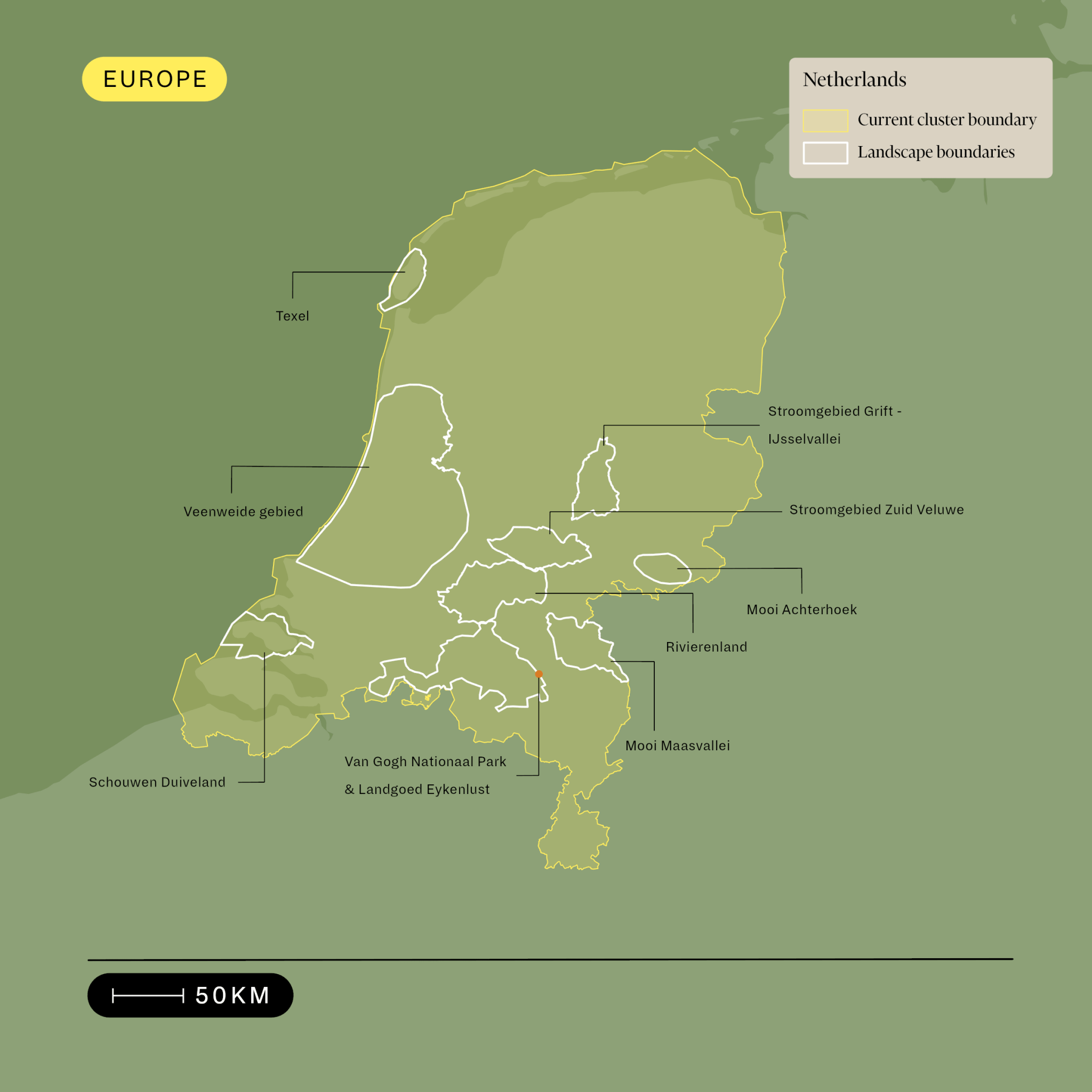
In these seven landscapes there are plenty of local initiatives, but what is missing is a coherent system of funding and support. Efforts remain fragmented, with initiatives often navigating disconnected programmes, institutions, and financial instruments.
To address this, a Bioregional Financing Facility is being piloted in the Living Delta as a new form of supporting infrastructure. It focuses on three interconnected areas of change:
strengthening place-based collaboration
developing governance systems designed for bioregions and portfolios rather than isolated projects
creating new financial flows that can move the right forms of capital to where they are most needed
Weaving these three strands of change does not happen on its own. It needs people holding the whole picture in order to connect and weave them together.
Before capital can move through a Bioregional Financing Facility, there needs to be something coherent for it to flow toward: That is what portfolio weaving builds. As mentioned in the intro, it is the foundational, relational work that turns a scattering of local initiatives into an investable whole. And it is the first step in the process that eventually connects to Delta-level funding and the BFF itself.
In each landscape there are landscape weavers, who in turn are “portfolio weaving” together with support from BWL Delta portfolio weavers Natasha Hulst and Deborah de Groot. The landscape weavers are engaging local initiatives and professional enterprises rooted in place, shaped by local history, navigating current opportunities and challenges, and together working towards a thriving future for that place and its people.
A landscape portfolio is a carefully composed ecosystem of initiatives, commons and enterprises that mutually reinforce each other and create combinatorial effects. Different initiatives can perform complementary functions: some restore soil and biodiversity, others create new ownership models, others provide knowledge or market access.
Portfolio weaving asks not only which initiatives are promising, but also which functions are missing to create a healthier system, which relationships need strengthening, and how the portfolio as a whole becomes more resilient than the sum of its parts. Together, as part of a portfolio, these initiatives nurture the conditions that enable the thriving of the landscape and its people.
The portfolio enables funders and investors to support the health and resilience of an entire bioregional system, rather than trying to identify which individual project is most likely to succeed in isolation. It also makes visible and fundable the enabling work that is usually overlooked: the relationship-building, governance, knowledge-sharing, and coordination. This work can be part of the portfolio, because together with the other initiatives it becomes a fundable whole.
The ambition is for each of the seven Oogst van Morgen landscapes to have its own portfolio weaver: someone who works closely with local stakeholders to map systemic initiatives, identify gaps in the portfolio, perform needs assessments, and support project owners and entrepreneurs in optimising their models and making them investable.
The work of weavers includes organising small convenings, with new forms of listening and quiet moments that help a system recognise itself as part of one shared ecological and cultural story. It is slow, often invisible work, but it is the foundation essential for an investable portfolio to emerge. Our interview with Jacqueline, weaver in Mooi Achterhoek, goes deeper into this often-overlooked side of the work, and the different challenges it brings.
Now that we have visited the different landscapes of the Harvest of Tomorrow, it is time to zoom out again to the bioregion these are situated in: the Living Delta bioregion. We will dive into how these seven landscape portfolios connect at bioregional level and how capital moves through a BFF to fund those portfolios.
Working at a bioregional scale offers four advantages that a landscape working in isolation cannot easily get:
Learning. Landscape teams can learn from each other, avoid repeating mistakes, and adapt what already works elsewhere to their own context.
Funding. The Living Delta BFF spreads capital across landscapes while each one keeps its local autonomy.
Spreading. When something works in one landscape, the Delta-level network can offer a pathway to explore it elsewhere. What travels well is context-specific. This means a model that works in one landscape rarely transfers unchanged, but the network makes that kind of cross-pollination possible, rather than leaving successes isolated.
Enabling. By identifying recurring systemic barriers across landscapes, the portfolio creates the evidence and collective voice needed to improve the enabling environment for regeneration. Together, landscape teams can engage funders, policymakers, and other institutions to help reshape funding architectures, policies, and governance so that regenerative initiatives can thrive.
In short: a bioregional approach creates the conditions for local flourishing. The Living Delta as a concept creates the conditions for the landscapes that are part of it to learn from each other, collaborate, and attract resources, without losing what makes each of them distinct.
Those advantages only exist because there is something concrete for capital to flow toward. This is the Living Delta Portfolio itself.
Composing a portfolio means weaving together different kinds of place-based projects and enterprises. Broadly, these are:
Those with strong systemic and demonstration value (proving a different model is possible)
Those that are scalable, while still adaptable to local context
Those that are bioregion-bearing and essential to how a specific place functions
These key landscape initiatives are included in a bioregional portfolio for the Living Delta, alongside other systemic innovations from across the wider Living Delta network (beyond the seven landscapes participating in the ‘Harvest of Tomorrow’ program). Together these key innovations strengthen the long-term health and resilience of a whole bioregion.
We regard the local landscape teams as key innovations. Seed funding then flows from the Delta-level portfolio to the individual landscape portfolios, connecting local work to the Delta level and back again. Both the landscape-level and Delta-level portfolios are being collected in a digital database, developed within the Bioregional Weaving Labs, which is partially displayed on the BWL website. Mapping and publishing this work is useful for visibility, inspiration, recognition, and funding.
Not just any initiative becomes part of the Delta portfolio. The focus is on systemic innovations, which are initiatives that create enabling conditions for wider transformation. It includes initiatives with models designed to be scalable or adapted across different contexts. Where a landscape-level portfolio answers the question “what does this place need,” the Delta-level portfolio tries to answer a different one: “which tools, structures, or lessons are worth investing in to scale across the whole bioregion?” A shared legal template, a training programme, or a financing mechanism only needs to be built once, and every landscape in the network can benefit from it, rather than each reinventing the wheel alone.
These different types of categories matter, because each attracts a different kind of capital. Some need investment, others need philanthropic support, and matching the two is exactly what the BFF is designed for. More specifically, initiatives in the Delta-level portfolio tend to fall into four categories:
Enabler: Strategic partners who enable key initiatives through services, knowledge, or infrastructure.
Area Catalyst: Acupuncture initiatives that stimulate change within a specific landscape. Some of these can potentially be applied to other landscapes.
Delta Innovation: Initiatives that generate or contribute to systemic breakthroughs, demonstrating that alternative models are possible, or that build crucial infrastructure for system transformation. Often scalable examples.
Seed funding: A fund-of-funds to finance area portfolios.
The portfolio logic aims to bring these types of financing together, on the premise that all of them grow faster through collaboration than any one of them would alone.
As Natasha Hulst describes it: “The Delta-level Portfolio is much more than a network connecting landscapes. It acts as a catcher’s mitt, bringing together capital, knowledge, and innovations that individual landscapes cannot easily develop or attract on their own.”
It is also a strategic portfolio of shared assets. Some of them enable innovations like governance models, legal structures, or financing mechanisms, while others produce productive assets that generate long-term income for regeneration itself. Natasha describes it as follows: “Imagine a community-owned wind farm whose revenues help finance land acquisition, ecological restoration, or common infrastructure across the Delta. By combining these kinds of innovations and assets in one portfolio, we create a flywheel: assets generate income, income strengthens the portfolio, and the portfolio increases the regenerative capacity of the whole bioregion and the seven landscapes nested within it.”
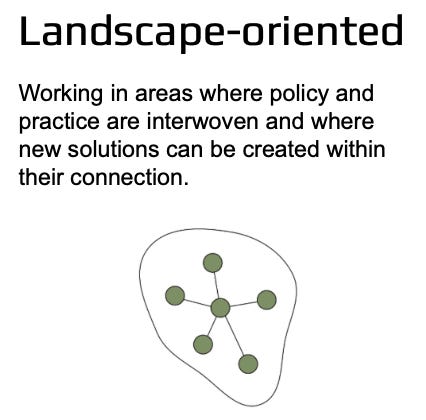
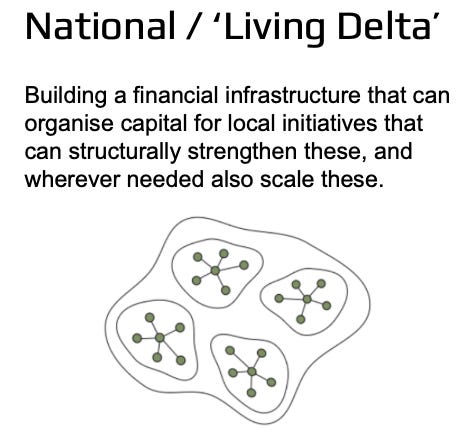
We have now seen that a portfolio can exist of a system of initiatives woven-together, at both the landscape- and the Delta level. The next question is how money actually reaches it. This is where the Bioregional Financing Facility comes in.
“We often talk about transforming landscapes, but we rarely question changing the financial infrastructure that shapes them,” says Natasha Hulst. A BFF in her view, is an attempt to redesign the relationship between financing and place: instead of asking communities to fit the logic of capital, it asks how capital can serve the long-term flourishing of a bioregion.
A BFF is the mechanism through which capital flows to reach the ground-work of bioregional regeneration. Instead of asking what return the investor is looking for, it asks: what does this bioregion need? So rather than investors picking individual projects off a list, they commit to a portfolio of initiatives, focused on what the bioregion needs.
Natasha Hulst is careful not to romanticize new financial infrastructures. She often uses the metaphor of roads in the rainforest: “they were built in the name of development and benefiting local communities, yet in practice they primarily enabled the extraction of timber, minerals, and other resources. Financial infrastructure is no different. It is never neutral. If it is designed around extraction, it will accelerate the extraction of wealth from places and communities. If it is designed around regeneration, it can circulate and steward value where it is created.”
The same logic applies to a fund that rewards only the fastest-growing and most scalable projects. Even with the best intentions, it can concentrate resources in a few initiatives while extracting value from the wider bioregion. A BFF is an attempt to design financial infrastructure the other way around: to enable the whole bioregion to flourish, rather than funnelling capital to a handful of high-growth initiatives at the expense of the wider ecosystem. Doing so requires a new form of collective governance that can steward capital in service of the health and resilience of the bioregion as a whole.
So, governance decides who steers the capital, and blended finance decides what kind of capital comes in in the first place.
Natasha Hulst: “There is growing consensus in the impact financing world around multiple value creation: recognising ecological, cultural and social returns alongside financial ones. If we are truly serious about multiple value creation, then financial returns will often need to be lower.”
The Living Delta BFF is built on this premise. It is not designed to deliver conventional market-rate returns. Instead, it works with a multiple-value-creation model, in which financial return is balanced alongside ecological, social, and cultural outcomes.
This is why the Living Delta BFF uses blended finance, combining philanthropic capital, public funding, and impact investment. By matching different forms of capital with different forms of value creation, it becomes possible to finance the kinds of long-term regenerative transitions that conventional finance alone is unable to support.
Blended finance solves the question of what kind of capital funds the portfolio. Risk absorbing capital solves the question who takes the first risk when things do not go as expected. Patient capital solves the question of how long that capital needs to stay in place.
Regenerative processes do not run on standard investment conditions and timelines. Agroforestry takes years to establish, and a real shift in land stewardship culture can take a generation. Some projects will not make it, due to a multitude of potential reasons. Standard low risk investment horizons of one to five years are too short for that kind of change.
That is why we envision a ‘first-loss’ layer in the capital stack when designing BFFs. We need to have a pool of committed resources to ensure the continued thriving of the whole synergetic portfolio. We also need a layer of patient capital.
Natasha explains: “Patient capital does not expect returns within one, two, or five years, but is willing to stay involved for ten to twenty years. By working with a longer time horizon, you can invest in building infrastructure and development, and spread risk over a longer period. That makes it not only more logical from an impact perspective, but ultimately more resilient and stable.”
As stated before, the Living Delta BFF is explicitly a prototype. Rather than attempting to finance complete landscape portfolios from the outset, it begins with a Delta-level portfolio that brings together initiatives from multiple landscapes. The Delta portfolio functions as the confluence where different streams of capital meet before flowing through the bioregion. It provides a shared entry point for funders and investors while ensuring that resources are distributed across landscapes according to the needs of the wider portfolio, rather than flowing only to the most visible, investment-ready, or scalable initiatives. Over time, as landscape portfolios and their governance mature, these financial flows can become increasingly decentralized through landscape-level BFFs.
The work remains primarily relational. Landscape portfolio weavers work closely with local stakeholders to engage initiatives and prototype portfolio structures. Natasha Hulst and Deborah de Groot work closely with the landscape Portfolio Weavers, who suggest relevant systemic innovations for the Delta-level portfolio. Family offices, philanthropic funds, and Dutch banks have been invited into the process too, both as potential funders and as co-designers. Together they form a community of practice to figure out how existing financial instruments might evolve to support place-based investing.
One of the current bottlenecks is capacity. Weaving remains underfunded, and landscape teams are understaffed. Philanthropic capital will likely need to come first, funding what Natasha calls the invisible infrastructure: “The weaving capacity, the legal structuring of a BFF, and the time it takes to move from fragmented projects to an investable, values-aligned whole.”
More information on the need for funding this essential humus layer can be found in our concept note ‘Weaving Communities of Action’.
A BFF represents a different theory of how capital should relate to place and living systems, one that the current system of banks, state-aid rules, and short grant cycles is unfortunately not built to support.
Natasha sums up what the Living Delta Portfolio and BFF ultimately represent: “Like in a river basin where all kinds of water flows come together in a delta, here initiatives from different landscapes come together in one portfolio to build strength. The BFF can shift the flow of capital to finance this portfolio.”
The Living Delta BFF is a way to make this logic visible before the full architecture exists. For impact investors and funders, it offers a model designed from the ground up to make sure money lands where the work is actually happening. The aim is not a better funding programme or even better investment ready pipeline, but financial infrastructure that can keep regenerating the bioregion without extraction: portfolios of strategic assets that let communities steward their own landscapes, continually reinvesting in ecological, social, and economic health for generations to come.
Want to understand how the BFF is tackling the deeper questions of regenerative financing? Our next article looks at the four Discovery Arcs (the design questions the team is working through), that shape how the Living Delta BFF is being designed.
You can also read our Concept Note ‘Shifting the Flow of Capital’.
Weaving Communities of Action, Rooted in Place
Comments
Nothing yet. Say the first thing.
Sign in to join the conversation.