
What if what we call exceptional in an athlete, a musician, or a leader isn’t an exception at all?
What if extraordinary capability emerges through a knowable pattern that is available to every one of us?
Connection → Belief → Biology → Agency → Practice → Growth
What if we moved from a culture of selection to a culture of cultivation—and built environments that reliably develop people, instead of sorting them? I believe we would see what many of us have sensed for a long time: talent is not rare. The potential for contribution isn’t scarce. It exists everywhere.
And the science of human possibility helps explain why.
False beliefs about people run through our social systems, our schools, our workplaces. If you’re not privileged or protected, you see a distorted or incomplete reflection of who you are. Doors don’t open—or they close to keep you out.
When you are growing up, you see these reflections; you feel them overshadowing you. They constrain your dreams, your beliefs about yourself, and your willingness to be brave and take risks. They can make you feel small and vulnerable, even ashamed.
By far the biggest myth of all is the myth that biology is destiny. How often have you heard someone say, “It’s in my DNA,” “I was born this way,” or “You can’t fight your biology”?
We are surrounded by language that suggests we are fixed—coded, predetermined.
Yet I will never forget the moment in my medical school class when the professor said this:
“There are 20,000 genes in the human genome, yet in our lifetimes, fewer than 10% will ever be expressed.”
I remember being stopped in my tracks, wondering, “What determines what is in that 10%?”
In fact, we are on the cusp of a paradigm shift in how society understands human potential. The antiquated bell curve model—the idea that we can know, sort, and cap a person’s potential in advance—has become the primary limiting factor in what individuals believe they can become.
The emerging paradigm rests on two scientific truths:
that human potential is practically limitless
that what any one person is capable of is not knowable in advance
What this means is that we can now move from a culture of selection to a culture of cultivation, grounded in the conditions that allow every person to realize their fullest possibilities.
I want to confront a few powerful myths that we cling to even though they are scientifically untrue. These myths are dangerous because they hold us back, constrain our dreams and undermine our belief in what is possible for ourselves and our children, and because they are embedded in our institutions as if they were true:
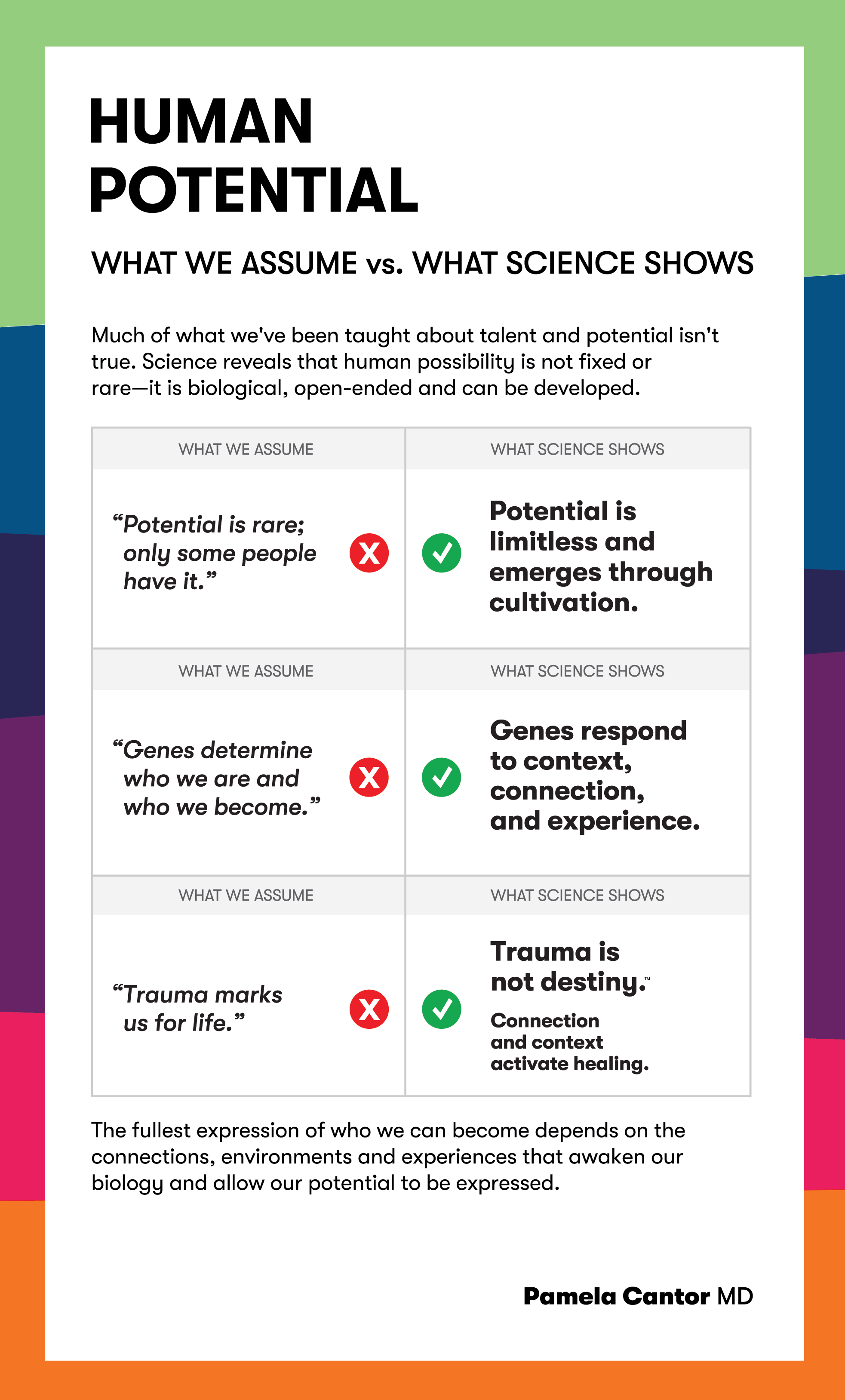
Genes are chemical followers that respond to environmental and relational signals. They are little packages of genetic material that can be turned on and off. What matters is not simply that we have particular genes, but what those genes are doing, and what is influencing what they are doing.
You can think of gene expression like a dimmer switch. And what influences the switch is context: the environments, experiences, and relationships in our lives.
Our genome is not just something we are born with. It develops as we do over our lifetimes. In fact, the genome you are born with is not the one you die with, and it won’t be the one you pass on to your children.
DNA contains instructions for building proteins, but environmental and relational factors play a huge role in which proteins are created. And it is these proteins that go on to influence what we do, and build, and become: intelligence, athleticism, musicality, a “gift” for writing.
Nowhere is this more true than intelligence. There are over 500 genes involved in the expression of our intelligence. But if you crank up chronic stress, fear, and relational deprivation, the expression of intelligence plummets, together with any measurement of your IQ. The genetic potential for intelligence will express itself in dramatically different ways depending on the context.
Genes are not destiny. They are possibilities that will be actualized, or not, depending on context.
How Context Shapes Human Potential
We can’t know what is encoded in our own DNA or what our brains are capable of. No one can. We can discover it through experiences that bring our capabilities to life. We come to know it through experience and relationships and opportunities that make our potential for good, great, or extraordinary performance visible. Healing, growth, and performance are one biological journey—the circuitry that repairs also strengthens, the one that strengthens performs and the one that performs can flourish.
Genes do not determine our destinies. Talent isn’t parceled out to a lucky few. Variation is the norm in human development.
What is true is this: potential is cultivated and revealed in relationships and through experiences that do exactly that—make our potential visible. This is because our brain is more like a live wire, rewiring itself based on what we feel, who we are with and what we believe is possible.
Question the myths you’ve absorbed about ability—in yourself and others. When you catch yourself thinking “I’m just not good at this” or “they’re not naturally talented,” pause. Ask: What experiences, relationships, or opportunities have shaped that belief? What might change with a different context?
Notice potential as something that grows. Whether you’re raising a young person, teaching, leading a team, or reflecting on your own path, remember: skills, confidence, and capability emerge through experience, support, and practice, not from fixed traits.
Choose environments and relationships that nurture belief. A door opened, a moment of encouragement, or a relationship rooted in trust can shift what feels possible for someone. Look for moments when you can offer opportunity—or a new way of seeing someone.
Carry this one idea with you: none of us fully knows what we are capable of until we experience the conditions to discover it. If you believe there is more in you—or in someone you care about—you are likely right.
Seek out the people and places where that “more” can be revealed. What you do matters.
—Pam
National Association of State Boards of Education (NASBE) State Education Standard
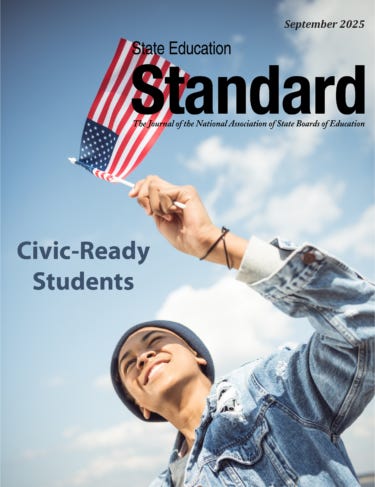
I explore these themes in another context in “The Science of Experiential Civics,” written with Fernande Raine and Susan Rivers. It considers how agency, experience, and relationships shape civic learning—and why context, not sorting, determines what young people can show us.

Comments
Nothing yet. Say the first thing.
Sign in to join the conversation.