
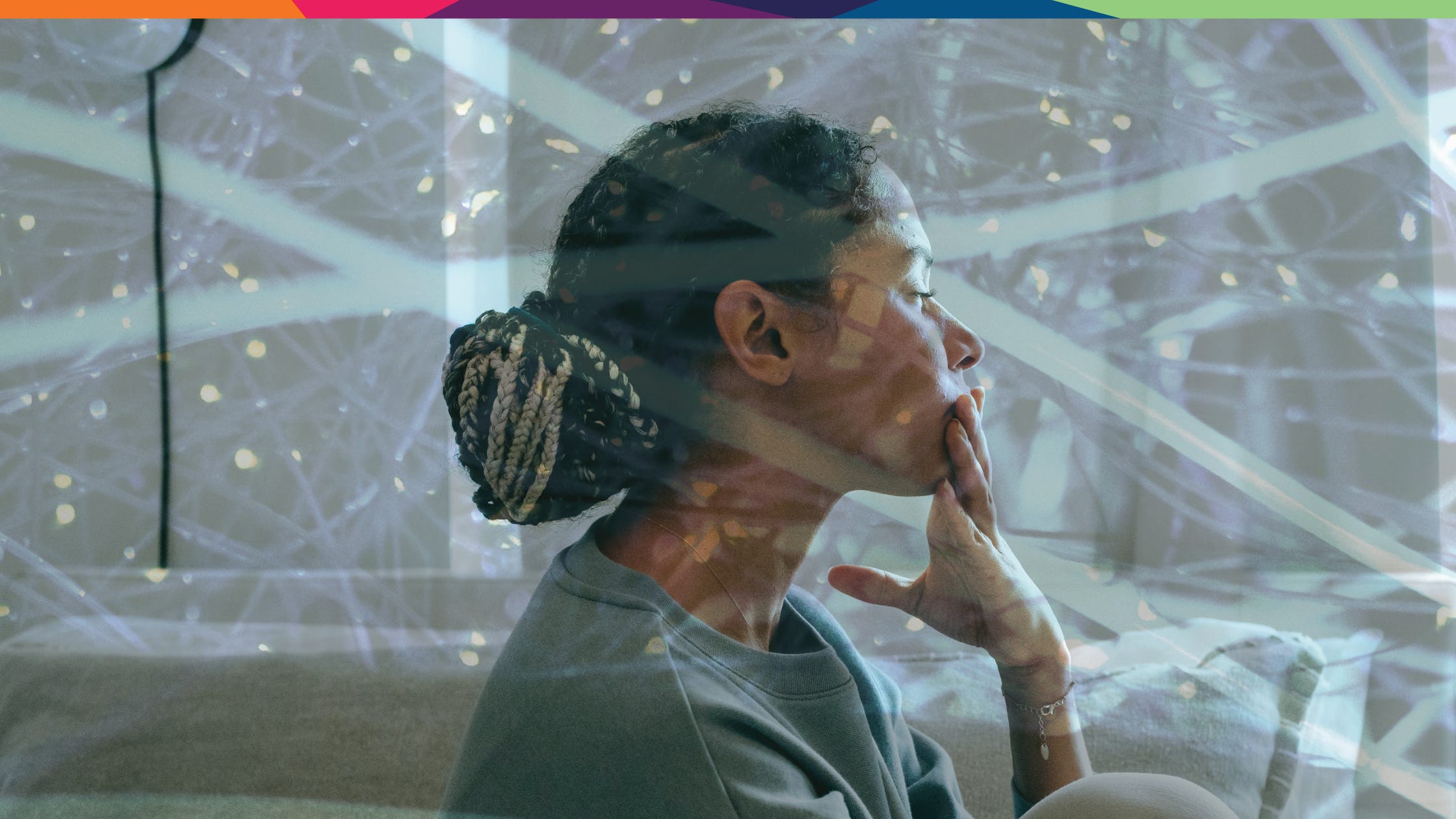
We now have substantial evidence that the brain can heal from trauma. Not just psychologically, but structurally, functionally, biologically. And what that science tells us should shift how we think about recovery, about where resilience comes from, about what is possible, and about what human healing actually requires.
Years ago, sitting across from my therapist Dr. Jay, I asked a question I wasn’t sure he could answer: Could I heal to the point where I became like a person who had never been damaged?
There was a long pause. Then he said, “That would be very hard. It would be a lot of work. But yes, it’s possible.”
I held onto that answer tightly for a long time. And then, when I became a child psychiatrist, I started hearing versions of the same question from my own patients. “Could I ever be like a person who was never ill?” Or: “I don’t just want to not be sick. I want a big life. Can I still have a big life?”
Their goal was never to manage a diagnosis. They wanted to know whether they could go on to do extraordinary things.
I always believed they could. But the science of childhood adversity had almost nothing to say about it. For decades, the field studied what goes wrong: it cataloged damage and gave adversity a number, one that could have implications for your entire life. That work mattered. But it left people with a score and no roadmap and often no hope.
We now have substantial evidence that the brain can heal from trauma. Not just psychologically, but structurally, functionally, biologically. And what that science tells us should shift how we think about recovery, about where resilience comes from, about what is possible, and about what human healing actually requires.
When we talk about the brain “rewiring” after trauma, we are really talking about several things happening at the same time, at different levels of our biology. I want to be accurate here, because the word “rewiring” gets thrown around in ways that make it sound like a quick simple fix. It isn’t—quick or simple. But it is possible. So let me tell you what it actually is.
At the level of individual synapses — the junctions between brain cells — connections that were affected by repeated experiences of threat can be weakened, and new stronger connections built in their place by new experiences.
At the level of the cells themselves, the branching arms of neurons that were pruned back by chronic stress can regrow, driven by a remarkable protein called BDNF (Brain Derived Neurotrophic Factor). Think of BDNF as “Miracle-Gro” for the brain. It is the brain’s own repair signal. It enhances neuroplasticity and learning by strengthening synaptic connections. It can literally instruct neurons to build new structures. Some of the very newest therapies involving MDMA and EMDR actually work because they increase the availability of this remarkable substance and open the window for neuroplastic healing.
At the level of brain networks, the patterns of communication between regions — particularly between the prefrontal cortex, which governs executive function, and the amygdala, the brain’s alarm center — can be restored toward balance.
And at the deepest level, the level of the genome itself, the chemical marks that trauma leaves on our genes, the ones that have been altering how our stress-response system functions, can begin to be rewritten by new experience.
All of this is measurable. We can see it on brain scans, in tissue, in the behavior of genes. Yet none of this is fast; these are processes that unfold over months and years. But they are real, and there is something important in our biology that goes beyond recovery alone.
Healing, growth, and performance are not separate journeys. The circuitry that is injured can be strengthened. The circuitry that is strengthened can perform. And the circuitry that performs can flourish.
This is what I was watching in my office for years before I had the science to explain it. A child who had been through something terrible would slowly start to feel safer. Then she would start to be curious again. Then she would start to take risks. And then she would start to dream. The same nervous system that had been tuned to threat was now tuning itself to possibility. It was one continuous process. Healing was not a destination she reached and then left behind on her way to growth — healing was the growth. But there was more.
A recent twelve-year longitudinal study from the University of New South Wales, published in American Psychologist, gives us a glimpse of what this looks like at the population level. Researchers followed more than 1,600 adults and found that two-thirds of people who experienced childhood trauma maintained moderate to high mental wellbeing into adulthood. Those in the resilient group were 74% less likely to develop a psychiatric illness. The lead researcher, Justine Gatt, said that mental health should be treated as a positive capacity that can be built, not a crisis to be managed when things fall apart.
I love that line. It is a quiet and growing revolution in how we think about mental health.
Which brings me to the part that matters most.
Every one of these processes — synaptic reweighting, BDNF signals, network restoration, rewriting of genes — is exquisitely dependent on the quality of the relational and environmental context in which it occurs. The human relationship is the primary mechanism and energy source through which the biology of healing, and of becoming, is activated.
This is not a soft claim or a hopeful metaphor. This is the biology. And it is why trauma and human connection appear so consistently at the center of the most remarkable human lives.
If you have been reading this Substack, you already know the chemistry behind this. Human connection activates a neurochemical cascade, led by oxytocin, that delivers the fuel the brain needs to grow and repair. What I am adding here is the rest of the story. The oxytocin cascade is the spark, but what it activates is the four-level repair process I just described. Connection is what tells the BDNF to flow. Connection is what calms the amygdala enough that the prefrontal cortex can re-engage. Connection is what creates the conditions in which the genome itself can begin to write a different story.
This is also why the most powerful interventions for trauma so often look surprisingly simple. Ann Masten is one of the foremost researchers on resilience. She is a researcher and developmental psychologist at the University of Minnesota who has studied resilience for decades. She calls the ingredients of resilience “ordinary magic.” Things like attuned social support, perseverance, and having even one person you can turn to. None of these are expensive treatments; they are the things most of us already have access to.
A framework called HOPE — Healthy Outcomes from Positive Experiences — built by Dr. Robert Sege, a Massachusetts pediatrician, has now been used by more than 100,000 clinicians. It rests on four building blocks: supportive relationships, safe environments, opportunities for emotional growth, and social engagement that promotes belonging. A San Diego pediatrician who uses the framework said it transformed how she practices medicine. As one of her colleagues put it: “We heal through relationships. That’s how we really make change.”
These researchers are converging on what I have always known from sitting with patients: The relationship is the medicine.
My patients who were healing weren’t merely returning to where they had been before. They were developing capabilities that hadn’t existed before the hard thing happened. I started calling these their “magic muscles.” The strengths that can only be built by first experiencing something hard and then overcoming it.
Years ago, a boy came into my office and asked me a question I have never forgotten. He said: “Where do you get discipline? Because that’s why I’m here. I don’t have it and I need to get it. My siblings have it. My parents have it. I don’t. Where do you get it?”
This was a bright and funny kid, convinced he was lazy because reading was hard for him in a way it wasn’t for his siblings. He had been told his whole short life that he wasn’t living up to his potential. What he was actually asking me, in his nine-year-old way, was whether the thing he was missing could be built.
It could. And over the time we worked together, I watched him build it. He had come to me asking where to get discipline, as if it were something other people owned and he had been left out of. What he learned was that discipline is not something you get. It is something you grow, and he grew it himself, out of the very thing he thought was broken in him.
That is what it means to develop magic muscles — and he sure built them.
When I began using that term with kids of different ages, nobody ever thought it was silly or soft. They believed it. They knew they had been through hard things, and they knew they had become stronger because of it. And they knew I not only noticed them, I was often awed by them.
Think about what happens when a muscle is injured. We see a buildup of tissue, sometimes called a scar. But a scar is actually a picture of your healing mechanism on overdrive. It is the body doing more than restoring what was lost. It is building something that wasn’t there before. Something strong.
That is exactly what magic muscles are. They are your healing mechanism going into overdrive to surmount a challenge and then becoming bigger still. And as I said to many of my patients, one day they will become your superpowers.
The relationship is the medicine.
Ask a different question. The next time you are with someone who has been through something hard, ask what’s working for them right now. What are they proud of? Where do they feel strong? That shift changes what the brain expects from the conversation, and from itself.
Name someone’s magic muscles. Think of a person in your life who has come through difficulty. Tell them, specifically, what you see in them that was built through something hard. When you name it, you make it come alive for them.
Be the one person. The research is clear: even one steady, trustworthy relationship can shift the trajectory of a life. You don’t need to be a therapist. You need to be the person who shows up, tells the truth with care, and refuses to see someone as the sum of their worst experiences.
As always, if these ideas resonate with you, I’d love for you to share this with someone who needs to hear it. Please leave your comments below. And if you want to go deeper into the science of how we become who we become, please subscribe.
Thank you for being here.
— Pam
SHARE THE BIOLOGY OF BECOMING
Comments
Nothing yet. Say the first thing.
Sign in to join the conversation.