
Greywater is the term used for some of the used water we send down the drains in our homes. This water can potentially be reused to water parts of our gardens, orchards, or landscapes, depending on what goes down our drains, what we are growing, and what local codes have to say about reusing greywater. The idea of recycling used household water can be very appealing to folks that have very expensive or rationed water, or live off grid.
Greywater typically refers to all the used water a household produces, except for the toilet. Toilet water is designated as black water, and it is generally considered too dangerous to recycle (for good reasons, but an exception is included in its own section below). Some writers and some jurisdictions include water from kitchen sinks in that ‘black water’ designation. This is primarily because of the types and amounts of bacteria and food residue that may be present in used kitchen water.
All greywater, however, contains more bacteria than fresh water coming from taps in areas that have well-functioning municipal water treatment facilities. Even though we are not going to drink, cook, bathe, play, or wash our hands in greywater, we don’t all feel the same way about bacteria. (And neither do all the permitting jurisdictions.)
We do need to think about this bacteria. I know for some folks, the idea of bacteria comes with such an ick factor, that it may be all they need to know to decide not to use greywater. Other folks may be (or may have family members who are) at a stage of life or health where exposure to excess bacteria might be risky.
For those less averse to the idea, strategies have been developed for reducing bacterial proliferating in greywater and thus reducing possible human exposure. I introduce a couple of the most commonly permitted strategies* below and share where to get more information. A key concept here, is that bad bacteria and bad bacterial proliferation can be reduced. But they probably can’t be totally eliminated. *Contact your local permitting agency about local codes. Codes are very diverse from one jurisdiction to the next. To steer clear of any problems, you will want to read the codes and ask your permitting agency any questions you may have.
Meanwhile, back when I was using greywater, I didn’t use any of these strategies nor did I inquire about the codes. I did something much easier and less expensive than any of this calls for. It didn’t involve any permanent modifications to my plumbing, nor did it require much digging (and I could have gotten away with no digging at all). The whole system (if you could even call it a system) could completely disappear in a matter of minutes. I will explain my process a little later, and why it worked for me. But I can’t recommend it because of bacteria, which I wasn’t worried about at that time. And I also can’t recommend it, because of potential code violations, which you might want to be worried about.
Meanwhile, what I did and do worry about, are the household chemical products that many people send down their drains, often without realizing what they are doing. There is more information on this, and recommendations for products and strategies to keep your greywater safe, in the books I recommend below, and I’ll give some additional tips in my own story as well.
Back to codes and permits for a sec. If you have the permits and follow the codes, you can avoid possible fines, orders to cease and desist, or orders to remove any modifications you may have made to your plumbing system. Plus, if you make unpermitted changes to your plumbing, it may impact the value of your home, your ability to get other needed permits, as well as your ability to sell the home if you ever need to do so. I don’t mean to lecture you here. Just think about it.
In addition to reading the codes, I also suggest carefully reading the books that I mention below with my small critiques in mind.
Two strategies that will help you reduce unwanted bacteria proliferation in your greywater are introduced below. The first strategy calls for using something called ‘Infiltration Basins.’ They are similar to shallow mulched swales used in many permaculture designs. Infiltration basins are a good DIY project for folks who are handy with a shovel, and on a limited budget. Another plus is that this strategy can be very flexible. It can be designed with some pretty complex plumbing both indoors and out, but that isn’t a must for everyone. You’ll learn more below.
The second strategy calls for ‘subsoil infiltration.’ This strategy is less flexible, it may require more digging, but it does a much better job of processing the greywater in a way that minimizes or eliminates contact with possible bad bacteria from your greywater. You’ll find an introduction to ‘subsoil infiltration,’ right below the info on infiltration basins.
Before we get started on the strategies, if you live on or near a slope you will need some information. Changing the moisture levels and moving dirt around on slopes or near slopes sometimes destabilize the slope. No matter which strategy you use, you will be adding moisture and moving soil around. For more information on the potential risks, see my article ‘Be Careful When Gardening on Slopes’. (It may be behind a $5.00 paywall. That’s the fee for a one-month subscription, which gives you access to my entire archive. You can unsubscribe before the end of the month to avoid reoccurring fees. If you honestly can’t afford $5.00, please send me a message with your email address, and I’ll comp you a free one-week pass.)
Let’s get started!
The Infiltration Basin Strategy:
This strategy embraces the basic principles that the greywater should never come in contact with the edible parts of plants, that greywater should not be used to water root crops, nor should it be delivered through sprinklers or drip systems, and that greywater should be used the same day it is created and never stored for more than 24 hours.
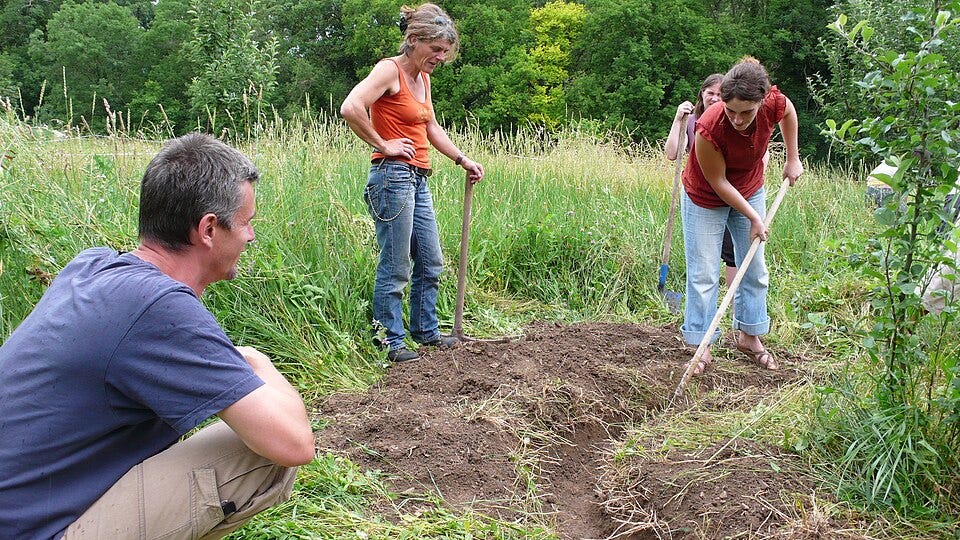
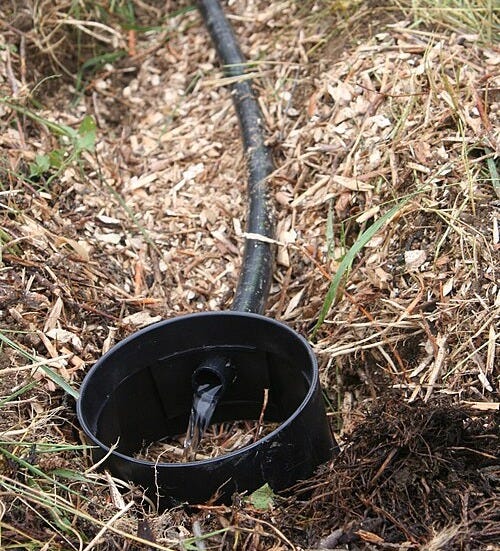
The infiltration basin strategy involves digging shallow basins as places to release greywater and adding deep mulch. The basins each need to be able to accommodate the amount of greywater you will produce at any one time from any one source. The main idea is to deliver the greywater (through hoses, pipes, or buckets) to these mulched basins, and then let the water soak into the ground. Each basin needs to dry out in between each application of greywater, to limit the proliferation of anerobic and possibly disease-causing bacteria.
Specific kinds of food crops can be planted around the basins such as; fruit and nut trees and shrubs, veggies like artichokes that grow up-right or tomatoes and vines that can be trained to a trellis. The main point on the types of plants, is that they must produce their edible parts above ground and away from the mulch and soil that is in direct contact with greywater.
You can use a soil moisture meter (or just eyeball it) to determine if the mulch and soil have dried out in between applications of greywater. Choosing whether or not to deliver more greywater to the mulched basin at any one time is super easy if you are using a hose or a bucket (which may not meet permitting requirements). On the other hand, if you chose to use infiltration basins and are planning on installing plumbing from your home to the mulched basins, (which may be required by local codes) you may need to install ‘three-way diverter valves’ in your home plumbing. With the diverter valves, you can send your drain water to your sewer or septic system when the mulched basins are still moist (even if it is from rain), or frozen when the water won’t be able to sink into the soil.
Everything you need to know to install a mulched basin infiltration greywater system:
Is found in two great books (reviewed below) that together provide you with great options and perspectives. You will also find a tip on inoculating your mulched basins with beneficial microorganisms as an additional strategy to help keep potential harmful bacteria in check.
~ ~ ~
Chapter 12 of Brad Lancaster’s book, Rainwater Harvesting for Drylands and Beyond, Volume 2, Water-Harvesting Earthworks, is all about greywater. He covers infiltration basins (and greywater) throughout the book (use the index to find the information outside the chapter). Chapter 5 is dedicated to infiltration basins, not just for greywater, but for rainwater as well. On page 125 you will find instructions for calculating the water holding capacity of infiltration basins, and on pages 300 & 301 you will find instructions to help you estimate how much greywater your home produces. Just remember, you don’t have to send all the greywater you produce to your infiltration basins. But if you are going to divert the water from a bathtub, shower, or washing machine you do want your infiltration basin (or basins) to be able to handle the full amount produced. If you don’t have room in your yard for an infiltration basin (or basins) large enough to accommodate the amount of greywater you produce at one time, you may be able to install a surge tank, and release the water slowly, which is covered in the book, Greywater, Green Landscape, below. Just remember, the water all needs to be released within 24 hours.
Brad’s book also covers integrating infiltration basins into the landscape; plumbing, indoors and out, installing three-way valves, and multiple ways to send greywater to different parts of your property; management of kitchen greywater to make it safer to use; safer soaps and other personal and household cleaning supplies; and some plant tips.
See second photo in the note below, for an example of a three-way valve. It seems like an odd name, because you are only switching between two possible outlets. But the switch is located where three pipes intersect. Please note, three-way diverter valves do not all look exactly like the one pictured.
Back to the Brad Lancaster’s book, some of the plans shared involve sending all the water from specific drains in your home to one particular spot with no way to divert the flow. If you are trying to manage your greywater to reduce bacteria proliferation, this might not be the best idea as it may cause the basin where the water is delivered to be continually moist, which would encourage the proliferation of anerobic bacteria.
Quick thought on trees. In some scenarios, the book recommends planting trees directly in the infiltration basins. Before doing this, you will want to be sure the species you are interested in are able to survive having their lower trunks submerged from time to time.
Meanwhile, if you already have Volume 1, Rainwater Harvesting for Drylands and Beyond, Guiding Principals, by Bob Lancaster, check the index for infiltration basins and greywater. You will find even more tips.
~ ~ ~
The second book is Gray Water Green Landscape, by Laura Allen. It covers much of the same information covered in Brad Lancaster’s book, above, but from a different perspective. Her design ideas are different, she explains things in a different way, and she uses different types of illustrations to support her points. I found that going back and forth between the two books, (and using the indexes to find what I was looking for in each book) helped me better understand what was being discussed.
Laura Allen also covers some information not included in Brad Lancaster’s books. She explains how to set up an electrically operated system to switch three-way-valves. See ‘How to Wire An Actuator,’ on page 142. (I once visited a bed and breakfast that had set up their well water and greywater systems so that they could use little toggle type switches to change whether they were using municipal water or well water. They also used the same type of toggles to switch various drains between sending water to the sewer or to the landscape. It seemed mysterious to me that this could be done with little toggle switches, but now I know how that worked.)
Greywater, Green Landscapes also covers electrical pumps. In Brad Lancaster’s book the emphasis is on gravity fed systems. But if you need to push your water up even a slight slope, you will most likely need a pump.
You will also find lots of information about navigating permits and codes in Greywater, Green Landscape. There is a full chapter on codes, and there is more info sprinkled through the book with tips on how to negotiate with your local permitting agency. She also offers lots of encouragement for folks who want to advocate for better codes in their local areas.
More thoughts on trees: Some of her designs seem to recommend digging infiltration basins just outside the drip line of mature trees. However, trees can have structural support roots and feeder roots outside their drip line. And these roots are very often near the surface of the soil, depending on the species of tree. Cutting too many support roots can cause a tree to be less stable and more likely to fall in windstorms or earthquakes. Cutting too many feeder roots all at once, can harm or even kill trees, especially if done in hot dry weather. (Trees can regrow feeder roots, but not during hot dry weather and it takes time.) Another possible issue is that mature trees are not always able to adjust to changes in soil moisture or alkalinity and acidity (pH). (Your graywater is likely to have fluctuating pH levels depending what goes down your drain.) And the infiltration basin may deliver more water than some species of trees will be happy about. If you don’t want to risk damaging a mature tree, you might want to consult a nursery, an arborist, a master gardener, or someone from your local county or college agricultural office. On the other hand, you might want to choose to plant young trees. Young trees tend to be more adaptable, and easier and less expensive to replace (especially if you grow them from seeds or cuttings).
One last point on Greywater Green Landscape: The book covers irrigating raised beds with greywater, on pages 118 and 119. However, if your intention is to reduce exposure to the potential bad bacteria in greywater, this doesn’t seem like the best plan to me. First of all, you would need to have enough water pressure to push the water up a short vertical pipe into the bed. Which may be impossible to provide for the full time the greywater is working its way through your water lines. You would need a way to completely drain the system to avoid having bacteria proliferating in water trapped in your greywater lines. In addition, if you’re like me, you tend your raised beds by checking the soil moisture, hunting slugs in the mulch, and managing weeds, which are all likely to bring you into contact with moist soil and potential bacteria from the greywater. If you don’t see this as a problem and your local codes allow it, that’s great. I just wanted to bring it up for those people who may want to avoid potential bad bacteria in their system.
~ ~ ~
Beneficial Microorganisms for Your Infiltration Basins
The natural beneficial bacteria and mycelium in your soil and mulch will help keep any bad bacteria from multiplying, as long as the soil is not continuously saturated. However, you may want to use untreated woodchips or a mix of woodchips and straw as the mulch in your basin, to help the good bacteria and mycelium flourish. To promote this process, you may also want to inoculate your mulch with a soil probiotic like TPS Plant Foods brand Mycorrhizae + Soil Probiotics to jump start the process and keep it going in a good direction. (I use this product and I am happy with the results. I am not an affiliate of the company, nor paid by them. There are many other similar products on the market, but I find this one is affordable and effective and not just inert dust, as some of the other products seem to be that I have purchased in the past.)
~ ~ ~
Subsoil Infiltration Systems
Subsoil infiltration systems do a better job of sequestering potential bad bacteria below the soil and mulch, making it much less likely that pets, wildlife, children or others will make contact with the greywater.
Subsoil infiltration systems pipe greywater directly from your household drains to an underground infiltration chamber, with a very few exceptions. (Those exceptions may include a surge tank, to keep the system from backing up, or a dosing tank, which subsoil system from becoming anerobic. Both are covered in the book Greywater, Green Landscape, which is linked above.)
As long as everything is working properly, subsoil infiltration systems eliminate the possibility of pets, children or others coming into contact with the grey water. In addition, these types of systems are required in some jurisdictions. They typically require deeper digging than mulched basin systems. However, they can be more suitable for small properties, as they can be designed to infiltrate all household greywater in one location. And if you can do it yourself, they can be super inexpensive and easy to set up.
Here’s a great video that explains one way to install a simple system that processes a small amount of greywater. He calls this system a ‘greywater septic system,’ but it is identical to other subsurface infiltration systems (he just does a better job describing and illustrating it than anyone else I found).
While subsurface infiltration systems can be simple and inexpensive, permits may require using a made-for-purpose ‘infiltration chamber,’ which can be very expensive, especially if you are required to use a licensed contractor to install it.
Also, depending on your needs, you can find options for more complex systems. On pages 164 & 165 of Greywater, Green Landscape, you will find comparisons of subsurface infiltration and mulched basins, information onuse in greenhouses and in homes with composting toilets, a comparison of costs between professionally installed systems and DIY, and a list of pros and cons. You will also find some information on purchasing a ready-made infiltrator and a little info on making your own, including using a wooden box or using half barrels which is covered more thoroughly in the video above. A graphic is included which shows subsoil infiltrators being used in to irrigate an orchard.
Brad Landcaster’s book, Rainwater Harvesting Volume 2, (linked above) also covers subsurface infiltration chambers (pages 306 & 307), which he calls ‘subsurface outlet chambers.’ There are three photos in the section, showing purchased chambers being installed and as installed. The photos along with description are very instructive in helping to get a sense of how subsurface infiltration works. He also gives recommendations on the best types of purchased infiltration chambers, and why they are better than DIY. He goes on to recommend a book, The New Create an Oasis with Greywater, by Art Ludwig, for designing, fine tuning, and sizing your system. I haven’t read this title from Ludwig, but I own and have read a couple of his other books. And Greywater, Green Landscape also references Ludwig’s work, so consider it highly recommended.
~ ~ ~
Blackwater: If you have a septic system or are planning to put one in, they can be modified with a ‘SludgeHammer’ blackwater recycling system for landscape and garden irrigation. Learn more on page 176 of the book, ‘Greywater - Green Landscape’ by Laura Allen. (There may be other companies that offer similar systems, I’m just going on author, Laura Allen’s recommendation.) Ms. Allen is one of the founders of the Greywater Action organization, and also one of the co-authors of a self-published zine called ‘The Guerrilla Greywater Girls Guide to Water,’ which I highly recommend. However, it does seem to be out of print. I was able to check out a copy through my local library system. If your library system doesn’t own a copy and they participate in the Inter-Library Loan system, they may be able to borrow a copy for you to read.
~ ~ ~
Short greywater critique, of the ‘Water-Smart Garden’, by Noelle Johnson: I am only including this as I recommended this book in my article on Rain Barrels for Beginners, in which I point folks to page 77 for ideas for using rain barrel overflow water. I also state that “The ‘Water-Smart Garden’ book is beautiful and full of interesting ideas, some of which you may be able to use.” And while I still agree with that for most of the book, her section on greywater is confusing, incomplete, and it contradicts some general principals of safe greywater use. And yes, in my own use of greywater (which I will write about eventually), I ignored these same principals, and maybe some of you will too. But it is irresponsible to write about greywater without being clear on what the principals are, and also clear when what you are proposing may go against those principals and may be against any codes that may exist.
~ ~ ~
Thanks for Reading! I am all out of room, but I’ll be back next week with more interesting and useful garden information to help enrich your gardening outlook. :)
Please feel free to forward, share, restack, excerpt, or quote this or any of my articles or notes, as long as your post automatically includes (or you add) a link back to the original here on Substack. (If you use the button, it’s automatic!)
If you just want to use my sources without any of my writing, neither links nor permission is required (from me). Do contact me about any other ways you might want to use my writing, as all other rights are currently reserved.
Text, copyright Harvest McCampbell, 2026. Photo & video credits found in photo captions & in the note and video.
~ ~ ~
Comments
Nothing yet. Say the first thing.
Sign in to join the conversation.