
In my last post, I called the war on Iran a “wakeup call” for the world about our dependence on oil for fertilizers to grow our food.
According to the Center for Strategic and International studies: “Prior to this war, approximately 20–30 percent of global fertilizer exports transited the Strait of Hormuz, including approximately 23 percent of ammonia and 34 percent of urea, the most commonly used nitrogen-based fertilizers, along with 20 percent of phosphates traded globally. The strait also transits approximately 20 percent of global LNG exports, and approximately 45 percent of global exports of sulfur, a byproduct of oil production that is used to produce phosphate-based fertilizers.”
A survey by the American Farm Bureau Federation found that right now, 70% of US farmers are unable to afford all the fertilizer they need for the coming season.
We are all bracing for food prices to soar. But it’s only the beginning because next year looks even worse as it will take years to repair some of the oil and gas infrastructure destroyed by the war. And then what happens after the day — not so far in the future — when global oil and gas production peaks and starts to decline? It’s not a renewable resource, after all.
It seems the only renewable resource we have is the endless load of BS that comes out of the mouths of the politicians and oligarchs who have gotten us into this mess.
But what if the actual BS - that is the actual manure - was what we really need?
A new study from Cornell says that animal and human waste in the U.S. could theoretically meet 102% of nitrogen and 50% of phosphorus needs for US agriculture. The only problem is that the manure is not evenly distributed. Some regions (like those nearest Washington, DC) have a huge surplus of excreta, while others are lacking.
Actually the Chesapeake Bay — DC’s watershed — does have an excess of chicken manure from all the poultry farms in the basin. Nitrogen and phosphorous leach into the waterways causing algal blooms and aquatic dead zones. The Swamp is even smellier than you thought.
Biochar to the rescue! Not only does biochar prevent leaching of nutrients by holding them in the soil where plants can use them, but it can also stabilize manure and prevent nitrogen loss when urea reacts with water to create ammonia, a volatile gas that transports nitrogen back to the atmosphere.
Here is a simple experiment that we did at a grass-fed beef operation a few years ago: on year one, we tested manure from the winter feed barn for nutrients after it was scraped out of the barn in the spring; year two, we mixed biochar with the manure as it was scraped and piled; and on year three we put biochar in the barn before the cattle entered it for the winter and tested the result after scraping and piling.
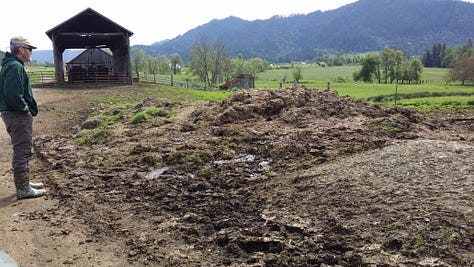
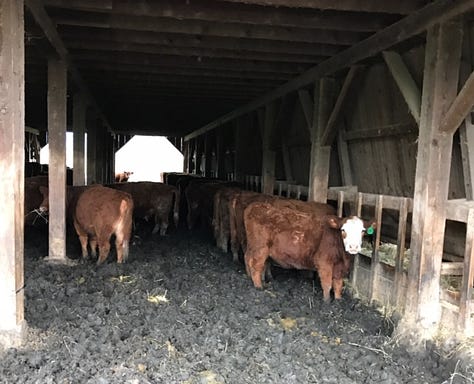
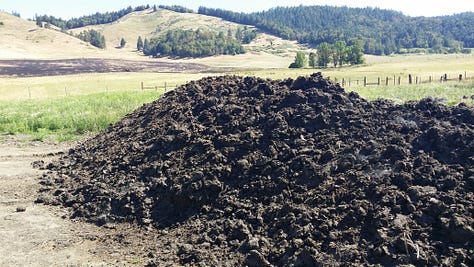
By adding biochar before the cattle came in for the winter, we captured 4.5 times more nitrogen than mixing the biochar in the manure after cleaning it out of the barn. Compared to not using biochar at all, biochar in the barn held 8 times more nitrogen.
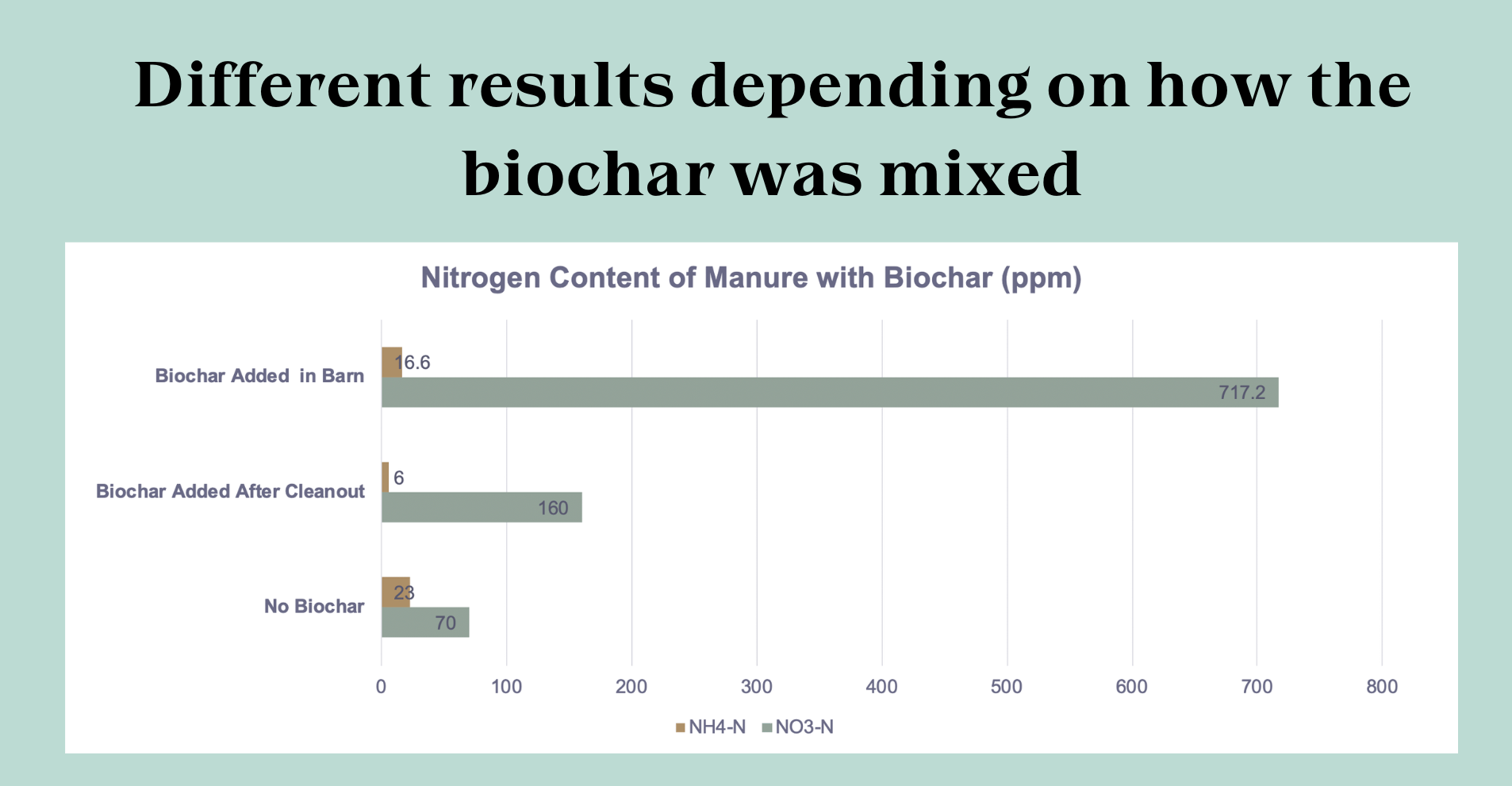
Most of the nitrogen was in the form of nitrate, that does not volatilize like ammonia does. Nitrate is more vulnerable to leaching into groundwater, but the biochar holds on to it, producing a stable, slow-release fertilizer that prevents pollution and waste.
Before starting this experiment, we asked the rancher about his goals. He wanted more manure for his pasture not just for the nitrogen, but also for phosphorous, organic matter, and the microbes in it. He had been purchasing chicken manure to supplement what he could scrape out of the barn. Interestingly, the chicken manure he bought had urea added to it. My mind boggled at this. Adding urea to chicken manure? In my limited experience of chicken coops, there is no shortage of nitrogen. You can smell it as ammonia. However, that ammonia smell is also the smell of nitrogen being lost.
The reason for adding urea to chicken manure was to balance out the phosphorous content to make a complete fertilizer. If a farmer adds enough commercial chicken manure to meet nitrogen needs, he is over-applying phosphorous that then leaches into waterways. But the original poo as it came out of the bird had plenty of nitrogen. It was mis-management in the poultry barn that wasted the nitrogen.
We can no longer afford to waste our “waste.” If poultry farms in the Chesapeake Bay would start using biochar in the barns, it would not only preserve nitrogen and save the Bay, it would improve the barn environment and keep the birds healthier, reduce mortality (up to 10% in badly managed barns) and save farmers money.
Poor manure management is our own “choke point” for distributing needed fertilizer to our farms. No foreign country is blockading our ability to unlock the flow of life-giving manure to soils that are hungry for it.
Manure that is stabilized with biochar can be loaded onto trains and trucks and sent to where it is needed. The manure inequality problem is solvable. We only need to negotiate with the US government to make the small changes in regulations and incentive structures that will promote biochar production and use in manure management.
Once we solve the animal manure problem, we can move on to better ways of utilizing human waste or “humanure.” I will share some ideas about that next week.
Please, if you want to learn more about practical biochar tips and tricks for growing your own food, or you are interested in stewardship biochar for restoring natural ecosystems and biodiversity, check out some of my links below:
The Biochar Handbook at Amazon.com
The Biochar Handbook at Bookshop.org
Purchase Kelpie’s Practical Biochar Course
Order your Ring of Fire Biochar Kiln®: RingofFire.earth
Check out my YouTube channel: www.youtube.com/@KelpieWilson
Biochar On Site network for practitioners of stewardship biochar
No posts
Comments
Nothing yet. Say the first thing.
Sign in to join the conversation.