
In the day-to-day coordination of a construction project, accurate data is your most valuable asset. If a structural engineer misclassifies a load-bearing column, or an architect provides inaccurate dimensional data in a Building Information Model (BIM), the consequences are immediate and costly. Clashes go undetected, material takeoffs are skewed, and the financial blowback hits the project’s bottom line. In a collaborative BIM environment, every stakeholder has a massive, built-in incentive to get the data right.
But what happens when governments and municipalities use those same BIM models for automated building permit checking?
The incentive structure completely flips. Suddenly, bad data isn’t a costly coordination mistake; it becomes a convenient loophole.
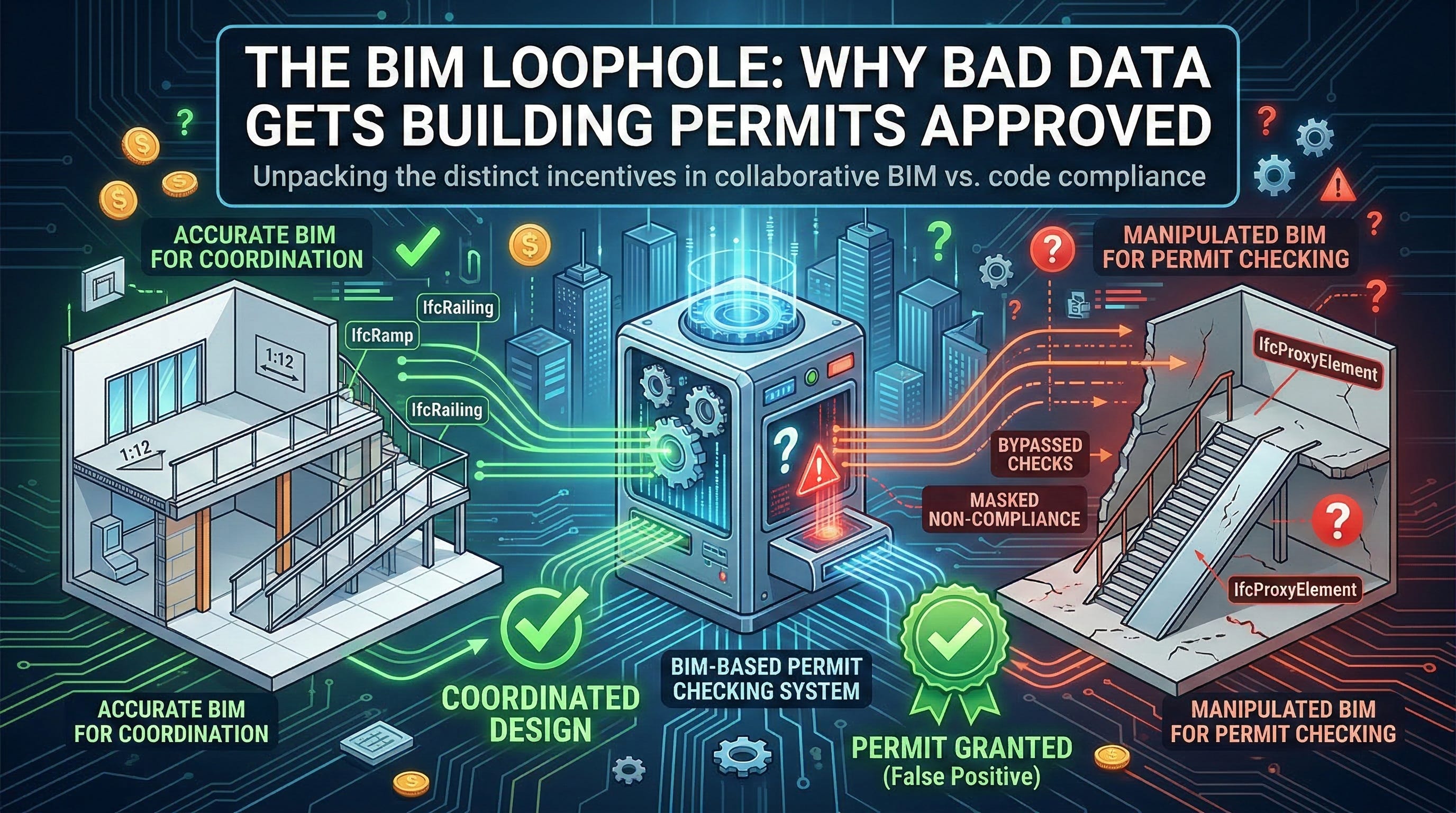
The core flaw in traditional automated permit checking is that the software is entirely blind to the physical reality of the building. It only “sees” the semantic labels, classes, and properties (manually) attached to the objects in the IFC dataset.
When a municipality links a permit approval to these specific labels or classifications, they are no longer checking the building’s physical safety: they are checking the modeller’s data entry. Because the ambition for the applicant is to get the permit approved as quickly as possible, the system inadvertently skips over incorrect modelling, bypassing strict rules.
This semantic reliance creates a massive vulnerability across almost every type of building code check:
The classic Ramp bypass (Entity-based checks): A standard rule checks objects classified as
IfcRampto ensure the slope isn’t too steep. However, if a modeller accidentally classifies that same ramp as a genericIfcProxyElement, the system assumes there is no ramp to test. The software simply skips the rule and issues a green “passed” checkmark for the building.The invisible fall hazard (simulation checks): Building codes dictate that any height difference of more than 1 meter (for example) must have a safety barrier or wall of at least 90cm (for example). In a traditional setup, the system looks for an
IfcRailingobject to verify the height. But if a dangerous drop exists in the physical geometry and the railing simply isn’t modeled or classified, traditional rule-checking cannot detect the hazard, requiring an integrated simulation approach to catch it instead.The escape route illusion (semantic relations): To automatically analyse a fire escape route (for example), the checking software fundamentally needs to know what a door is. If a modeller incorrectly classifies a vital exit door as a window, the entire escape route analysis breaks down, potentially validating an unsafe design. Simulations are had to integrate in BIM regardless. Asking this from modellers is shifting the workload and the risk.
The property padding problem (property-based checks): To check if a parking garage has the right ratio of accessible wheelchair spots, the system forces the industry to add highly specific custom properties to
IfcSpaceobjects. Data they would not normally add to their models in that phase of the process. If a user simply types a passing value into that property field, it can lead to a false positive result, even if the physical geometry of the parking spot is completely inaccessible.
The overarching problem is crystal clear: the lack of perfectly structured, manually entered information often results in safety checks simply not being executed. This issue is broader and even goes beyond permit checks: only a perfect BIM can be used for energy simulation, cost estimation, etc. This is a topic for another post.
When a skipped permit check defaults to a granted permit, we are dealing with risky false positives. By continuing to pile on more manual information requirements, the industry is trading actual building safety for a false sense of security.
For the designers and developers applying for permits, automated checking is supposed to be a time-saver. However, any automation in this process has a great upside, but only when the required input for automation doesn’t bring more work.
Currently, the industry practice is to define more requirements for every use case. A typical simple project already accounts for multiple pages of Excel rows with information requirements on properties and objects. At some point, the manual work of adding information to an IFC file can outweigh the gains of the automated permit check.
This creates a perverse business incentive. If adding endless, unstandardised properties costs billable hours, and misclassifying an object bypasses a strict regulatory check and gets the permit approved faster, the financial incentive leans heavily toward poor data quality. It seems that the regulatory responsibility (an applicants often stays responsible for the safety of the building even when a permit is given) seems the only reason this is not a problem in practise at the moment.
For municipalities, digital permit checking is particularly beneficial, as safety and legal compliance are paramount. However, the risks associated with false positives and negatives in digital permit checking are multifaceted and significant. Approving a building that violates fire codes or accessibility standards because of a misclassified IfcProxyElement opens the municipality, or the tool provider, up to severe safety risks and legal liabilities.
Furthermore, smaller municipalities with less human resources and access to the right software and hardware are particularly vulnerable. A concern of those smaller municipalities was that 3D tools are too expensive. They can achieve great benefits from the implementation of automatic checks as it would save time and resources for them. But if those automated checks are easily bypassed by bad applicant data, these municipalities are taking on massive hidden risks without the resources to manually catch the errors.
For the software vendors building these compliance tools, there is a wake-up call happening. Observing a trend where more specifications are being made that ask for more data in the IFC file, the sense of security is falsely increasing. It becomes overwhelmingly clear that the movement towards adding more and more information requirements is inefficient and error prone. This creates a false sense of completeness that is unrealistic and may lead to an unjustified feeling of security.
Technology providers building their entire business model on semantic rule-checking are standing on a fragile foundation if they assume the data fed into their systems will be honest and accurate.
When faced with this “false positive” loophole, the knee-jerk reaction from checking authorities is often to simply mandate stricter modelling guidelines. Massive Excel sheets demanding that architects and engineers input highly specific, standardised properties for every single object. Alternatively they could focus on the fact that applicants always stay responsible for safety.
Forcing the industry to build hyper-specific models just to satisfy a permit-checking machine completely defeats the purpose of automation. Providing automation that provides no value for the applicant when they keep responsible and have no access to the ‘black box’ also does not provide added value. Any automation in this process only provides a real upside when the required input doesn’t generate more work for the creators, and when the outcome is reliable. If we just shift the administrative burden onto the designers, the total time to get a permit doesn’t shrink; the industry simply ends up doing more manual, un-billable work so the government can process checks faster. Furthermore, adding too many extra modelling requirements actively damages support and adoption among the applicants submitting the models.
We cannot solve a technology problem by putting a heavier administrative burden on the AEC industry. Instead, the technology itself must evolve.
The future of digital permit checking lies in smarter systems that can deal with any typical BIM or GIS dataset (in an open format) without demanding perfection in manual data entry. We need to shift toward algorithm-based checking, which is inherently more reliable and carries far fewer prerequisites for the submitted BIM models.
Instead of relying on fragile text labels and classifications, algorithmic checks analyse the raw physical geometry of the model. Some examples that are already available and used today at some governments:
Voxelisation and connectivity graphs: By converting the 3D model into spatial grids (voxels) or analysing the physical connections between spaces, algorithms can independently figure out if a surface is a ramp, if a barrier is tall enough, or if an escape route is valid.
Eliminating manual dependency: By letting the software interpret the geometry, we remove the dangerous dependency on manually entered values that cause the “false positive” trap in the first place.
Governments should keep extra requirements for BIM designs as limited as possible. The ultimate goal isn’t to force architects to become data-entry clerks for the municipality. By adopting smarter, algorithm-driven checking systems, authorities can extract the answers they need directly from the geometry.
This creates a true win-win: governments get the fast, highly reliable compliance checks they need to ensure public safety, and the industry gets faster permit approvals without having to drastically change how they model.
Enjoyed this deep dive? Building better systems starts with better insights. If you found this breakdown of the BIM compliance loophole valuable, please forward it to a colleague or your BIM coordination team.
If this email was forwarded to you, make sure to subscribe so you never miss a post of BIM Business.
Comments
Nothing yet. Say the first thing.
Sign in to join the conversation.