
For decades, the AEC industry has been obsessed with the “I” in BIM. We’ve built massive databases, refined IFC schemas, and argued over Level of Development (LOD) until our eyes bled. But here’s the cold truth: even the most detailed Building Information Model is still just a static map. It is a “dead” environment that requires additional actions to read it, query it, and decide what to do next. We’ve spent twenty years learning complex UIs, filtering layers, and writing SQL queries just to make our spatial data speak.
Google DeepMind’s latest breakthrough, SIMA 2 (Scalable Instructable Multiworld Agent), could change that.
SIMA 2 isn’t just another AI model; it’s a generalist agent that can reason, act, and learn within 3D virtual worlds. By integrating the reasoning power of AI, it moves beyond following simple instructions to actually “understanding” the goals within a 3D space. For those of us in BIM and GIS, this marks a fundamental shift from managing databases to managing autonomous spatial experts.
The most immediate impact will be the evolution of the Digital Twin. Currently, these are often little more than sophisticated dashboards: they show you a sensor is failing, but they don’t do anything about it. With SIMA 2, we can transition to actionable insights. Imagine “dropping” a reasoning agent into a BIM model of a high-tech hospital or factory. Instead of a human checking for maintenance clearances, the agent navigates the virtual space, identifies the tools needed, and simulates the entire repair process. It catches logistical conflicts like a temporary scaffold blocking an emergency exit, before a single wrench is turned on-site.
This intelligence extends into the macro-scale of GIS. While traditional GIS handles static layers like roads and zoning, a reasoning agent can transform urban planning into a dynamic laboratory. We could simulate how thousands of “intelligent” pedestrians would actually navigate a new city layout during an emergency evacuation, accounting for panic and obstacles with human-centric reasoning rather than just sterile path-finding algorithms.
As these agents become part of our workflow, the way we interact with spatial data will shift toward natural language and intent. The era of hunting through an MEP model is ending.
Soon, a facility manager might simply tell an agent: “Find the quickest path to shut off the water in Sector 4 and show me if any equipment is blocking the way.” In urban planning, a user could ask the system to play through a 5-year growth plan, ensuring all residents remain within a 10-minute walk of a park.
The agent doesn’t just calculate a result; it iterates through configurations until it finds the one that actually works. This can all be done without complex predetermined simulation tools.
SIMA 2 offers a solution to the “data rot” that plagues our industry. BIM data is notorious for logical errors; pipes that lead nowhere or doors that open into structural columns. Traditional clash detection catches physical overlaps, but it’s a lot worse at catching spatial nonsense. Because SIMA 2 “plays” the world, it acts as an autonomous auditor. If you task an agent to walk every accessible path and it gets stuck, it flags a reasoning error. This solves the Permit checking issues we talked about last week. It finds the problems that scripts miss because it interacts with the model like a human would. You don’t have to predetermine what could go wrong and test for the correct measures; the agent will probably find issues that nobody even thought about upfront.
In a BIM context, a SIMA 2-style agent could be deployed to “live” within a digital twin, where it independently identifies and solves spatial or operational failures through iterative trial-and-error. For instance, an agent tasked with optimising facility maintenance could spend thousands of simulated hours navigating a complex hospital model, learning to identify the most efficient routes for equipment repair or emergency response without needing a human to hard-code every possible scenario. By generating its own experience data and receiving feedback on its “success” in these virtual walkthroughs, the agent essentially becomes an autonomous auditor that constantly learns and refines the building’s logic. It flags design flaws, like an inaccessible valve or a poorly placed structural column, that traditional static scripts would never have the reasoning capacity to detect.
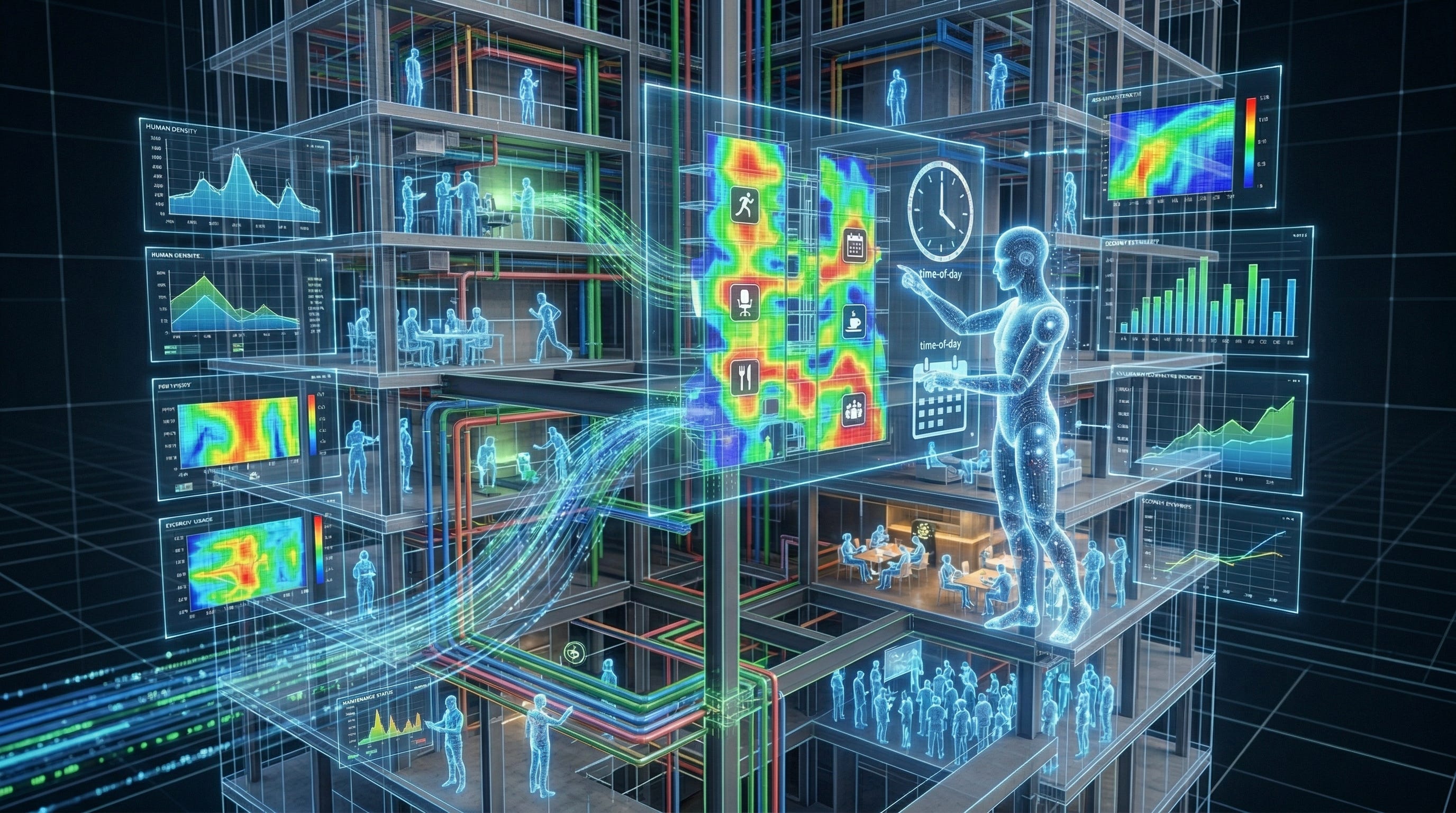
This same “trial and error” logic will revolutionise generative design. Rather than just optimising for maximum floor area or solar gain, an agent can “live” in a virtual apartment and provide feedback: “The kitchen layout makes it difficult to reach the pantry while cooking.” We move from optimising for math to optimising for living.
The era of the “passive blob” is ending. We are entering the era of the “spatial teammate.” In this new world, our job isn’t just to model geometry and properties; it’s to build the environments where intelligent agents can solve problems before they ever manifest in the physical world. The BIM is no longer just a reference; it is a training ground for the future of work.
Comments
Nothing yet. Say the first thing.
Sign in to join the conversation.