
By guest author Pim van Meer Redert
Imagine we know with 100% certainty that the world is ending. We have to go to Mars. It sounds like a sci-fi prompt, but it’s actually the ultimate stress test for the construction industry. Mars is the final boss of Lean Construction.
On Earth, we talk about efficiency. On Mars, inefficiency is a death sentence.
For those of us in the BIM and digital construction business, this analogy uncovers a harsh truth: we have the data, the tools, and the models to build perfectly, yet we rarely do. Here is what happens when we apply “Mars Logic” directly to our business models on Earth.
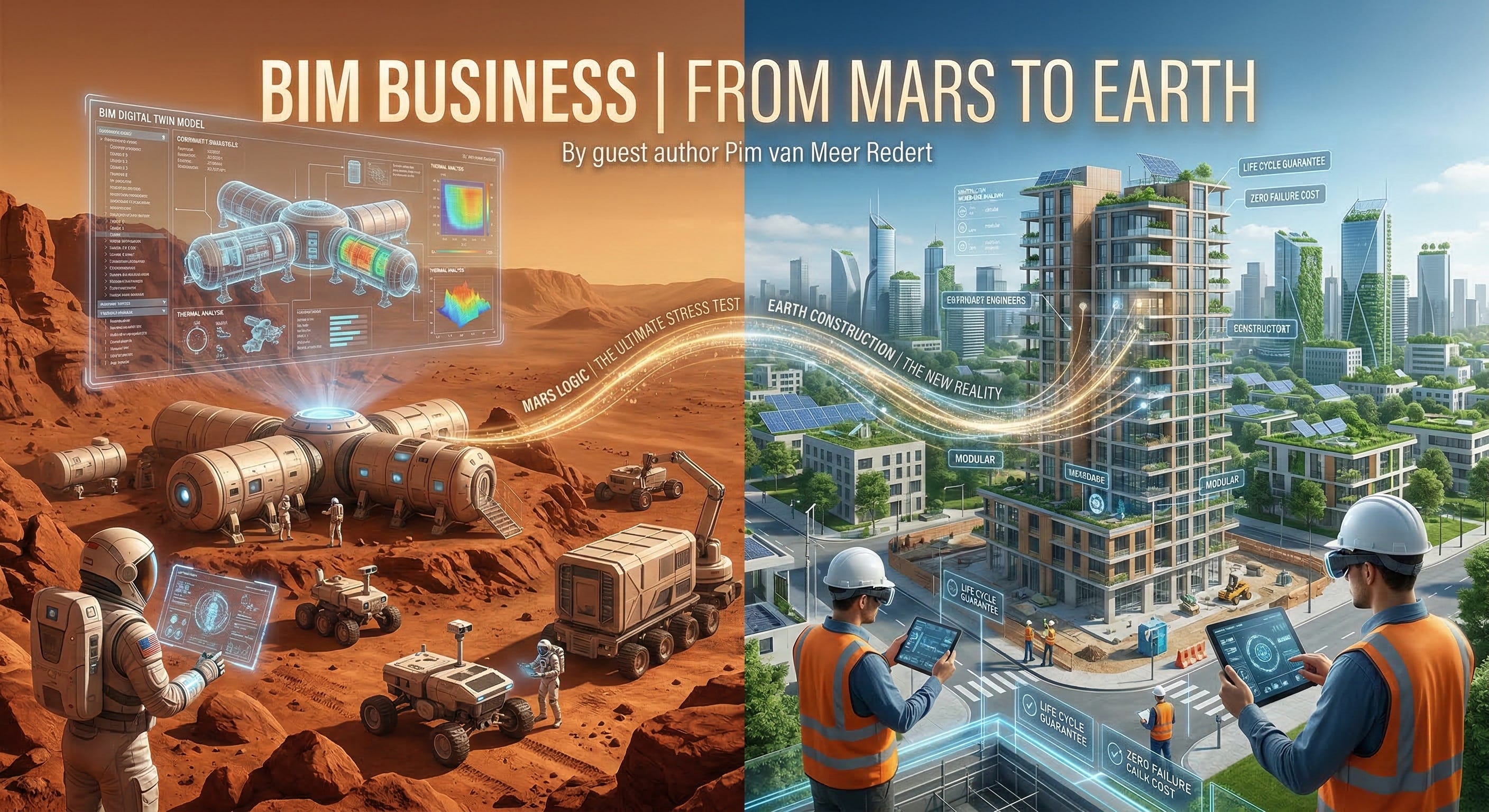
On Mars, there is no margin for waste. You don’t get to “try again.” There is only one design question: How do we build so people survive, using minimal resources for maximum lifespan?
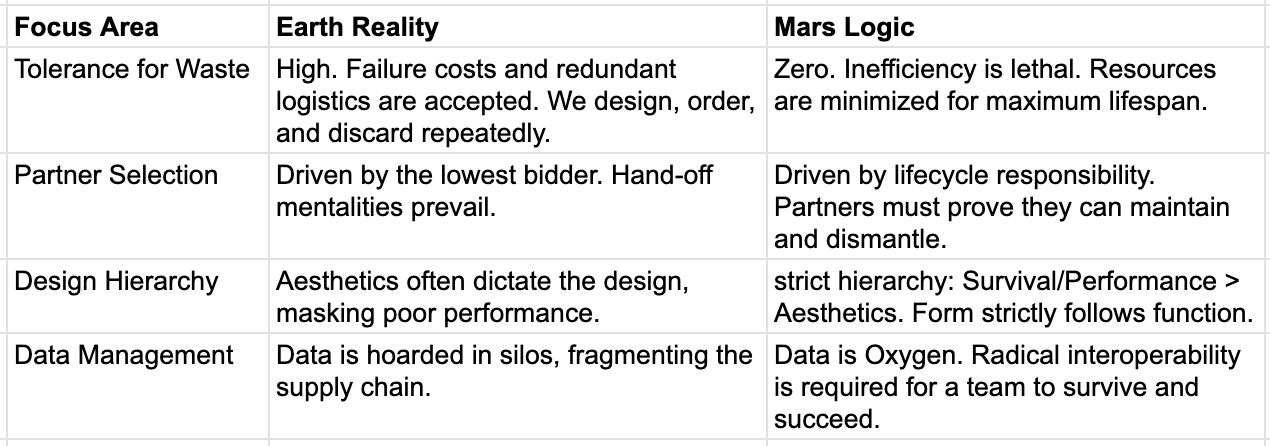
The Business Shift: On Earth, we accept failure costs and redundant logistics as if they are laws of physics. We draw things three times, order them twice, and throw them away at least once. Mars pulls the plug on that behaviour.
BIM Implication: In a Mars-gated economy, your BIM model isn’t just a visualisation; it’s a survival simulation. Every object in the model must have a justified “kilo-cost.” If your digital twin doesn’t perfectly predict logistics, you don’t launch.
If we were leaving for Mars tomorrow, who would get a ticket? You wouldn’t send the lowest bidder. You would send the partners who take responsibility for the full lifecycle.
You only send parties who can prove they will maintain, adapt, and dismantle what they build. You only ship modular concepts that are inspectable and repairable. The ones that know they can deliver and not only talk about it.
The Business Shift: Currently, we treat homes as “final products.” If something breaks, we call it a “management challenge” rather than a design error.
BIM Implication: This moves BIM from a Design/Build tool to an Operations/Asset Management asset. The business model shifts from selling a building to guaranteed performance. You don’t get the contract unless your metadata proves the facility is circular, modular, and virtually error-free before a single brick is laid. Brick ;-)
On Mars, heat loss isn’t a discussion about energy labels; it’s a probability of death. You build airtight and thermal-bridge-free because you have to.
Here on earth, we prioritise aesthetics. “It has to look like the 1930s, or it won’t sell.” On Mars, the hierarchy is strict: Program > Health > Energy > Maintenance > Flexibility > Aesthetics.
The Business Shift: Aesthetics can no longer be an excuse to hide poor performance or a program that almost fits.
BIM Implication: Aesthetics is a plus. The value lies in the parametric data governing energy and health. A “Mars-ready” BIM business sells the simulation results first, and the renderings second. And of course it will be beautiful!
This article argues that Mars forces us to be “socially mature”: if one person ignores the air filters, everyone suffocates. Living is a team sport.
The Commercial Reality: To build efficiently on Earth (or Mars), we must stop hoarding data. A fragmented supply chain cannot survive in a high-stakes environment.
The Opportunity: The businesses that will thrive in the next decade are those that treat Data Interoperability as a survival mechanism. If your software locks data in a silo, you are a liability to the mission.
The Service Model: Future profitability lies in Predictive Construction. Just as a Mars habitat must predict oxygen levels, BIM businesses must pivot to predicting program, cash flow, maintenance cycles, and carbon impact with 100% accuracy. The “Mars Standard” requires us to verify performance before construction.
We already have the knowledge. We know how to isolate better, create material passports, build demountable structures, and use water intelligently. The question isn’t whether we can.
The question is: When will we demand “Mars Logic” for our projects on Earth?
The companies that adopt this mindset now (treating every project as if resources are finite and failure is not an option) will own the future of the construction industry.
If you're ready to treat data as your oxygen and apply 'Mars Logic' to your daily operations, you belong with us. Subscribe to the BIM Business newsletter for ongoing strategies, sharp industry insights, and the digital blueprints you need to build flawlessly. Subscribe today, and let us know in the comments: what is the biggest 'Earth inefficiency' your team needs to leave behind?"
Comments
Nothing yet. Say the first thing.
Sign in to join the conversation.