

Call it the Lone Star State swap.
Oil and gas titans once deeply skeptical of renewable energy and technology giants once determined to move away from fossil fuels have effectively traded places.
ExxonMobil, Chevron and dozens of smaller drillers have been racing to electrify the extraction and pipeline operations, including going out of their way to thwart a move in the legislature aimed at hobbling the state’s renewable energy industry.
Meanwhile, tech giants, including Alphabet Inc.’s Google, Meta Platforms, Microsoft Corp and OpenAI, are rushing to adopt natural gas as their go-to fuel for the massive data centers needed to win the artificial intelligence race.
For over a decade now, I’ve watched the Texas energy story play out along two very separate, competing tracks.
The oil and gas industry flourished by drilling wells in a cascade of innovative new ways. It has pulled fossil fuels from reservoirs previously considered unreachable. As the saying goes, never doubt the ingenuity of a Texas oilman.
But the state’s renewable energy industry has proven no less resourceful. First, fleets of wind turbines sprung up across the state’s blustery expanses — an effort driven by Republican governors George W. Bush and Rick Perry and a Republican legislature, by the way. Next came giant solar arrays to leverage the state’s bountiful sunshine.
Solar is still growing fast, but these days, batteries are proliferating alongside to store low-cost renewable power for use when the sun isn’t shining and wind isn’t blowing.
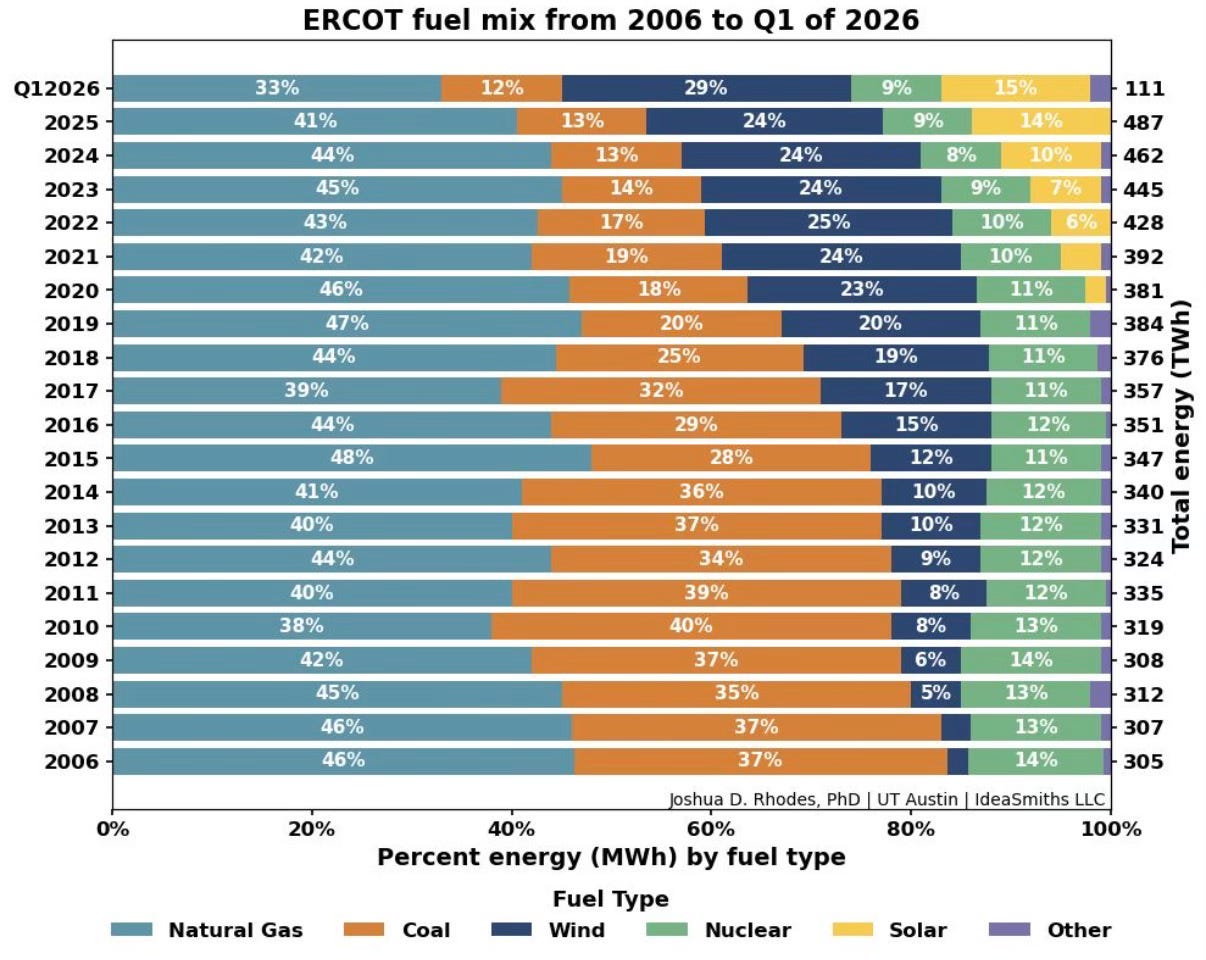
Last year, renewables and battery storage met more than 90% of the new electricity demand added to the state’s grid. Through this year’s first quarter, solar and wind provided 44% of the state’s overall electricity, compared to 45% for coal and gas.
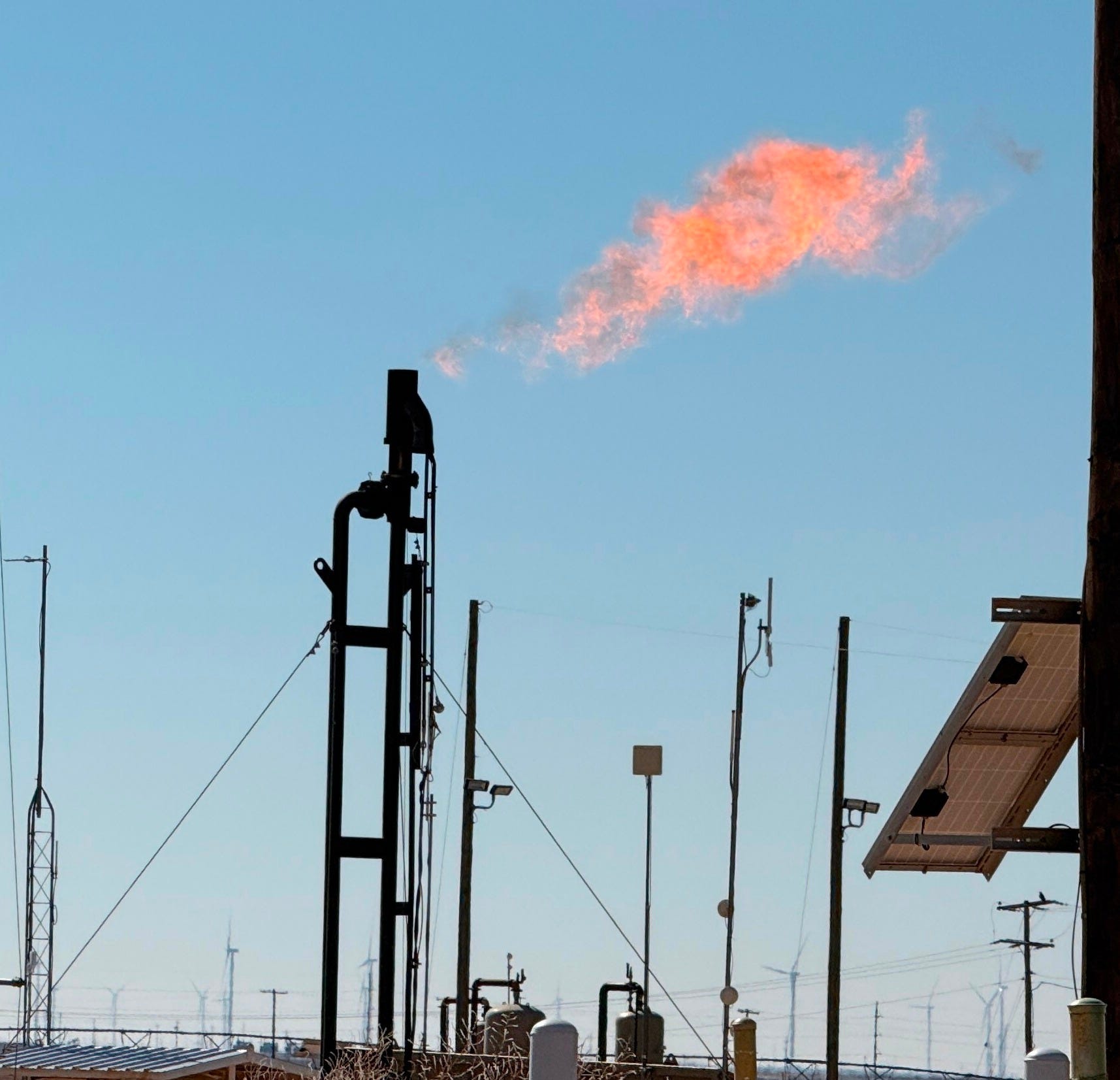
To drive through West Texas today — as I’ve done twice this year so far — is to navigate vistas pocked equally by oil derricks and wind turbines, gas flares and solar farms. All visible all at once in some panoramas — oil pumps nodding, fracking rigs rising, wind turbines spinning, solar panels splayed out glinting in the hot Texas sun.
For hard-core clean energy advocates and fossil fuel stalwarts, these two industries may seem to be locked in existential competition. That may be true over the long haul. But these days, as energy demand in the state skyrockets, the two industries can just as easily be caught cooperating.
“Hey, American Energy Dominance. ‘We got your back,’” a big solar panel manufacturer in the state proclaims on its web site, alongside a map of the Permian Basin, one of the biggest fonts of fossil fuels on the planet.
The company, T1 Solar, notes that 88% of electricity flowing into the state grid from that part of Texas comes from renewables. Drilling firms that tap into this grid save $1 per barrel of oil equivalent, it adds. That’s huge when you consider the Permian produced 11.5 million barrels of oil equivalent per day last year.
Even more eyebrow-raising, the fossil fuel industry rode to the rescue of renewables last year when anti-renewable politicians tried to hamstring wind and solar generation. The state’s powerful oil and gas lobby flexed its political muscle to make sure that didn’t happen.
Why? They need more electricity.
Renewables are where new electricity mostly comes from in Texas these days.
At least in Texas, at least for now, the renewable and fossil fuel industries have become “frenemies,” competing for market share but also cooperating to keep the energy coming. The catalyst is the new gunslinger in town: the tech industry, with its desperate need for electricity now but desire to stay clean over time.
This shift from competition to “coopetition” is a sure sign we’ve crossed into a messy middle stage of the energy transition, one scrambled and accelerated further by war in the Persian Gulf. Wind, solar and batteries are transforming systems long dominated by fossil fuels, which are responding by reshaping the system further.
Oil and gas companies are obviously not giving up on fossil fuels. Quite the opposite. They see solar, wind and batteries as useful to cut their operating costs, allowing them to produce even more oil and gas with fewer greenhouse gas emissions per barrel. This makes their oil and gas more palatable to overseas buyers.
Technology giants, for their part, have not renounced oft-stated commitments to decarbonize, even as their greenhouse gas emissions climb steadily higher. They argue combusting natural gas is unavoidable right now in order to develop artificial intelligence that will eventually help solve the world’s climate challenge.
But their separate paths have brought them together, at least for now.
The oil and gas industry’s shifting attitude toward renewables in Texas flows directly from its own success. Starting a decade ago, the new ways drilling and extracting oil and gas revived a long-moribund U.S. fossil fuel industry. U.S. production, which had been declining for decades, reversed and soared to record levels.
So much so it opened the door to exporting oil and gas for the first time in almost a century. Oil began shipping into global markets when the Obama administration signed off on exports in 2015.
Natural gas required more than government approval to reach overseas buyers. Huge plants were built to chill and pressurize the gas into a transportable form — liquified natural gas, or LNG — that special, bulbous tankers could deliver to overseas.
Global oil and gas markets, however, are brutally competitive. Middle East oil kingdoms, especially, enjoy production costs far lower than U.S. producers. Meanwhile, some buyers — particularly in the European Union — have become increasingly concerned about greenhouse gasses emitted during the extraction, transport and processing of these fossil fuels, especially LNG.
For decades, the oil and gas industry deployed diesel engines to power the hydraulic drills, pumps, compressors and separators used to carry out that extraction, push the product through pipelines and perform that processing.
About a decade ago, U.S. oil and gas companies began switching from diesel to electricity to power their own operations. This has been especially true in West Texas, the heart of America’s oil patch and a major repository of natural gas.
“We’re trying to electrify all of our equipment,” ConocoPhillips CEO Ryan Lance told a group of industry executives last year.
To meet its own carbon emissions reduction targets, the U.S. industry needs to switch 90% of its energy use over to electricity, according to one study.
The shift, which has now begun to get real traction, implies electricity demand from oil and gas companies in West Texas will increase four-fold to 17.2 gigawatts from 4.2 gigawatts in the decade from 2022 to 2032, concluded a study that six oil and gas companies commissioned from consultant S&P Global.
Oil and gas service providers Halliburton and SLB (formerly Schlumberger), which provide and operate equipment for drilling and extraction, have made electrifying the industry a mainstay of their offerings to oil and gas companies.
Awash in oil and natural gas, the challenge, ironically, has been finding electricity.
Some companies, such as Occidental Petroleum Corp., Chevron and ExxonMobil, have built their own renewable energy, usually solar arrays along with batteries. But they and others mostly have relied upon generators running on trucked-in diesel fuel or the natural gas that co-exists with oil deposits and rises up alongside the oil.
Historically — and even today — natural gas largely has gone to waste in the Permian Basin, where it accompanies oil below ground and comes to the surface whether it’s wanted or not. Mostly not, which is why Permian gas is often burned off — a practice called controlled flaring — or even vented directly into the atmosphere, where it acts as an especially pernicious greenhouse gas.
But the technology industry has emerged as a buyer of the cheap gas.
At first, this meant the occasional cryptocurrency mining operation, which deploy cheap electricity to power computers that create bitcoin. A corporate upstart, Crusoe, even dedicated itself to building electricity generation plants to snap up the region’s gas to provide electricity to bitcoin miners flocking to the state.
Soon, however, another class of technology companies arrived with an even larger appetite for electricity: the massive technology companies whose breakthroughs with artificial intelligence were stoking a race that could be largely decided by which company can get its hands on energy fastest.
It was a fortuitous convergence, one that would quickly snowball into a stampede of data centers in to the state, many of them looking not to choose between West Texas’ smorgasbord of energy options, but rather to combine them.
In the next post, we’ll look at what that means for energy in Texas and beyond.

Comments
Nothing yet. Say the first thing.
Sign in to join the conversation.