
Last week, I participated in the opening fireside chat at the Vanderbilt School of Engineering’s 20th Annual Healthcare Design + Construction Symposium. The event was held at Vanderbilt’s new Chelsea campus in Manhattan, which will welcome its first students this fall. Built in 1817, the historic building and grounds were previously home to an Episcopal seminary, and now Vanderbilt will continue this site’s history as a place for living, learning and connecting to New York City’s unbounded opportunities in finance, media, technology, healthcare, the arts, and beyond.
I sat down for an in-depth, wide-ranging conversation with the CEO of Penn Health, Dr. Kevin Mahoney. While not an exact transcript of our discussion, below are my responses to Dr. Mahoney’s thoughtful questions on reimagining health and healthcare in an era of financial constraint, and in a changing climate.
Thanks for reading A Second Opinion! Subscribe for free to receive new posts and support my work.
The consistent through-line of my remarks: Sustainability is not separate from healthcare. The world around us shapes the health and wellbeing within us.

Senator Frist and Dr. Kevin Mahoney, CEO of Penn Health, kick off Vanderbilt’s 20th Annual Healthcare Design + Construction Symposium at the University’s brand new Manhattan campus.
Fireside Chat: Value Matters: Reimagining Healthcare in an Era of Financial Constraint | July 29, 2026
Dr. Mahoney: You’ve spent your life caring for human health, first as a surgeon, then as a legislator, and now you chair the global board of the Nature Conservancy. What convinced you that caring for the planet and caring for people are the same work?
Senator Frist:
• For me, that understanding began in the operating room. As a heart and lung transplant surgeon, I saw that disease rarely begins when a patient reaches the hospital. It begins much farther upstream, in the air people breathe, the water they drink, the food they eat, the heat they endure, and the communities where they live.
• Lung transplantation also taught me that nature is not simply scenery. Cyclosporine, the drug that made successful lung transplantation possible, came from a fungus discovered in soil. Nature literally made that medical breakthrough possible.
• Over time, I came to understand that the world around us shapes the health and wellbeing within us. Clean air and water, healthy soil, stable ecosystems, and access to nature are not separate from medicine. They are part of the foundation of human health.
• That is why I see caring for people and caring for the natural world as the same work. Both are ultimately about protecting life.
The healthcare sector accounts for roughly 8.5 percent of U.S. emissions, and hospitals are among the most energy-intensive buildings we operate. As co-chair of the National Academy of Medicine’s Climate Collaborative, how do you persuade the sector to confront its own footprint? And does a program like the Joint Commission’s sustainability certification actually move the field, or are early adopters still leading the way?
• I begin with the healthcare mission: first, do no harm. Climate change is a health issue first and foremost. If our operations contribute to pollution, extreme heat, or other conditions that make people sick, then addressing our own environmental impact is part of our responsibility to patients.
• As you mentioned, the health sector accounts for approximately 8.5 percent of U.S. greenhouse gas emissions. That gives us both a responsibility and an opportunity to lead by example.
• This is about resilience as much as sustainability, and there is a compelling business case. Investments that reduce emissions can strengthen health system resilience, improve operational efficiency, lower costs over time, and better prepare hospitals for extreme weather and supply chain disruptions.
• Leaders should ask a practical question: How are energy use and climate-related risks affecting our patients, workforce, facilities, supply chain, and bottom line? When we look carefully at the numbers, the budgetary impact of a changing environment on healthcare is larger than many leaders expect.
• Many of the largest opportunities, especially in supply chains, infrastructure, and care delivery, extend beyond the walls of any single hospital. Progress at scale therefore requires collaboration across the entire health ecosystem.
• That is why the National Academy of Medicine launched its Climate Collaborative, a public-private partnership of more than 60 organizations and more than 80 health-sector leaders. It is deliberately a big tent, through both the Collaborative and the broader Accelerating the National Climate and Health Movement initiative.
• The Collaborative brings together health systems, clinicians, industry, suppliers, researchers, policymakers, accreditors, and others to develop shared approaches that no one organization could build alone.
• The emphasis is on measurable, evidence-based actions that organizations can implement today, wherever they are in their sustainability journey and at any level of maturity. Through the NAM Climate and Health Movement, any health-related organization can join the work.
• Healthcare has always advanced through collaboration. Patient safety, quality improvement, and infection prevention became standard through shared learning. Climate resilience and sustainability should follow the same model.
• I want to commend Dr. Victor Dzau, the outgoing president of the NAM, for bringing health systems together around climate solutions that benefit patient health and the long-term sustainability of American healthcare.
• On certification, both early adopters and common standards are essential. Early adopters show what is possible and develop new approaches. Standards and certification spread those practices across the field.
• The Joint Commission’s healthcare sustainability certification translates commitment into action by establishing consistent expectations, accountability, and a framework for continuous improvement. More than 250 hospital sites have achieved certification, which demonstrates growing interest across the sector.
• My longtime friend Dr. Jon Perlin, who leads the Joint Commission, described the certification as an organizing principle that helps a health system get started and unifies the organization around reducing its carbon footprint.
In the current environment in Washington, I know some organizations may not want to be publicly out front, but their clinical staff and younger employees increasingly expect a visible commitment to environmental stewardship. Certification demonstrates that commitment.
• Sustainability is increasingly being recognized as part of operational excellence, risk management, and long-term strategy, not simply as an environmental initiative.
• Practice Greenhealth’s 2026 Environmental Excellence Awards show the same momentum. A record 430 organizations submitted sustainability data representing more than 700 healthcare facilities in the United States and Canada. Those 430 organizations received 538 awards across 11 areas of sustainability, the largest awards cycle in the program’s history.
• All of these mechanisms matter. Early adopters innovate. Certification establishes common standards and accountability. Recognition highlights success. Peer learning accelerates adoption across the sector.
Throughout your career, you’ve brought people together to solve problems that improve human health. How do the people in this room make that case to their own leadership, especially the ROI case for investing in green buildings and infrastructure?
• Do not begin with an abstract climate argument. Begin with the institution’s own data and with the problems its leaders already own.
• At Select Medical, I saw how board-level visibility changed quality from an aspiration into a management discipline. We put quality and patient safety before the board, used color-coded dashboards to connect performance at individual facilities with the enterprise view, and created a Collaborative Skin Integrity Committee after the data exposed wound-care problems. Over time, measurement led to management, and management helped change the culture. Rehabilitation patient satisfaction rose from roughly 85 percent to 95 percent.
• The lesson for sustainability is the same. Give it board-level visibility. Measure it consistently. Assign responsibility. Connect each investment to clinical operations and enterprise performance.
• Translate the proposal into the language leadership uses: avoided energy and water costs, lower maintenance expense, reduced exposure to utility-price volatility, fewer disruptions, better staff retention, healthier indoor environments, and protected continuity of care.
• Use total cost of ownership, not initial construction cost alone. A cheaper building that is expensive to operate, fragile during extreme weather, or unhealthy for the people inside it is not truly lower cost.
• The ROI case is straightforward: well-designed sustainability investments can reduce operating expenses, protect capital assets, strengthen continuity of care, and create healthier conditions for patients and employees.
• Start with one project whose results can be measured. Report the health, operational, and financial outcomes together. A successful first project makes the next decision easier.
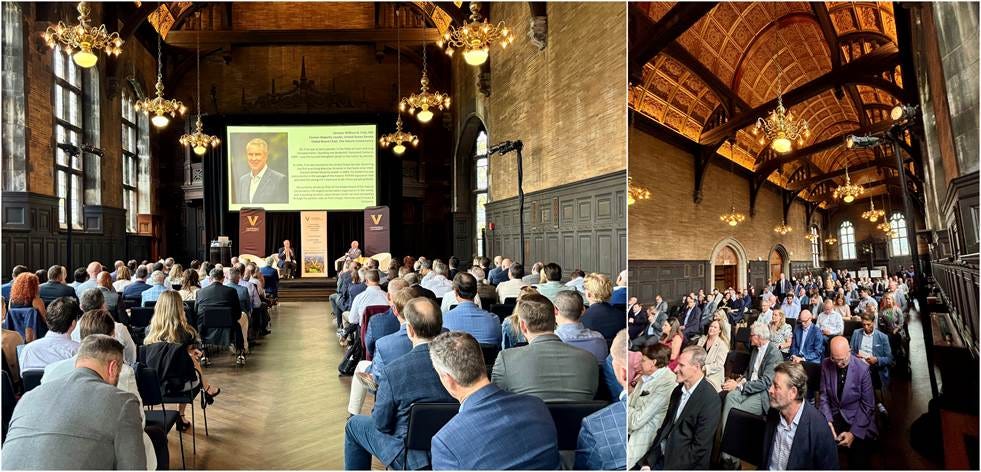
Senator Frist shares his insights on how sustainable design is central to healthcare’s mission, in conversation with Dr. Kevin Mahoney.
Often, conversations around climate can break down along political lines. But there is a lot of progress happening at the city and state level, where it’s less about ideology and more about concrete steps that improve people’s lives. You’ve seen this up close, from tree planting like Green Heart Louisville to how a city like Phoenix is handling extreme heat. Why do you think that local, on-the-ground work goes further than the gridlock we keep hitting nationally?
• At the local level, leaders cannot treat extreme heat, flooding, dirty air, or failing infrastructure as an ideological abstraction. They have to solve the problem in front of them. That urgency creates room for practical action.
• Green Heart Louisville is a good example. The planting of 8,000 trees and shrubs in south Louisville neighborhoods was framed as a neighborhood health intervention. Compared with residents in nearby control areas, people in the planted neighborhoods showed reductions in chronic inflammation and cardiovascular risk, with evidence of improved immune function.
• That same investment can raise property values, lower utility costs through shade, and support mental health. A nature-based solution can produce several benefits at once and continue paying dividends across generations.
• I recently saw the same practical spirit in Phoenix. Dr. David Hondula, Cleo Warner, Assistant Fire Chief Tim Kreis, and their colleagues are treating extreme heat as a public-health emergency that can be measured and managed.
– The city uses heat-related EMS call data to decide where cooling centers should be located and when they should be open. It connects residents through a 211 hotline, an online heat-relief map, and free Lyft rides to cooling sites.
– The response is not one program. It is a coordinated system that includes the Heat Response and Mitigation Office, the Fire Department, hospitals, libraries, homeless services, faith-based respite centers, Maricopa County, and Arizona State University.
– Phoenix is also working upstream through tree planting, shade structures, cool pavement, reflective roofing, green stormwater infrastructure, and a goal of shade at every feasible bus stop by 2030.
– At Phoenix Fire, I saw how clinical practice has changed as well. Rapid whole-body cooling now begins immediately for heat stroke, because the first 20 to 30 minutes can determine brain and organ outcomes.
• Local solutions create visible results. People can see the shade, reach the cooling center, feel the lower indoor temperature, or watch emergency care improve. Visible results build trust, and proven local models can then be repeated elsewhere.
The climate crisis is a health crisis. Yet in most hospitals, sustainability is still treated as a facilities issue, set aside from patient care. How do we change that, so it’s understood as part of caring for people?
• We have to broaden our definition of care.
• Patient care is not only what happens during a clinical encounter. It includes the air inside the hospital, the food served to patients and staff, the waste generated by care, and the health effects created by the institution’s energy, transportation, and purchasing choices.
• That means sustainability cannot sit within one department. Clinical leadership, facilities, finance, procurement, emergency preparedness, food services, quality, and population health all need to share responsibility.
• Stanford Health Care offers a useful model. Its goal is to integrate sustainability into established quality and performance frameworks, embedding it within the definition of healthcare excellence rather than treating it as a facilities-only program.
– At 500 Pasteur, sustainability was translated into both clinical care and engineering operations. Nature-focused layouts and modular design support healing while reducing the disruption and waste of future renovations.
– The hospital paired a 25 percent carbon-reduction target with energy performance approximately 30 percent better than baseline. It uses carbon-free electricity, water reuse for the green roof, and healthier materials in patient-care and public spaces.
• Valley Children’s Healthcare in Madera County, California, offers another memorable example. It built a solar field in the shape of its mascot, George the Giraffe. The design makes the hospital’s commitment visible while also supporting uninterrupted patient care during brownouts or wildfire-related disruptions.
• The key is to measure sustainability through health, quality, resilience, and operational outcomes as well as emissions. What we define as quality is what the organization learns to manage.
We’ve covered why sustainability matters and how to make the case for investing in it. But what does getting the design right actually look like? When a healthcare campus has to balance clinical needs, cost, and sustainability all at once, how should the natural environment factor in, and what does a campus that strikes that balance feel like to the patients and staff inside it?
• A well-designed healthcare campus should feel healing before a clinician ever enters the room.
• Easy, convenient access to nature, even for short periods, is a relatively low-cost intervention that can measurably reduce stress and improve health and wellbeing.
• In a hospital setting, that can mean an outdoor garden, a wooded walking trail, green space beside the medical center, or simply a well-placed window with a view of trees, plantings, or water.
• I remember vividly going on hospital rounds with my physician father when I was a child. At the end of a long, colorless hallway, he would tell me that the architects should have placed a large window there. Patients would have better outcomes, he said, and nurses and other employees would be happier.
• He said the same about every patient room. Natural light and an outdoor view were not decoration. ‘They heal faster,’ he would explain. Years later, research confirmed what he understood intuitively. He went on to help found Hospital Corporation of America, where those ideas influenced hundreds of hospitals.
• Research summarized in Scientific American has found that even three to five minutes looking at views dominated by trees, flowers, or water can begin to reduce anger, anxiety, and pain and induce relaxation, with measurable changes in blood pressure, muscle tension, and heart and brain activity.
• Good design therefore serves several goals at once. It supports healing, reduces stress for families, gives clinicians moments of restoration, and can help reduce burnout.
• The natural environment should be treated as part of the clinical program from the beginning, not as landscaping added after the major decisions have been made.
You testified before Congress that food is medicine and that a healthy diet belongs in healthcare as much as anything you prescribed as a physician. Yet ultra-processed foods make up much of what we eat, including in our own hospitals. For the people here who design and run these campuses, how should that change what we build and serve around care?
• Poor nutrition is the leading risk factor for death and disability in the United States, causing more harm than major risk factors such as tobacco use, alcohol, opioids, physical inactivity, or air pollution.
• Ultra-processed foods now account for nearly 60 percent of the calories consumed by American adults and nearly 70 percent of the calories consumed by American children. That pattern increases the risk of obesity and other chronic diseases.
• Poor diets drive heart disease, type 2 diabetes, obesity, hypertension, and certain cancers. They also contribute to poor gut health, declining brain and kidney function, impaired immunity, and allergies.
• When I began my medical career, the national epidemics of obesity and type 2 diabetes we see today did not exist at this scale. Their rise has occurred within our adult lifetimes.
• It makes little sense to counsel patients about nutrition and then serve inpatients, their families, and our own employees food that works against their health. Hospitals should align what they serve with what they tell patients.
• The evidence for nutrition’s role in health is clear, and the hospital food environment deserves the same design intentionality as any other space on a healthcare campus. The people in this room are in some ways better positioned to address this than most physicians.
• Build kitchens for healthy food preparation and storage. Moving from reheat-and-serve lines to more scratch cooking requires adequate production space, ventilation, cold storage, equipment, and dock capacity for fresh produce.
• Plan patient food service and visitor or retail dining together. They are often funded and operated separately. If only one side is equipped for scratch production, the healthier-food commitment stops at the cafeteria door. Both need the right equipment and square footage from the beginning.
• Create space for food-is-medicine programs. Teaching kitchens and food pharmacies can support medically tailored meals, medically tailored groceries, and produce prescriptions as part of a patient’s treatment plan. These programs have shown benefits for both clinical outcomes and healthcare utilization.
• Design the defaults. What is at eye level, beside the register, in a vending machine, or available to a family at two in the morning matters more than a nutrition poster. Placement and convenience can nudge people, often without conscious effort, toward healthier choices.
• Make the healthy choice the easy choice. The goal is not simply to remove options or lecture people. It is to make nourishing, minimally processed, nutrient-rich food the most convenient and appealing choice.
• Connect the campus to the community through local farmers, produce-prescription partnerships, and medically tailored meal programs. Food should become part of the care plan, not an afterthought.
• These changes benefit patients and visitors, but they also reshape the daily food environment for everyone who works in the hospital, from clinicians to gift-shop staff. That can improve health and wellbeing, energy at work, and potentially the hospital’s own employee healthcare costs.
If food is medicine, then how it’s grown matters. You’ve said it starts upstream, with healthy soil and healthy land. Help us connect those dots. How does regenerative agriculture tie together the soil, the food we eat, our health, and the land itself?
• Food begins in soil, and the condition of that soil influences everything that follows.
• Healthy soil holds more water, supports biodiversity, reduces erosion, and helps farms withstand drought, heat, and heavy rain. Those are environmental benefits, but they are also food-security and health benefits.
• Regenerative practices such as crop rotation, cover crops, reduced soil disturbance, and carefully managed grazing can rebuild soil structure and biological life while reducing dependence on costly inputs.
• The connection is straightforward: healthier soil supports more resilient farms; resilient farms strengthen the food supply; and a healthier, more reliable food supply supports human health.
• Regenerative agriculture brings environmental stewardship, food security, rural prosperity, and prevention together in one system. It is another example of why caring for land and caring for people cannot be separated.
You’ve spent a career connecting where people live and what they’re exposed to with how their health turns out. AI is starting to make those same links at scale, even tracing someone’s symptoms back to the environment where they grew up. Do you see that changing how we understand the tie between environment and health?
• Yes. AI can help connect a patient’s health with the conditions that shaped it over time, including air quality, heat, housing, food access, water, occupation, and geography.
• By combining clinical information with environmental and community data, AI may reveal patterns that are difficult for any one clinician or institution to see. It could help identify who is at risk earlier and where prevention would have the greatest impact.
• The real promise is moving medicine upstream, from treating disease after it appears to predicting and preventing it.
• We must also be disciplined. Environmental data can be incomplete, clinical records can carry past bias, and correlation is not causation. Privacy, consent, data quality, transparency, and equitable performance have to be designed into these systems from the beginning.
• Used responsibly, AI can make the connection between place and health visible at a scale we have never had before, while still leaving clinical judgment and human relationships at the center of care.
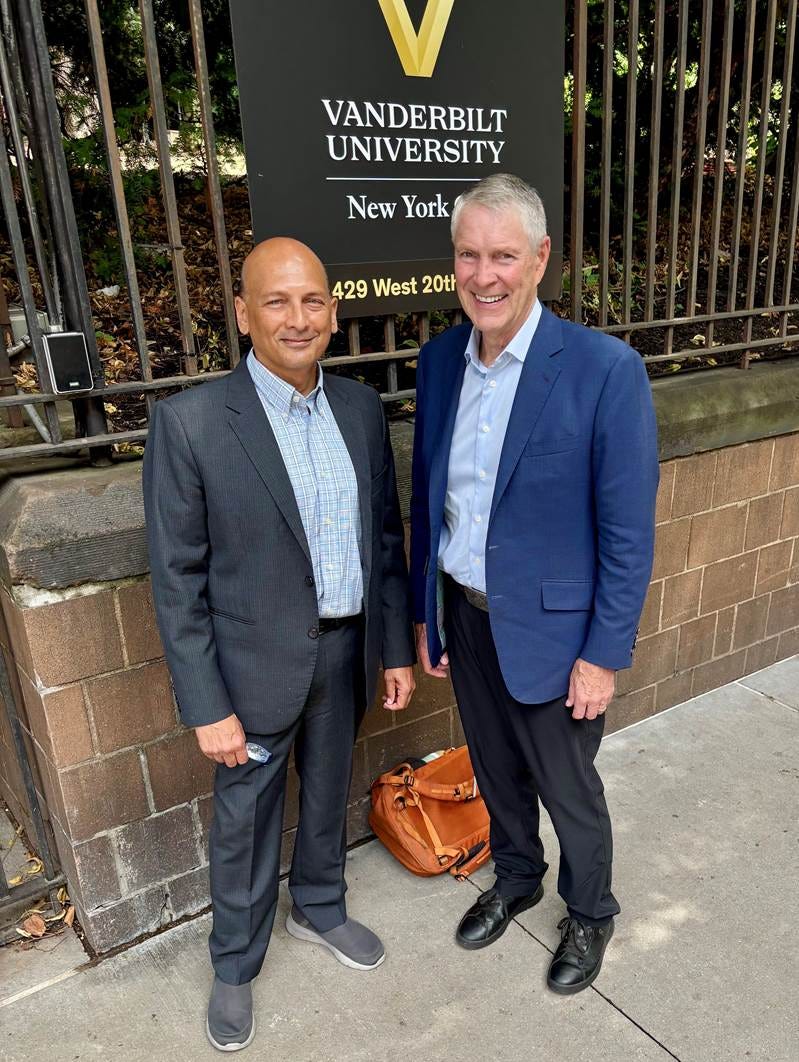
Vanderbilt Civil Engineering Professor Sanjiv Gokhale welcomes Senator Frist to Vanderbilt’s new NYC-based campus on July 29, 2026.
If everyone in this room took away one thing from this conversation and acted on it, what would you want it to be?
• Ask one question inside your own institution: How is the environment we create affecting the health of the people we serve?
• Then choose one measurable action.
– Reduce energy waste.
– Improve resilience.
– Plant trees or add shade.
– Change the food you serve.
– Protect workers and patients from extreme heat.
– Examine your supply chain.
– Connect sustainability goals to patient, workforce, and operational outcomes.
• Do not wait for a perfect national policy or a complete institutional plan. Begin where you have influence, measure the result, and build from there.
• The central idea is simple: sustainability is not separate from healthcare. Protecting the world around us is one of the most important ways we protect the lives within it.
Thanks for reading A Second Opinion! Subscribe for free to receive new posts and support my work.
Comments
Nothing yet. Say the first thing.
Sign in to join the conversation.