
Last week, while in New York for meetings, I had the chance to duck into the Marketing Brew Summit held at The Times Center in midtown, for a day of networking and idea-sharing with creative and brand leaders at the bleeding edge of their respective industries.
Amidst several thought-provoking conversations, one panel stood out: “Marketing’s Next Horizon.” Moderated by Morning Brew founder Alex Lieberman, the panel featured notable thought leaders:
David Lee, Chief Brand & Creative Officer at Squarespace
Christina Loff, Head of Lifestyle, Partnerships, Substack (appropriate for this article!)
Barbra Sainsurin, Global Chief Marketing Officer, Anthropologie Group
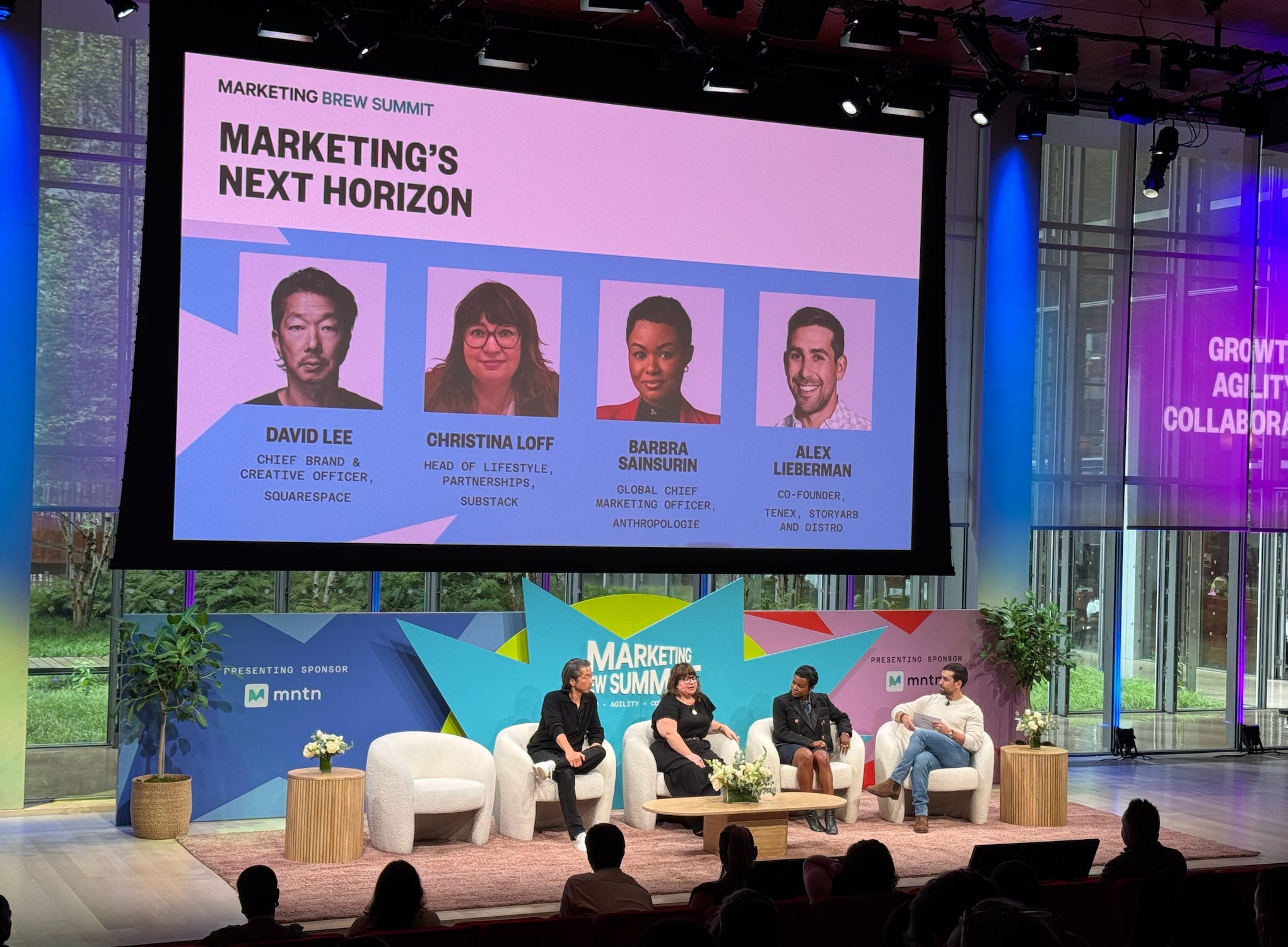
Each of these leaders and the brands they represent are actively navigating the shifting and complex landscape of AI, brand-building, and content strategy. And the panel stood out to me as their discussion underscored a tension many of us feel in our day-to-day work, and one I often cover in this newsletter: how do we balance performance with brand, harness AI without losing human creativity, and build trust in a world of infinite content?
Among others, panelists shared four lessons for all of us winding our way through this modern Renaissance.
Sainsurin reminded us that consumers aren’t looking for more noise—they’re looking for solutions. Too often, marketing defaults to chasing metrics or trends (ROAS, clicks, engagement rates), but the campaigns that move the needle are the ones that address real needs.
She argued for a broader view of impact, urging marketers to think across the entire funnel rather than only the last click. Media mix modeling and top-of-funnel investment matter if we want to build brands that endure.
I’d take it a step further. Brand is back. Or as her fellow panelist David Lee has said, “creativity is the only job left.” In a market completely saturated by noise, capturing audience attention (distinct from clicks, actual attention) is the hallmark of an effective brand experience.
No surprise here, as all three panelists addressed AI, though from different angles. Sainsurin noted its promise in unlocking creative bandwidth—freeing teams from repetitive work so they can focus on higher-value experiences. This is already happening across teams, though pick-up has probably been slower than reported in media buying into the hype cycle.
Loff, who works closely and exclusively with creators on this platform, highlighted that every implementation of this technology in her world is centered on how to empower the creative process. While Substack uses AI tools like Granola internally to generate weekly summaries and recaps at scale, development within the platform is focused on tools like how to more easily edit video or audio for publication (and without technical skills required). She gave me lots to think about in my own content production here :).
For his part, Lee underscored the responsible and intentional integration of AI that his colleagues have taken within the workflow at Squarespace. He described being “shocked at the exponential growth of AI” and skeptical about its impact on authenticity and intellectual property.
At Squarespace, AI is more of a sparring partner than a production solution. In fact, they maintain a policy of avoiding AI for external creative work (aside from in early-stage exploration). Preserving the human craft that makes the brand resonate so powerfully is a non-negotiable to Lee.
I really enjoyed his perspective here, and it aligned with a piece I wrote about the precious importance of craft in the age of AI recently for Rolling Stone Culture Council. Of course, the team at Squarespace is still bullish on the impact of AI. Lee urged marketers to “get on board this rocket ship” if they plan to be in the business long-term—recognizing that AI is not a replacement for creativity, but a tool to amplify it.
Technology is ubiquitous, and the impact AI and other tools will have on our work and life is immeasurable. Still, I find myself far more interested in the human aspect of work and creativity, in particular as a counter-motion to our digitally-driven existence. The panelists agreed that brands will need to lean into connection in a future market dominated by experiences that will be inherently “artificial.”
Loff emphasized a coming shift toward realness in marketing: fewer middlemen, deeper direct connections with consumers, and above all, creator-led brands. “So much of content is just storytelling,” she said. “Brands don’t always understand this. It’s not all metrics tracking—content is about connection.”
When I wrote my last book in 2019, Mindspace, James DeJulio, CEO and founder of Tongal, predicted something similar. At that point, artists and comedians were just beginning to go audience-direct, such as Jim Gaffigan’s decision in 2019 to forego a major streamer and partner with independent production company Comedy Dynamics - a decision that earned him $30M and a place on Forbes list of highest earning comedians that year.
In 2019, DeJulio told me this was not a fluke, but a trend that would take over media and push advertising and brand-building into an entirely new paradigm. And 6 years later, it seems we’re here.
Lee agreed, and framed it well by calling for brands to “bring people back around the campfire.” In a fragmented digital landscape, authenticity and shared experiences may become the ultimate differentiators. It could be said, bringing people together around the campfire might be a good solution to problems outside of marketing, but that’s a different discussion.
Finally, the panel also touched on the perennial question of in-house vs. external agencies. Lee noted that external partners will always play a role because of accountability—and that in-house creative only works when the internal culture supports it. This, too, ties back to authenticity: the right model is less about structure and more about whether teams are empowered to create meaningful work.
Today, where portfolio careers are proliferating and there is less general loyalty to brands and employers, internal culture becomes a true differentiator for those who get it right. And building a culture well requires intention, focus, and discipline. It does not happen by accident. My friend and industry leader Silvia Oviedo wrote a nice piece this week on the topic on her Substack; it’s worth a read.
“When we talk about ‘building culture,’” she says, “it’s tempting to think in big moves: Mission statements, all-hands speeches, big programs. But culture is actually built in the little things. The (virtual or literal) high five when things go well. The Lego figurine left on a desk. The small, intentional acts that tell people: you belong here.
At the end of the day, whether you are a consumer of a product or an employee working for an organization, isn’t that the feeling we are after? You belong here.
This conversation reinforced that marketing’s future won’t be defined by AI or metrics alone—it will be defined by how we use these tools to tell stories, solve problems, and build trust with one another. The brands that thrive will be the ones that balance performance with long-term brand equity, embrace AI thoughtfully, and double down on what makes human creativity irreplaceable.
Photo by Tegan Mierle on Unsplash.
Comments
Nothing yet. Say the first thing.
Sign in to join the conversation.