
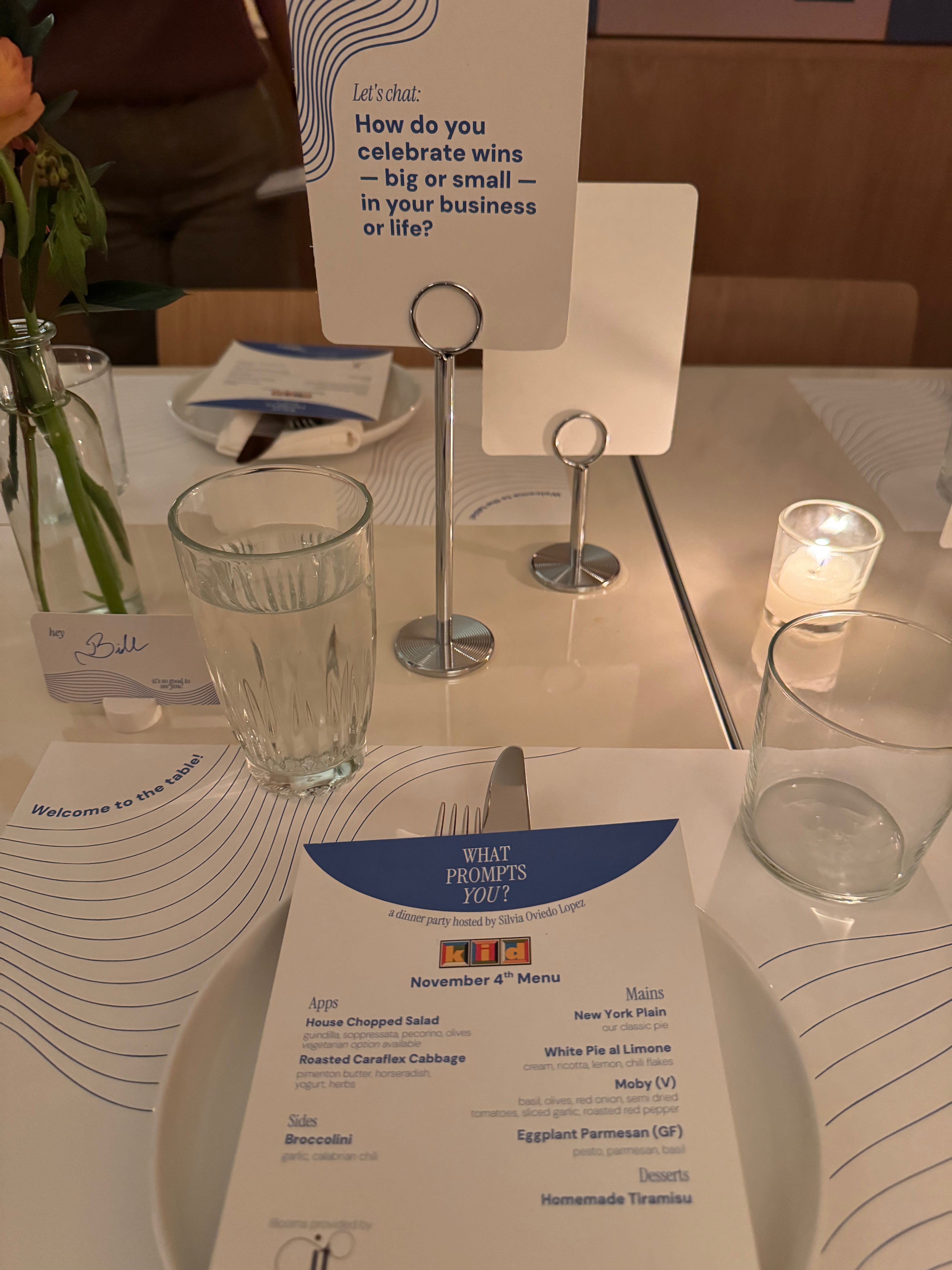
“What is a new C-level position that you would create for the future?” This was a question posed at a dinner I attended last night in New York. An “in-real-life” prompt, if you will, set as one of several place cards for a curated audience of creative leaders brought together by , a builder and executive who has scaled teams at several brands you’ve heard of, including Pinterest and Canva, most recently.
After thinking about it, my answer was “Chief Relationship Officer,” which I realize is not particularly new but is a role I expect will increasingly grow in relevance in an AI-driven ecosystem where bots talk with bots, exclusively. It’s also a role my friend Rick cheekily ascribes to me given the vast amount of seemingly random people I know from the many (equally random) lives I’ve lived.
Customer relationships are critical for B2B (business-to-business) companies, where executive-to-executive connection can literally make or break large commercial agreements. You have fewer, higher-paying customers. But in the direction we’re heading, I expect that customer relationships will become equally critical in B2C (business-to-consumer) environments as well.
Start with human, end with human.
We are all grappling with how and where to appropriately integrate artificial intelligence into our lives. And it seems inevitable that this tech will, and is already getting, incredibly sophisticated and powerful.
Large companies are making bets that they can continue growing top-line revenue with less staff, based exclusively on the idea that AI will replace the need for expensive, complicated human beings to sit behind keyboards. In our personal lives, the impacts are even more dramatic. Recently, AI-wearable company Friend launched a massive campaign, aiming to be a companion for anyone dealing with feelings of loneliness or isolation. It is being marketed as “your closest confidant,” which to me reflects an ominous premise: we don’t need employees to work at our companies, we don’t need artists to make our art, and we don’t need people to be our friends. Without the latter, I would ask (and excuse my language), what the fuck is the point?
Still, I am ever an optimist. And part of why I love having the experience of dining with such brilliant people as I did last night is that they give me hope that there are still people out there with good intentions and the power to do something with them. Judy Lee, from Pinterest, shared a mantra she is using with her team as they explore how to integrate AI into their workflows.
It’s simple: Start with human, end with human. The implication being that in the middle, AI can be an incredibly useful tool. But if you don’t start with a truly human insight, and you don’t finish with the soft tissue wrapping that can only come from the bumps and bruises of a shared human experience, your product / marketing / message is going to fall flat. And we’re racing incredibly fast to an era of “AI slop” that will either drag us down with it or jolt us into a new normal.
Andrew Yeung, an investor and the founder of events company and community Fibe, predicted this week “I think we’re about to see a huge swing back toward physical, analog businesses,” and I couldn’t agree more. These businesses will not have the valuation ceilings that tech can bring. They will not lead to headlines of tens of billions of dollars in commitments being thrown at them from other tech players. But they will find loyal, committed audiences.
Squeezing the “last drop” of each relationship.
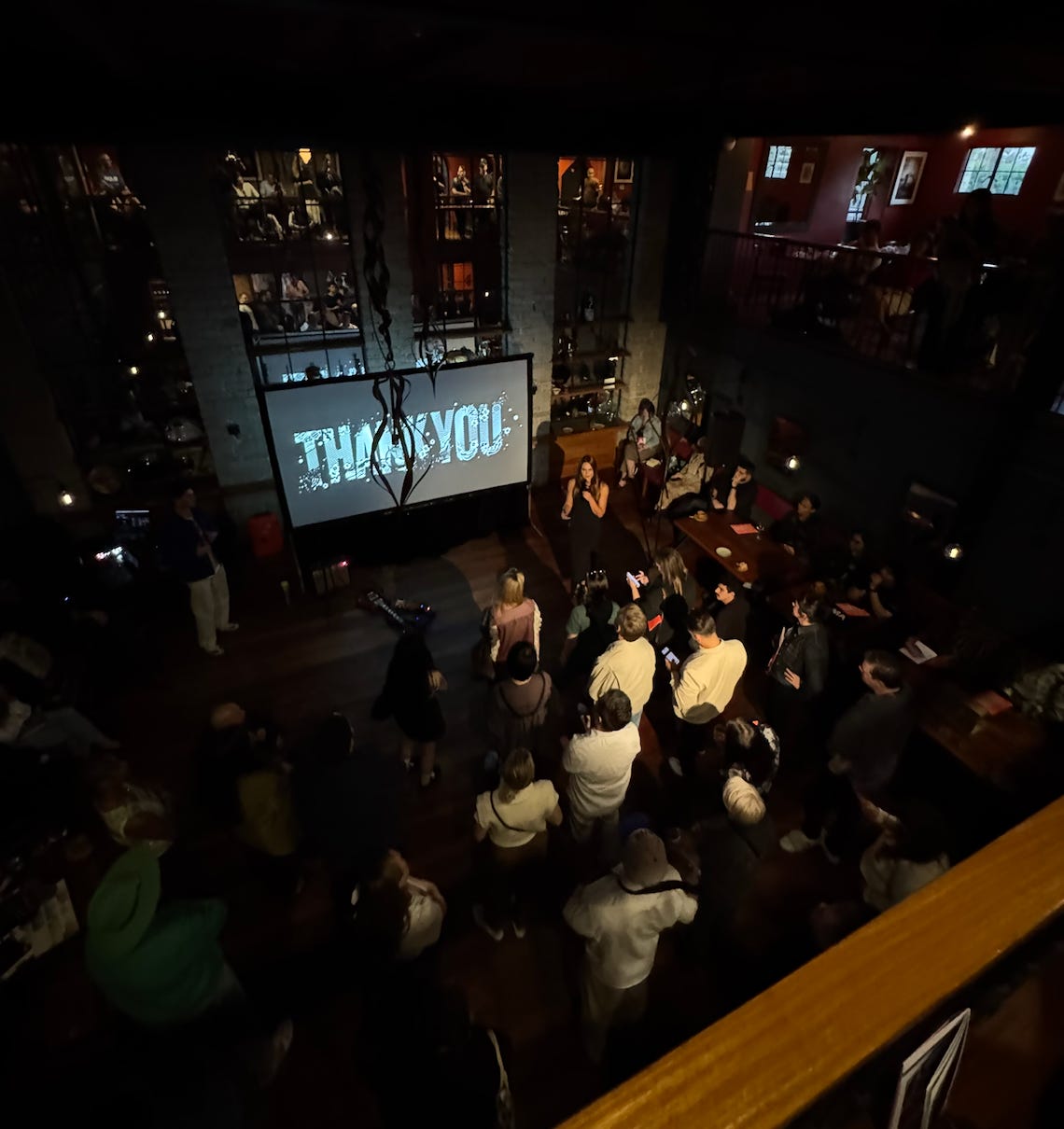
Last week, I was at another curated dinner that our team hosted with our friends at COLLINS and Adobe after a creative meetup in Los Angeles ahead of the Adobe MAX conference. We had artists, journalists, executives, founders, etc., breaking bread and discussing all kinds of things. It is the unexpected connections that often spark the most meaningful output. And in work, as in life, the first conversations we have with people are a bit guarded. Surface level talking points that can sometimes, if we let it, even sink down to the weather or weekend plans — gasp! Connecting with someone for real is hard work. You have to dig to get to the good stuff. In the whiskey world, they call that the “devil’s cut,” the portion of liquid that gets trapped in the barrel. When extracted, it is richer, more bold, more complex.
Humans are inherently complicated. There is no doubt about it. I would imagine that managing a team of AI agents will be significantly easier, with no HR issues, no aspirations for growth or pushback on strategy or direction. The same is true in interpersonal relationships. AI partners will pump you up, they won’t challenge your worst traits or ideas, they’ll have you believing you can take over the world. Which, in moderation, can be a good quality as most of us are our own worst critics. But, when left unchecked, some of us are likely to start believing the hype. Real people push us to be better, rather than clearing a path for us to continue doing the least necessary work on ourselves.
The complexity of people is what makes the magic happen.
We have to do everything we can to protect that aspect of our work and our lives. Otherwise, respectfully, what is the point?
Photo by Ben Sweet on Unsplash.
Thanks for reading Renaissance Plan! Subscribe for free to receive new posts and support my work.
Comments
Nothing yet. Say the first thing.
Sign in to join the conversation.