
My students asked me this question ? Who is going to win ? stupid but at the end interesting for teaching energetics of sport 😉😂💪
Hawaii. Kona. The Ironman World Championship.
The ocean sparkles. The heat crushes. Three giants stand on the start line:
- Léon Marchand – World record swimmer, master of the water.
- Tadej Pogačar – Two-time Tour de France champion, cycling phenomenon.
- Eliud Kipchoge – The fastest marathoner ever.
Same starting gun. Same brutal course. And for this experiment: the same VO₂max — 85 ml·min⁻¹·kg⁻¹.
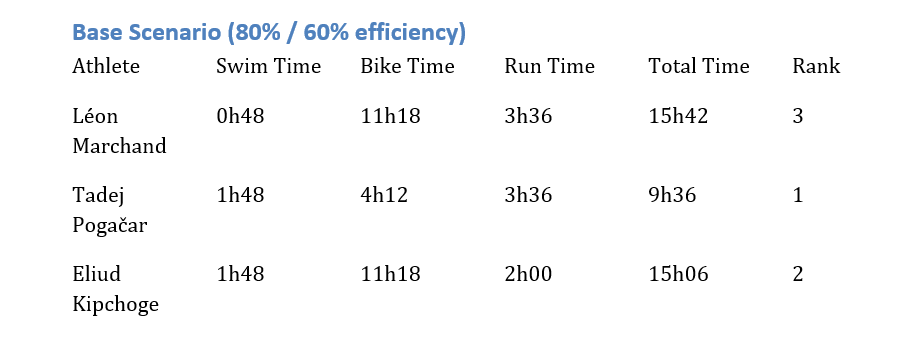
In their own sport, each can tap 80% of that VO₂max at peak efficiency. Outside their comfort zone? Efficiency drops to 60% and energy costs skyrocket.
Translation:
- Marchand cuts through water like a torpedo… but on a bike, he’s just another rookie.
- Pogačar flies on two wheels… but running burns through his oxygen budget.
- Kipchoge runs like the wind… but in the ocean, drag is his worst enemy.
- Swimming: Oxygen-hungry.
- Cycling: ~20× cheaper than swimming in energy cost.
- Running: ~4× more expensive than cycling.
The final result is shaped as much by where you’re moving as by how fast.
In most scenarios, Pogačar’s insane bike split carries him to victory — even with slower swim and run times. Kipchoge often takes second thanks to his legendary marathon pace, while Marchand dominates the swim but can’t recover the time lost on land.
But the real winner? The one who spends the least energy per meter. Big engines are great… but low fuel consumption wins the race.
- Swim: High-performance wetsuits slash drag.
- Bike: Aero frames, disc wheels, wind tunnel positions.
- Run: Carbon plate shoes for elastic energy return.
Even pacing strategies — like Sub2h marathon pacer formations — are tech-optimized.
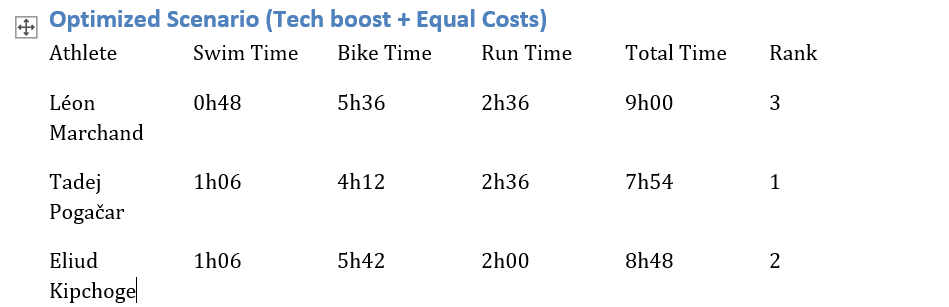
Sometimes, the all-rounder beats the legend. And in Kona, the ocean decides first.
This hypothetical match shows that the winner isn't necessarily the one with the most powerful engine, but the one who can convert every watt into useful speed while minimising energy losses. So, working on energy costs is really important, and technology plays a big part in that. Even though around 71% of the planet is covered in water, our bodies are actually adapted to being on land. When you compare this to other options, water is pretty energy-intensive, air is manageable, and the ground provides elasticity. The Ironman shows that the winner isn't just the person with the highest VO2max, but also the one who pays the least for each meter they travel.
The role of tech
Aerodynamics, hydrodynamics, and the return of elastic energy through carbon-plated shoes are all really important for performance. For the Sub2h marathon project, even the positioning of the pacemakers was optimised in a wind tunnel. We can picture the role of tech in cycling: streamlined frames, lenticular wheels, extreme positions in time trials.
When it comes to swimming, high-performance wetsuits can help you swim faster by reducing drag. When you're running, carbon plate shoes help you to get the most out of every stride.
And most importantly, make sure you're getting the most out of your strength and muscle power to avoid hamstring cramps or worse, a pulled muscle. With carbon shoes, you can save time and avoid getting injured for weeks at a time with a VO2max that can only handle a break from training for three weeks at most!
When it comes to cycling, you'll need to put in the hours to earn the thousands of dollars needed for a machine that battles friction and gravity.
You could spend your time training!
It's always the same story: should you lose your life trying to win it?
Anyway, the general rule in sport is to save time by training at all levels of intensity so that you're ready to put on those shoes or get on that bike of yours.
Fancy a swim? Here's some advice: start young, very young! And with a good coach who doesn't just make you swim laps, especially if you're aiming to win an Ironman in a real aquatic environment with waves and maybe even (again?) fish.
The good news is that if you're a pretty good triathlete, you'll beat those sports titans!
Aucun post
Comments
Nothing yet. Say the first thing.
Sign in to join the conversation.