
The hard part, after 40 years of R&D, is to recall the ideas that feel obvious to me because they’ve become second nature. This blog forces me to excavate them for readers who don’t get paid to do it. Today, here’s a simple, science-first way to make an 80/20 distribution actually useful when you only have three sessions per week.

Why two flavors of HIIT feel so different
Not all HIIT is created equal. Some sessions live around 90% vVO₂max (2–4 min repeats, equal recoveries). Others attack ~100% vVO₂max (30–60 s bouts with active recovery). They load the system differently—central (heart) vs peripheral (muscle).
90% vVO₂max: power with physiological stability
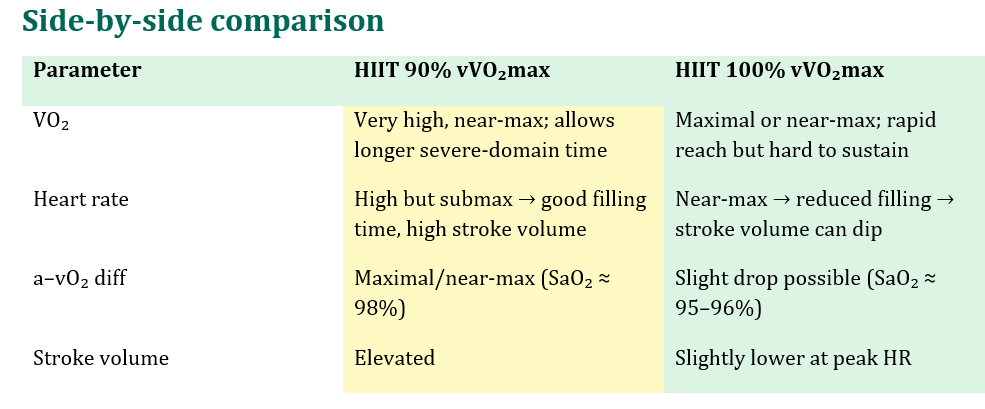
At ~90% vVO₂max you stay in the severe domain (above lactate threshold yet below all-out). HR rises but stays submaximal, preserving ventricular filling and keeping stroke volume high; arterial oxygen saturation remains ~98%, maintaining a strong a–vO₂ difference. Translation: big cardiac output without destabilizing oxygenation.
· Central: strong volume loading → diastolic function and ejection improve.
· Peripheral: well-oxygenated muscle → mitochondrial and capillary adaptations.
· Exercise-induced hypoxemia risk: low, ventilation-perfusion stays matched.
100% vVO₂max: maximal cardio-respiratory stimulus
Short-interval formats (30/30, 60/60) drive VO₂ to peak quickly. HR hits near-max, shortening filling time; stroke volume can dip and cardiac output relies more on rate. Ventilation may outstrip perfusion briefly; some athletes show mild desaturation (exercise-induced hypoxemia). Still, these sessions are excellent to elevate VO₂max and cardiac power.
· Central: rapid, high-intensity stimulus → pushes VO₂max upward.
· Peripheral: fast-twitch recruitment and buffer training.
· Hypoxemia risk: higher in sensitive athletes → monitor HR–speed for a deflection/plateau.
Fick in one line
VO₂ = Q × (CaO₂ − CvO₂). In trained athletes, the bottleneck is often Q (cardiac output). Long HIIT (~90%) grows how long you can live near this ceiling; short HIIT (~100%) raises the ceiling itself.
How to train (3 scenarios)
1. Goal = ↑ VO₂max & cardiac power → emphasize short HIIT (30/30, 60/60) at ~100% vVO₂max with controlled reps and active recovery.
2. Goal = ↑ severe‑domain tolerance (time at high VO₂) → emphasize long HIIT (2–4 min) at ~90% vVO₂max; keep oxygenation high and avoid early central fatigue.
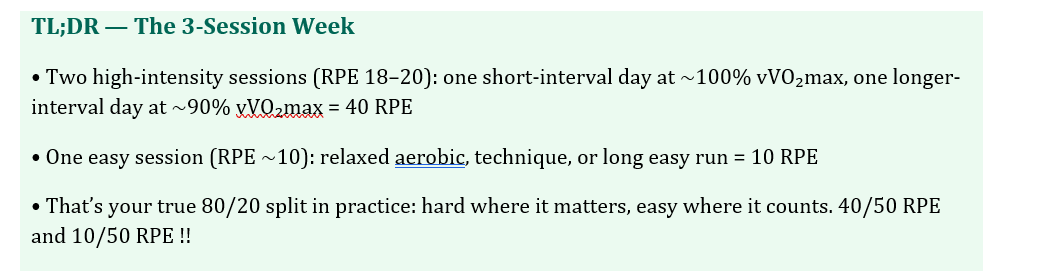
3. Goal = Health + Performance → mix both weekly: 2 hard days (one ~100%, one ~90%) + 1 easy day (RPE ≈ 10).
Coach’s Field Notes
• RPE 15–17 = useful severe domain; if breathing fragments too early, ease off slightly.
• Cardiac cost (beats per meter): if it rises faster than speed falls, you’re paying too much.
• Women, marathon: a 1000 m all‑out after 10 km at marathon pace is a sensitive checkpoint.
Go deeper (original sources)
Classic papers and notes:
• Billat (1994) — Tlim at vVO₂max (reproducibility)
• Faina et al. (1996) — Anaerobic contribution at minimal intensity eliciting VO₂max
• Lepretre et al. (2004) — Exercise intensity, VO₂max & cardiac output
• Lepretre et al. (2004) — Heart‑rate deflection to defend stroke volume
Aucun post
Comments
Nothing yet. Say the first thing.
Sign in to join the conversation.