
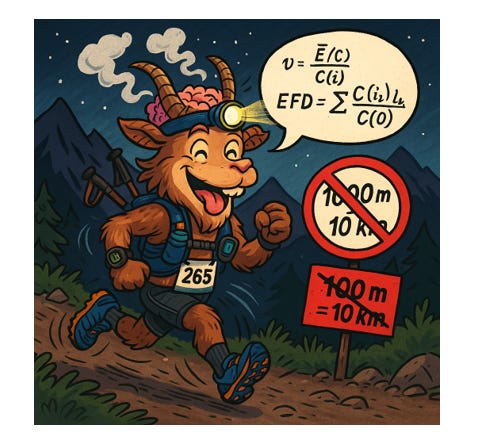
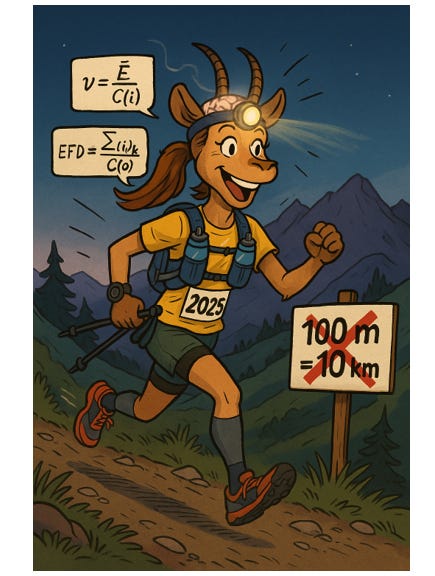
Let’s admit it: the equivalence “1000 m of vertical gain = 10 km flat” is a mountain Dahu (a myth). It’s told to novice mountain runners to haze them, and a few apprentice “scientific types” repeat it solemnly, wielding the mechanical talisman below. Except… mountains don’t read rulebooks.
The often-invoked mechanical talisman:

Why it’s a Dahu (myth)
• The energetic cost is neither linear nor symmetric: it depends on slope i. Running downhill at −10% to −20% can cost less than flat, whereas steep uphills blow up the cost per meter.
• The movement pattern is not unique: we run, we hike, we use poles. A “pure running on flat” model is off-base.
• The terrain is not standardized: snow, mud, scree… the surface changes the cost.
Actual speed depends on a simple ratio: available power over cost per meter:
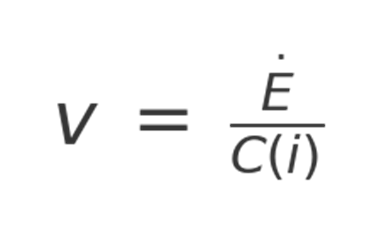
When slope i changes, C(i) changes; therefore, for the same power, you don’t get the same speed. So we replace the back-of-the-envelope rule with a falsifiable measurement: integrate the GPX trace, compute the slope-dependent cost, and convert total energy into a flat-equivalent distance (EFD).

Consequence for rankings
Forcing the Dahu into a “1000 points” ceiling pegged to the marathon world record ends up ranking trail races as if they were marathons in disguise. What you mostly grade is the scoring system’s error: EFD computed from GPX systematically diverges from “10 km/1000 m”, sometimes massively.
Take-home
• The “1000 m D+ = 10 km flat” calculation is a Dahu legend: easy to tell, wrong in practice.
• The mountain imposes real bioenergetics: C(i) varies with i, with surface, and with locomotion mode.
• To compare and rank, measure energy along the actual trace (GPX) and derive EFD—not a mechanical shortcut.
Therefore, the energetic cost of positive and negative slopes—including snow (cf. UTMB 2025)—changes the flat-equivalent distance (EFD), reduces speed for the same trail finishing time, and thus lowers the true flat-equivalent distance. Otherwise, the marathon world record would be… shattered.
Demonstration (with equations and numbers): why the correction “1000 m ascent = 10 km flat” is mechanically tempting but bioenergetically wrong
Realizable speed depends on energy cost per meter, which itself is a function of slope (positive and negative).
1) Mechanical reminder (insufficient)
The classic argument compares gravitational potential to kinetic energy:

Even though this suggests a numerical “equivalence” (since g ≈ 9.81), it ignores locomotor physiology and the dependence of energetic cost on slope and muscle contraction type (concentric/eccentric).
2) Energy cost of running as a function of slope
The mass-specific energy cost per meter of running (level: 3.6 J·kg⁻¹·m⁻¹) varies nonlinearly with slope i (decimal; e.g., +0.10 = +10%):

The curve has a minimum around −17% (moderate downhill), and rises steeply for large magnitudes of slope—both uphill and downhill (eccentric braking).
3) Realizable speed and “Equivalent Flat Distance” (EFD)
For a given athlete, sustainable speed on slope i relates to the sustainable fraction of VO₂max and to the cost:
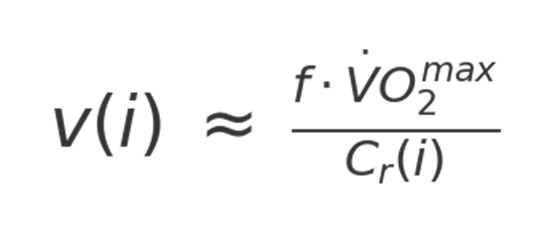
On a GPX trace, integrate segment energy to obtain EFD:

4) 2025 application (men’s winners) — Sierre‑Zinal & UTMB
Public profiles and cautious average slopes for uphill/downhill segments provide a lower bound on the divergence from the “10 km/1000 m” rule.
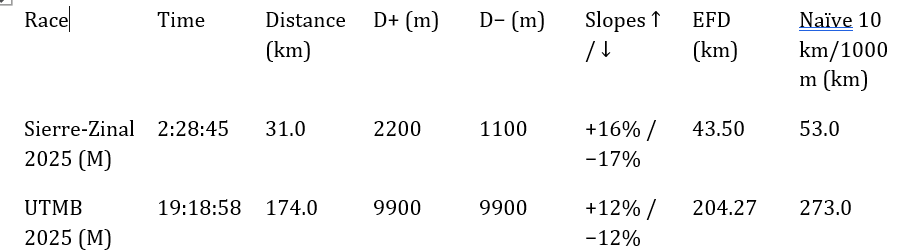
The “10 km/1000 m” rule overestimates EFD by +22% (Sierre‑Zinal) and +34% (UTMB) compared with the bioenergetic calculation. Conditions like snow/mud would further increase actual EFD.
• “1000 m = 10 km” rule: 31 + 2.2×10 = 53.0 km → overestimation ~25%.
UTMB 2025 (shortened + snow): three illustrative scenarios:
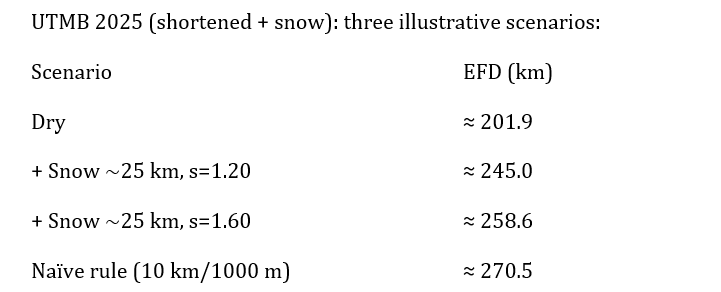
Naïve comparison ignores (i) the downhill cost minimum around −10% to −20% and (ii) the surface penalty (snow) when present.
Abbreviations & notation
• D+, D−: positive/negative elevation gain (m).
• i: slope in decimal (e.g., +0.10 = +10%).
• C_r(i): mass-specific cost per meter at slope i [J·kg⁻¹·m⁻¹].
• EFD: Equivalent Flat Distance — flat distance with identical total energetic cost.
• VO2max (\(\dot{V}O_{2}^{max}\)): maximal oxygen uptake (rate).
• f: sustainable fraction of VO2max (depends on duration/pacing).
• GPX: track file (distance/elevation/time points).
• UTMB: Ultra‑Trail du Mont-Blanc; ITRA: International Trail Running Association.
Summary
Comparing a trail to a standardized flat race via “1000 m D+ = 10 km” is physiologically unfounded. Running cost depends on slope (up/down) and terrain conditions, so average speed and points derived from a naïve flat‑equivalent distance are biased. EFD from integrating C_r(i) along the trace provides a robust basis for evaluation.
It's a free, open blog with a serious side to it, perfect for my Sundays! You can give a gift to show you care, but it must be something you like, even if it's free (doom).
Aucun post
Comments
Nothing yet. Say the first thing.
Sign in to join the conversation.