
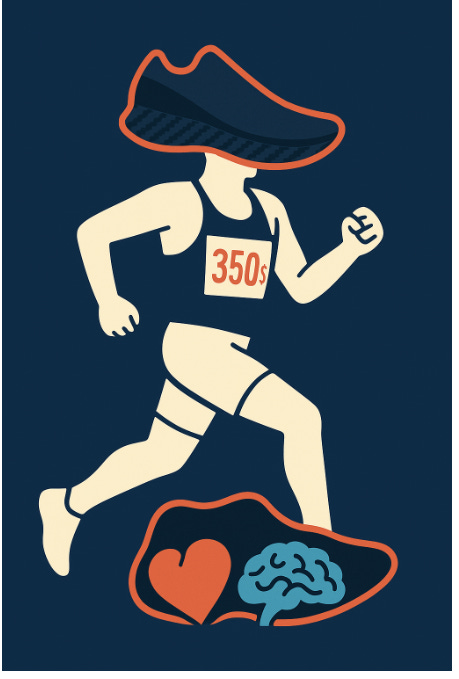
However, physiology tells a different story: well-structured training involving heavy and explosive strength work, training close to the vVO₂max threshold and controlled pace variability yields greater, more reliable and sustainable improvements in energy cost and sustainable speed. As for ‘4%', it is often lost in biological variability and measurement uncertainty. This post puts the numbers in perspective — and the runner at the centre.
Why is the '4%' a practical (and scientific)
The famous figure comes from heterogeneous laboratory protocols and limited samples. Repeat the measurement on another day, change your pace slightly or switch from the treadmill to the track and you can easily get a variation of ±2–4% just from variability and measurement noise. Recent literature emphasises this point: to determine whether a shoe 'gives you an advantage', you need to conduct multiple tests, counterbalance the conditions and accept that the benefit is not universal. Certain body types (such as those with pronated feet) derive less benefit from the plates, while for others, the benefit is real and sometimes clear, but conditional on speed, technique and dynamic stability. In short, there is no general recipe, only individual responses.
What training really does — and to a much greater extent
— is that the most powerful tool is in your legs and in your training plan. Reviews and meta-analyses show that adding heavy strength training (≥80% 1RM) and/or explosive/plyometric training to endurance training lowers economy (cost) by 2–8%, depending on the protocols. It also improves vVO₂max and increases performance over distances of 1.5–10 km. The longer the cycle (8–16 weeks), the more pronounced the effect. In short, gains often exceed 4%, with lasting benefits.
These gains can be mechanically explained by better neuromuscular coordination, more efficient muscle-tendon stiffness and delayed recruitment of less economical fibres. The impact is not limited to the laboratory, however; it can also be seen on the stopwatch.
The shoes are not 'fake' — but they won't run for you!
Certain geometries (e.g. curved plate, pronounced rocker and resilient foams) redistribute the work, placing less strain on the ankle and more on the knee, which can sometimes result in better mechanical efficiency of the ankle. This may or may not result in a reduction in cost. In addition, shifting loads has trade-offs: depending on the model and your profile, stress on the knee and Achilles tendon can increase, and the leg return phase can become more vigorous, increasing the eccentric demand on the hamstrings if you are not ready. Hence the golden rule: gradual use, eccentric strengthening and an individualised approach.
The runner-centred method: the energy radar.
Rather than buying into a promise, measure your profile and let the shoe adapt to it. Here is a simple energy radar to follow:
Aerobic power and speed reserves (easy → hard → sprint).
Cadence and contact time (spatio-temporal stability).
Controlled variability of pace (governance).
Dynamic stability (directional/rotational).
Mechanical tolerance (leg, ankle, Achilles and knee).
Specific endurance (cost at target pace).
From there, we pair foam (return/relaxation), rocker/apex, stack height, stiffness and plate shape (flat vs. curved) according to your needs, not the other way around. Then we train the areas that need improvement (heavy/eccentric strength, technical work close to vVO₂max and speed oscillations) to consolidate the gains made.
What the literature data says (order of magnitude to remember).
Shoes (group): reported modest and heterogeneous average O₂-cost reduction (not universal; depends on model, speed and profile).
Pronators: reduced benefit with plates.
Weight: the rule of thumb is that there is an energy cost of approximately 1% per 100 g added or removed.
Training: heavy/explosive strength + intervals close to vVO₂max → 2–8% cost reduction (according to studies), vVO₂max and times increase — a lasting and replicable effect.
Test instructions: Test at home (ground > treadmill): 2 × 10 minutes at marathon pace with a 3-minute recovery. Compare heart rate (HR), rating of perceived exertion (RPE) and contact time between the two repetitions.
Conclusion:
The '4%' sales pitch is an unreliable average. Physiology is more generous: if you train intelligently, you can achieve more than 4% (an 11% increase in 'easy' speed, 'average' and 'hard' speeds, and even 'very hard' speed in 8 weeks with BillaTraining), with less risk and more control. The shoe is a tool; you are the engine. 😉
References (selection, for the curious reader):
Barnes, 2014; Denadai, 2016; Blagrove, 2018; Lanos-Llagos, 2024; Mayoralas, 2017; Montero, 2015; Rønnestad, 2013; Van Hooren, 2024–2025; Miyazaki, 2024; Seo, 2025; Toshiya, 2025; Werkhausen, 2024; Brueggemann, 2025; Carranza, 2025.
For more details, see my updated bibliographic research on the issue of carbon shoes from 2024–25:
1) Why 'energy cost' really governs performance
In trail running, as on the road, performance is not just a question of VO₂ max; it is the energy cost of movement (ECM)—the energy required per kilogram per kilometre—that converts VO₂ into actual speed. This is why the simplistic 'equivalence' of 1,000 metres of elevation gain equalling 10 kilometres on flat ground is not universal. Depending on the slope, pace, technique and equipment (i.e. shoes), the ECM varies greatly, as does the resulting speed. Recent studies linking biomechanics and running economy remind us that this cost depends on multiple factors (technique, anthropometry, muscle architecture, etc.) and inter-individual variability — a key point in understanding heterogeneous responses to modern shoes.
2) The mythical threshold of ~3.8 kJ·kg⁻¹·km⁻¹ and the rush for carbon plates
In the quest for a sub-2-hour marathon, a CED of around 3.8 kJ·kg⁻¹·km⁻¹ has been identified as a prerequisite for achieving record speeds. This goal has given rise to a wave of 'super shoes' (highly resilient foam + plate—often carbon—curved into a high sole). The first Nike Vaporfly 4% was released on 20 July 2017, after prototypes emerged as early as 2016. The regulatory change by World Athletics then set the sole height at 40 mm and required a commercially available model (2020 rules).
From a scientific perspective, pioneering research demonstrated reductions in O₂ under controlled conditions, but without identifying a single, universal mechanism, which necessitated more detailed analysis. (PubMed)
3) 'Effective'... but for whom and under what conditions?
The literature from 2024–2025 (including your contributions) provides a more nuanced picture:
The curvature of the plate and the 'teeter-totter effect'
Beyond just 'longitudinal bending stiffness' (LBS), geometry matters. A protocol on an instrumented track shows that a curved plate can reduce mechanical work and improve mechanical efficiency at the ankle (less plantar torque during much of the stance phase), which is consistent with more economical muscle contraction.
This study highlights segmental energy transfer (shank to foot) and explains how curvature enhances the 'rocker' function, shortens the lever arm and moderates unfavourable angular velocities.
Stiffness (LBS) does not explain everything.
A 2025 meta-analysis examined LBS and energy return from foam and found heterogeneous effects and modest effect sizes, which depend on the runner's profile and the shoe model. In short, there is no single '+4%' button.
Biomechanical mediators vary from person to person.
A 2025 review led by Van Hooren emphasises that no mediator (e.g. kinematics, morphology, muscle architecture, comfort filter) stands out as universal in explaining RE gains through shoes. It also insists on the need for multiple trials per condition, as biological and instrumental variability can mask or mimic a 'gain'.
Pronators experience less or no gain.
A dedicated study shows that people with pronated feet derive less benefit in terms of energy return (RE) from a carbon plate than people with "normal" feet, possibly due to reduced ankle and toe range of motion (ROM) and a lower capacity to store and restore energy from the plate.
Kinematic/kinetic analysis of the foot-leg
Comprehensive 3D measurements (2025) show modulations in angles and moments at the foot and leg joints under the carbon plate. This confirms that the mechanical action shifts (less at the metatarsophalangeal joint and more elsewhere, depending on the model and gait). However, these redistributions do not systematically result in better RE for everyone.
Stability and fatigue:
At the same time, changes in dynamic stability are observed (stiff insoles) as well as the effects of fatigue on the shape and efficiency of the plate. In other words, what 'works' well at a moderate pace may be different at the end of a marathon or on a downhill trail.
Treadmill vs. terrain / road vs. trail
Comparisons on uphill/downhill trails show responses that are specific to the slope. Extrapolating the results from a treadmill to terrain is difficult, and many contradictory conclusions are explained by heterogeneous protocols.
4) Mechanics first, physiology second: a mismatch
As physiologists with 35 years' experience, and as former athletes and coaches, we believe that shoes have been designed with mechanics in mind, such as increasing the useful lever arm, storing and restoring energy, and stiffening 'costly' areas (MTP). In real life, it is often the runner who adapts to the shoe, not the other way around, except for a few champions who have custom-made shoes (geometry, foam, rigidity and "governance" of pace). Recent developments precisely argue for individualisation: selecting the right combination of foam, plate, rocker and stiffness for a given energy and biomechanical profile, rather than "one plate for all".
5) Why the '+4%' is often a measurement error
On small samples, a single test per condition is enough to 'create' a +/- 2–4% variability (day-to-day, VO₂ calibration, cardio drift, micro-pacing), hence the methodological warning to repeat the tests, counterbalance the orders and respect the equilibrium times. The 2024–25 reviews emphasise this point.
Add to this the fact that certain populations (pronators and those with specific technical adaptations) respond differently or negatively.
6) A new approach: shoes dictated by the runner's 'energy radar'
Rather than imposing mechanics, we should measure the individual's 'energy radar' (power, cadence, speed variability, power reserve, eccentric tolerance, MTU elasticity, MTP efficiency, directional stability, etc.). Based on this radar, we choose the geometry (stack/rocker/apex position), stiffness (flat vs. curved plate) and foam (return/relaxation time). Recent data supports this individualisation (clustered responses to stack heights, LBS, etc.).
This is exactly the spirit of Billatraining: working at vVO₂max and using speed oscillations (e.g. 30”/30”) to maximise time spent at VO₂max and improve pace control and economy within realistic constraints, before validating the 'shoe' tool for the athlete (PubMed, publications.billatraining.com). (PubMed, publications.billatraining.com).
7) Injuries and 'stiff recovery': watch out for hamstring injuries.
MAX/plate technologies can shift loads, relieving the ankle and Achilles tendon via the rocker. However, this increases moments at the knee and sometimes puts stress on the Achilles tendon, depending on the position of the fulcrum. There is also an increased risk of injury (observations over 12 months: knee and Achilles tendon). In certain settings, the 'snap' of the return can accelerate leg return and increase proximal eccentric demand (hamstrings) at the end of the cycle, especially if the technique is not prepared for this.
In short, without progressive adaptation and eccentric strengthening, the promise of 'economy' can result in days off, which cancels out any theoretical gain.
What your added papers say (in brief):
Miyazaki (2024, J Biomech): The curved plate improves mechanical efficiency at the ankle (MEC increases, MEE decreases) by modulating the angular velocities of the shank and foot, and shortening the lever arm. This is a plausible way to improve RE, but direct metabolic evidence is still needed.
Stephen 2025 (review/meta): LBS + energy return → inconsistent results dependent on subject/model; optimisation is not a simple case of 'stiffer = better'.
Van Hooren (2025): no single mediator, high variability and the need for multiple trials.
Toshiya (2025): pronators → reduced RE gain with plate via limited ROM and reduced storage-restitution.
Seo (2025): foot-leg kinematics and kinetics are modified by the plate (reallocation of forces); there is no guarantee of metabolic gain in all subjects.
Fukuchi (2024, trial): specific responses to uphill/downhill; caution regarding extrapolation from treadmill to terrain.
Gao, Xu and Yang (2025): stability and fatigue interact with fitness and stiffness, and the effects may be attenuated or reversed depending on fatigue status and pace.
Brüggemann (2025, pre-print) and 12-month cohort: 'MAX' increases loads and the risk of knee and possibly Achilles injuries compared to other technologies. The tool strongly influences the injury profile regardless of age or volume.
Aucun post
Comments
Nothing yet. Say the first thing.
Sign in to join the conversation.