
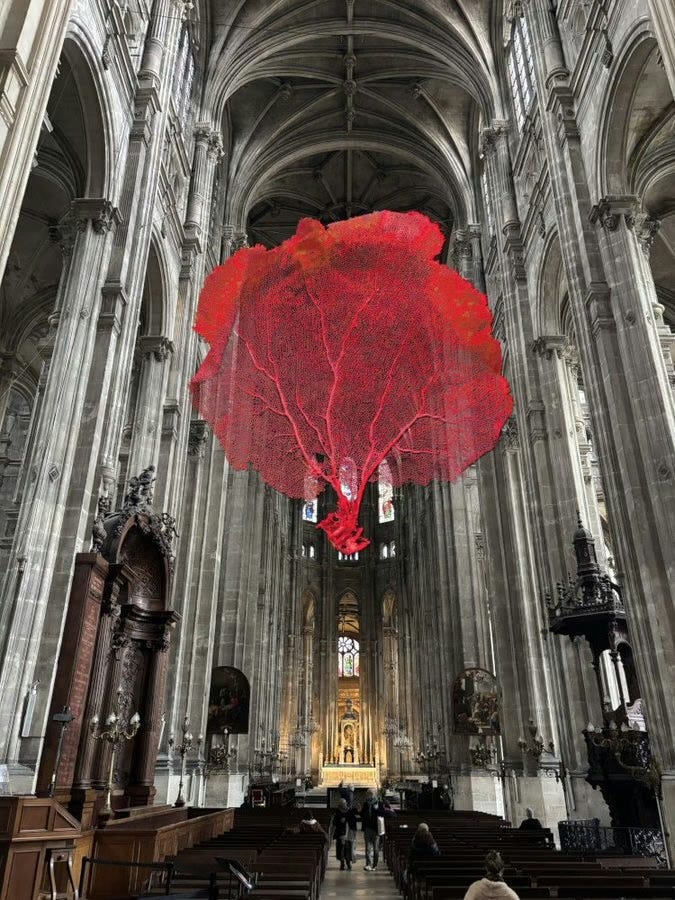
Saint-Eustache turns the nave into a temple of environmentalism
Lydie Arickx’s Le Souffle—The Breath—is cut from aluminum, shaped like branching coral, and scheduled to remain in Saint-Eustache through September 29. Its sponsors present it as coral, a leaf, a heart, and the Tree of Life. Their publicity invokes threatened ecosystems, fertility, resilience, and a “shared space for meditation”. Arickx calls Saint-Eustache an église verte. She likens the Gothic church to a forest and the coral to a cathedral.
That language plunders Christianity while refusing its claims. The Tree of Life belongs to the history of salvation and reaches its fulfillment in the Cross. “Breath” inside a church evokes the Spirit of God, and the human heart calls to mind the Sacred Heart pierced for sinners. Even the word cathedral carries a specific Catholic meaning: the church of the bishop’s teaching chair. Le Souffle raids this treasury of associations and redirects them toward ecological fragility.
The installation therefore preaches. Creation is displayed without the Creator who gives it being. Ecological damage supplies a secular fall; resilience supplies redemption; planetary responsibility supplies a moral law. The drama of sin and salvation is displaced by an environmental creed broad enough to satisfy tourists, donors, cultural officials, and churchmen who prefer transcendence without dogma.
The sculpture’s enormous scale is for a reason. Churches catechize through space before a sermon begins. The axis of the nave, the upward pull of the vaults, the sacred images, the altar, and the tabernacle order the eye toward sacrifice and divine presence. Suspending a seven-meter object at the center of that architecture seizes its teaching power. Saint-Eustache has allowed an environmental installation to interpret the church rather than allowing the Catholic faith to interpret creation.
Even the postconciliar rules condemn this abuse. Canon 1210 reserves sacred places for worship, piety, and religion, admitting other uses only when they accord with the holiness of the place. Sacrosanctum Concilium says sacred art fulfills its purpose by turning the mind devoutly toward God. The published rationale for Le Souffle turns the mind toward “the fragility of living things,” meditation, and planetary duty. Christ, the Holy Ghost, sacrifice, grace, judgment, and eternal life disappear from the explanation.
This is a profanation by substitution. Saint-Eustache has supplied the incense of Catholic memory to a creed that will not confess God. The environmental message gains an aura it could never generate in a white-walled gallery, while the church is reduced to an atmospheric shell for whatever cause receives the curator’s approval.
Modern desecration often leaves the statues standing and the tabernacle undisturbed. It empties the building by changing what the building is for. The men responsible for Saint-Eustache have treated a consecrated church as cultural property and offered its sacred power for lease.
Providence builds an “LGBTQ+” program around the altar
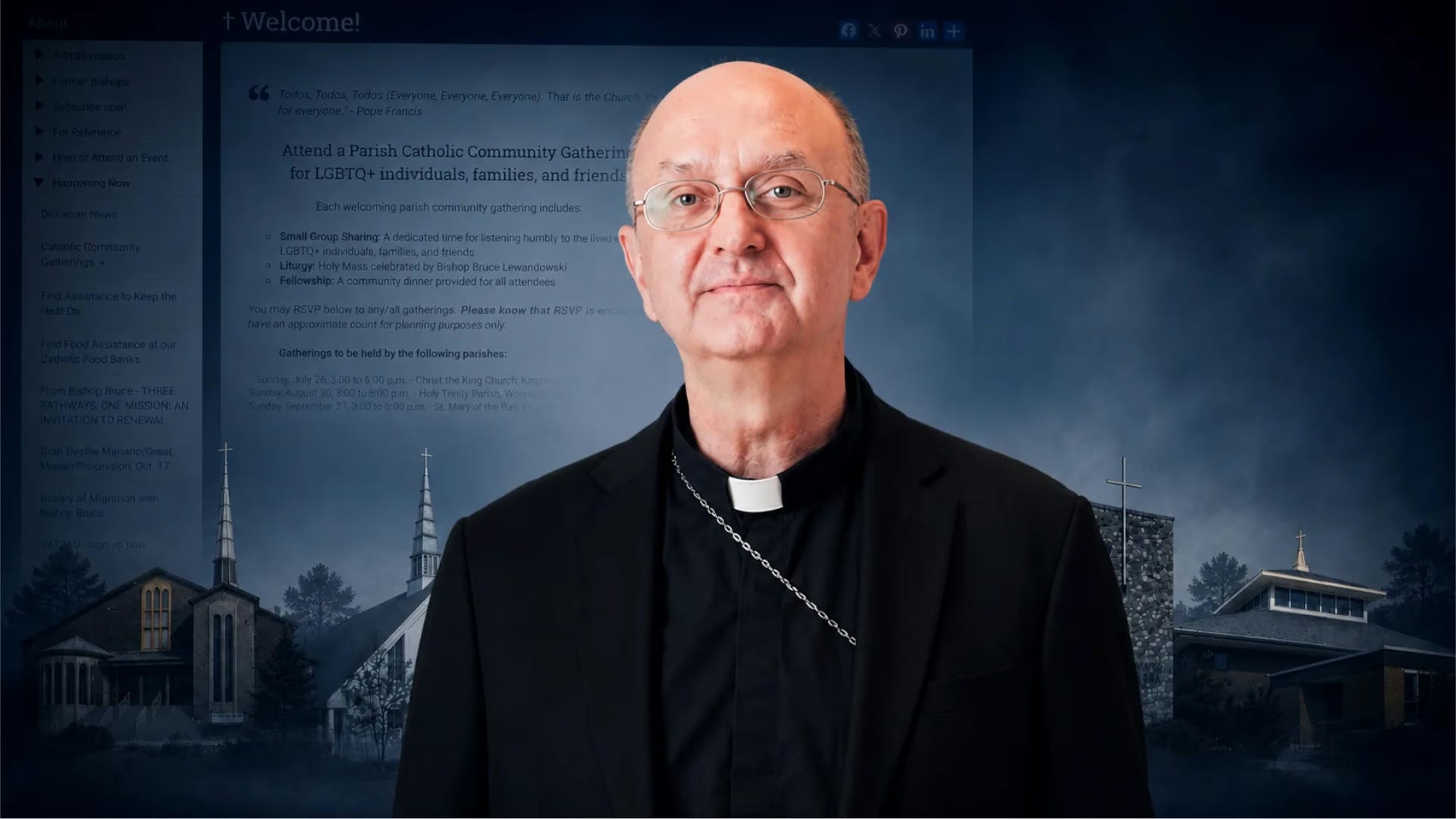
The Diocese of Providence has organized four “Catholic Community Gatherings” for “LGBTQ+ individuals, families, and friends.” Its official announcement opens with Francis’s familiar cry: “Todos, Todos, Todos.” Each gathering combines small-group sharing, a community dinner, and Mass celebrated by Bishop Bruce Lewandowski.
The organizing category comes directly from sexual politics. The diocese has accepted “LGBTQ+” as a pastoral identity, advertised “lived experience” as privileged testimony, and placed the bishop’s Mass inside that framework. The altar supplies institutional recognition to a category built to collapse the Catholic distinction between a person, an inclination, and a sinful act.
The official page can name the acronym, the dinners, the listening format, the participating parishes, and the presiding bishop. It says nothing about chastity, repentance, confession, continence, or the moral law. That silence carries the program’s central message. Participants are gathered under an identity the world has taught them to affirm, while the truths capable of judging and healing that identity are withheld from the invitation.
The omission drew a precise inquiry. The Lepanto Institute asked whether confession would be available and whether attendees would hear a call to conversion. The diocesan communications director answered with a general statement about the bishop’s duty to understand the spiritual needs of his flock and accompany people toward a deeper relationship with Christ and His Church. Neither question received an answer.
The chancery’s evasion is damning. A Catholic diocese was asked whether a sacrament for the forgiveness of sins would accompany four events organized around sexual identity. It refused to say. The communications director retreated into boilerplate about understanding spiritual needs and deepening relationships with Christ. Every chancery knows how to issue a direct answer when it wants one understood.
Cardinal Joseph Ratzinger’s 1986 Letter on the Pastoral Care of Homosexual Persons reads like a reply drafted for Providence. He wrote that no authentic pastoral program could gather homosexual persons while avoiding a clear statement that homosexual activity is immoral. Frequent and sincere use of Penance belonged at the center. His conclusion was wonderfully resistant to chancery prose: “Only what is true can ultimately be pastoral.”
Providence has set itself against that standard. Ratzinger required moral clarity and frequent Penance. Lewandowski’s published program offers identity-based listening, dinner, and Mass, while his chancery refuses to confirm whether confession will even be available.
Francis’s “Todos, Todos, Todos” supplies the theological alibi. Repeated without the command to repent, it turns the universality of the Church’s mission into universal affirmation. Christ called Zacchaeus and restitution followed. He saved the woman taken in adultery and commanded her to abandon her sin. He loved the rich young man and imposed a demand that sent him away sorrowful. Every Gospel welcome opens onto conversion, sacrifice, and the Cross.
Providence reverses that order. The identity category is fixed in advance. Lived experience becomes the favored testimony. The bishop listens, the group shares, and the Eucharist arrives inside an atmosphere already structured as recognition. The program teaches through its sequence even if the chancery avoids writing the heresy in a press release.
The Mass is the unbloody renewal of Calvary, never a ceremonial seal placed upon a demographic category. The Church listens first to God, confesses His revelation, offers the sacrifice of Christ, and commands communicants to examine themselves. Canon 916 requires anyone conscious of grave sin to receive sacramental confession before Communion. The rule binds every Catholic. A bishop who advertises dinner while refusing to answer whether confession will be available has exposed the priorities of his program.
This false pastoral care places souls in danger. It withholds the call to chastity, encourages participants to understand themselves through an ideology opposed to Christian anthropology, and places the Eucharist at the climax of the exercise. The language is warm because the error is severe: affirmation is offered where conversion is required, and the sacrament of unity is recruited to ratify an identity founded upon rebellion against the natural law.
Morelia received the archbishop the activists were waiting for
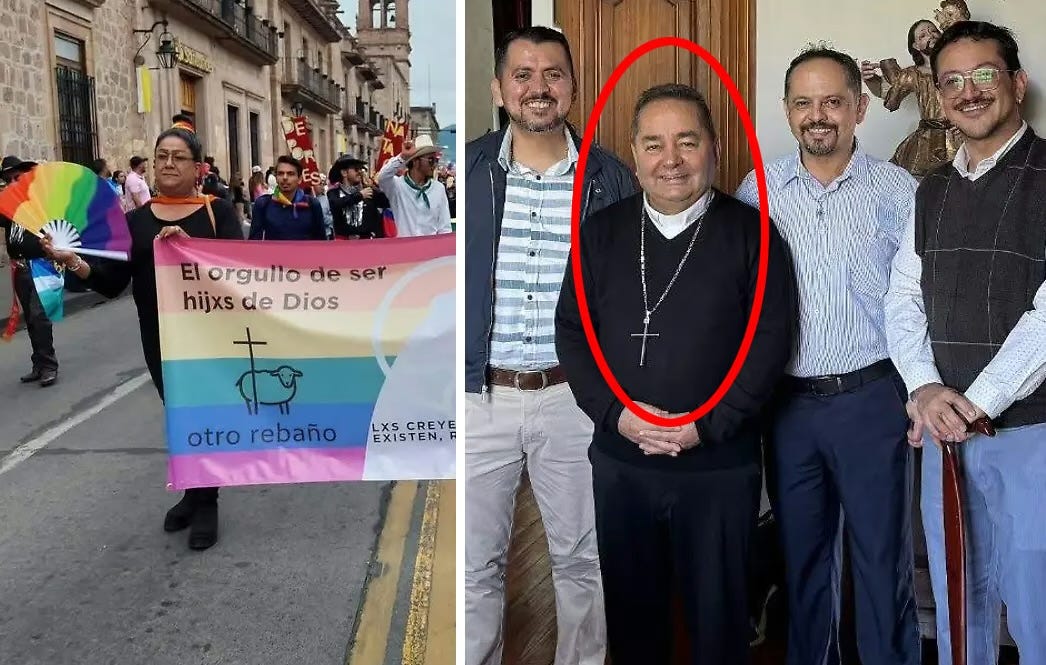
In Morelia, the activist group Otro Rebaño has spent the past year demanding ecclesiastical recognition. It marched in the 2025 Pride parade beneath a banner proclaiming “the pride of being children of God” and declaring that “LGBTIQ+ believers exist, resist, and insist.” The group criticized Catholic doctrine as hostile, invoked Fiducia supplicans, and sought institutional space inside the parishes. Then-Archbishop Carlos Garfias Merlos used confused clinical language about homosexuality, yet he maintained the decisive boundary: homosexual identity groups would receive no foothold inside Catholic churches.
Otro Rebaño addressed its protest to Garfias and his coadjutor, José Armando Álvarez Cano. A year later, the contrast between the two prelates had become the story. In a June 16 profile, the group’s coordinator Erick Ballesteros described Álvarez as receptive and willing to listen. After meeting him, the group announced that the encounter had filled its members with hope.
The meeting supplied exactly the public recognition Otro Rebaño had been seeking. The group emerged speaking of hope because Álvarez’s record gave it every reason for hope. No reported correction of its Pride activism, attack on Catholic doctrine, or demand for parish space disturbed the celebratory message.
As Bishop of Tampico, Álvarez embraced Fiducia supplicans immediately after its publication. A local newspaper announced “Blessing of same-sex couples, yes” and quoted him promising blessings for all God’s children. He treated the declaration as the dawn of “new times” and acknowledged that such blessings were already occurring in many parishes.
The document he welcomed was itself a fraud of carefully managed vocabulary. In 2021, the doctrinal office declared that the Church lacked power to bless homosexual unions because God “does not and cannot bless sin.” Less than three years later, Fiducia supplicans advertised an “innovative contribution” permitting blessings of same-sex couples. It denied changing marriage while authorizing a public religious act directed toward the couple precisely as a couple. The disclaimer preserved the old sentence on paper; the blessing destroyed its force in practice.
Álvarez’s path to Morelia reveals how personnel is used to make the revolution irreversible. Francis appointed him coadjutor in January 2025. Under Canon 409, a coadjutor automatically succeeds when the see becomes vacant. Francis therefore planted the next archbishop beside Garfias while Garfias still governed.
The appointment passed through the Dicastery for Bishops while Robert Prevost was its prefect. The available record does not reveal which names Prevost personally favored, but it establishes his institutional place at the summit of the process. When Leo accepted Garfias’s resignation on January 19, the Vatican bulletin called the result a “resignation and succession”. He activated the succession Francis had prepared through the dicastery Prevost once led.
Álvarez’s enthusiastic implementation of Fiducia supplicans presented no impediment to promotion. His record was known, public, and easily discoverable. Within months of his succession, the pressure group that had encountered closed parish doors under Garfias was posing with the new archbishop and announcing hope.
That photograph is an act of government. Promotions teach priests which positions Rome rewards and activists which doors will soon open. Morelia required no new decree. The prepared succession moved the boundary on its own, because the candidate was already the policy.
Leo constitutionalizes Francis’s fait accompli
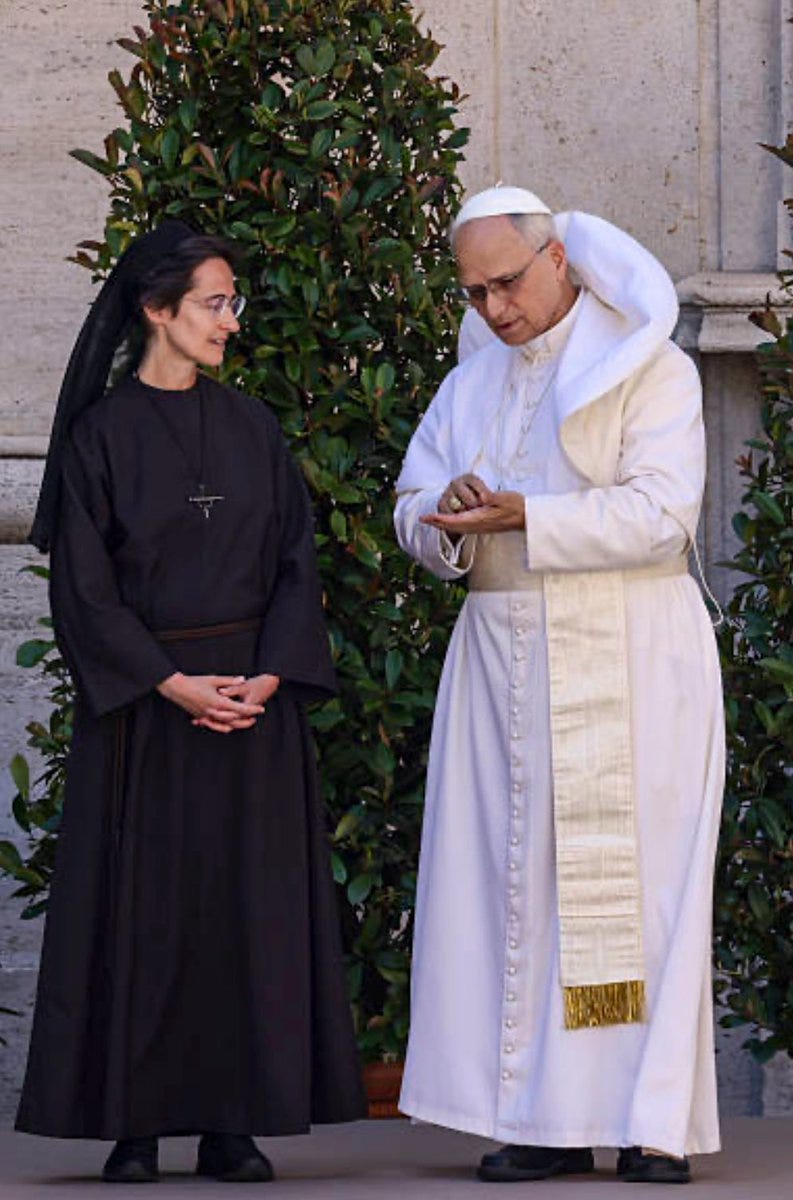
Francis appointed Sister Raffaella Petrini president of the Pontifical Commission for Vatican City State and president of the Governorate in February 2025. She became the first woman to hold the posts. The Fundamental Law Francis had promulgated only two years earlier still reserved the commission’s presidency to a cardinal. His personnel decision outran his own published constitution.
Leo rescued the appointment. On November 19, 2025, he issued a motu proprio repealing the cardinal requirement and allowing “other members” to serve as president. On July 31, 2026, he promulgated a new 25-article Fundamental Law. The Vatican’s own explanation states that the constitution incorporates his amendment and replaces Francis’s 2023 text.
Vatican City is a civil state, and women have always been capable of administering temporal affairs. That observation leaves Leo’s action untouched. This is the papal state, an absolute monarchy whose sovereign claims full legislative, executive, and judicial authority by virtue of being Roman Pontiff. The Pontifical Commission exercises delegated legislative power, and its president also heads the executive Governorate. The office was reserved to a cardinal until Francis chose Petrini and Leo erased the restriction.
The reform advances the Francis program of detaching governance from sacred order and recasting it as managerial function. Police, museums, post, health services, utilities, and customs fill the official descriptions. The cardinal’s place disappears. A non-cardinal president becomes constitutionally normal, and the first beneficiary is the woman Francis selected as a symbolic breakthrough.
The sequence exposes government by fait accompli. Francis placed a favored official into an office his own constitution reserved to a cardinal. Leo praised the “solutions” that had developed, changed the law to protect the appointment, and incorporated the change into a replacement constitution. The official explanatory note boasts that the new text “confirms and integrates” the recent changes.
The appointment created the precedent. Leo’s November decree removed the legal obstacle, and the new constitution now shields the result.
Leo’s defenders continue to describe his reign as a period of patient evaluation, as though Francis’s experiments remain on a table awaiting judgment. Leo has already rendered judgment. He used the most durable language a sovereign possesses and made Francis’s improvised arrangement part of the fundamental law of the state.
This was a voluntary act of continuity. Leo could have restored compliance with the existing cardinal requirement by appointing a cardinal president. He chose to abolish the requirement, preserve Petrini’s position, and secure the innovation against reversal. Francis created the exception; Leo gave it constitutional permanence.
The same revolution wears four costumes
Apologists will separate these stories and shrink each one to its least offensive description. Saint-Eustache hosted art. Lewandowski welcomed people to Mass. Álvarez met members of his flock. Leo modernized a civil administration. The descriptions are technically true and morally evasive.
Saint-Eustache used consecrated architecture to sacralize an environmental creed. Providence organized the Eucharist inside a homosexual identity program that refuses to mention conversion. Morelia’s prepared successor gave an activist group the episcopal recognition it had demanded. Leo altered the law of the papal state to preserve Francis’s symbolic experiment in female governance.
The ideological direction never varies. Providence has never announced four bishop-led gatherings for adulterers and their supportive friends, centered on humble listening to the lived experience of remarriage while confession disappears from the program. Saint-Eustache will hardly place a monumental Last Judgment above the nave for three months and invite tourists to contemplate hell. A bishop known for resisting Fiducia supplicans would receive no triumphant welcome from activists as the face of a new ecclesial future.
Ambiguity always shields the revolution. Clarifications arrive only after scandal erupts, and they preserve the action everyone understood in the first place. Appointments move the boundary without a doctrinal decree. Law then secures what personnel and practice have already accomplished.
For Catholics, the cumulative record is the point. The argument never depended upon one sculpture, one photograph, or one administrative appointment. It arises from decades in which the men presented as Catholic authorities have repeatedly used the Church’s name, buildings, sacraments, offices, and laws to form souls in principles opposed to the religion they claim to govern.
Indefectibility requires the Church to remain a recognizable teacher of revealed truth and a safe guide toward salvation. What becomes of that claim when putative shepherds repeatedly lend Catholic prestige to movements opposed to natural law, package the Eucharist inside identity politics, turn consecrated spaces into platforms for secular spirituality, promote officials who implement the change, and legalize the precedents afterward?
The Church can suffer corrupt and cowardly prelates. Indefectibility still has content: she cannot become a dependable public instrument for forming souls in principles contrary to faith and morals. The habitual pattern therefore reaches the marks of the Church herself. It exceeds a collection of imprudent appointments, vulgar artworks, and badly worded invitations. The question arises because the machinery presented as Catholic authority keeps producing anti-Catholic formation with official approval.
The standard answer—wait, interpret generously, distinguish again—requires the faithful to become ghostwriters for a hierarchy that communicates clearly whenever it advances error and discovers ambiguity whenever Catholics object. Leo’s record makes the plea for more time absurd. He watched the episcopal selection system from its summit as Francis’s prefect. In office, he has preserved Fiducia supplicans, activated the prepared succession in Morelia, regularized Petrini’s presidency, and written the arrangement into a new constitution.
Catholic authority exists to consecrate the world to Christ, judge ideologies by revelation, call sinners to repentance, guard the sacraments from sacrilege, and govern according to the divine constitution of the Church. The authorities in these stories reverse that mission. The world’s causes are carried into the sanctuary and granted Catholic legitimacy. The hard words of the Gospel disappear. Activists learn that persistence will be rewarded, while Catholics are ordered to admire the process as listening, accompaniment, culture, and reform.
The ecclesiological scandal has become impossible to postpone. Men claiming the authority of the Catholic Church are using her altar, architecture, episcopate, and law to advance ideas the Church exists to condemn and convert. Their silences establish the practice, their photographs establish the precedent, and their laws preserve the result. By the time Catholics are invited to debate what changed, the change is hanging over the nave, printed on diocesan stationery, smiling beside the archbishop, and secured in Leo’s constitution.
If you value independent Catholic analysis and want to help keep this work going, you can make a contribution or subscribe below. Every donation and subscription directly supports the writing, research, and production of Hiraeth in Exile.
Thank you for helping preserve independent Catholic journalism rooted in truth and tradition.
Comments
Nothing yet. Say the first thing.
Sign in to join the conversation.