
NOTE:
First, a big thank you to all who have contributed so far to the Give Send Go for Monique. She responded today.
”Thank you everyone! I’m very grateful to those who have prayed, shared, and donated. Your messages are very touching, as well. The Lord has used you to save me from drowning financially, emotionally, and spiritually. May Sofia pray for all of you.”
If you have not yet heard about the fundraiser, please find out more here:
Now on to the Sunday meditation.
God bless!
Chris
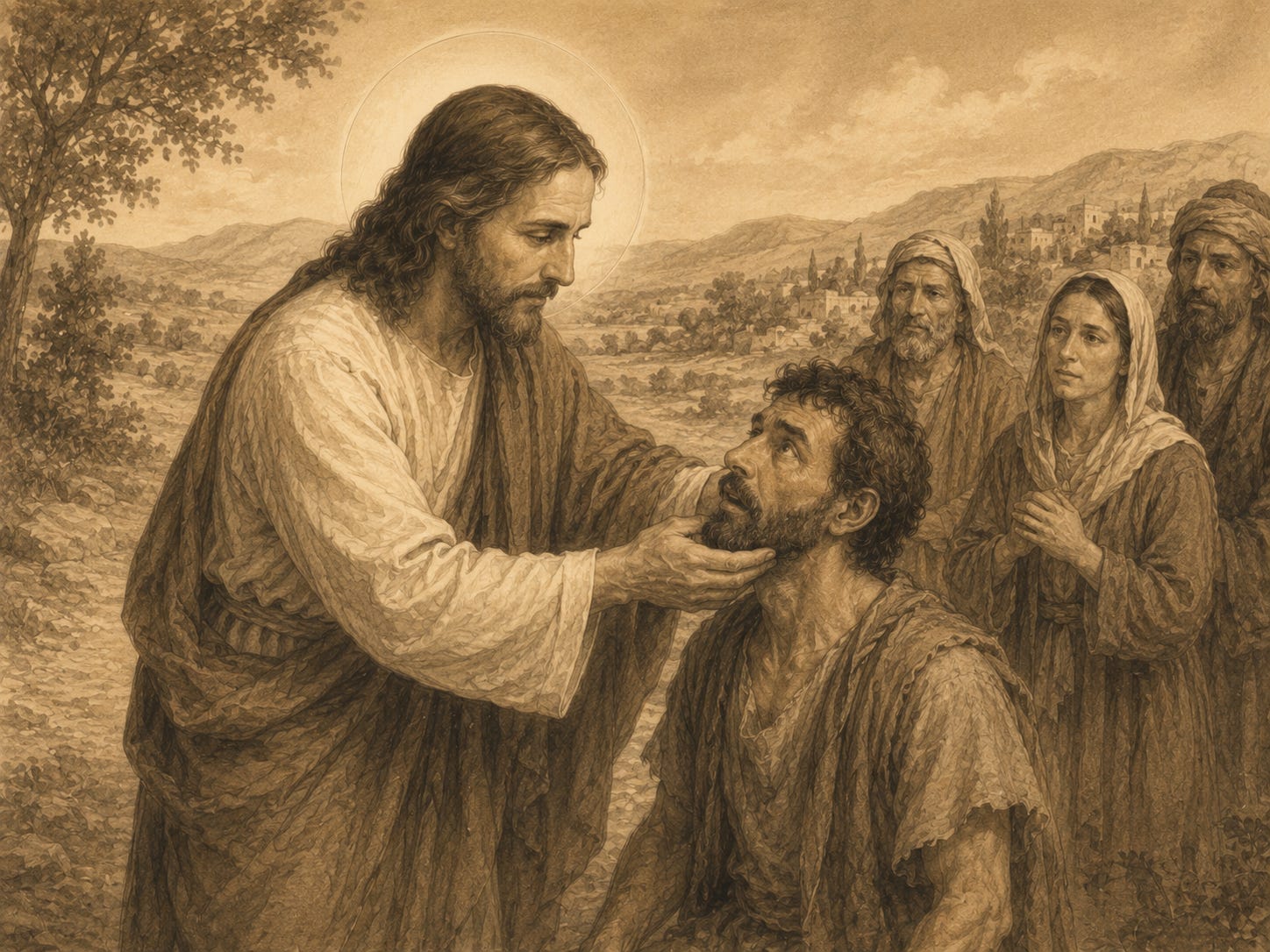
Before the old Roman rite of Baptism was stripped down, the priest performed a small ceremony that many Catholics today have never seen.
He touched the child’s ears and nostrils and said the word spoken by Christ in today’s Gospel:
Ephpheta.
Be opened.
The gesture came directly from St. Mark. The Church took seriously what Our Lord did to the deaf man in Decapolis and carried the action into the baptismal rites. Dom Guéranger points out that the Church understood the miracle as something larger than the cure of one unfortunate man. The deaf-mute stands for fallen man himself. Christ opens him so that he can hear divine truth and speak rightly of God. The old baptismal ceremony made that interpretation visible.
That is a useful thing to remember on a Sunday when St. Paul says something almost equally simple:
“For I delivered to you first of all, what I also received.”
Received. Delivered. Opened.
Those three words describe Catholic life better than half the language produced by modern church conferences.
We receive the Faith. We hand it on. Grace opens us enough to hear it.
The whole crisis of the Church can be measured by what happened when men grew embarrassed by that order.
The Mass begins with confidence.
“God is in His holy dwelling, God Who makes men of one mind to dwell in a house; He shall give power and strength to His people.”
This is a strange Introit for an age in which Catholics often feel scattered.
One family drives an hour to Mass because its neighborhood parish has become unbearable. Another depends upon an SSPX chapel. Another has found an independent priest. A young couple discovers the old religion through an obscure recording online because no one in their parish ever mentioned it. Some Catholics have reached grave conclusions about the men claiming authority in Rome. Others remain uncertain where the legal boundaries finally lie, while knowing perfectly well that the crisis itself is real.
The old Mass begins by reminding all of them that God has suffered no eviction.
He is in His holy dwelling.
The Psalm does not say that every visible administrator will govern wisely, but that God remains. He gives strength to His people. His enemies scatter when He arises.
That distinction saves the soul from two errors. We need neither pretend that ecclesiastical devastation is imaginary nor behave as though the survival of Catholicism depends upon our nervous systems.
Goffine tells the faithful to pray at this Introit for brotherly love and protection “against our enemies within and without.” Catholics of earlier centuries were evidently capable of admitting that enemies could exist inside the visible household without concluding that God had abandoned it.
The phrase “makes men of one mind to dwell in a house” also says something important about unity. Catholic unity has a content. The household has a Father, a creed, a sacrifice, commandments, and inherited worship. Men become one because they are gathered around the same truth.
A committee can produce unanimity by lowering the stakes until nobody has anything worth fighting over. That is a different achievement.
The Collect is one of those Roman prayers that becomes more unsettling the longer you sit with it.
God, we say, gives more than we deserve and even more than we desire. Then we ask Him to forgive whatever our conscience dreads and to give us things our prayer “does not venture to ask.”
There are sins a man names easily in confession.
There are others he circles around for years.
The grudge that has become part of his personality. The marriage in which affection has been replaced by bookkeeping. The habit he has domesticated by giving it a respectable name. The act of cowardice he still describes as prudence. The cruelty hidden inside a correct opinion.
Conscience knows before the mouth admits it.
And the Collect does something wonderfully Catholic. It does not tell us to silence that dread with self-esteem. It asks God to forgive its cause.
Then it goes further.
Give us what we are afraid even to request.
A man may ask to escape a trial when what he needs is courage inside it. A mother may pray that a wandering child be spared every humiliation, while Providence knows that one hard collapse may finally send him to confession. A priest may ask for peace in his parish when God intends to make him strong enough to preach what has been avoided for twenty years.
Divine generosity frequently arrives disguised as an answer we would have been too frightened to formulate.
Two brothers had stopped speaking over their father’s estate.
The quarrel began with money, though after five years neither man could explain the original numbers without checking old emails. By then the money had become secondary. Each had assembled a case.
Michael knew exactly what his brother had said after the funeral. He remembered who failed to show up when their mother needed help. He could recite the insulting text message almost word for word.
He also prayed the Rosary every night.
One Saturday his confessor asked a question that irritated him.
“When you pray for your brother, what do you ask God to change?”
Michael answered immediately.
“His heart.”
The priest waited.
Michael knew what was coming.
“And yours?”
The silence lasted long enough to become uncomfortable.
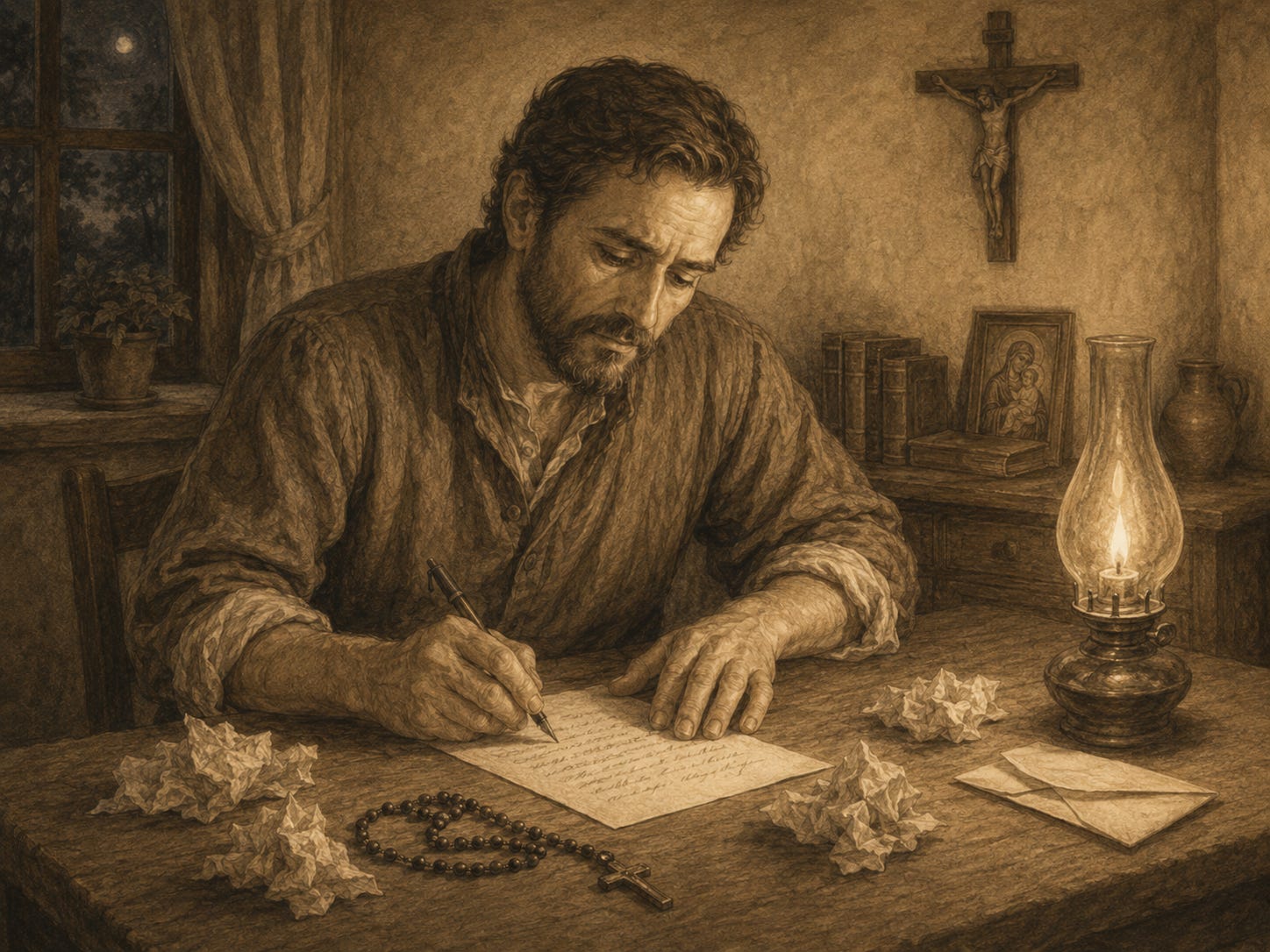
That evening Michael sat at the kitchen table with a sheet of stationery and tried to write his brother a letter. The first version explained the entire history. He tore it up. The second was shorter and still managed to prove that he had been right.
The third began:
“I have been rehearsing what you did to me for five years. I have spent much less time asking what I did to you.”
He admitted two things for which he owed an apology. He asked for nothing in return.
His brother never answered.
For three months.
Then an envelope arrived. Inside was the original letter, folded twice, with a note beneath it.
“I kept this because I wasn’t ready to answer it. I think I am now.”
The reconciliation took almost a year. Some questions about the estate remained disputed. The brothers never reached perfect agreement about the past.
They began speaking again.
There are knots of the tongue that require a miracle before a man can say one clean sentence.
St. Paul turns our attention toward the Resurrection:
“I recall to your minds the Gospel that I preached to you, which also you received, wherein also you stand, through which also you are being saved, if you hold it fast.”
Then comes the language on which the Church lives:
“For I delivered to you first of all, what I also received.”
Paul does not appear as a religious entrepreneur with a new pastoral model.
He is a custodian.
He received something prior to himself, carried it faithfully, and placed it into other hands.
Goffine draws the obvious lesson: the Catholic must persevere firmly in the same Faith received from the Apostles. He ties that perseverance to St. Paul’s humility, because Paul attributes everything good in himself to grace.
St. Thomas, commenting on Paul’s statement that grace in him “was not in vain,” says that Paul used grace for the purpose for which it had been given. Grace produced work. It opened a persecutor, and the man who had tried to silence the Church became one of her greatest voices.
There is a magnificent severity in Paul’s sequence.
Received. Stand. Hold fast. Saved.
The Gospel is handed down as something definite enough to retain and definite enough to lose.
That language sits awkwardly beside the habit, now several generations old, of treating Catholic doctrine and worship as material perpetually awaiting reinterpretation. The old religion thinks in terms of inheritance. The conciliar establishment developed a taste for process.
One hands down.
The other keeps reopening.
After his mother died, a man named Stephen spent several weekends clearing her house.
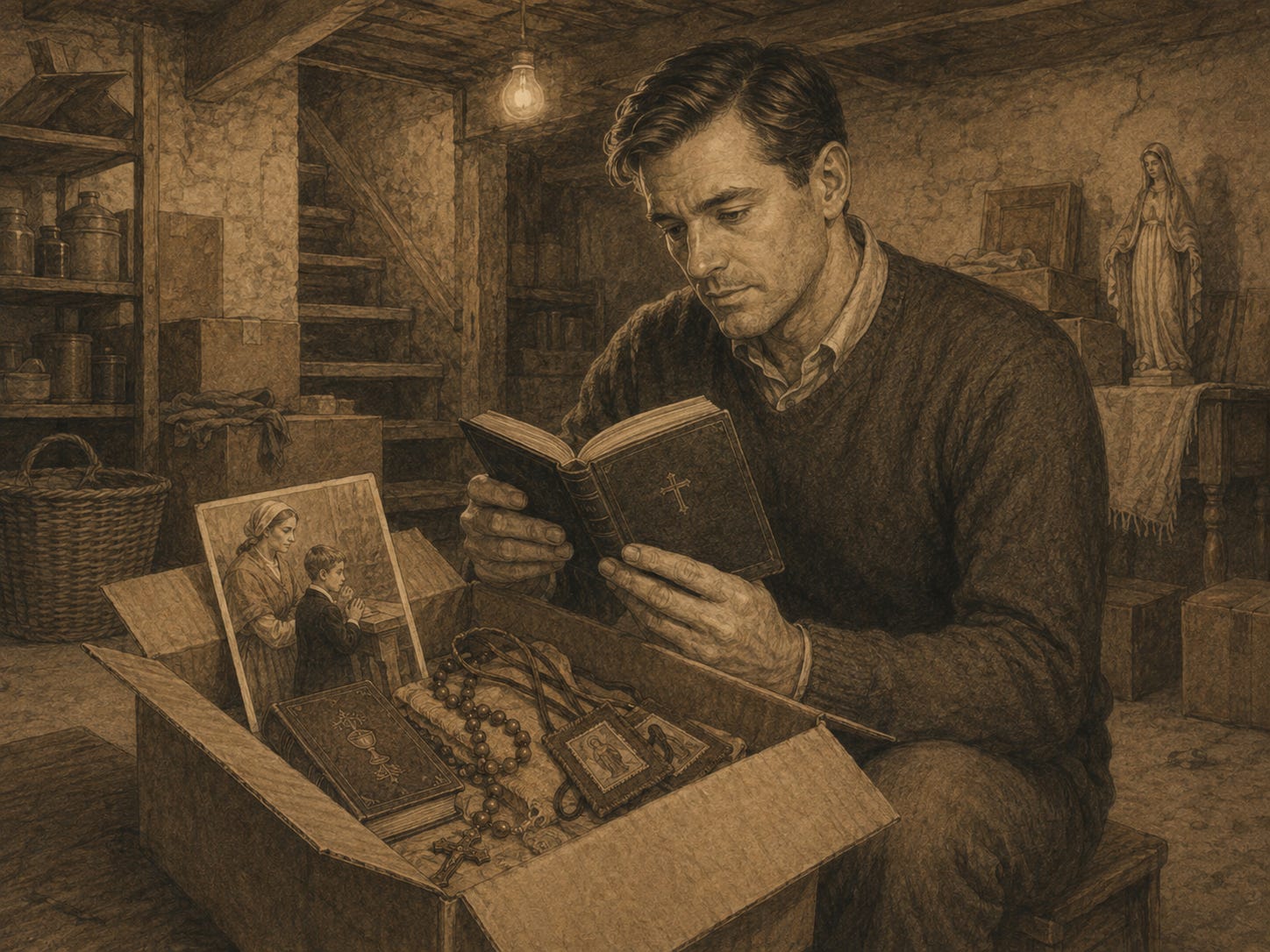
Most of the work was ordinary: old tax returns, kitchenware, winter coats, furniture no one wanted. In the basement he found a cardboard box with his name written across the lid in his mother’s handwriting.
Inside were the Catholic things from his childhood.
His First Communion missal.
A scapular he had worn until the cord broke.
The Baltimore Catechism from seventh grade.
A photograph of his mother kneeling beside him at the Communion rail.
Stephen had been away from Mass for sixteen years.
He sat on the basement floor and opened the catechism mostly out of curiosity. Several answers had been underlined in pencil. Beside one his mother had written a date.
It was the week he left for college.
He remembered the argument before he drove away. She had begged him to find a parish. He accused her of being afraid of the modern world.
The answer she had marked concerned the purpose for which man was created.
Stephen closed the book.
Then opened it again.
He took the box home.
Nothing dramatic happened that night. He did not wake the next morning transformed. For several weeks the box sat beside his desk.
Eventually he looked up the Mass time at the church near his apartment.
He sat in the back.
A month later he went to confession.
His mother had spent years fearing that everything she taught him had disappeared. Much of it had simply been waiting in a basement for the right hour.
Tradition often survives that way.
Someone keeps the book.
Someone remembers the prayer.
Someone refuses to throw the inheritance away.
St. Paul does something in this Epistle that modern therapy would probably advise him against.
He remembers his shame.
“I am the least of the Apostles, and am not worthy to be called an Apostle, because I persecuted the Church of God.”
He does not live inside that shame. He refuses to erase it, because the memory makes grace intelligible.
“But by the grace of God I am what I am.”
That sentence contains neither self-hatred nor self-congratulation. Paul knows what he did. He knows what God did. The comparison destroys pride.
A Catholic who forgets his sins eventually begins treating grace as personality. He thinks he was simply born more perceptive, more disciplined, more orthodox, more courageous than other people.
Paul remembers the road to Damascus.
That memory never stopped him from rebuking Peter, condemning false teachers, confronting immorality, and defending the Gospel with apostolic ferocity. Humility made him more useful to truth because he knew whose truth it was.
This point matters for traditional Catholics in particular.
We have every reason to expose error. The last sixty years have supplied enough of it to occupy several lifetimes. Yet the Faith we defend was given to us.
The old Mass was given. The catechism was given. The priests who taught us were given. The books that survived the wreckage were given. Even the ability to recognize the wreckage was given.
The traditional Catholic can therefore fight hard without becoming spiritually impressed with himself.
Paul did.
The Gospel now becomes almost intimate.
They bring Christ a man who cannot hear properly and can barely speak. Our Lord does something curious: He takes him away from the multitude.
Then come the physical gestures. Fingers into the ears. Spittle upon the tongue. Eyes raised to heaven. A groan. And finally:
Ephpheta.
Guéranger lingers over these details because a single act of divine will could have cured the man. Christ chooses a sequence of visible gestures because the miracle teaches as well as heals. Guéranger says explicitly that the Church applied the scene to all of us in the ceremonies of Baptism.
Goffine sees another lesson in Christ drawing the man away from the multitude. The soul sometimes needs distance from noise in order to hear God.
That observation has acquired a new force in 2026.
We carry the multitude in our pockets.
Every spare minute arrives already occupied: messages, video, scandal, advertising, sports, politics, outrage, entertainment. Even Catholic life can become another stream of constant stimulation.
There are times when the answer to spiritual deafness is embarrassingly practical.
Close the door. Put the phone elsewhere. Sit before the tabernacle. Read ten pages slowly. Say the Rosary without an audio track playing underneath it.
A man can spend the whole day discussing the crisis in the Church and give God no uninterrupted five minutes in which to address his own.
The problem there is not Catholic reporting. We need men willing to document what is happening. The problem is noise becoming a substitute for recollection.
Christ sometimes takes the man aside before He opens him.
A father and his seventeen-year-old son had developed a ritual on the drive home from Mass.
The father complained.
Sometimes the complaints were justified. The sermon had been weak. A bishop had issued another statement. Rome had done something indefensible. Another Catholic institution had embarrassed itself.
The boy usually listened.
One Sunday, the father started the engine, pulled out of the chapel parking lot, and began talking about the latest outrage. After a few minutes he noticed that his son was staring through the window.
“What?”
“Nothing.”
“You’ve been weird all morning.”
The boy shrugged.
Then, with the peculiar cruelty of an honest teenager, he said, “I don’t think I know what you like about being Catholic.”
The father started defending himself.
His son interrupted.
“I know what you hate. I know what’s wrong with Rome. I know which bishops are bad. I just don’t know what you love.”
The father drove another block and pulled into a parking lot. He turned off the car. They sat quietly for a while.
Then he told his son about the first High Mass he had ever attended: the incense under the church lamps, the silence of the Canon, the sudden sound of the bells, the strange realization that something was happening at the altar that had nothing to do with entertaining him.
He told him about the priest who heard his first adult confession. He told him why he loved the Sacred Heart.
The boy asked questions.
The father still covered the crisis at home. He still explained what Rome was doing and why it mattered. Something changed in the order.
His son began hearing about the treasure before hearing about the thieves.
A few months later the boy asked to learn the responses for serving Low Mass.
There is a time to sound an alarm.
There is also a generation that needs to know what the alarm is protecting.

The irony of this Gospel in our present moment is difficult to miss.
Rome speaks constantly about listening.
The synodal implementation process confirmed and promoted under Leo XIV now runs through diocesan, national, continental, and Vatican assemblies toward 2028. Official documents call for “conversation in the Spirit,” listening to signs, narrative reports, letters between Churches, and the continued development of a “synodal missionary Church.”
Leo himself described synodality in June as something embodied in collegial work and said that all the baptized participate in it.
The Church certainly needs bishops capable of listening.
The question is what they hear.
St. Paul’s rule is brutally simple: I delivered what I received.
The Deposit of Faith does not emerge from a listening session. Revelation enters the meeting already true. The Mass inherited from our fathers does not acquire its value from the enthusiasm of a focus group. Moral law does not wait upon narrative reports. The Roman authorities can organize conversations until 2028, 2038, or 2088. No process has jurisdiction over what God has revealed. This is where the present conflict with the Society of Saint Pius X becomes especially revealing.
On July 1, the SSPX proceeded with four episcopal consecrations at Écône after saying that a continuing state of grave necessity required bishops for its apostolate. The Vatican decree issued afterward called the act schismatic and declared excommunications; the Society filed a preliminary canonical appeal and continued to argue necessity and the salvation of souls.
Those facts raise canonical arguments larger than one Sunday meditation. The spiritual irony belongs here.
Rome demands that traditional Catholics listen to men who have spent decades refusing to hear why those Catholics are in the wilderness. Listen to the families who watched altars dismantled. Listen to the priests who saw doctrine reduced to ambiguity. Listen to the Catholics who were told that the Mass of their ancestors was dangerous while every modern experiment required patience. Listen to the young people who discovered tradition after the official structures failed to give it to them.
The SSPX controversy did not fall out of a clear sky in July 2026. It arose from a crisis with a history.
Before another ecclesiastical assembly lectures Catholics about listening, the Gospel gives Rome a word of its own:
Ephpheta.
Once the man hears, he speaks correctly. That order is important. Catholic speech should come after Catholic hearing.
A man who has never listened to the Fathers becomes a theologian on social media. A cleric who has never absorbed the Roman liturgical inheritance becomes an architect of worship. A bishop formed by the latest pastoral vocabulary lectures families who have spent thirty years keeping the Faith alive.
The tongue runs ahead of the ear.
Goffine attaches to this Sunday a long instruction on the dangers of the tongue. He invokes St. James: the tongue can bless God and curse men; it can ignite whole communities. His remedy is restraint, judgment, and prayer for divine help.
That counsel does not require silence before error. St. Paul was hardly silent. It requires speech governed by truth rather than appetite.
There is a difference between exposing a bishop’s public teaching and circulating an unverified accusation about his private life. There is a difference between calling heresy heresy and enjoying another man’s damnation. There is a difference between warning the faithful and making oneself indispensable to their anger.
When Christ loosens the tongue, the man “spoke right.”
Accuracy belongs to the miracle.
A cabinetmaker named Frank had employed his nephew for six years.
They were good craftsmen and terrible partners.
Frank corrected everything loudly. His nephew responded by becoming secretive. Small errors turned into arguments about character. Eventually the younger man quit in the middle of a job and found work across town.
For almost a year they saw each other only at family gatherings. Frank told everyone the same story: the boy had become thin-skinned.
One evening he was repairing a drawer in the shop when he found his nephew’s old pencil inside the workbench. The sight of it brought back an argument in which Frank had humiliated him in front of two customers.
The correction had been deserved. The humiliation had been deliberate. Frank sat on a stool for a long time. The next morning he drove to the other shop. His nephew came outside with his arms crossed.
Frank had rehearsed a complicated speech. He abandoned it.
“I taught you a lot about wood,” he said. “I also taught you that being right gives a man permission to be cruel. I was wrong about that.”
His nephew looked at him without answering.
Frank continued.
“I’m sorry.”
Nothing dramatic happened. The nephew did not return to the family business. Months later they began having lunch together on Fridays. Eventually Frank was asked to be godfather to his nephew’s first child.
The hardest use of the tongue is sometimes the smallest sentence.
Grace loosens what pride has tied.

The crowd’s verdict on Christ is one of the most beautiful lines in St. Mark:
“He has done all things well.”
Cornelius a Lapide sees in the miracle an image of Christ repairing what sin has disordered. The cure restores the man to the right use of his faculties. The ears hear; the tongue speaks. The man is made whole enough to do what those organs were created to do. The Fathers preserved by St. Thomas also read the physical actions sacramentally and morally: Christ touches the senses so that the inner man may be opened.
This explains the Postcommunion.
We ask that the sacrament bring help “in mind and body,” so that being cured in both we may experience the full effect of the heavenly remedy.
Catholic redemption is wonderfully concrete. God saves souls who live in bodies. He sanctifies ears, tongues, appetites, hands, money, bedrooms, meals, work, and speech. The same religion that contemplates the Trinity cares whether a man controls his temper in the kitchen. The same Church that defines the hypostatic union tells us what to do with our wealth.
The Communion antiphon says:
“Honor the Lord with your wealth, with first fruits of all your produce.”
Give God the first part. The first hour of Sunday. The first claim upon income. The first attention in the morning. The first allegiance of the intellect. The first loyalty of the child’s education.
Modern life trains us to give God the remainder. Whatever time is left after work and entertainment. Whatever money remains after appetite. Whatever moral claims survive public opinion. Whatever doctrine can be fitted around the age.
The old religion begins at the other end.
First fruits.
A young couple had reached the month when every bill seemed to arrive together.
The transmission failed. Their youngest needed dental work. The husband’s overtime had been cut. They sat at the kitchen table with a calculator and began removing everything optional.
At the bottom of the list was the small amount they gave each month to their chapel. His wife drew a line through it. “We can put it back when this passes.”
Her husband looked at the number. They had argued before about money, and he had no desire to turn generosity into another test of faith.
Then he said, “Let’s cut it in half. I don’t want the first thing we teach ourselves in trouble to be that God gets whatever survives.”
They did.
Nothing miraculous happened to the checking account. The transmission still cost too much. They postponed a trip, bought fewer groceries that were convenient, and spent several uncomfortable months rebuilding savings.
A year later their oldest daughter was filling out a school worksheet about family habits. One question asked what mattered most in their home.
She wrote:
“We go to Mass even when things are hard.”
Her parents had never used those words.
Children hear what a household pays for.
First fruits preach.

There is a way to read the Eleventh Sunday after Pentecost as a compact history of the Church.
Christ opens the ears. The Apostles hear. They receive. They preach. Others stand in what was delivered. Grace works. The Faith moves through centuries because one generation gives the next what it did not invent.
That chain can be damaged. It can become painfully thin. Bishops can betray it. Seminaries can corrupt it. Roman congregations can punish men for holding it. Whole populations can forget it.
The chain begins again whenever someone actually hands on what he received.
A priest teaches the old catechism. A father explains the Mass. A mother corrects a child’s prayer gently until the words are learned. A young man enters a traditional seminary. A family drives farther than should be necessary because the Faith is worth the gasoline. A writer opens the Roman document and tells readers what it actually says. An old woman puts a missal into a grandchild’s hands.
These acts may look small beside the machinery of the modern Church.
So did the fingers in the ears of one deaf man in Decapolis.
The man in the Gospel could not cure himself.
That may be the final humiliation contained in the miracle.
Someone brought him to Christ. Christ took him aside. Christ touched him. Christ sighed. Christ spoke. The man received the opening.
We need the same mercy.
Open our ears to what has been handed down. Open the ears of priests frightened by their bishops. Open the ears of bishops who have listened to committees longer than to Tradition. Open the ears of Rome. Open the ears of fathers whose children have been trying to tell them something. Open the ears of children who have mistaken the world’s noise for freedom. Loosen the tongues of priests who know the truth and have postponed saying it. Loosen the tongues of spouses who owe apologies. Loosen the tongues of Catholics who have been trained to speak about everything except conversion.
And when grace has opened us, give us enough humility to say with St. Paul:
“By the grace of God I am what I am.”
His grace need not be fruitless in us.
The old baptismal command still belongs to the Church.
Ephpheta.
Be opened.
Then hear what was received.
And hand it on.
If you value independent Catholic analysis and want to help keep this work going, you can make a contribution or subscribe below. Every donation and subscription directly supports the writing, research, and production of Hiraeth in Exile.
Thank you for helping preserve independent Catholic journalism rooted in truth and tradition.
Comments
Nothing yet. Say the first thing.
Sign in to join the conversation.