
There is a garden where the King of Heaven knelt in the dark and wept.
Where His sweat came like drops of blood. Where the Son of God prayed that, if there were any other way, the cup might pass.
For 2,000 years we’ve walked past its name without ever stopping to ask what it means.
Because the name of that garden becomes a stunning picture of what was about to happen inside it — and of what God may be waiting to do IN YOU.
Let me show you.
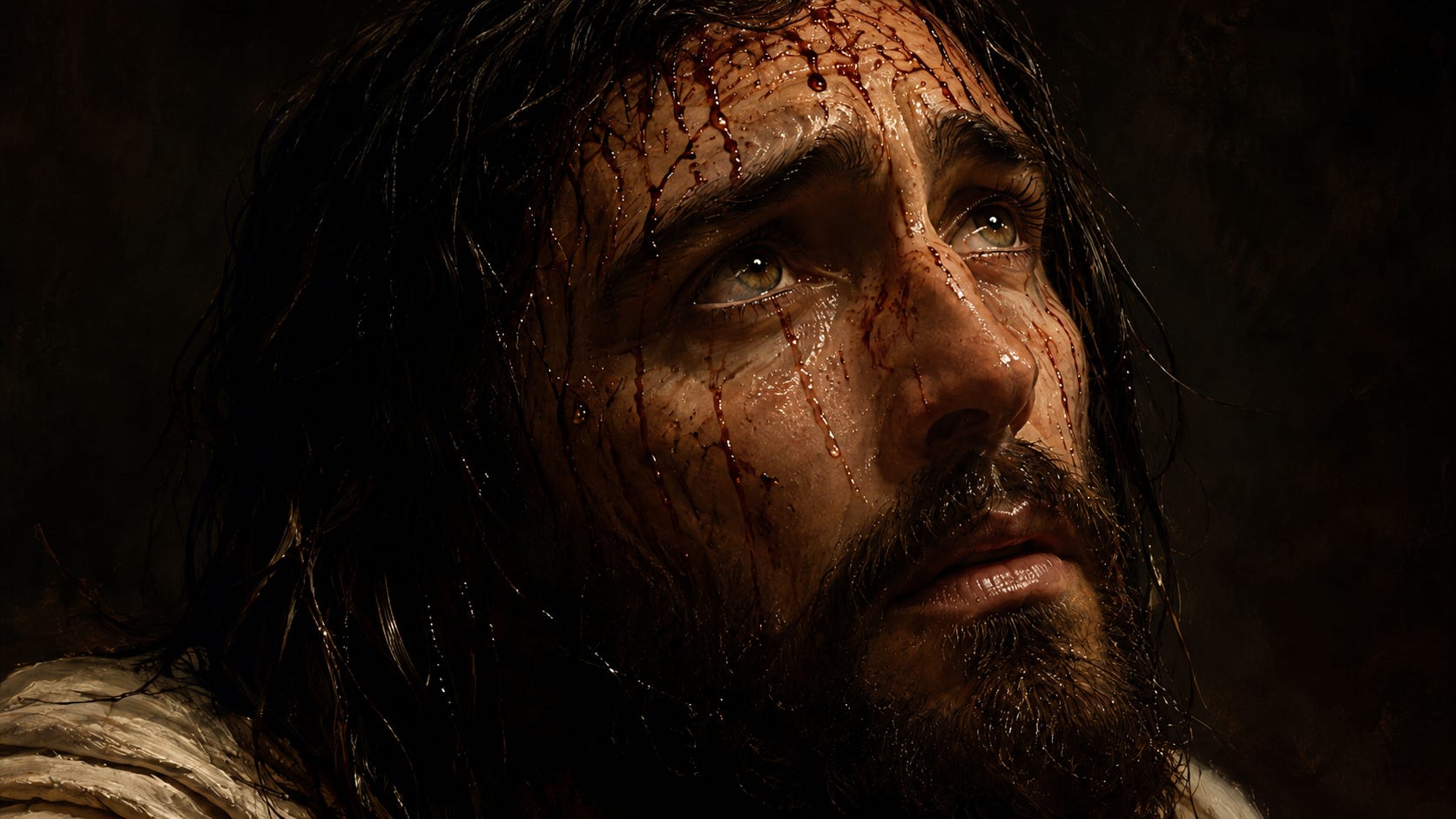

Gethsemane.
We picture the olive trees. The torches. Jesus on His knees in the dark.
But almost nobody stops to ask what the name actually MEANS.
Gethsemane comes from a Hebrew/Aramaic expression meaning “oil press” — Gat Shemanim.
It means oil press.
The most agonizing night in human history took place in a spot literally named for CRUSHING.
And whether or not the Gospel writers intended us to hear the wordplay, the picture is almost impossible to miss.
Hold that one word — press — as we walk through this garden. Because by the time we reach the end, the name itself is going to preach the whole Gospel to you.
Here’s the first thing that should stop us.
On the surface, it looks like Jesus is running. Slip away at night. Cross the valley. Duck into a quiet garden in the dark.
But John tells us the exact opposite:
Now Judas, who betrayed him, also knew the place, for Jesus often met there with his disciples. — John 18:2
Read that again.
Judas knew where to find Him BECAUSE Jesus went there all the time.
It was Passover. Jerusalem was packed with pilgrims — a crowd He could have vanished into. The road to Bethany was wide open. If Jesus wanted to escape, He had a hundred ways out.
Instead, He walks to the ONE place His betrayer is guaranteed to look.
That’s not a man hiding.
That’s a man setting the table for His own arrest.
And there’s a clock ticking underneath all of it. All through John’s Gospel, one phrase keeps surfacing again and again — the hour.
It starts at a wedding in Cana, when His mother wants Him to act:
My hour has not yet come. — John 2:4
Not yet.
His own brothers push Him to reveal Himself:
My time has not yet come. — John 7:6
Not yet.
The crowd tries to seize Him — and can’t:
No one laid a hand on Him, because His hour had not yet come. — John 7:30
Again, at the temple treasury:
No one arrested Him, because His hour had not yet come. — John 8:20
Not yet. Not yet. Not yet.
You can feel the whole Gospel leaning forward, waiting.
And then — the moment some Greeks come seeking Him — the clock finally strikes:
The hour has come for the Son of Man to be glorified. — John 12:23
From that point on, everything changes. At the table:
Jesus knew that His hour had come to depart out of this world. — John 13:1
And at last, on this very night — just before leaving for the garden — He lifts His eyes to heaven and prays:
Father, the hour has come; glorify your Son. — John 17:1
He isn’t just ACCEPTING what’s about to happen.
He’s keeping an appointment He’s been walking toward the entire time.
He went to the one place He knew He’d be found.
Now watch what happens when you set this garden beside the FIRST garden.
Because the whole story of humanity turns in a garden.
Twice.
In Eden, after the first man sinned, here is what he did when God came looking for him:
And the man and his wife hid themselves from the presence of the Lord God among the trees of the garden. — Genesis 3:8
Adam HID. Among the trees. Guilty, ashamed, running from God.
Now come back to Gethsemane.
Watch what Jesus does when the soldiers come looking for HIM:
Then Jesus, knowing all that would happen to him, CAME FORWARD and said to them, “Whom do you seek?” — John 18:4
Incredible.
In the first garden, guilty humanity HID from God among the trees.
In the second garden, the sinless Son STEPPED OUT from among the trees and gave Himself up.
Adam, the first man, hid when God came looking for him.
Jesus, God incarnate, came forward when sinners came looking for Him.
Where the first Adam grasped and took, the Last Adam surrendered and gave.
For as by the one man’s disobedience the many were made sinners, so by the one man’s obedience the many will be made righteous. — Romans 5:19
Scripture even gives Jesus that very title:
The first man Adam became a living being; the last Adam became a life-giving spirit.
— 1 Corinthians 15:45
And once you see it, you realize the whole story of Scripture is told in gardens.
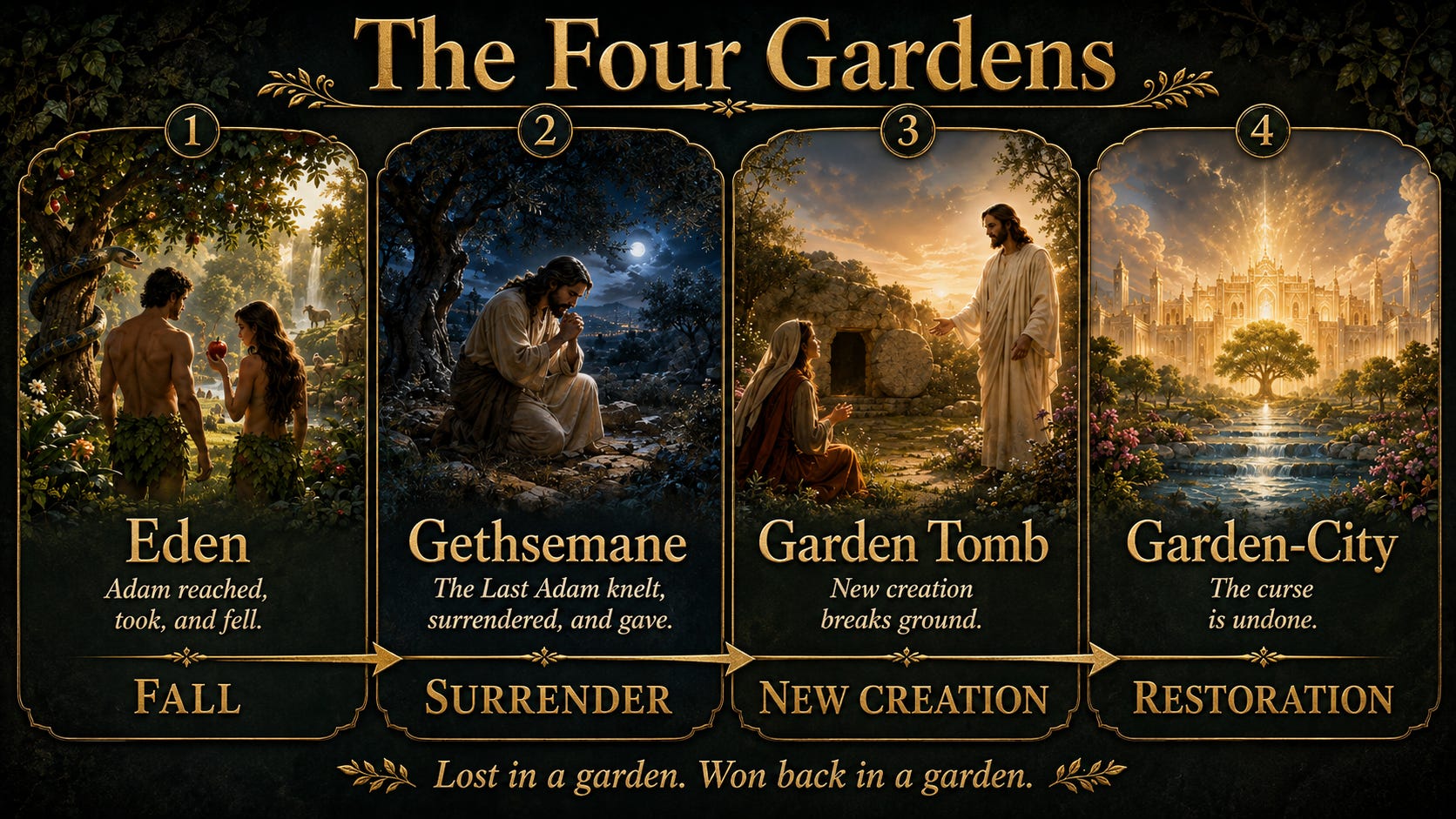
The whole story of the Bible begins in a garden.
Eden — where the first man reached out, took, and fell.
It turns in another.
Gethsemane — where the Last Adam knelt, surrendered, and gave.
Then Jesus is buried in a garden — and when Mary meets Him risen, she mistakes Him for the gardener.
New creation, breaking ground in a garden tomb.
Now in the place where he was crucified there was a garden, and in the garden a new tomb. — John 19:41
And at the very end of the Bible, the garden comes back one last time. The New Jerusalem is a garden-city — the tree of life and the river of life return, and the curse of Eden is finally, forever undone.
No longer will there be anything accursed... and the throne of God and of the Lamb will be in it. — Revelation 22:3
Eden. Gethsemane. The garden tomb. The garden-city.
Fall. Surrender. New creation. Restoration.
Scripture never lines them up for us in so many words. But once you see the four gardens, you cannot unsee the beauty of it — the God who lost us in a garden was determined to win us back in one.
Now roll the clock back a thousand years.
King David’s own son, Absalom, has betrayed him and seized his throne. David has to flee his own city.
Now watch how he leaves.
First, he sends the Ark of God back to Jerusalem. And he says this:

If I find favor in the eyes of the Lord, he will bring me back... but if he says, “I have no pleasure in you,” behold, here I am, let him do to me what seems good to him. — 2 Samuel 15:25–26
Let Him do to me what seems good to Him.
That is surrender — a rejected king laying his whole fate in God's hands. Hold that phrase. Because a thousand years later, another King will pray almost the very same thing on the very same hill.
And THEN:
But David went up the ascent of the Mount of Olives, weeping as he went... and all the people who were with him covered their heads. — 2 Samuel 15:30
A rejected king. Crosses the Kidron.
Climbs the Mount of Olives.
Weeps.
Surrenders himself to the will of God.
Now come to the Son of David.
He crosses the same Kidron:
When Jesus had spoken these words, he went out with his disciples across the brook Kidron, where there was a garden. — John 18:1
He goes to that same Mount of Olives. And there He prays the same surrender David prayed a thousand years before — not My will, but Yours.

And it goes deeper still.
David’s most trusted counselor, a man named Ahithophel, defected to Absalom in the rebellion. A trusted counselor of the king turned against him.
And here is how his story ends:
He set his house in order and hanged himself. — 2 Samuel 17:23
The trusted friend who betrayed God’s anointed king... hanged himself.
A thousand years later, Judas betrays the Son of David — and hangs himself.
And Jesus reaches back into a Psalm from David’s own world and lays it directly on Judas:
He who ate my bread has lifted his heel against me. — John 13:18, quoting Psalm 41:9
The betrayer who shared the King’s own table and ate His bread.
Many have connected the betrayal behind that Psalm to Ahithophel himself. The Psalm never names him, so hold that as a picture, not a proof. But the shape of the story is unmistakable — and Jesus is walking straight into it, eyes open.
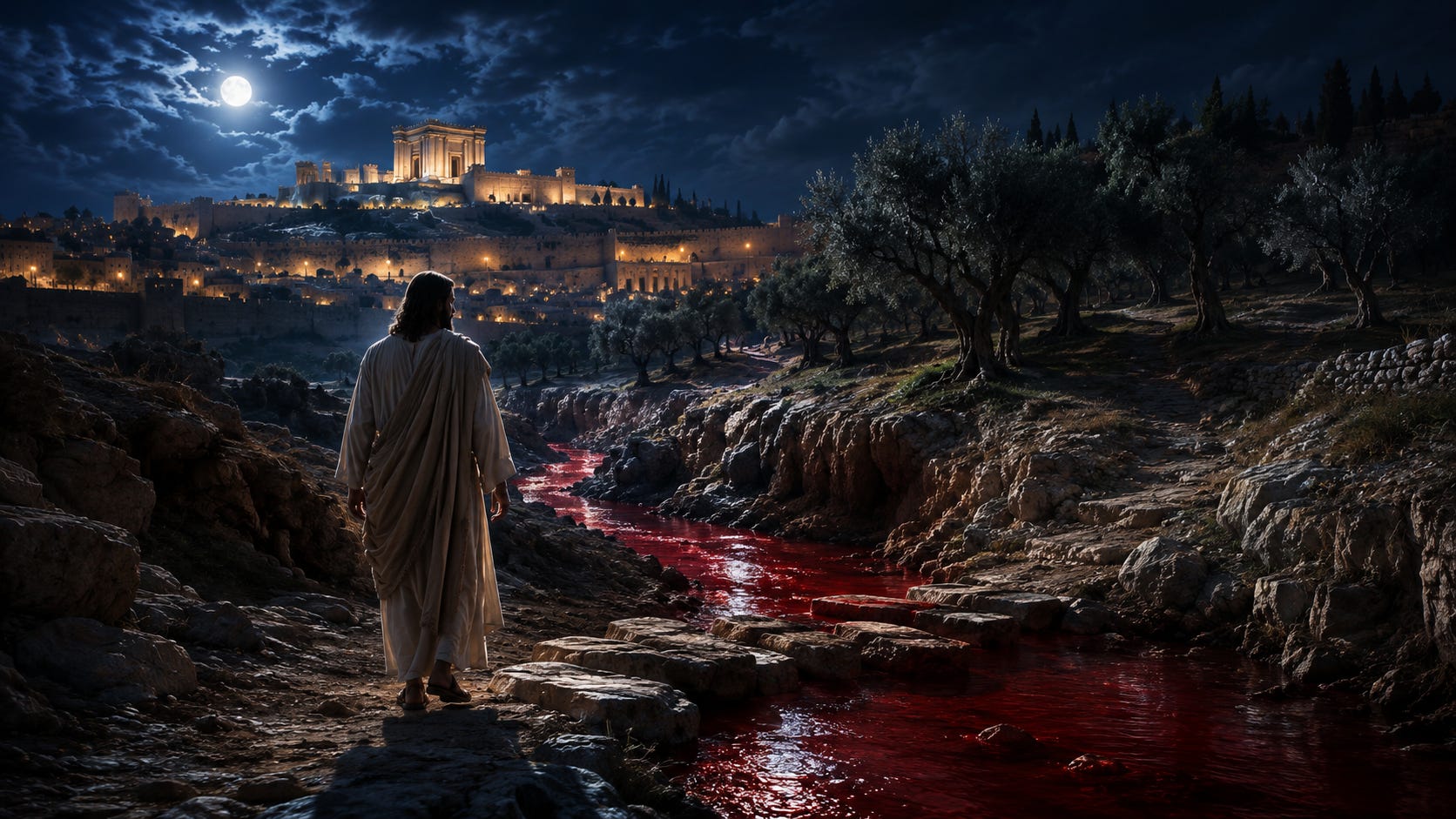
There’s also something about that valley most people never realize.
Later Jewish tradition describes the excess blood from the temple altar flowing out through the drainage system and down toward the Kidron.
If that practice reflects the temple in Jesus’ day, the picture is staggering.
On the night He becomes the Lamb, Jesus crosses the very valley associated with the blood of the sacrifices...
...on His way to become THE sacrifice.
Behold, the Lamb of God, who takes away the sin of the world! — John 1:29
The valley of blood was the last thing between Him and the garden.
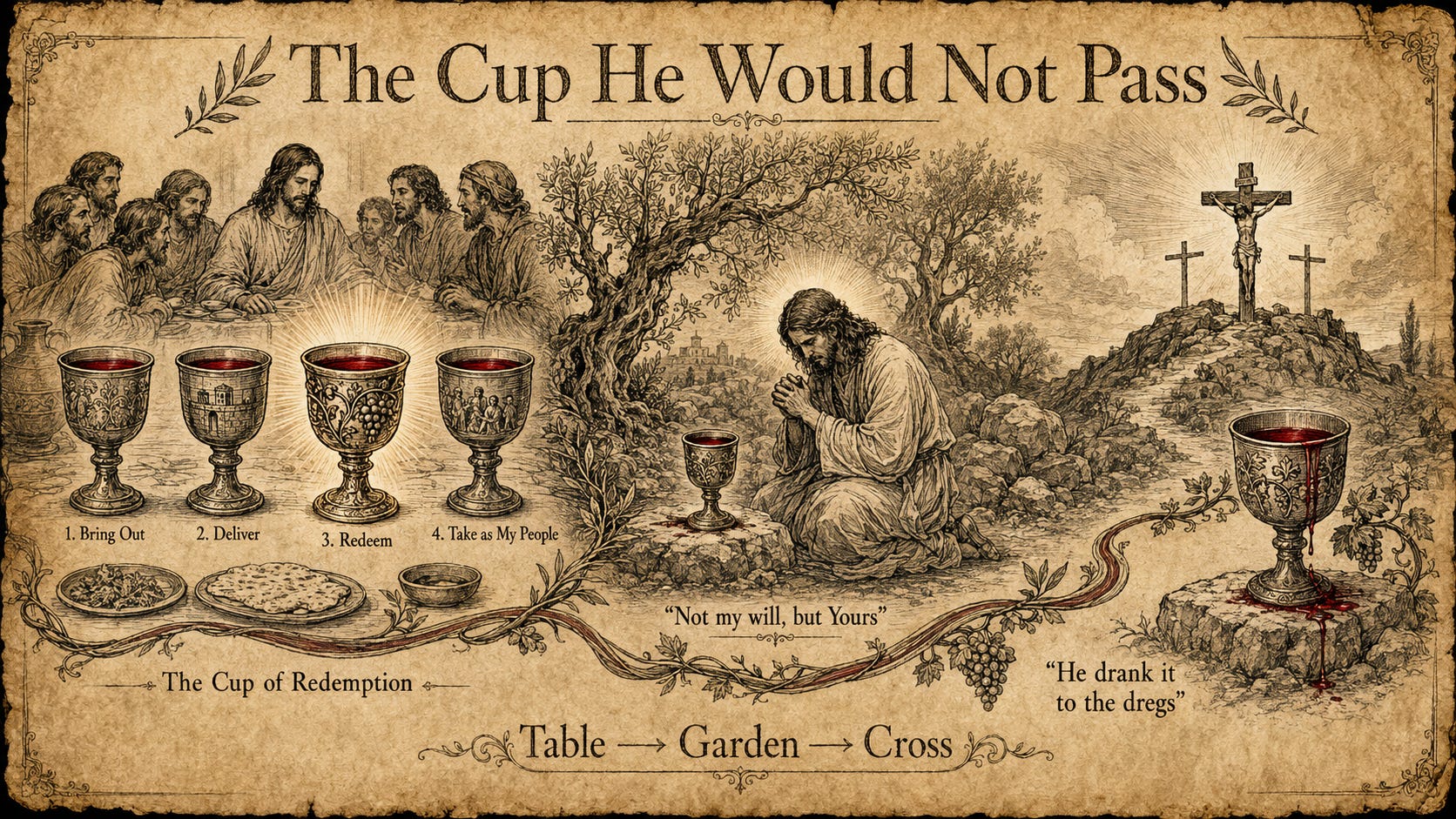
To understand the garden, you have to go back to the table.
That same night, Jesus and His disciples were keeping Passover — and a Passover meal moves through FOUR cups of wine, each tied to one of God’s promises in Exodus:
1) I will bring you out.
2) I will deliver you.
3) I will redeem you.
4) I will take you as My people.
Sanctification. Deliverance. Redemption. Praise.
And it’s over the 3rd cup — the Cup of Redemption — that Jesus says something no one had ever said over it before:
This cup that is poured out for you is the new covenant in my blood. — Luke 22:20
The cup of redemption. His blood, poured out for them.
Then He says something strange. He tells them He will NOT drink of the fruit of the vine again:
I will not drink of the fruit of the vine until the kingdom of God comes. — Luke 22:18
Many have noticed what seems to be missing here:
The fourth cup.
The Cup of Praise — the cup of consummation, of the kingdom fully come. Jesus stops short of it. As if to say, this celebration is not finished yet. (Scripture doesn’t spell out His reason, but the picture is a striking one.)
Because there is another cup He must drink first.
He leaves the table. He crosses to the garden. And there He falls to His knees over a very different cup:
Father, if you are willing, remove this cup from me. Nevertheless, not my will, but yours, be done. — Luke 22:42
At the table, He GIVES the cup of redemption — to them.
In the garden, He takes up a cup He must drink alone — for them.
And this is no calm, untroubled Savior:
My soul is very sorrowful, even to death. — Matthew 26:38
Mark says He was deeply distressed and troubled. The eternal Son — who came for this exact hour — trembles before what lies ahead. This is the fullness of His HUMANITY.
A Savior who felt nothing could never reach you. But a Savior who was overwhelmed with sorrow and obeyed anyway knows exactly what your darkest night feels like — and shows you the way through it.
Hebrews describes His suffering in words that sound remarkably like this scene:
In the days of his flesh, Jesus offered up prayers and supplications, with loud cries and tears... he learned obedience through what he suffered. — Hebrews 5:7-8
He was not learning to stop being disobedient. He was living out perfect obedience through real human suffering.
And notice this: in the garden, He does not yet drink the cup. He accepts it. He surrenders to it. The cup itself — the full cup of God’s judgment that Scripture calls the cup of His wrath —
For in the hand of the Lord there is a cup with foaming wine... and all the wicked of the earth shall drain it down to the dregs. — Psalm 75:8
— that cup is poured out the next day, at the cross, when He cries, “My God, my God, why have You forsaken me?”
In the garden, He says yes to the cup.
At the cross, He drinks it to the dregs.
The cup we earned. Drained dry. So that one day, at the marriage supper of the Lamb, He could finally raise that last cup of praise — with us.
Three times Jesus goes off to pray. Three times He comes back to find His closest friends... asleep.
Could you not watch with me one hour? — Matthew 26:40
And here’s the part most people miss.
“Watch” doesn’t mean stand guard. He doesn’t need lookouts — He knows exactly who’s coming, and when. The watching was never for His protection. It was for THEIRS:
Watch and pray that you may not enter into temptation. The spirit indeed is willing, but the flesh is weak. — Matthew 26:41
He had taught them to pray these very words long before:
And lead us not into temptation. — Matthew 6:13
Now the temptation is here. The testing has arrived. And He tells them plainly — pray, or you’ll fall.
Luke makes it even more urgent. Only hours earlier, Jesus had warned Peter:
Simon, Simon, Satan demanded to have you, to sift you like wheat. But I have prayed for you. — Luke 22:31
The warning could not have been clearer. Stay awake. Pray. The enemy is coming for you tonight.
They slept.
And before sunrise, Peter — the one He warned by name — denied Him three times.
The friends He asked to watch with Him couldn’t even stay awake. Before a single soldier laid a hand on Him, Jesus had already tasted what it means to suffer alone while the people closest to you sleep.
Now Judas arrives. And he brings a sign — a kiss.
Now the betrayer had given them a sign, saying, “The one I will kiss is the man; seize Him.” — Matthew 26:48
But stop and think about the sign Judas chose.
Jesus would not be identified by a crown, or a halo, or some visible mark of divinity. Judas would point Him out with something as ordinary and intimate as a kiss.
The Son of God. The Maker of the universe. And He had walked among them so FULLY, so ordinarily human, that He had to be POINTED OUT.
And you know what’s amazing? People still miss Jesus for the very same reason.
He rarely forces Himself into obvious view.
He’s standing right there — present, near, in the room — and people walk right past Him. Until someone points Him out.
Judas pointed Him out to BETRAY Him.
You and I are called to point Him out to REVEAL Him.
Same act. Opposite heart.
Then comes the reversal. The soldiers step forward. Jesus asks who they’re looking for. They say, “Jesus of Nazareth.” And He answers:
When Jesus said to them, “I am he,” they drew back and fell to the ground. — John 18:6
He answers ego eimi — “I Am He.”
In John’s Gospel, those two words carry enormous weight, echoing the great “I AM” declarations Jesus makes all through the book.
And at the sound of them, an armed arresting party draws back and falls to the ground. What this reveals is so powerful.
They did not overpower Him.
John wants us to see that Jesus is not helplessly swept into the cross. He gives Himself over willingly. As He said Himself:
No one takes it from me, but I lay it down of my own accord. — John 10:18
He is not seized.
He surrenders.
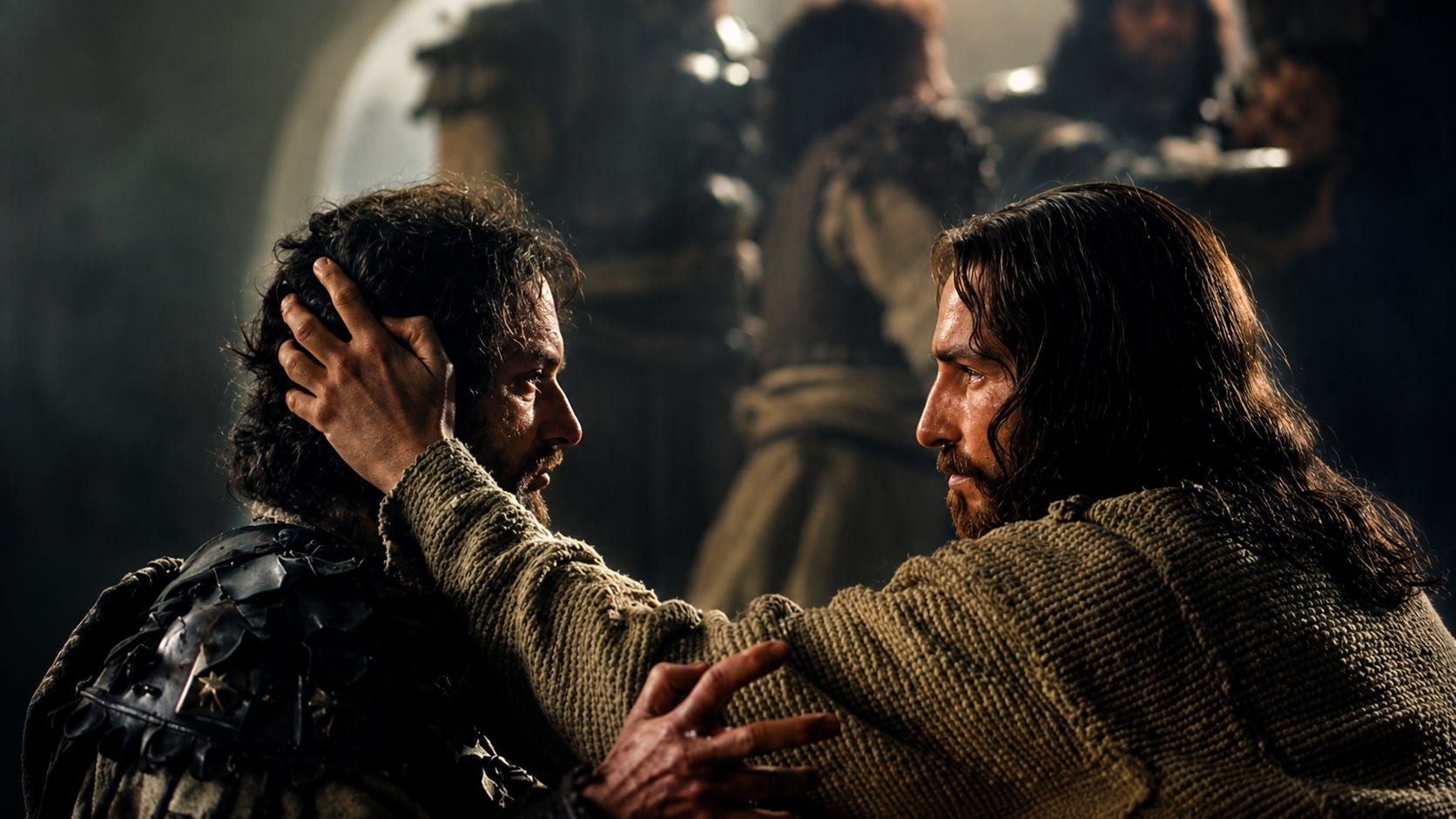
Peter panics. He grabs a sword and swings — and cuts off the ear of a man named Malchus.
And He touched his ear and healed him. — Luke 22:51
The very last miracle Jesus performs before the cross...
...is healing an ENEMY who came to arrest Him.
And look closer at what’s really happening.
This is a wound inflicted by one of Jesus’ OWN disciples. Peter drew the sword. Peter did the damage. And Jesus — in the middle of His own arrest — stops to repair the harm His follower caused to the very man sent to take Him away.
He had taught them, “Love your enemies.”
And now, with soldiers closing in and His own death only hours away, He DOES it.
Not as a sermon. As an action.
Peter wounded in Jesus' name.
Jesus healed the one he wounded.
He has been doing it ever since.
There’s a quiet and extraordinary irony hidden here, too.
Malchus is the servant of the earthly high priest — and he is healed by the very One that Hebrews calls our GREAT High Priest. The lesser high priest sends men to seize Him. The true High Priest heals the man they sent.
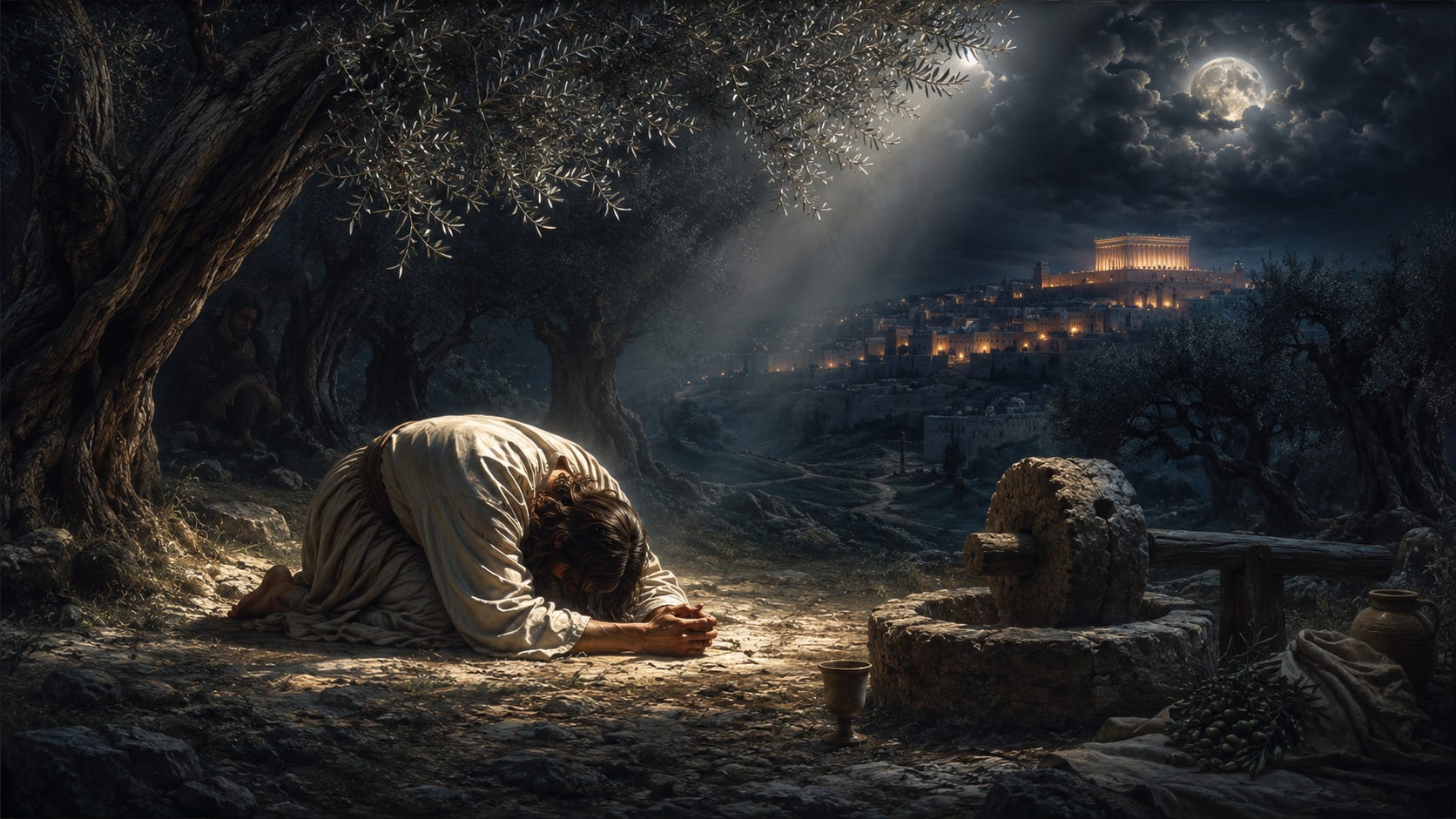
Now we come back to the name. And everything comes together.
The very FIRST time an olive appears in the entire Bible, it’s here:
And the dove came back to him in the evening, and behold, in her mouth was a freshly plucked olive leaf. So Noah knew that the waters had subsided. — Genesis 8:11
A dove.
An olive leaf.
The first sign that the judgment was OVER — that the flood had passed, and peace had finally come.
In Noah’s story, the olive leaf becomes the sign that judgment has receded and peace is returning.
Now remember exactly where Jesus is standing.
Among the olive trees. At the press.
Here’s the revelation.
“Messiah.” “Christ.” Both words mean the same thing: the Anointed One.
And Scripture tells us precisely what He was anointed WITH:
God anointed Jesus of Nazareth with the Holy Spirit and with power. — Acts 10:38
Now think about how the sacred anointing oil was even made. In Exodus 30, it used olive oil as its base — blended with myrrh and fragrant spices into something holy and set apart.
And how does an olive give up its oil in the first place?
It must be PRESSED.
Squeezed. Broken under enormous weight.
And ONLY then does the oil flow out.
The ANOINTED ONE goes to the place of PRESSING.
At the garden called “oil press,” the Anointed One begins the final surrender that will carry Him all the way to the place where Isaiah’s ancient words finally come true:
But he was pierced for our transgressions; he was crushed for our iniquities. — Isaiah 53:5
He is pressed in the garden. He is crushed at the cross.
And out of that crushing flows the very thing the dove promised at the dawn of the world:
Peace after judgment.
The name of the garden becomes a picture of the whole Gospel — hidden in plain sight the entire time.
So let me ask you something.
Where are you being pressed right now?
Maybe the weight has been building for so long that you’ve stopped whistling, stopped singing, stopped hoping. Maybe you’ve been asking God the very question Jesus asked in the dark: why this cup?
Listen.
Not every hard thing in your life is a machine God built to squeeze anointing out of you. Some of what you carry is simply the brokenness of a fallen world — and God grieves it right alongside you.
But look at what Paul says about the press. This is a man who was beaten, shipwrecked, imprisoned, and left for dead:
We are afflicted in every way, but not crushed; perplexed, but not driven to despair; persecuted, but not forsaken; struck down, but not destroyed. — 2 Corinthians 4:8–9
Hard PRESSED — but not crushed.
Struck down — but not destroyed.
That is the promise. Not that the pressing will never come. But that in Christ, the pressing will never have the final word.
The olive press was not the end of Jesus.
And your press is not the end of you.
Let me tell you why I know this isn’t just a nice idea.
About three years ago, I was completely full. Full-time ministry. Making commercials for a living. My family. And underneath all of it, a desire I couldn’t act on — I wanted to write for the Lord, to create things for Him, and I had no time.
None.
So I prayed a simple prayer. God, open up ten or fifteen hours a week for me.
And here’s what He did.
He didn’t hand me empty hours to spend however I wanted. Instead, He opened a door to seminary — which would DEMAND about fifteen hours a week. Reading. Papers. Deadlines. On top of everything I was already carrying.
I didn’t understand it. I asked for relief, and it felt like He handed me MORE weight.
But looking back, I see what He was really doing. He saw the desire underneath my prayer — the longing to glorify Him with my writing. And He answered it in a way I never would have imagined. It was as if He said: I hear you. I will give you the time. But first, I’m going to equip you to do it properly.
That was the press.
It was hard. Juggling all of it nearly broke me some weeks. But under that pressure, something began to flow that I never could have squeezed out on my own. My mind opened up to the structure of Scripture — who wrote it, when, why, how the Old and New Testaments lock together. The very connections I now get to share with you every single week came out of that pressing season.
I asked God for time.
He gave me a press.
And the oil that came out of it is the reason you’re reading these words right now.
Because the God who was pressed in a garden full of olive trees knows EXACTLY what your pressing feels like. He didn’t watch it from a safe distance. He walked straight INTO it — to the one place He knew He’d be found — so that your pressing would never be the end of your story.
Surrender the cup.
And trust the One who drank it first.
Father,
Thank You that You did not run from the press.
That when the cup was set before You, and everything in Your humanity recoiled, You still bowed Your head and said, “Not My will, but Yours.”
Thank You that You crossed the Kidron, and stepped forward out of the trees, and gave Yourself up — for me.
Lord, I bring You the places where I feel crushed. The weight I’ve been carrying in the dark. The cup I keep asking You to take away.
I don’t always understand the pressing. But I trust the One who was pressed for me.
Where I am afflicted, remind me I am not crushed. Where I am struck down, remind me I am not destroyed. And where I feel alone, remind me that You have already been to this garden ahead of me.
Let whatever flows out of my pressing be the fragrance of Your Spirit.
Make me more like the One who surrendered here.
In Jesus’ name,
Amen.

If this article helped you see Gethsemane — and your own hard seasons — in a deeper way, there’s so much more waiting for you.
Unlock every Revelation the moment it drops.
Go DEEPER into Scripture than ever before.
Get full access to the complete archive.
Love you guys. 🙏
And if this BLESSED you, share it with someone who is
being pressed right now — and remind them they are not crushed.
No posts
Comments
Nothing yet. Say the first thing.
Sign in to join the conversation.