
We’ve all held one in our hands.
We’ve read it. Underlined it. Memorized parts of it.
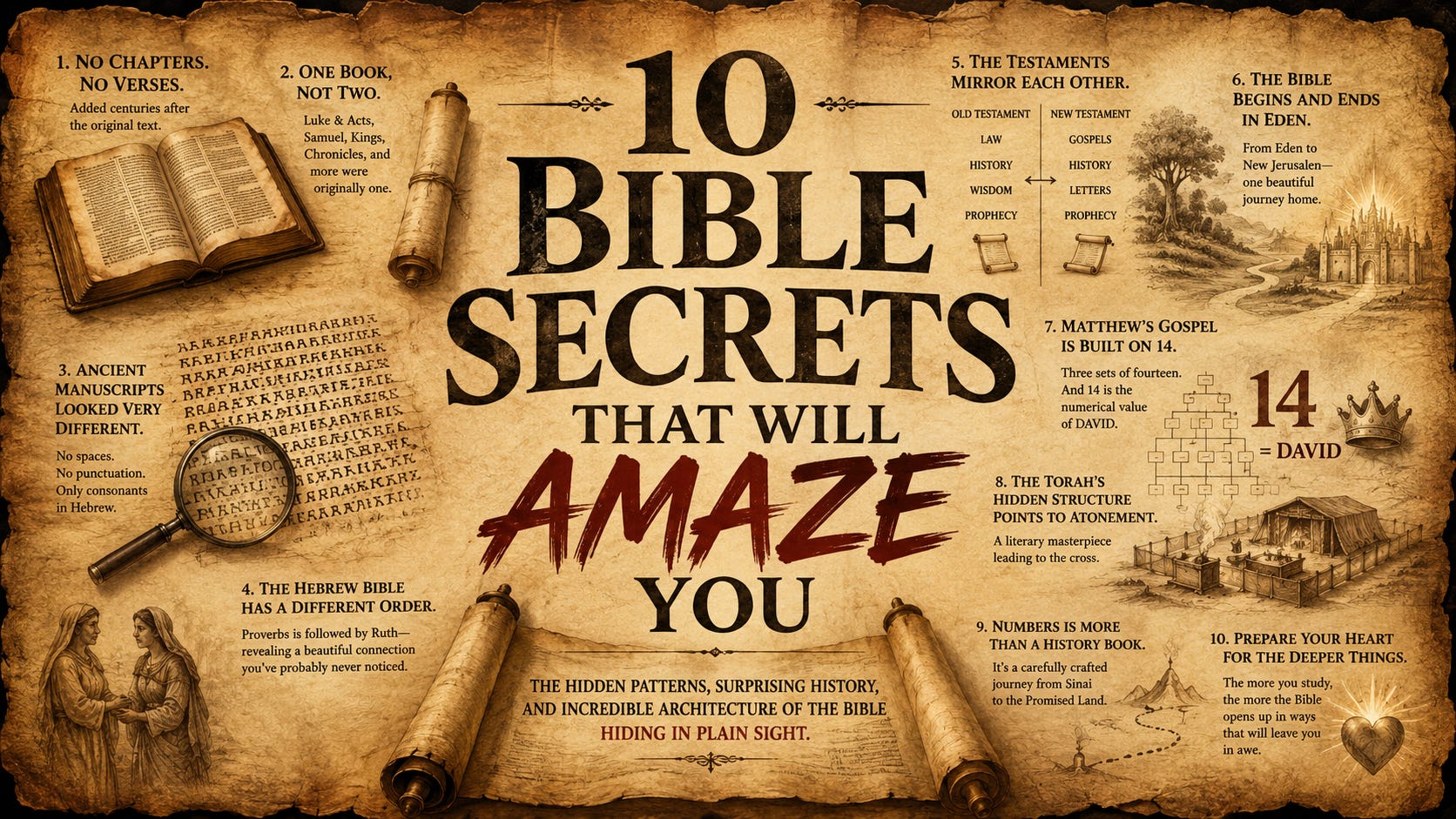
But almost nobody asks how the Bible itself is built.
Not what it says. How it’s designed. The seams. The structure. The architecture hiding in plain sight.
Because here’s what most people never stop to consider:
The Bible was written across roughly 1,500 years, by around 40 authors, across different places and cultures—and yet it holds together as one unfolding story.
That’s not just a book. That’s a blueprint.
And once you start seeing the design, you can’t unsee it.
Here are 10 things you probably didn’t know about the book itself.
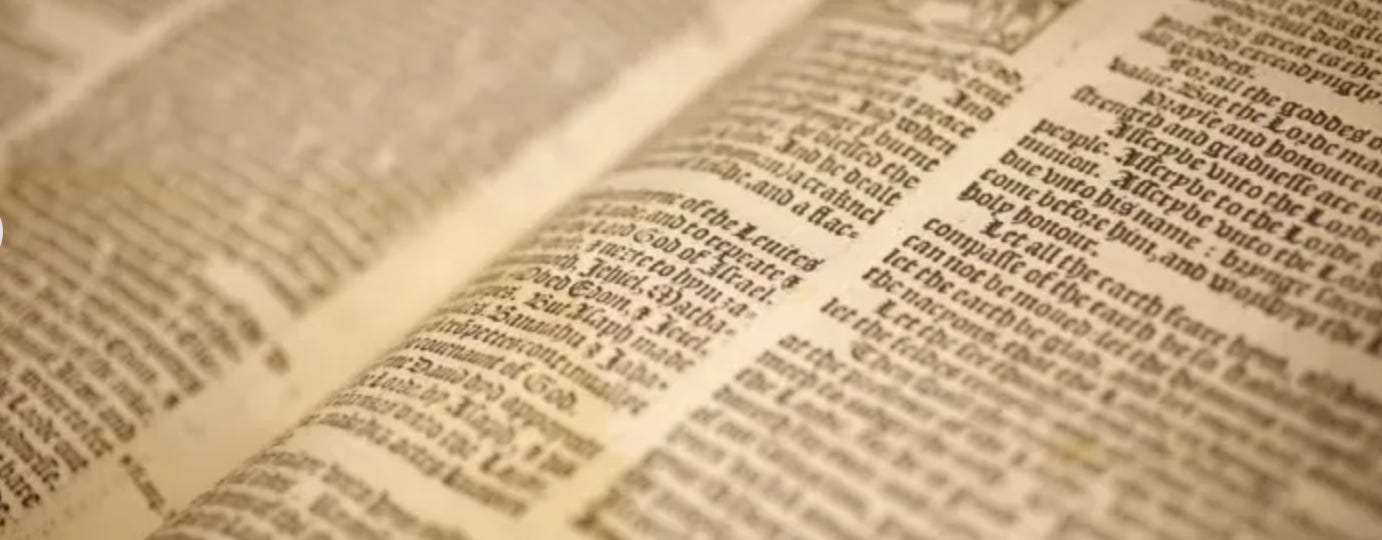
Open your Bible to any page—chapter numbers, verse numbers, neat divisions that let you flip straight to John 3:16.
Did you know that NONE of that was in the original text?
The chapter divisions we use today developed in the early thirteenth century and are traditionally associated with Stephen Langton, Archbishop of Canterbury.
The verse divisions came even later—added to the whole Bible by a French printer, Robert Estienne, in 1551.
And the first English Bible to put both on the page?
The Geneva Bible of 1560.
So the next time you flip straight to a favorite verse, remember—the biblical authors never saw a single one of those numbers.
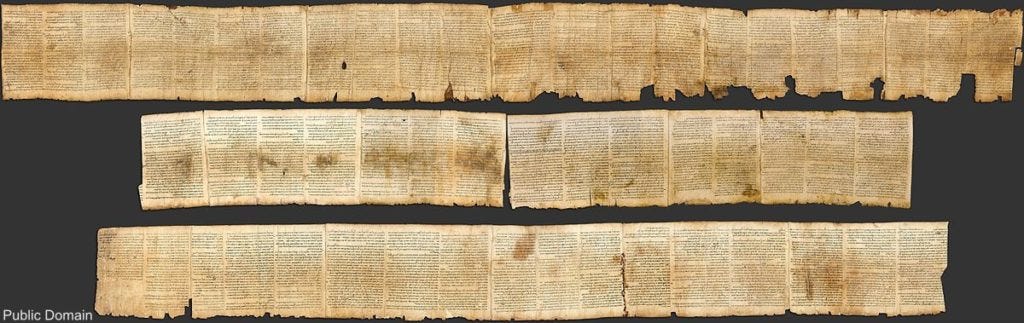
We think of the Bible as 66 separate books.
But several of those “books” were originally a single work—split apart later.
Luke and Acts were written by the same author, to the same man (Theophilus), as two volumes of one continuous story. Scholars even call it “Luke–Acts.” In the developing New Testament collection, Luke came to stand with the four Gospels, while Acts followed them as the bridge into the apostolic writings.
And it doesn’t stop there.
1 & 2 Samuel. 1 & 2 Kings. 1 & 2 Chronicles. Ezra–Nehemiah.
Every one was a single book in the Hebrew Bible.
In the Greek tradition, these longer works came to be divided into two volumes—likely influenced in part by the practical limits of scroll length.
So the “1 and 2” you see wasn’t part of the original Hebrew form of these books. It came later.
Sometimes the most familiar features of our Bible exist for surprisingly practical reasons.
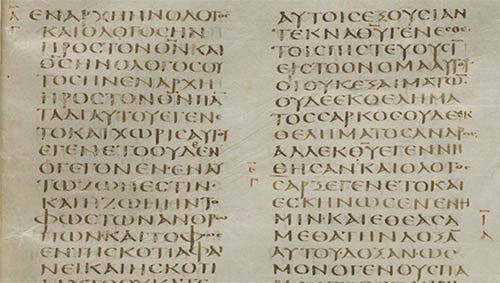
Imagine opening the Bible and finding this:
INTHEBEGINNINGGODCREATEDTHEHEAVENSANDTHEEARTH
Early Greek manuscripts were commonly written with little or no spacing between words and without our modern punctuation.
Ancient Hebrew was also different. It was written primarily with consonants—the vowel-pointing system familiar from modern printed Hebrew Bibles came much later.
Those dots and dashes were developed by scribes known as the Masoretes, centuries after the biblical texts were composed.
And here’s the remarkable part: their work reflects an extraordinary concern to preserve the received consonantal text and its traditional reading.
The text we hold is a testimony to how seriously it was guarded.
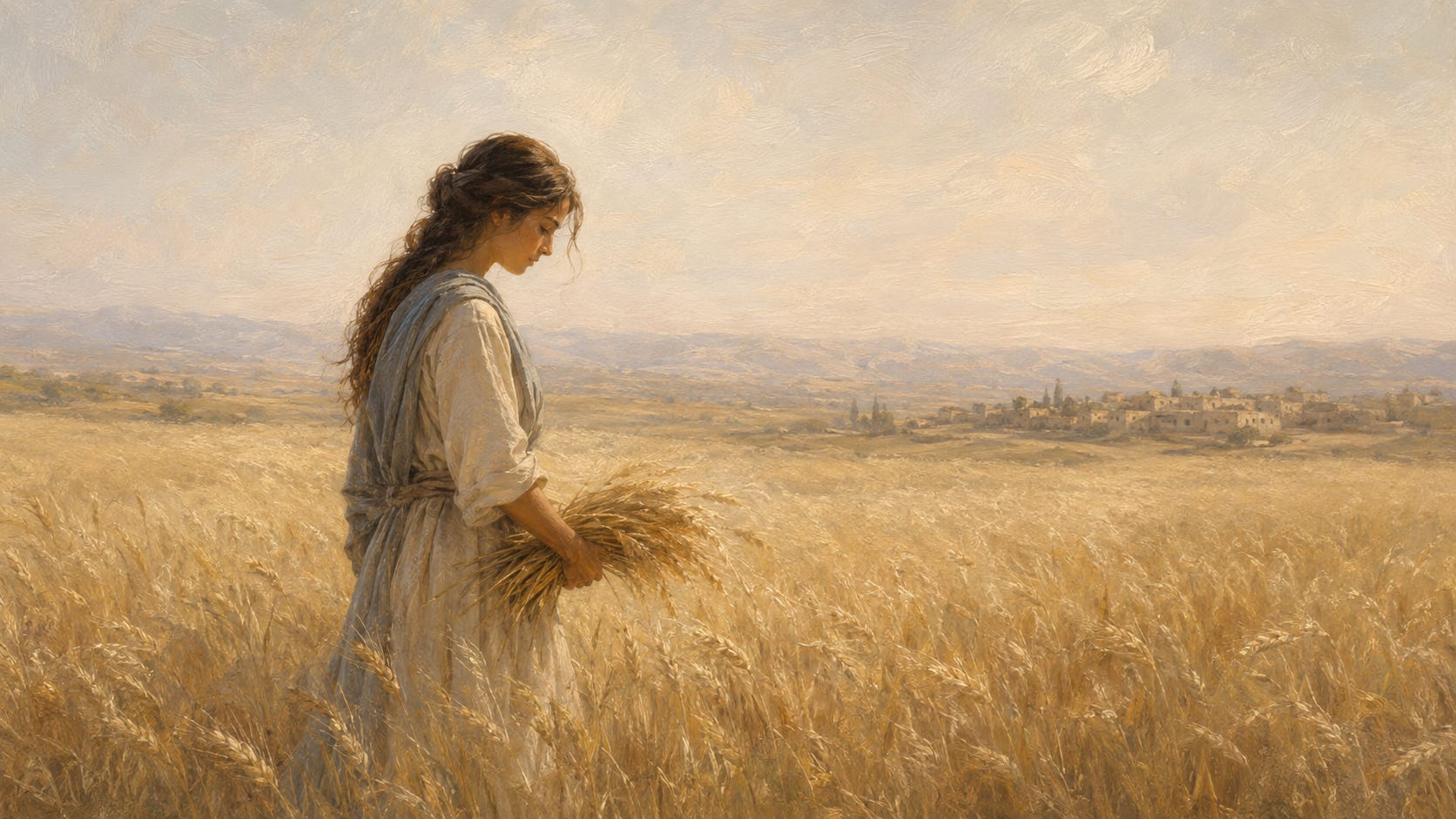
We read the Old Testament in one familiar order. But Jewish tradition has preserved other arrangements—and sometimes those arrangements create fascinating literary connections.
In some Hebrew manuscript traditions, Proverbs is followed by Ruth!
Proverbs ends with the famous poem of the eshet chayil—the “woman of valor” of Proverbs 31.
Then you turn the page…and meet Ruth.
A Moabite widow. An outsider. And in Ruth 3:11, she herself is called an eshet chayil—a woman of valor.
This points to Ruth as the mysterious Woman from Proverbs 31. (Read my full article on this here.)
Our English order follows the Greek and Latin tradition, grouped largely by type of book. Hebrew manuscript traditions preserve different arrangements—and when you read them that way, connections can light up that our familiar order quietly hides.
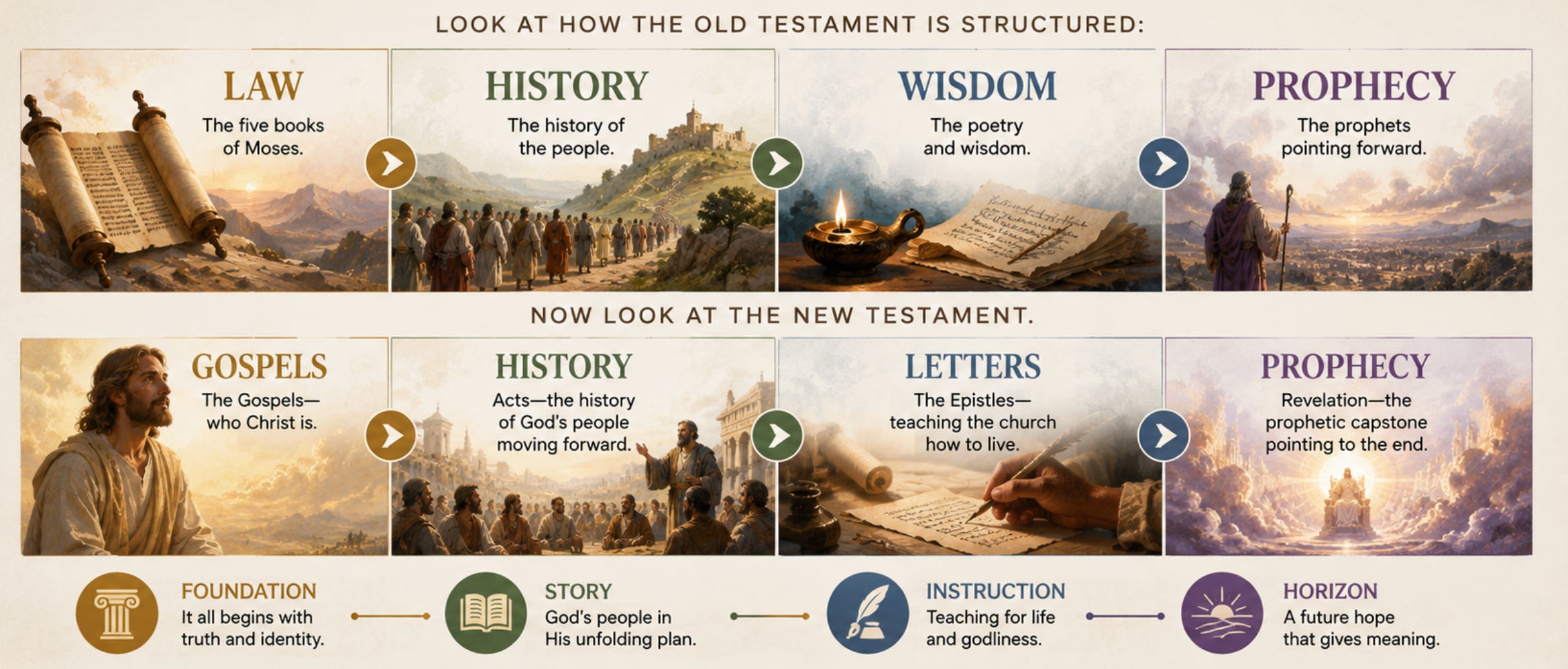
This one changed the way I see my whole Bible.
Look at how the Old Testament is structured:
Law → History → Wisdom → Prophecy
The five books of Moses.
Then the history of the people.
Then the poetry and wisdom.
Then the prophets pointing forward.
Now look at the New Testament.
Gospels → History → Letters → Prophecy
The Gospels—who Christ is.
Then Acts—the history of God’s people moving forward.
Then the Epistles—teaching the church how to live.
Then Revelation—the prophetic capstone pointing to the end.
Foundation. Story. Instruction. Horizon.
Twice. Once in each testament.

The Bible opens in a garden, with a tree. And it closes in a garden-city, with a tree.
In Genesis, we see a river. The Tree of Life, where humanity lives in the presence of God. And then sin enters. The curse falls. Humanity is driven from the garden.
Now turn all the way to the final chapters of Revelation.
And suddenly the imagery comes rushing back.
A river of the water of life, flowing from the throne of God.
The Tree of Life, appearing again. God dwelling with His people again.
And then one of the most beautiful lines in the entire Bible:
“No longer will there be any curse.” —Revelation 22:3
See the architecture?
The Bible ends by returning to the images it began with. But it isn’t simply going backward. God isn’t merely restoring Eden—He’s bringing the story to its intended destination.
The Bible is not a collection of disconnected religious stories. It is one enormous story of creation, fall, redemption, and restoration.
The Bible doesn’t merely move forward.
It moves home.
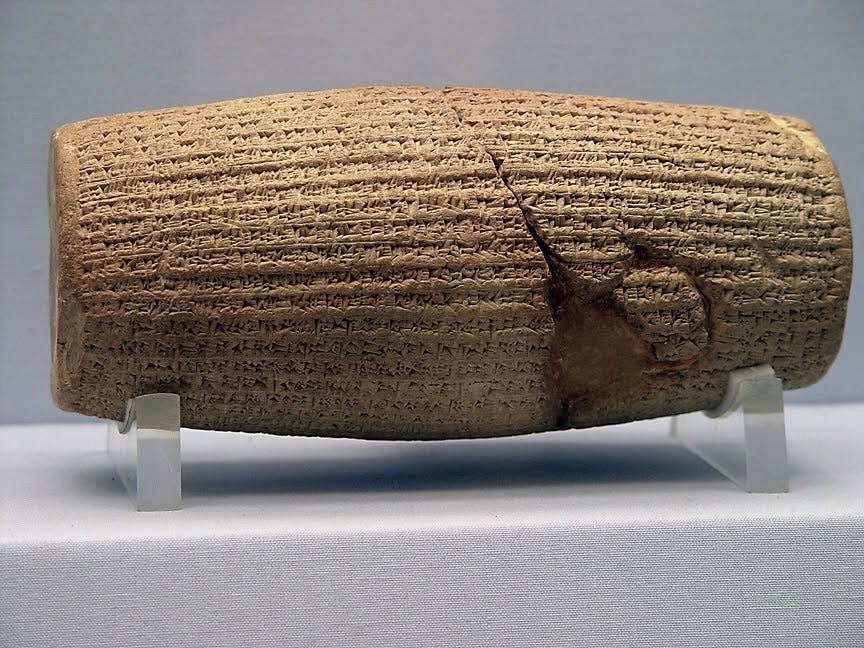
Our Old Testament ends with the prophet Malachi and a warning about a coming messenger.
But the Hebrew Bible ends somewhere completely different.
It ends with 2 Chronicles—with the decree of King Cyrus, releasing God’s people from exile:
“Whoever is among you of all his people, may the LORD his God be with him. Let him go up.“ —2 Chronicles 36:23
And remarkably, archaeology preserves evidence of the broader Persian policy behind that decree. The Cyrus Cylinder, now in the British Museum, reflects Cyrus's policy of restoring displaced peoples and their religious sanctuaries.
That’s it. That’s the last word of the Hebrew Bible.
“Let him go up.”
The Hebrew Bible doesn’t end with an ending. It ends with an invitation.
An open door—let him go up to Jerusalem.
The Hebrew canon doesn’t close—it aims. It leaves you standing at the edge of Jerusalem, waiting for what comes next.
And for the Christian reader, that unfinished movement toward Jerusalem eventually carries the story toward another Judean town just a few miles away: Bethlehem.

Most people skip the genealogy at the start of Matthew. All those names. All those “so-and-so begat so-and-so.”
But hidden in the structure is a CODE.
Matthew deliberately arranges Jesus’ genealogy into three sets of fourteen generations (Matthew 1:17).

Why fourteen?
In Hebrew, letters double as numbers. And the name David—D-V-D—adds up to exactly fourteen (4 + 6 + 4).
Three sets of fourteen.
It is as though the genealogy is quietly spelling DAVID, DAVID, DAVID—drumming the name of the king over and over.
Matthew isn’t merely recording history. He’s preaching with mathematics:
This is the Son of David. This is the promised King.The technique is called gematria—reading the numeric value of Hebrew letters. Many interpreters see Matthew's three sets of fourteen as a deliberate numerical echo of David's name, reinforcing the messianic claim running through the genealogy.
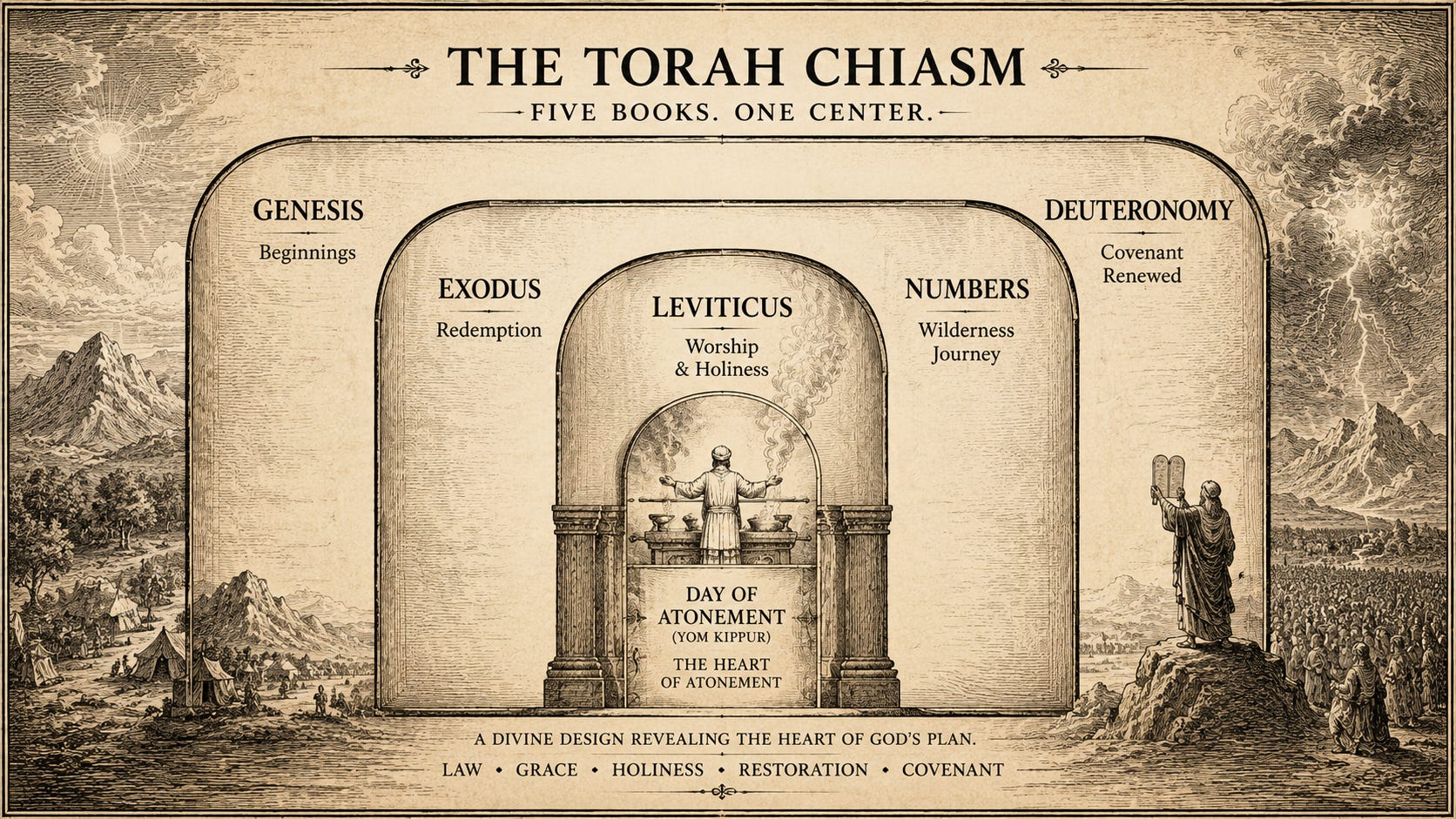
The five books of Moses aren’t just five books in a row.
Many scholars see them arranged as a MIRROR, folding inward:
Genesis matches Deuteronomy (beginnings and renewed covenant).
Exodus matches Numbers (journeys through the wilderness).
And Leviticus stands alone—right in the middle. The center of the fold.
And notice what this mirrors.
The Tabernacle was built the same way—concentric, closing inward. Outer court, then the Holy Place, then the Most Holy Place at the center, where the blood was brought.
The Torah is shaped like sacred space. You move inward to reach the center.
And right at the center of Leviticus…
Something extraordinary.
Many interpreters see the movement continuing inward within Leviticus itself, toward Leviticus 16—the Day of Atonement. The one day a year the high priest entered the Most Holy Place with blood to cover the sins of the people.
Read this way, the structural bullseye points toward the day when blood is brought into the sanctuary to make atonement for sin.
For Christians, the architecture becomes a remarkable preview of the gospel. The Torah is built like the Tabernacle itself—everything drawing inward toward the place where blood is shed to cover sin.
Everything in the Torah folds inward toward the one thing the whole Bible is ultimately about:
God's answer to sin—and for Christians, its fulfillment in Christ.
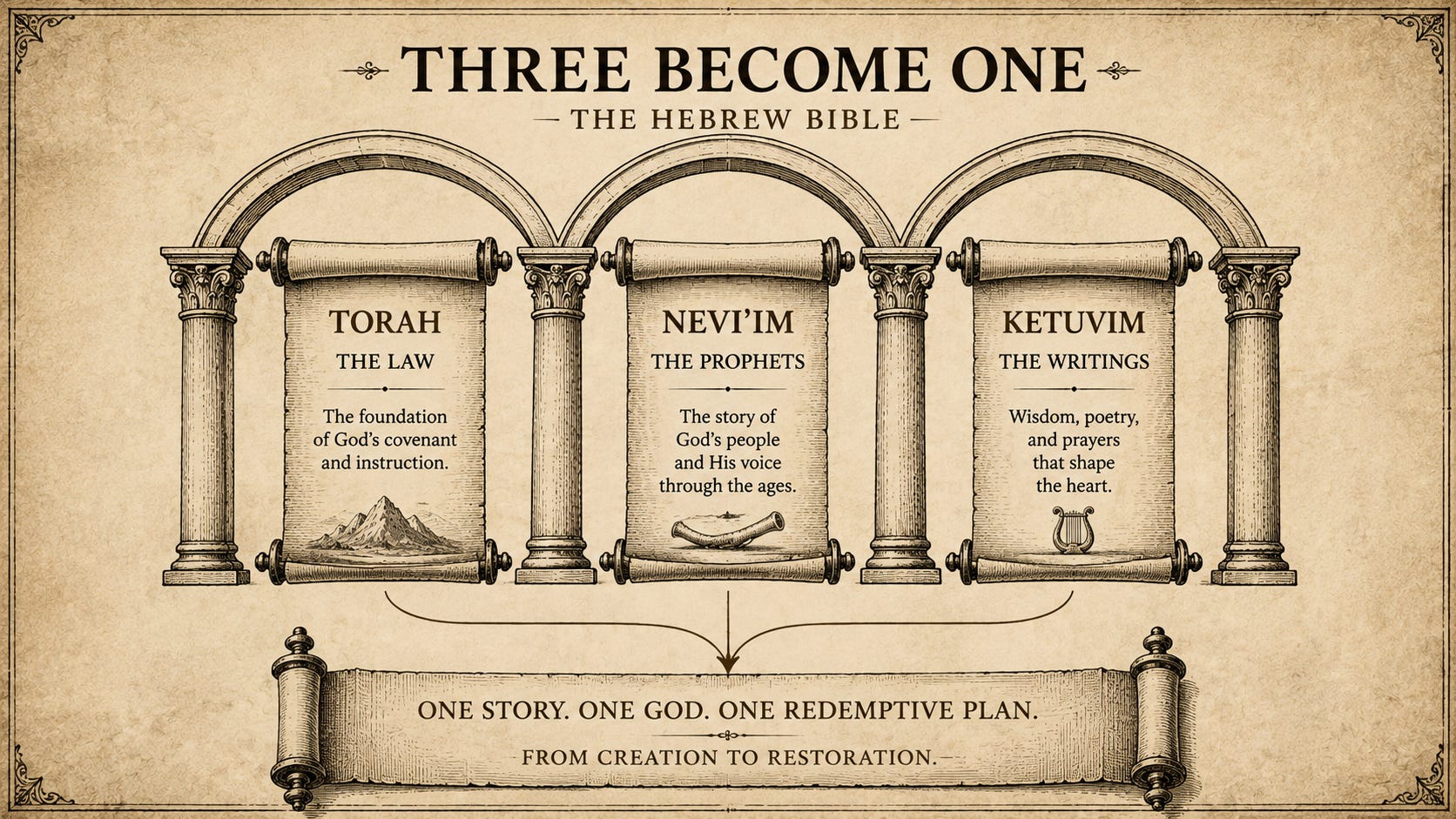
The Hebrew Bible has a name most Christians have never heard:
The Tanakh.
It’s an acronym for its three divisions:
T — Torah (the Law) N — Nevi’im (the Prophets) K — Ketuvim (the Writings)
Law.
Prophets.
Writings.
Three parts. One book.
Now watch what the risen Jesus says to His disciples:
“Everything must be fulfilled that is written about me in the Law of Moses, the Prophets and the Psalms.” —Luke 24:44
He didn’t pick those three categories at random.
Many scholars understand Jesus here as echoing the threefold shape of the Hebrew Scriptures—Law, Prophets, and Writings, with Psalms representing that third collection.
Jesus wasn’t pointing to a handful of isolated proof texts. He was pointing to the ENTIRE library—and placing Himself at the center of it all.
In one sentence, He reached across the whole architecture of the Hebrew Scriptures and said:
This is about Me.
Jesus didn’t just quote a verse here and there. He claimed the entire structure of the Old Testament as testimony to Himself.
The whole blueprint points to Him.
These are only ten examples.
We haven’t even touched:
Chiasms — passages built like mirrors
Inclusios — stories framed by matching beginnings and endings
Ring compositions — entire sections that circle back to where they began
Parallelism — ideas deliberately repeated and balanced
Typology — people and events that foreshadow what comes later
Temple imagery — sacred-space patterns woven throughout Scripture
Eden imagery — echoes of the garden appearing again and again
Biblical hyperlinks — words and images that quietly connect one passage to another
Intertextual echoes — later writers deliberately echoing earlier Scripture
The deeper you dig, the more astonishing the architecture becomes.
Every seam, every structure, every hidden pattern is a fingerprint—evidence of a single mind behind a book no committee could have coordinated across fifteen centuries.
We tend to read the Bible like tourists—passing through, snapping a photo of a favorite verse, moving on.
But God wrote it like an architect.
And great architects don’t simply design beautiful rooms. They make every hallway lead somewhere.
Scripture does the same thing. And ultimately, every hallway leads toward Christ. Every pattern. Every promise. Every echo. Every page finds its fulfillment in Him.
So when you slow down long enough to see the blueprint, you don’t walk away doubting.
You walk away in awe.
Because a book built like this doesn’t happen by accident.
It happens by design.
Lord,
Thank You for giving us Your Word—not just its message, but its making.
Forgive us for reading it quickly, carelessly, like tourists passing through.
Open our eyes to see the architecture—the patterns, the structures, the echoes, the seams—and let them convince us again that You are real, that You are intentional, and that every word fits into a design we’re only beginning to understand.
Teach us to read like architects, not tourists.
And help us not merely to admire the beauty of Your Word, but to know the Architect Himself.
Slow us down. Draw us deeper. And through the very structure of Your Word, draw us closer to the One it was all pointing to.
In the mighty name of Jesus,
Amen.
Then would you consider helping me keep this ministry going?
Every article like this takes hours of study, research, writing, and prayer. I want to keep digging into Scripture and sharing what I find with as many people as possible.
That’s where you come in.
If these Bible studies have helped you see God’s Word differently, consider becoming a paid subscriber. Your support gives me the time to keep studying, writing, and reaching more people with the Word of God.
Help me create the next one—and reach the next person. 🙏
Can’t become a paid subscriber right now? You can still help.
If this blessed you, share it with someone who needs to read it. That’s one more person reached with God’s Word. 🙏
No posts
Comments
Nothing yet. Say the first thing.
Sign in to join the conversation.