
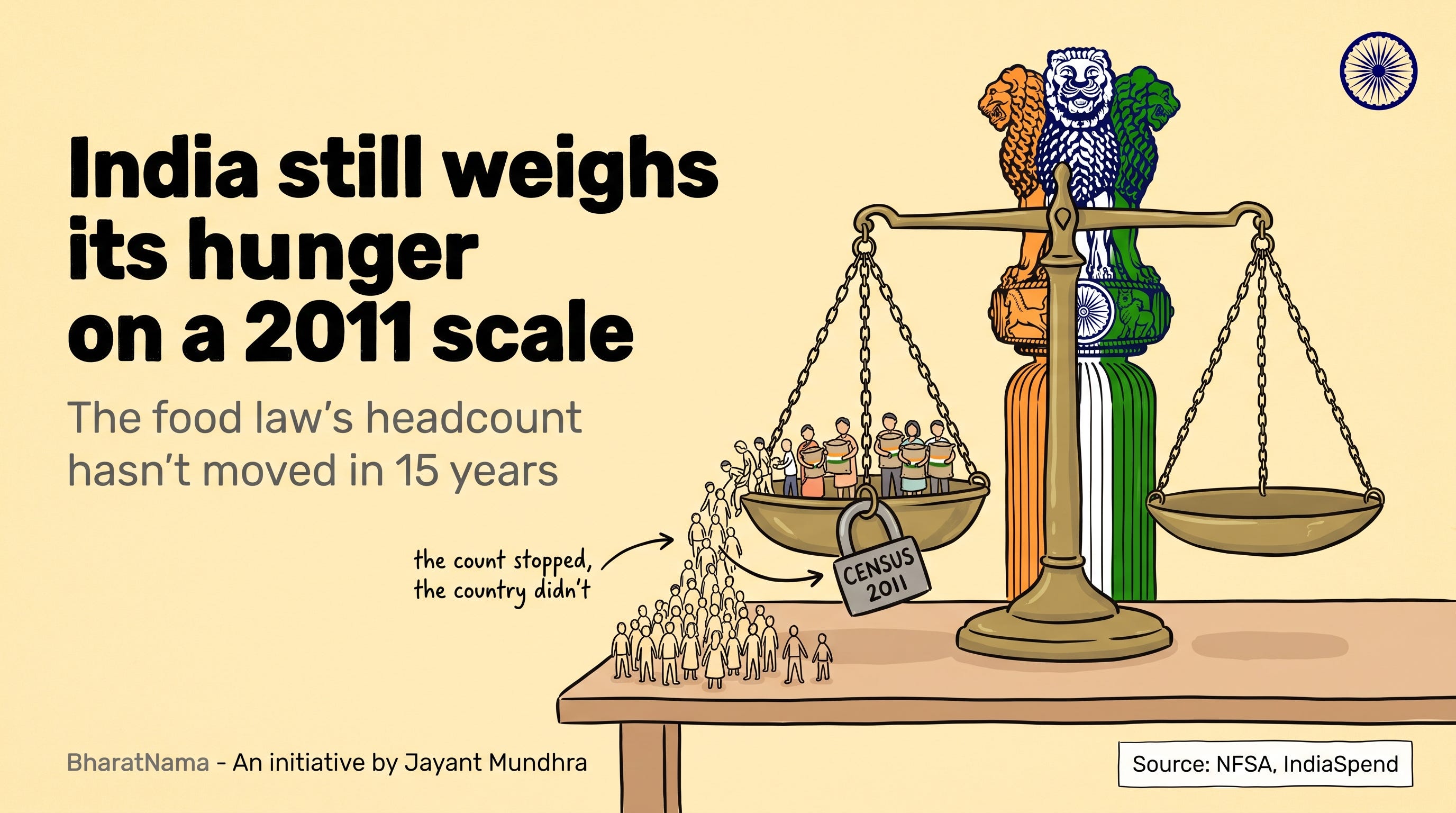
Right now, until 13 July, the government has the National Food Security Act open on its desk for amendment.1 Public comments are being invited on a draft bill. And here is what it proposes to change: the fixed 35kg monthly grain quota for the very poorest households would become 7kg per person, capped at 35kg per family.1
That is the reform on the table. A tweak to how grams are split inside a household.
What the draft does not touch is the hole that actually matters. India's food law is legally supposed to cover two-thirds of the country. It currently rations that coverage using population figures from the 2011 Census.2 More than a decade later, that single design choice has quietly locked out somewhere between 10 and 14 crore of the poorest Indians.3 4
This is not corruption. It is not a leaky ration shop or a stolen sack of wheat. It is an exclusion written into the arithmetic of the law itself. And that, to me, is the more unnerving kind of failure, because you cannot fix it by catching a thief.
What the law actually promises, and how it counts
The NFSA, passed in 2013, was a genuine landmark. It turned subsidised food from a discretionary scheme into a legal right, and it made the eldest woman of the household the ration-card holder by law.2 It entitles up to 75% of rural India and 50% of urban India to cheap grain, which works out to roughly two-thirds of the population.2
The catch sits in Section 9. The Act says the number of people to be covered "shall be calculated on the basis of the population estimates as per the census of which the relevant figures have been published."2
In plain terms: the size of the safety net is pinned to the last published census.
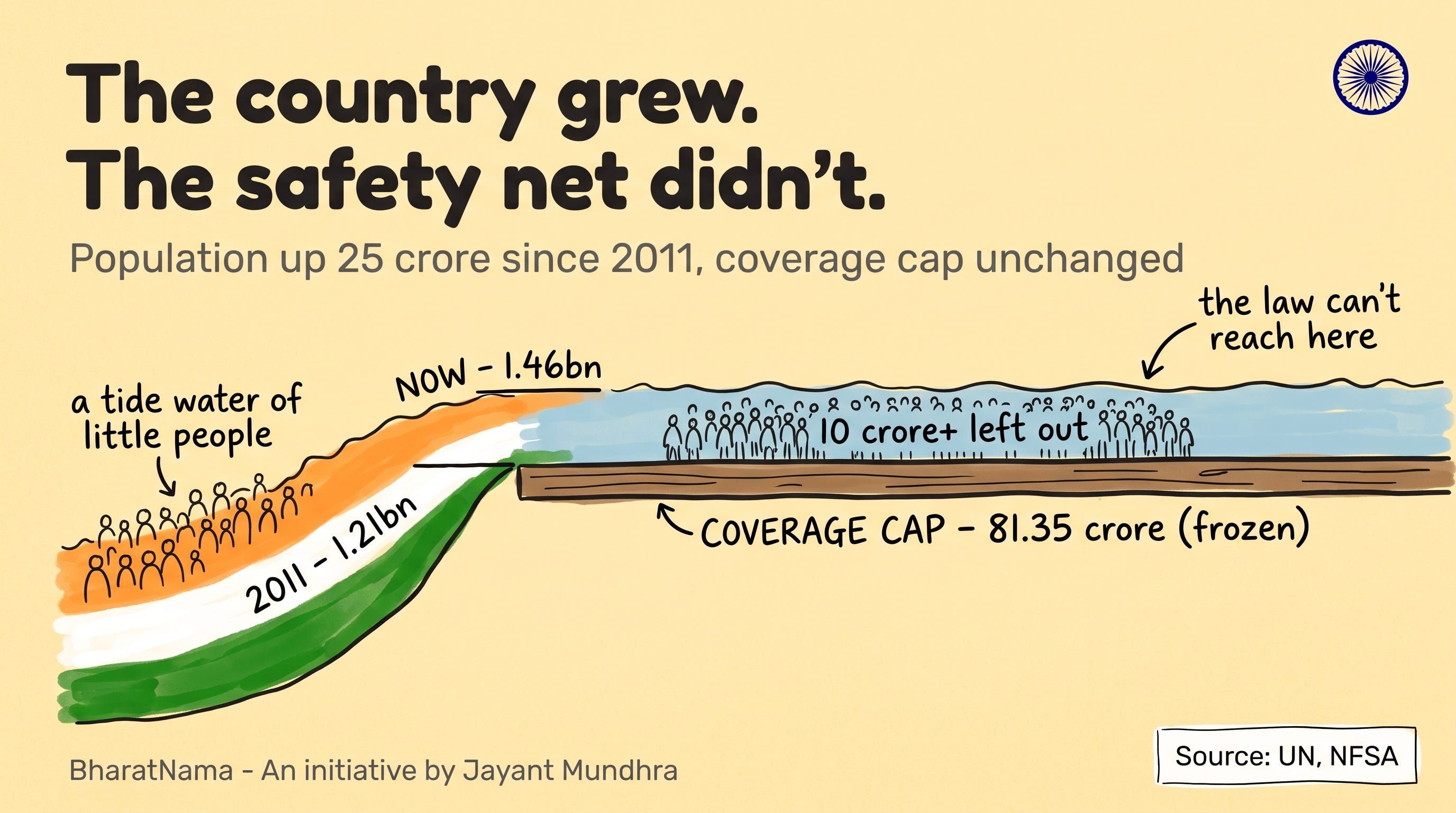
In 2013, the last published census was 2011, when India had ~1.21bn people.2
Apply 75% rural and 50% urban to that, and you get a national ceiling of 81.35 crore beneficiaries.2
That ceiling has not moved since.
Every state gets a slice of that 81.35 crore and cannot legally exceed it. As of July 2025, states had filled 80.56 crore of those slots, leaving room for just 0.79 crore more names nationwide before the cap is breached.2 A country of 1.46bn people has legal headroom to add fewer than 80 lakh ration cards.
The frozen headcount versus the growing country
Here is the interesting bit. The census froze. The population did not.
India crossed China to become the world's most populous nation, and the UN now puts the count at ~1.46bn for 2025.5 The denominator kept climbing. The numerator stayed bolted to 2011.
Economists Jean Drèze, Reetika Khera and Meghana Mungikar did the arithmetic that made this concrete. On 2020 population projections of ~1.37bn, the two-thirds mandate should have covered ~922mn people. Actual coverage was ~809mn. The gap was already ~113mn.3
By late 2024, reporting using the government's own projections put the shortfall at ~13 crore.4
Run the same sum on today's 1.46bn and the number only grows. Two-thirds of 1.46bn is close to 98 crore. India covers ~80.6 crore. On paper, the law owes food to millions it has never counted.
Now let that sink in for a second. These are not people who failed a means test. They are people the state has simply refused to see, because seeing them would mean admitting the 2011 baseline is dead.
And here is where it gets strange. The system is perfectly capable of subtracting names. It just cannot legally add them.
In the past few months alone, states weeded out ~2.25 crore beneficiaries flagged as ineligible, and 2.49 crore cards have been cancelled since 2020 for death, duplication or migration.14
That machinery works because removing a name never breaches the cap. Adding one does.
So the pool churns furiously at the edges while its total stays frozen. A poor family can only get in if another family drops out, regardless of how many genuinely need it.
The result is a welfare net that is energetically policed for who should leave and legally blind to who should enter. That asymmetry is the whole tragedy in miniature.
This kind of buried, structural number is exactly what I keep pulling apart, and it is the sort of thread we chase most mornings in the BharatNama WhatsApp community, where I share a smaller India deep-dive like this with thousands of readers every day (t.ly/h2jq1).
The court could see them, even when the government would not
The proof that these people exist did not come from the census. It came from a different government database.
After the 2020 lockdown exodus, the Supreme Court took up the plight of migrant workers and pushed the Centre to build the e-Shram portal, a register of unorganised-sector workers. It has now crossed 30.9 crore registrations.6 When the court cross-checked it against ration records, the gap was stark: of the workers registered, around 8 crore had no ration card at all.7
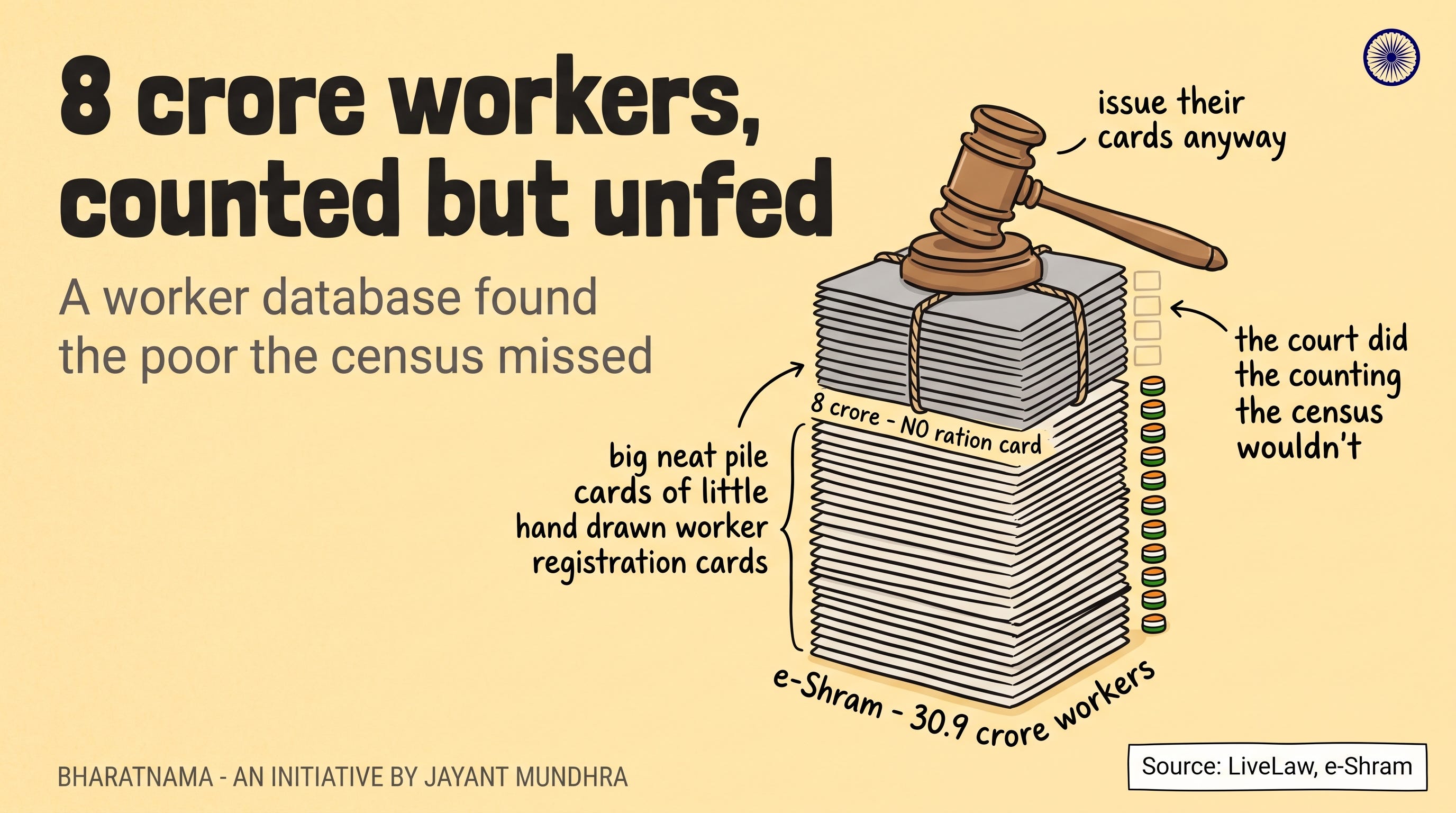
So in March 2024, the court did something remarkable. It ordered every state to issue ration cards to those 8 crore workers, and to do it irrespective of the Section 9 quotas, later setting a final deadline of 19 November 2024.7 It effectively told the executive to bypass its own frozen formula because, in its words, the hungry cannot wait.
The executive did not agree. And this is where the story stops being administrative and becomes a genuine clash of worldviews:
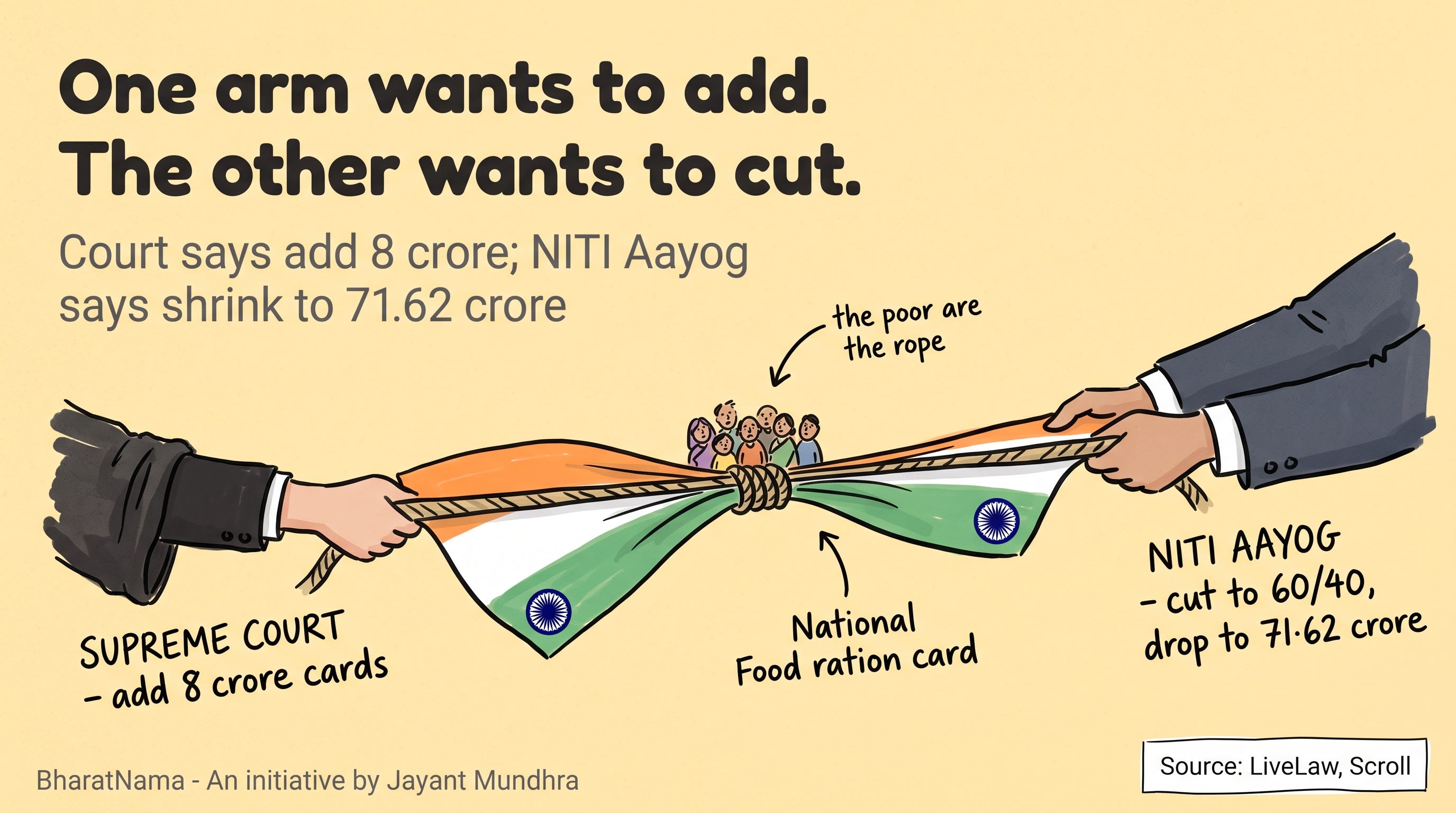
The judiciary reads the right to food as flowing from Article 21, the right to life, and treats the 2011 freeze as a violation to be overridden.7
The executive, backed by NITI Aayog, reads Section 9 literally: coverage cannot change until a new census is published, full stop.8
And NITI Aayog wants to go the other way entirely. Rather than expand, it has floated cutting coverage from 75/50 down to 60/40, which would drop the covered pool to ~71.62 crore and save the exchequer roughly ₹47k crore a year.8 One arm of the state wants to add 8 crore names. Another wants to remove nearly 10 crore. The poor sit in the middle of that argument.
Where India stands: the world updates, India waits
This is the part that should sting, because the fix is not a mystery. Other countries stopped tying welfare to a decadal snapshot a long time ago.
The cleanest benchmark is Brazil's Cadastro Único, the single social registry behind Bolsa Família and dozens of other schemes.9
It is continuous, not decadal. A family that falls into poverty can walk into a municipal centre and register any day of the year, and benefits follow.9
It is huge and live: over 40mn families sit in the registry, with ~19.9mn families drawing Bolsa Família today.9
Because everyone vulnerable is already pre-registered, Brazil could switch on emergency cash to millions within weeks during COVID, simply by activating dormant records.9
The gap is really a gap in clocks. Brazil's headcount updates the day a family's circumstances change. India's updates once a census, which has now meant once every 16 years and counting.5 One system is designed to notice poverty as it happens. The other is designed to wait.
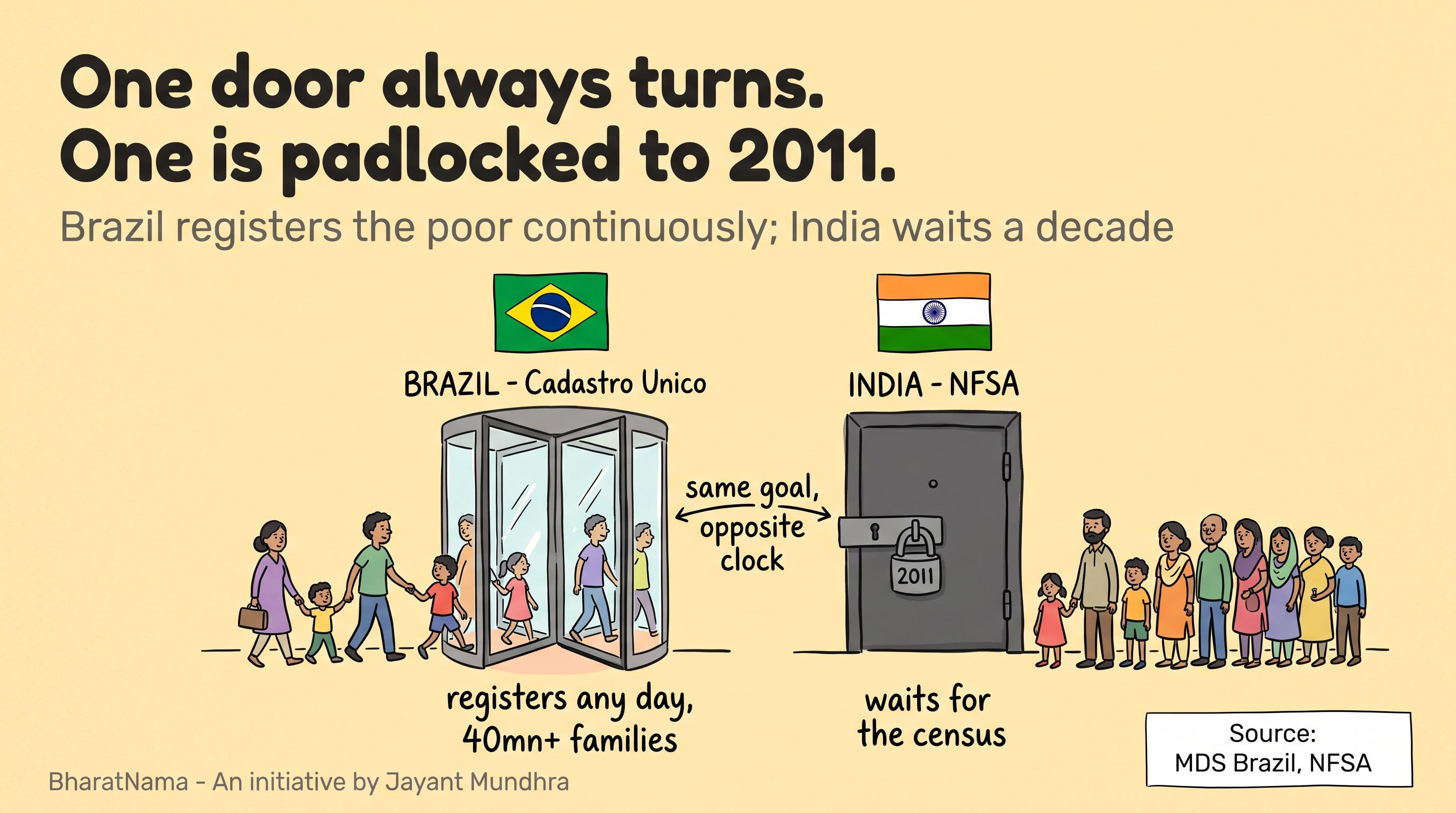
India, by contrast, waits for a census. When COVID hit and the Centre gave free grain over and above the NFSA quota, every one of those extra kilos went only to people who already held a card. The 10-crore-plus excluded got nothing, because to the system they did not exist.
The lesson from Brazil is not "copy Bolsa Família." It is narrower and sharper: delink the count from the census, and let a live registry do the counting.
Where India stands: against itself
Now break the national number open, because the intra-India picture is where the real inequity lives.
With the Centre frozen, richer states have quietly built their own parallel safety nets out of their own budgets:2
NEEM cards (entitlements equal to or better than NFSA) cover ~90mn people, funded by states, not Delhi.10
LEAN cards (lesser entitlements) cover ~51mn more.10
In the southern states, NEEM cardholders make up 31% to 45% of everyone the PDS reaches. Tamil Nadu runs a universal system and gives rice free to all.10 11
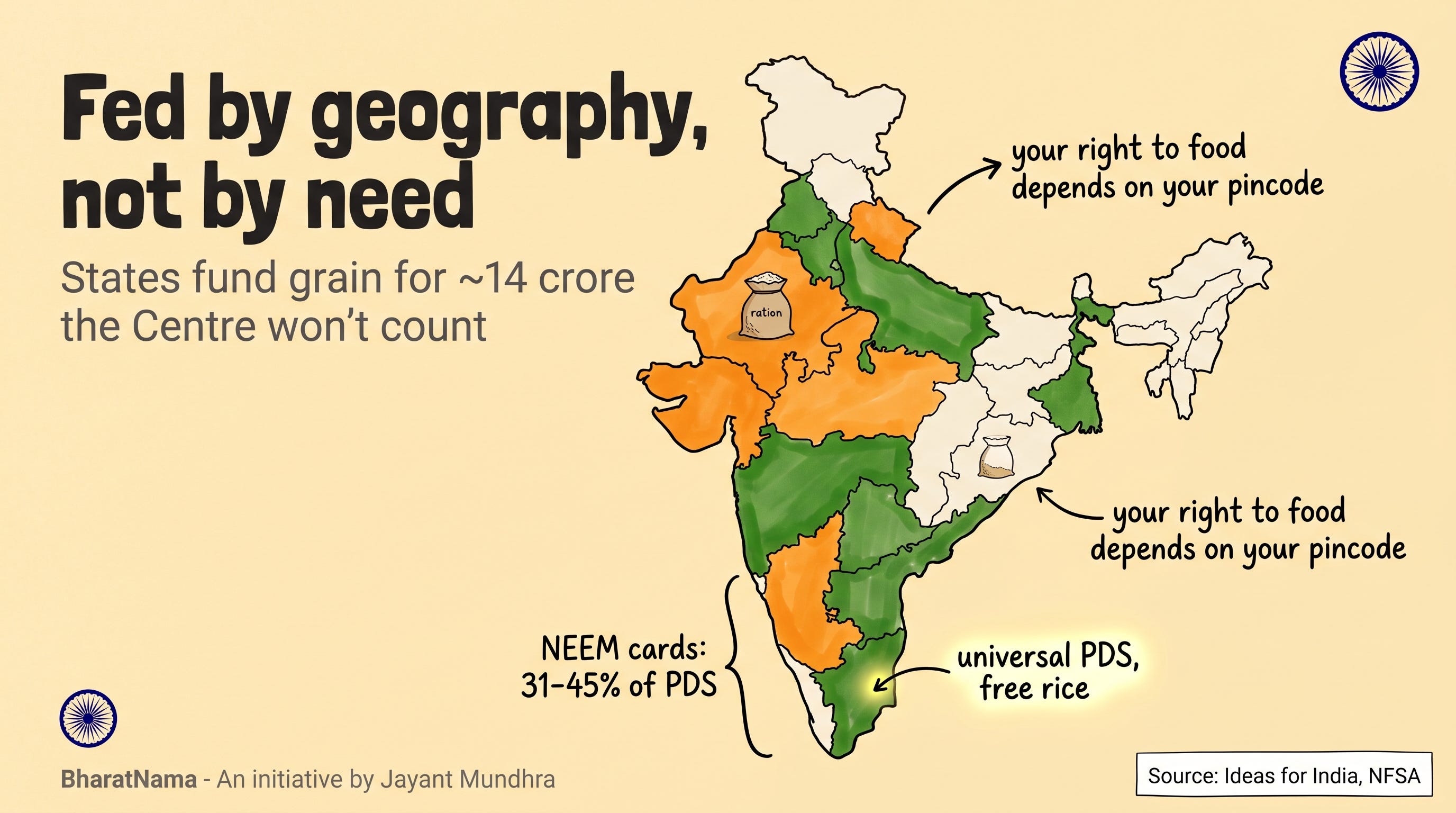
Combine these and states are feeding ~14 crore people the Centre refuses to count. That is a quiet act of federal generosity, but it is also a scandal.
What India can learn, and already knows
Here is the honest bit: India does not need Brazil to prove this works. It has already built the pieces at home.
Haryana's Parivar Pehchan Patra gives each family an 8-digit ID and pushes pensions and certificates to people automatically, no re-application needed.12
Karnataka's Kutumba and Rajasthan's Jan Aadhaar do the same, and Uttar Pradesh has copied the model.12 When Karnataka linked scholarships to its family registry, uptake nearly doubled overnight because the system found eligible students instead of waiting for them to apply.12
And the e-Shram database already holds 30.9 crore unorganised workers, live and Aadhaar-linked.6
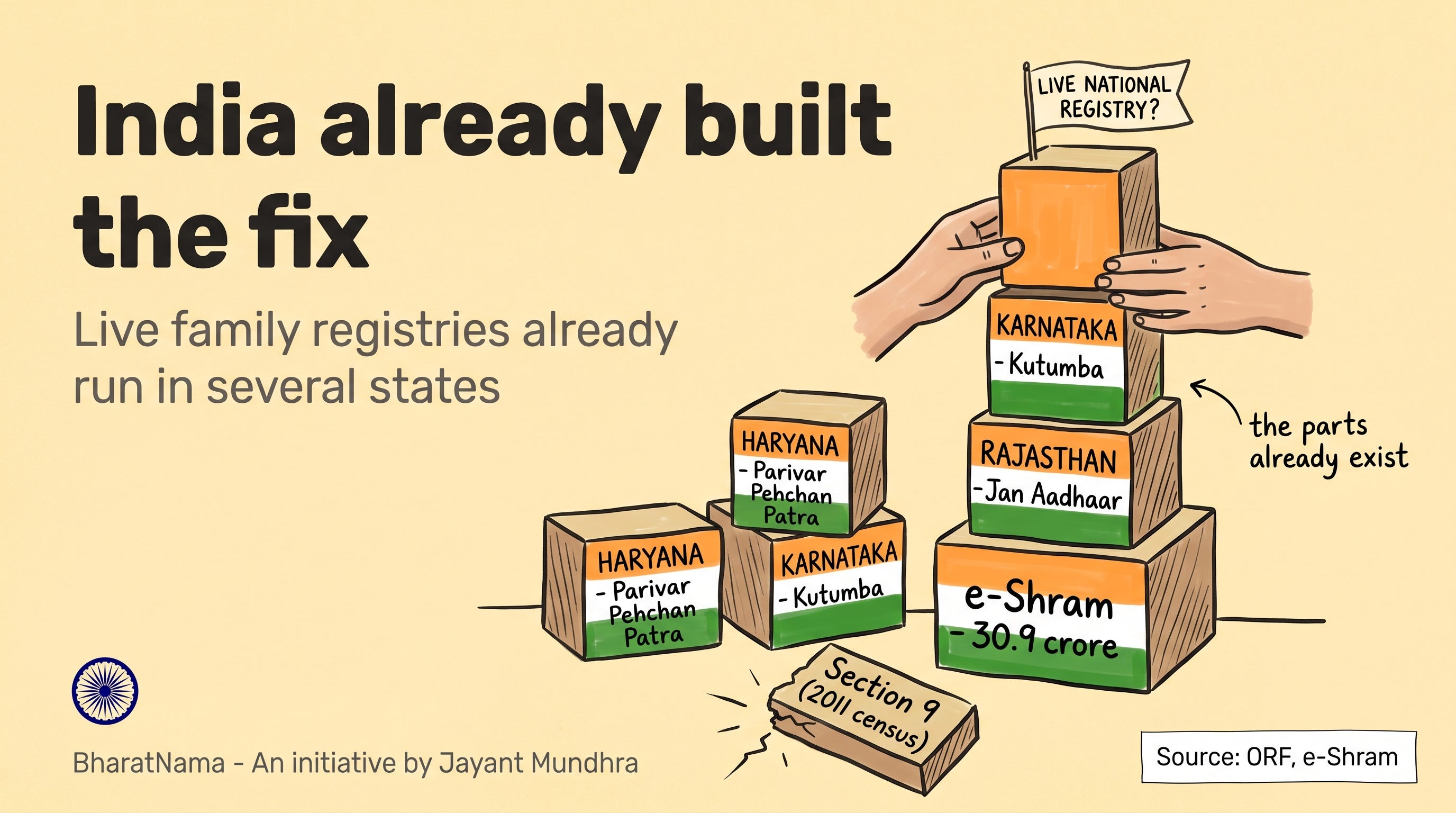
So the technology, the data and the state capacity all exist. What is missing is the legal will to let a dynamic registry override a dead census. That requires Parliament to amend Section 9, which is precisely the sort of change the draft bill on the table this week could have made, and did not.1
There is a real prize here too, not just a fix. A live family registry lets the state track intergenerational poverty, target nutrition, and respond to shocks in weeks instead of a decade. That is the opportunity India keeps leaving on the table.
What to watch
The amendment bill. Comments close on 13 July.1 Watch whether the final draft touches the coverage cap at all, or stays limited to the 7kg-per-person tweak.
Census 2027. House-listing began in April 2026, enumeration is set for February 2027, and the Centre has put ₹6k crore behind it.13 5 But results will not land until ~2028, so the freeze holds for at least two more years.
The 8-crore compliance. Track whether states actually issue the e-Shram ration cards the court ordered, and whether the Centre supplies the extra grain to back them.7
State fiscal strain. Watch how long poorer states can keep funding NEEM and LEAN cards without central tide-over grain.10
The one line
India has built a food-security net wide enough to be the envy of the world, then chosen to measure it with a ruler that stopped growing in 2011.
And well that is it for today's edition. That said, do check out my core WhatsApp community Biz News+ where I share 4-5 deepdives from the world of business, economics & public economics daily: https://t.ly/h2jq1
And if you want to understand where China stands and what it means for India, do check out my companion newsletter, Decoding the Dragon: https://t.ly/t7uhs
And, do check out my work on the following platforms as well: Instagram, LinkedIn and Youtube
Best,
Jayant
References
1. Down To Earth, draft National Food Security (Amendment) Bill: link
2. NextIAS / The Wire, NFSA coverage 81.35 crore vs 80.56 crore identified and Section 9: link
3. IndiaSpend, Drèze-Khera-Mungikar estimate of 100mn+ excluded and 922mn mandate: link
4. Newslaundry, 13 crore Indians denied rations: link
5. TASS / UNFPA, India population surpasses 1.46bn in 2025: link
6. IBEF / PIB, over 30.9 crore unorganised workers registered on e-Shram: link
7. LiveLaw, Supreme Court directs states to issue ration cards to 8 crore e-Shram workers: link
8. Scroll, NITI Aayog recommends cutting NFSA coverage to 60/40: link
9. Global Alliance against Hunger and Poverty, Brazil Cadastro Único and Bolsa Família: link
10. Ideas for India, NEEM and LEAN cards and state-funded expanded PDS: link
11. Wikipedia, Tamil Nadu universal PDS and free rice: link
12. ORF / Bajaj Finserv, Haryana PPP, Karnataka Kutumba, Rajasthan Jan Aadhaar family IDs: link
13. Outlook / PIB, Census 2027 schedule and ₹6,000 crore budget: link
14. The Pioneer / Outlook, 2.25 crore ineligible removed and 2.49 crore cards cancelled since 2020: link
Comments
Nothing yet. Say the first thing.
Sign in to join the conversation.