
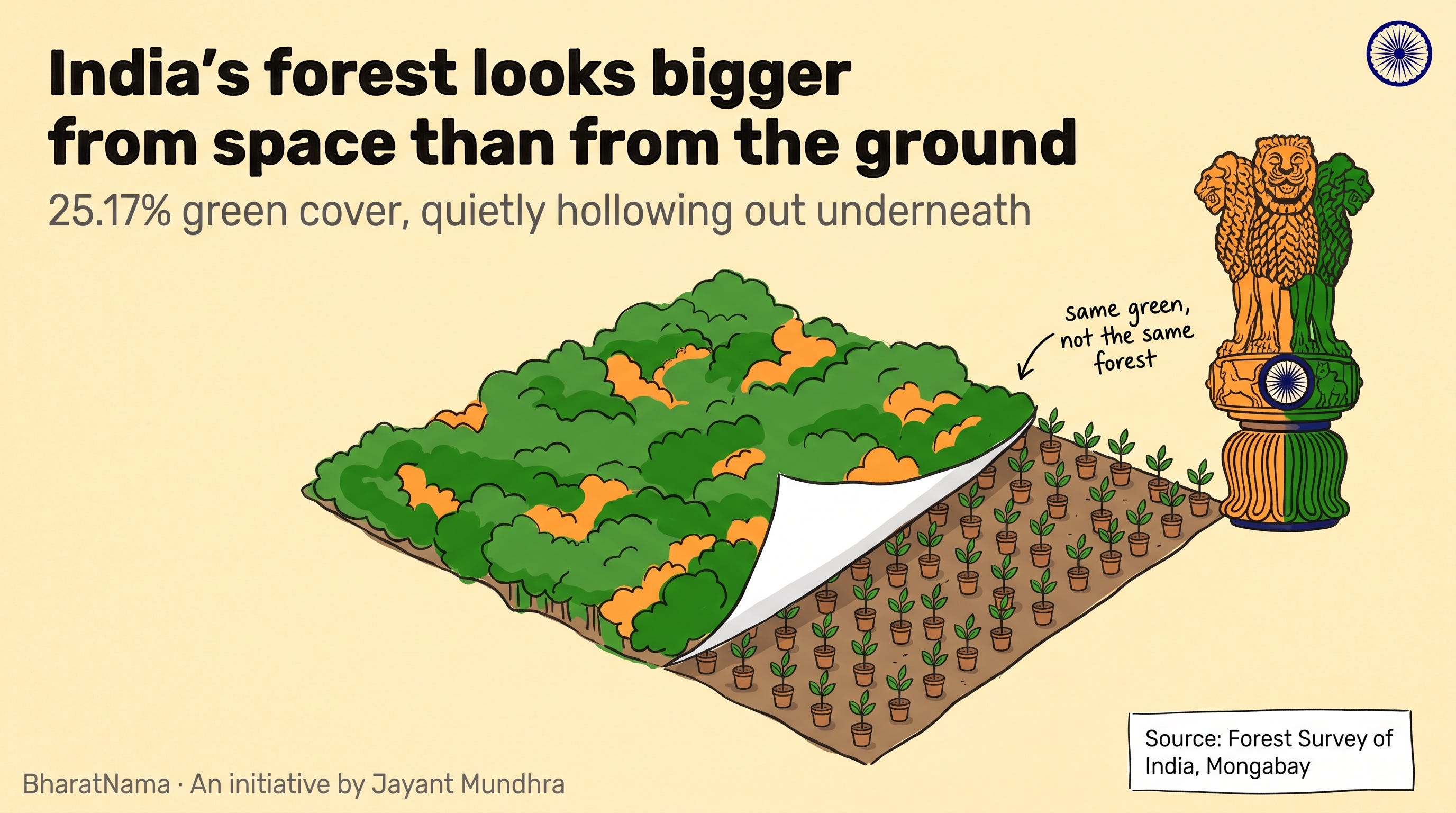
Here is a number the government is proud of, and it deserves a second look. India's forest and tree cover now stands at ~8.3 lakh sq km, or 25.17% of the country's land, the highest it has ever been recorded.1
That is the headline of the India State of Forest Report 2023, the biennial audit that is still the country's latest word on its own forests.1 It is a good news story. Forest and tree cover rose by 1,445 sq km in two years. India's forests hold a carbon stock of 30.43bn tonnes of CO2 equivalent, and have already added 2.29bn tonnes of the 2.5 to 3.0bn-tonne sink India promised the world by 2030.2
Now here is the number nobody puts on a press release. Over the decade to 2021, roughly 93,000 sq km of India's forests, an area larger than Andhra Pradesh, structurally degraded: dense forest thinning to open, forest and scrub collapsing into bare land.34
Both numbers are true at once. That is the paradox this edition is about.
Start with what "forest cover" actually means in India, because the definition is doing almost all the work.
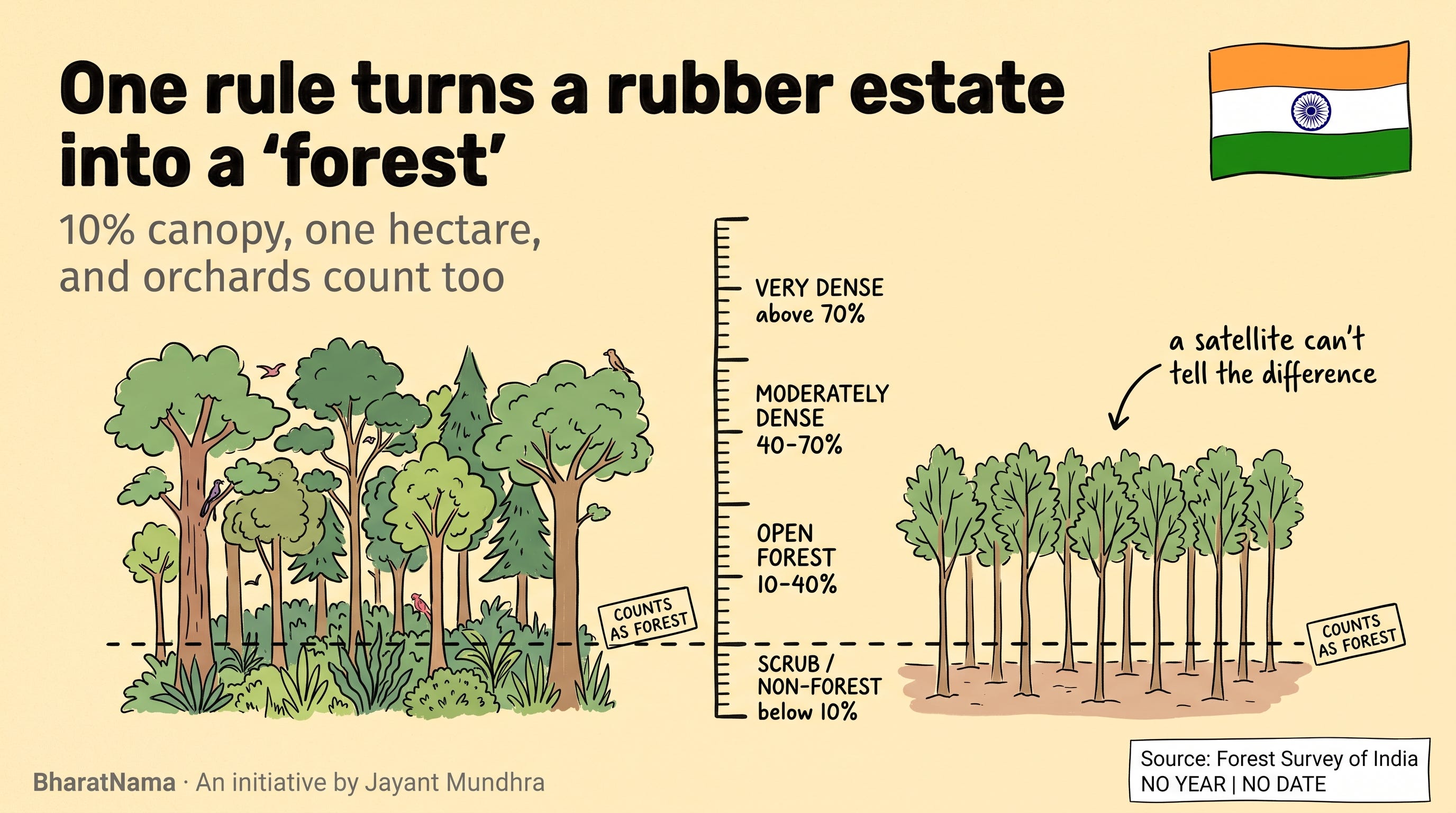
The Forest Survey of India counts as forest any patch of at least one hectare with a tree canopy of 10% or more.1 That is it. Not who owns it, not whether it is a legal forest, and crucially, not what is growing there. As the FSI's own methodology says, the count includes commercial orchards, bamboo, and palm and rubber plantations.4
So the picture is stitched together from satellite imagery, mostly the indigenous LISS-III sensor at 23.5-metre resolution.4 A satellite is superb at seeing green. It cannot tell an ancient, multi-layered rainforest from a monoculture rubber estate. Both read as "forest".
Layer on the classification the FSI uses within that green:
Very Dense Forest (VDF): canopy above 70%.
Moderately Dense Forest (MDF): canopy 40 to 70%.
Open Forest (OF): canopy 10 to 40%.
Below 10%, land is scrub or non-forest.
The trouble is that a number can climb even as the thing it measures falls apart. A rubber plantation crossing 10% canopy adds to the tally exactly as a thinning old-growth forest slips down through the classes. The aggregate goes up. The ecology goes down. This is a story I keep coming back to in the BharatNama WhatsApp group, where I share a smaller India deep-dive like this with thousands of readers every morning, and forest data is a near-perfect case of a metric that flatters the thing it is meant to police (t.ly/h2jq1).
→ Join the BharatNama community
Look under the aggregate and the direction of travel reverses.
Between 2011 and 2021, inside recorded forest areas, the degradation ran in a clear downward staircase:34
40,709 sq km of Very Dense and Moderately Dense Forest, India's richest carbon and biodiversity stores, thinned into Open Forest.
5,573 sq km of forest slipped further, into scrub.
46,707 sq km of forest and scrub lost their canopy entirely and became non-forest.
That is close to 93,000 sq km of structural loss. The FSI itself concedes that restoring this degraded land to its former density would lock up an additional ~637mn tonnes of carbon.3 That is the sequestration the current trajectory is bleeding away.
So how does a report built on that reality announce a net gain? Through a step that has spatial ecologists genuinely puzzled. A straight comparison of the 2021 and 2023 raw data suggests nearly 1,93,000 sq km of dense and open forest was lost or altered.4 The published report applies an unexplained "normalisation factor" that turns that gross loss into a net increase of just 297 sq km for those categories.4 The method is opaque to independent researchers, which is a polite way of saying nobody outside the FSI can reproduce it.
Here is the tell that makes the whole thing click. Organised plantation activity in India is estimated at nearly 18,000 sq km every year.4 Yet total forest and tree cover rose by only 1,445 sq km over two years.1 Either vast tracts of natural forest are being cut at a pace that almost cancels all that planting, or most of those plantations are simply dying. Neither reading supports the triumphant headline.
The instinct is to shrug: a tree is a tree, green is green. The soil says otherwise.
Most of a forest's durable carbon is not in the trunks and leaves you can see. It sits underground, as soil organic carbon, held there by the tangle of diverse roots, continuous leaf litter, and stable microbes that only a natural forest builds up over centuries.
A study by the Kerala Forest Research Institute and collaborators in the southern Western Ghats put paired plots side by side: pristine natural forest and adjacent teak plantations of 40 to 50 years.5 Over the top 50 cm of soil, the natural forest held roughly 225 tonnes of organic carbon per hectare. The teak plantation held about 195.5
That gap is the buried cost of every "offset" plantation. When a complex forest is cleared for a monoculture, the plantation may hit the 10% canopy bar within a few years and register as recovered cover, but the soil carbon, the acidity, the buffering capacity, all degrade over successive harvest rotations. On the satellite it looks like a win. In the ground it is a slow, uncounted haemorrhage.
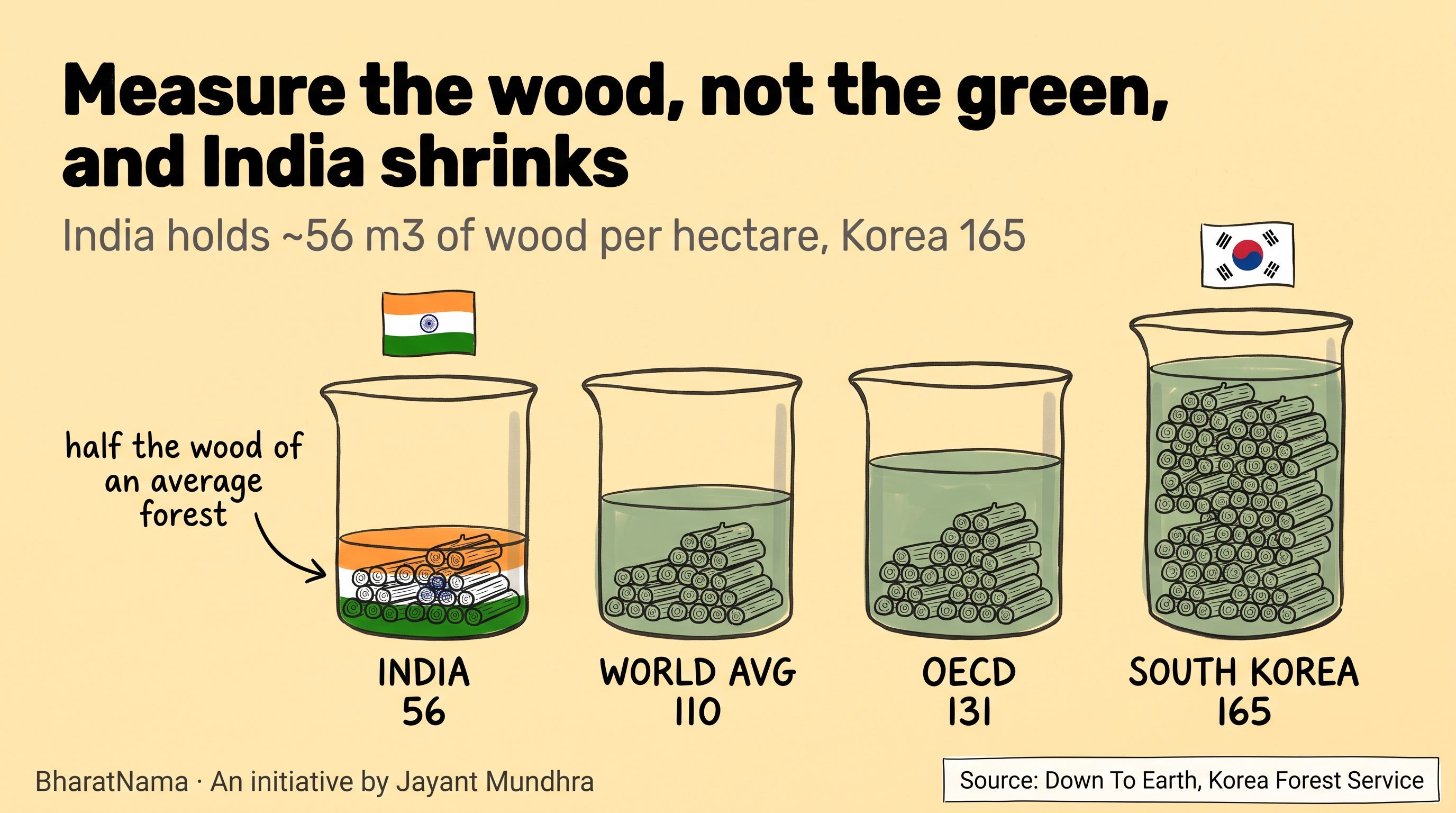
Strip away canopy area and measure forests the way foresters actually do, by "growing stock", the volume of living wood per hectare, and India's position is far more sobering.
Growing stock captures height, girth, age and density. It is the honest proxy for how much forest is really there. On this measure:
India: roughly 56 m³ of wood per hectare.6
World average: around 110 m³ per hectare.6
OECD average: about 131 m³ per hectare.7
South Korea: 165 m³ per hectare, as of 2020.7
India's forests, in other words, hold barely half the wood per hectare of an average forest anywhere, and roughly a third of South Korea's. India's total growing stock is nudging up in aggregate, to ~6.4bn cubic metres, but that is being propped up by trees outside forests, orchards and farm trees, even as the dense natural forests that carry the real volume thin out.1
The picture from abroad is not all grim, and honesty cuts both ways. The FAO's Global Forest Resources Assessment 2025 ranks India 9th in the world by total forest area, at 72.7mn hectares, up a place, and 3rd globally in annual forest gain.8 India's forests remove ~150mn tonnes of CO2 a year, the 5th-largest forest carbon sink on earth.8 India is planting furiously. The question is what it is planting, and what it is losing to plant it.
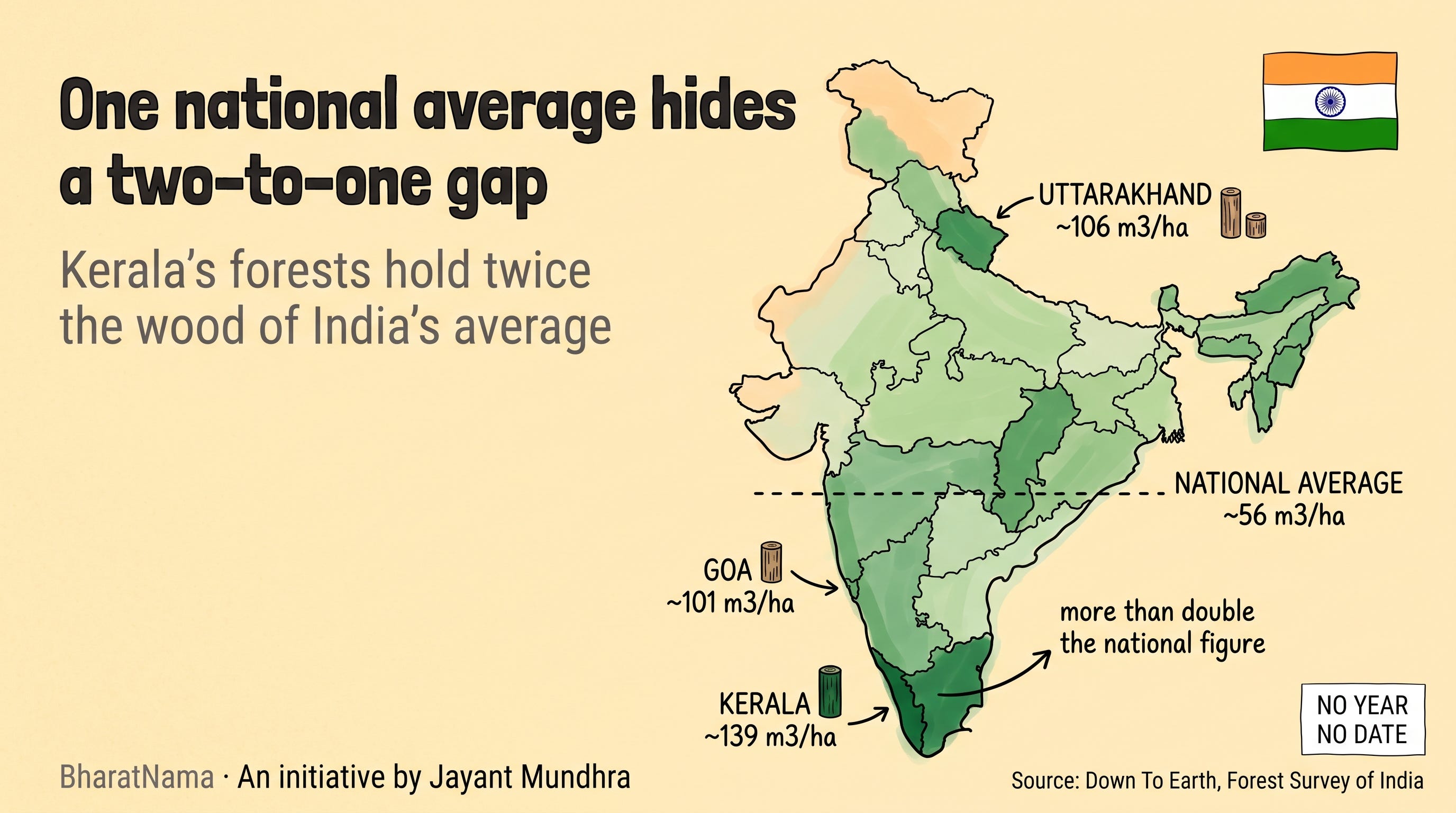
Now turn the lens inward, because the national average of ~56 m³ per hectare hides a striking spread:6
Kerala: ~139 m³ per hectare, more than twice the national figure.
Uttarakhand: ~106 m³ per hectare.
Goa: ~101 m³ per hectare.
And the loss is concentrated in exactly the places India can least afford to lose. Between 2021 and 2023, almost every northeastern state, the country's richest biodiversity belt, lost forest inside its recorded areas: Tripura shed 116 sq km, Assam 86, Manipur 47, Arunachal Pradesh 45, with Mizoram the lone exception.9 In the Western Ghats, forest cover outside protected areas fell by 58 sq km against 2013 levels.3 Mangroves, India's coastal shield, slipped to 4,991 sq km, a net loss of 7.43 sq km, with Gujarat alone down 36 sq km.3
Even fire tells a local story the national average erases. Overall fire hotspots fell, yet Uttarakhand's incidents exploded from 5,351 in 2022-23 to 21,033 in 2023-24, and Himachal Pradesh's rose more than 1,300%.1011 A single dry season in the hills can undo years of slow canopy gain.
If one country has earned the right to lecture on forests, it is South Korea, and its lesson is precisely about the metric.
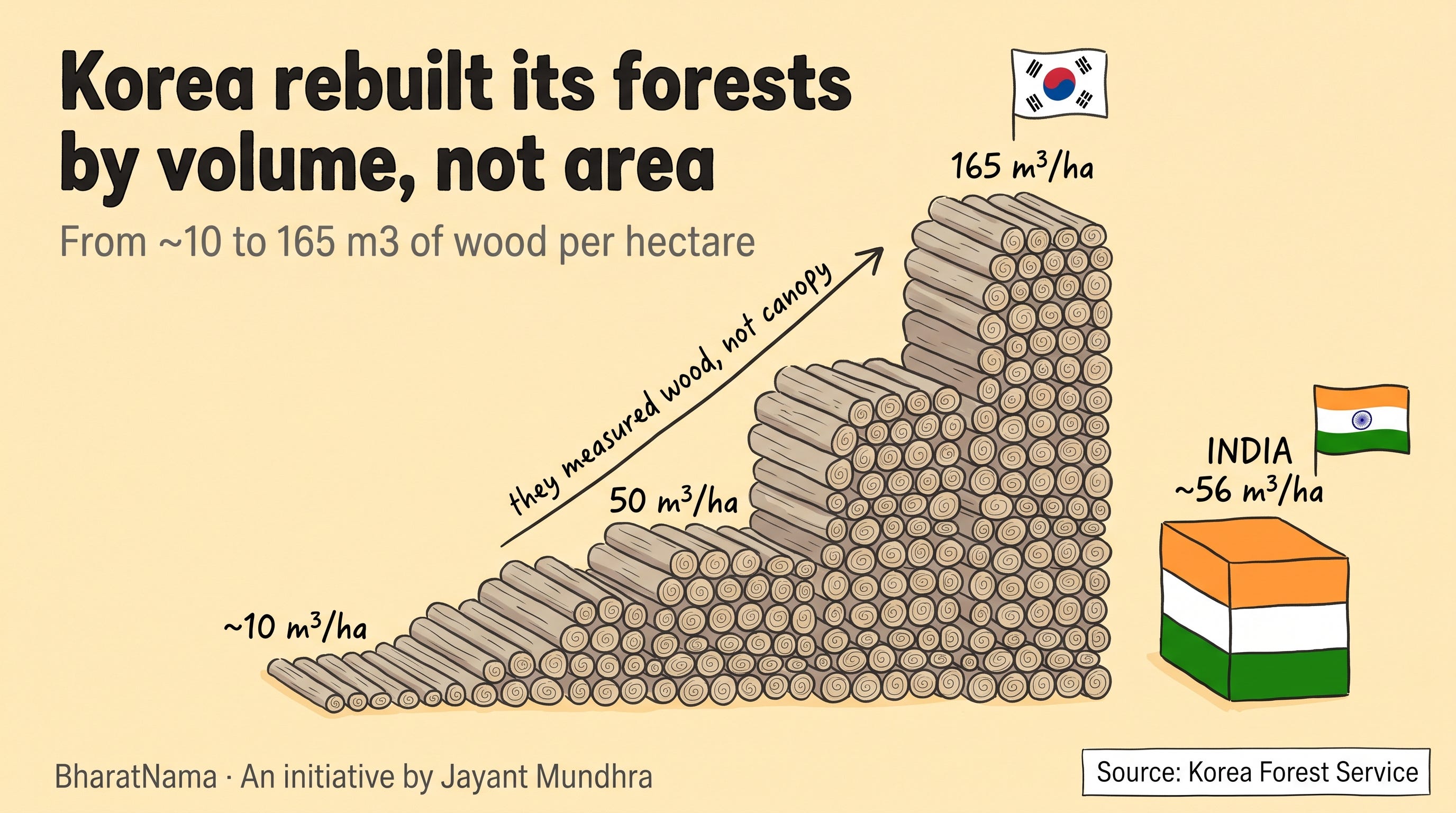
By 1953, war and colonial extraction had stripped Korea's forests to roughly 10 m³ of growing stock per hectare, near-total devastation.7 Seoul launched a national rehabilitation drive in 1973, wove it into the Saemaul Undong village movement, and planted billions of trees. So far, so familiar; India plants at scale too.
The difference was what Korea chose to measure. Not hectares of canopy, but growing stock, the three-dimensional volume of the forest. And it climbed relentlessly: to 50 m³ per hectare by 1990, and to 165 by 2020.7 Korea did not get there by watching saplings grow. It actively thinned overcrowded stands, paid landowners to convert commercial plantations back to natural forest, and stretched timber rotation ages by decades.7
This is the thread worth pulling, and it is exactly the kind of "what actually works abroad" comparison we chew over in the BharatNama community every day (t.ly/h2jq1). The portable lesson is not "plant more". India already does. It is to change the yardstick: reward volume, soil carbon and biodiversity, not the bare fact of green. What does not transfer easily is Korea's state capacity and its smaller, more uniform geography. India's federal, forest-dwelling, wildly diverse landscape makes the accounting harder, which is all the more reason to get the accounting honest.
→ Join the BharatNama community
None of this is accident. It is incentive.
When forest is diverted for a mine or a highway, the user agency pays into CAMPA, the compensatory afforestation fund, which states are meant to spend replanting an equivalent area. In practice the money sits still. Between 2019-20 and 2023-24, National CAMPA approved ~₹3.85 lakh crore for state plans, of which only ~₹2.6 lakh crore, about 68%, was actually spent.12
Andhra Pradesh is the parable. It holds a CAMPA corpus of ~₹2,257 crore, yet spent just ₹658 crore between 2019-20 and November 2025, leaving ₹1,947 crore idle in government accounts.13 Planting is seasonal and monsoon-bound; when funds arrive months late, the window is missed and saplings die. National assessments put the survival rate of compensatory saplings at ~33.5%, roughly half the 60 to 65% the Forest Research Institute considers viable.13
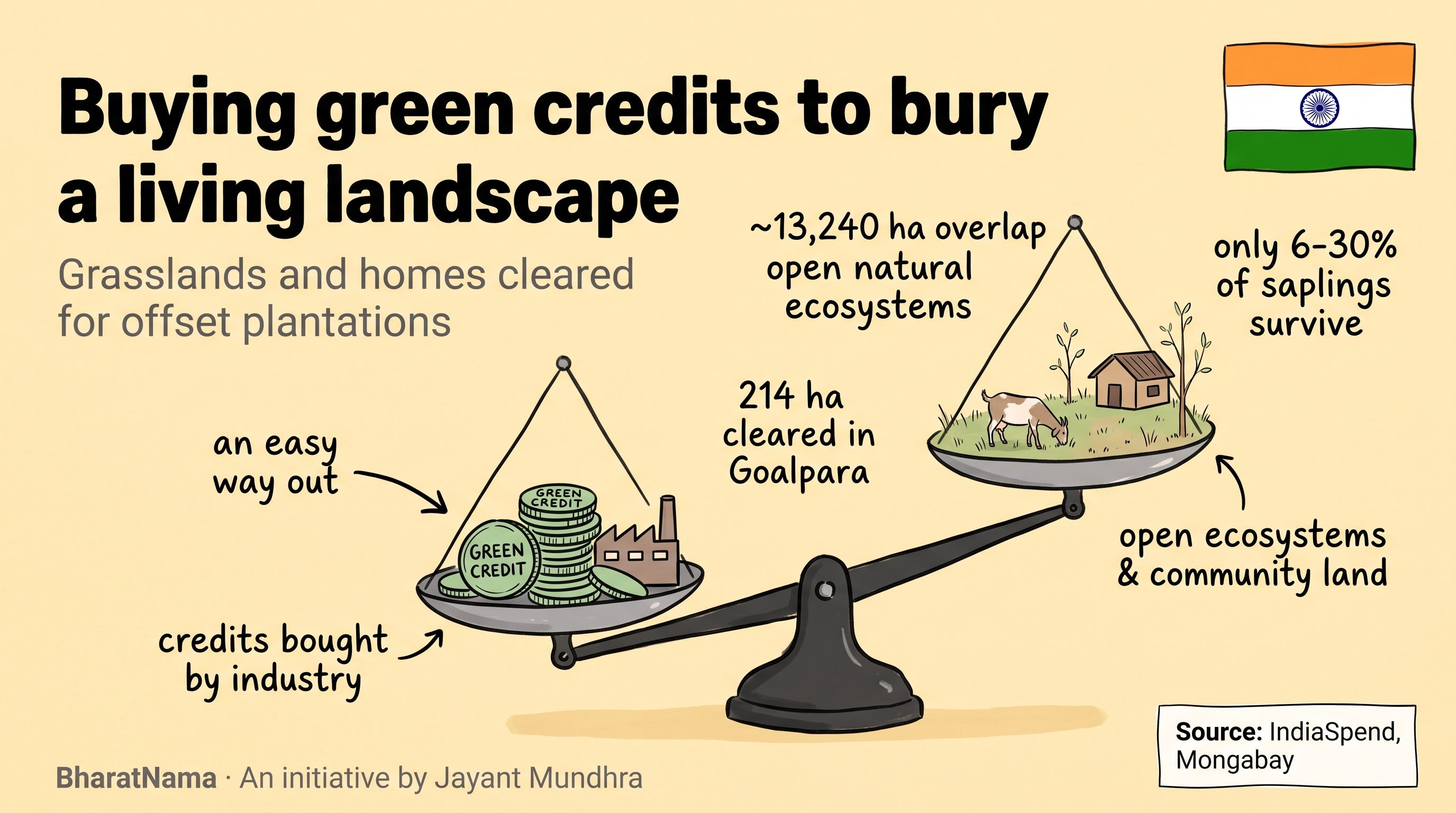
Then there is the newer instrument, the Green Credit Programme, launched in October 2023, which lets companies buy credits by funding plantations on "degraded" land.14 Two problems have surfaced fast:
There is no firm definition of "degraded", so naturally open ecosystems, savannas, grasslands, scrub that support unique species and pastoralist livelihoods, get swept in. Roughly 13,240 hectares selected under the scheme overlap with likely open natural ecosystems.14
The human cost is real. In Assam's Goalpara, reporting found five sites covering 214 hectares cleared of homes, farmland and even schools in the name of restoration.14 Plantation survival on these sites runs between 6 and 30%.14
And in August 2025 the government widened the programme so those credits can now count towards compensatory afforestation itself, letting industry, as one former forest officer put it, buy an easy route out of land it would otherwise have to replace.15 The scheme now faces a Supreme Court challenge.14
The Supreme Court and the definition of "forest". In interim orders on 3 February and 4 March 2025, the Court told every state to keep applying the wide 1996 Godavarman definition of forest, and barred any reduction of forest land without compensatory land first, effectively freezing the dilution in the Forest (Conservation) Amendment Act 2023.1617 Watch for the final ruling.
ISFR 2025. The next State of Forest Report is due. Watch whether the FSI finally separates natural forest from plantations, or repeats the normalisation.
CAMPA drawdown. Track whether idle state balances, Andhra's ₹1,947 crore above all, actually get spent on the ground before the next planting season.
Green Credit rules. Watch the litigation and whether the "degraded land" definition is tightened to protect open natural ecosystems.
India's forest map is greening on a satellite screen while its natural forests thin out underneath, and until the country measures wood, soil and biodiversity instead of bare canopy, it will keep mistaking a plantation for a forest.
And well that is it for today's edition. That said, do check out my core WhatsApp community Biz News+ where I share 4-5 deepdives from the world of business, economics & public economics daily: https://t.ly/h2jq1
And if you want to understand where China stands and what it means for India, do check out my companion newsletter, Decoding the Dragon: https://t.ly/t7uhs
And, do check out my work on the following platforms as well: Instagram, LinkedIn and Youtube
Best,
Jayant
Press Information Bureau, India State of Forest Report 2023 release: pib.gov.in
DD News, India's forest cover increases by 1,445 sq km, ISFR 2023: ddnews.gov.in
The Wire, ISFR 2023's grey areas: forest degradation, decline and FRA: thewire.in
Mongabay India, Forest survey reveals India's shift towards plantations: india.mongabay.com
Springer, Soil organic carbon pool under tree plantations in the Southern Western Ghats of Kerala: link.springer.com
Down To Earth, Forest survey report: India's growing stock and per-hectare volume: downtoearth.org.in
Korea Forest Service, Korean Forests at a Glance (growing stock 165 m³/ha, 2020): english.forest.go.kr
Press Information Bureau, GFRA 2025 ranks India 9th globally in total forest area: pib.gov.in
The Sentinel, Arunachal loses 549 sq km of forest cover, ISFR 2021-2023: sentinelassam.com
Business Standard, Uttarakhand, Himachal record sharp rise in forest fires: ISFR: business-standard.com
Down To Earth, Forest fires increased 1,339% in Himachal Pradesh: downtoearth.org.in
Khan Global Studies / CEC, Compensatory afforestation fund utilisation in India: khanglobalstudies.com
Counterview, Andhra Pradesh's unspent CAMPA funds raise ecological concerns: counterview.net
IndiaSpend, What's ailing India's Green Credit Programme?: indiaspend.com
Mongabay India, Green credit rules tweaked to favour canopy cover, remove trade provision: india.mongabay.com
Down To Earth, FCAA 2023: states must act as per Godavarman, says SC: downtoearth.org.in
LiveLaw, States must follow Godavarman definition of forest till 2023 rules applied: Supreme Court: livelaw.in
Comments
Nothing yet. Say the first thing.
Sign in to join the conversation.