
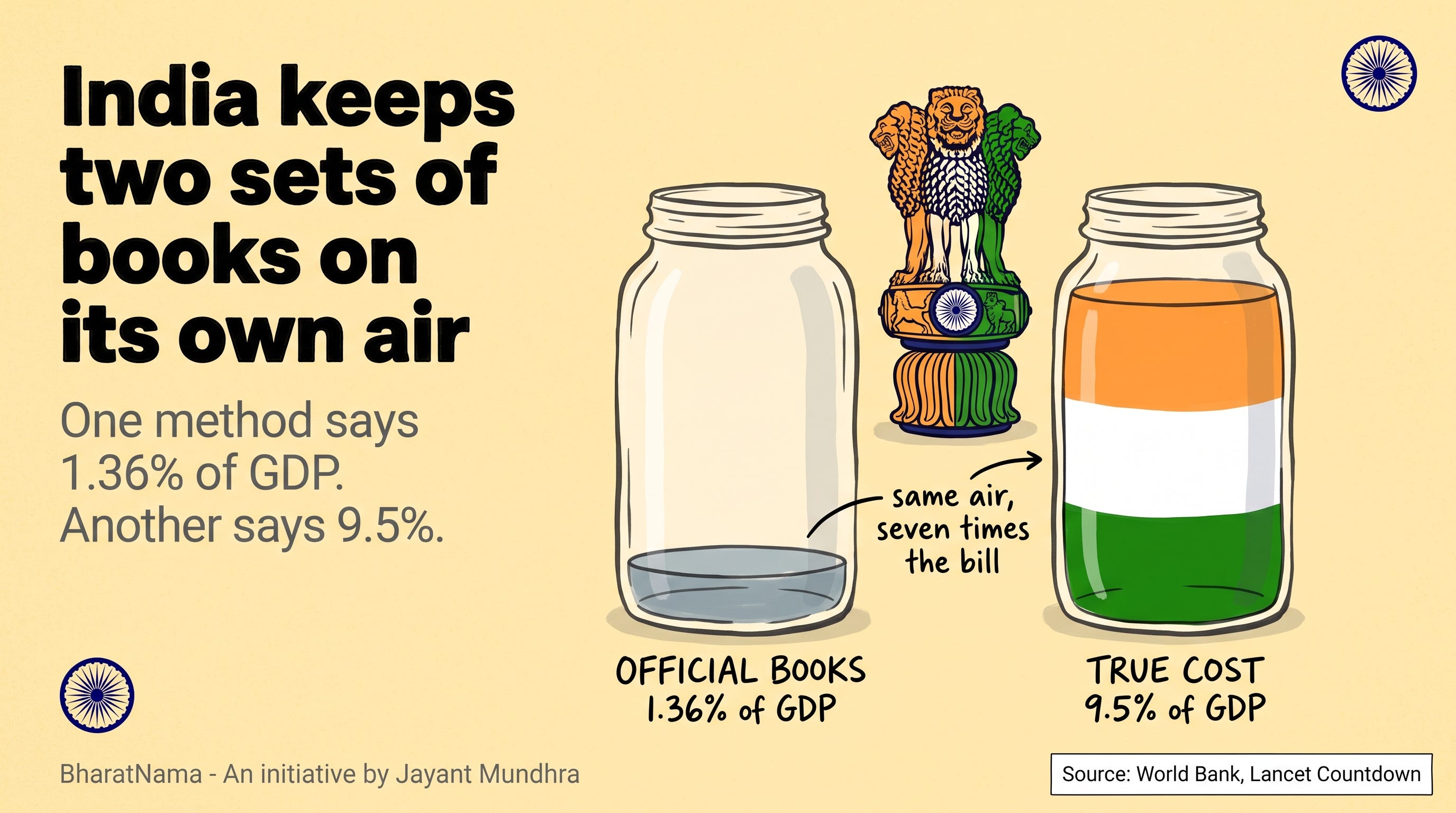
Here is a number that stopped me cold. India's own accounting says air pollution costs the economy 1.36% of GDP. An equally credible method says the real figure is 9.5%.12
Same country. Same toxic air. Same year, near enough. The two numbers are seven times apart.
That is not a rounding error. It is a fault line running straight through how the Indian state decides what to spend on clean air, and which side of that line you sit on quietly decides whether pollution control looks like a cost or the highest-return investment India could make.
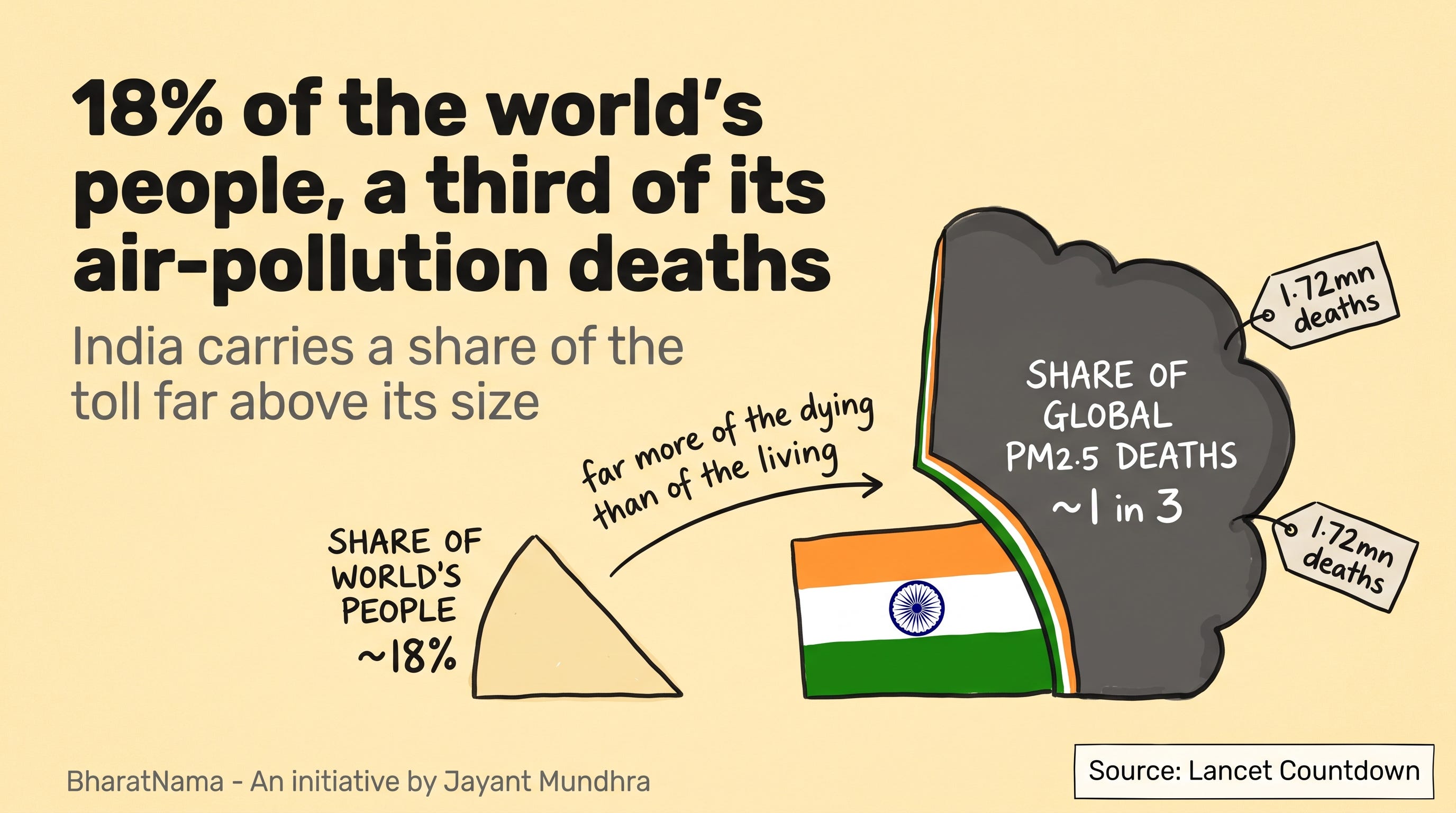
The health story is well told by now. In 2022, fine particulate matter (PM2.5) was linked to about 1.72mn premature deaths in India, roughly a third of all such deaths on the planet.1 What almost nobody talks about is the accounting. And the accounting is where the money, and the policy paralysis, actually lives.
The two numbers, and why they diverge
Both numbers are real. They just answer different questions.
The World Bank used what economists call the human capital, or lost-output, approach. It asks a narrow question: if a person dies early or falls sick, how much economic production is lost? Add up forgone wages and medical bills, discount to today, and you get a figure.
The result: air pollution cost India about $36.8bn in 2019, or 1.36% of GDP.2
Of that, ~$28.8bn was lost output from premature death, and ~$8bn was the direct cost of illness.2
The Lancet Countdown, the health-and-climate assessment run with the WHO, used a completely different lens: the Value of a Statistical Life (VSL). It does not price a named person. It measures how much a whole society is collectively willing to pay to shave down the risk of dying early, and multiplies that across the deaths.
The result: the monetised cost of premature mortality from outdoor air pollution in India in 2022 was $339.4bn, or 9.5% of GDP.1
That is nearly ₹30 lakh crore, a sum that dwarfs India's entire annual health budget.1
Now, the honest caveat first, because BharatNama does not paper over these. The World Bank figure is 2019 data and the Lancet figure is 2022 data. But the three-year gap explains almost none of the divergence. India's GDP did not grow seven-fold in between. The gap is about method, not timing.
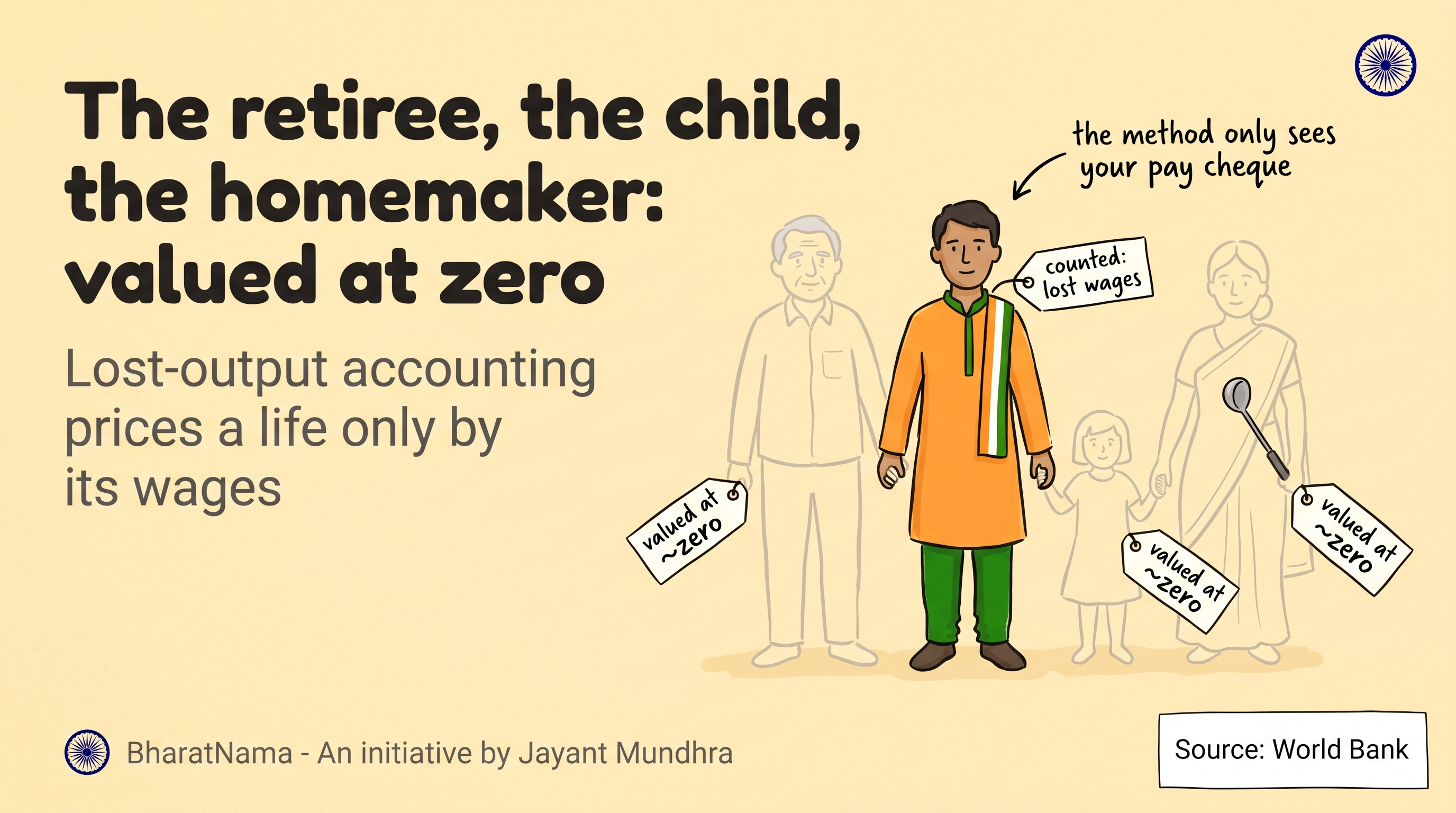
The lost-output approach has a brutal blind spot: it values you only for your wages.
A retiree who dies from pollution-triggered heart failure has zero forgone earnings, so the model records almost nothing.
A child, an unpaid homemaker, an elderly parent: all near-invisible on the ledger, precisely the people most likely to die from bad air.
It captures the pay cheque you lose, and nothing of the life.
The VSL method captures the welfare loss the lost-output method throws away. Neither is "wrong". But when a finance ministry runs a cost-benefit test on a clean-air investment using the lost-output number, it is comparing the full cost of scrubbers and grid upgrades against a benefit figure that has been deflated by a factor of roughly seven. Cleaning the air looks like a luxury India cannot afford. That is the fiction the accounting builds.
The bill that never reaches the health ministry
Mortality is only the headline. The quieter drain is what pollution does to people who are very much alive and at work.
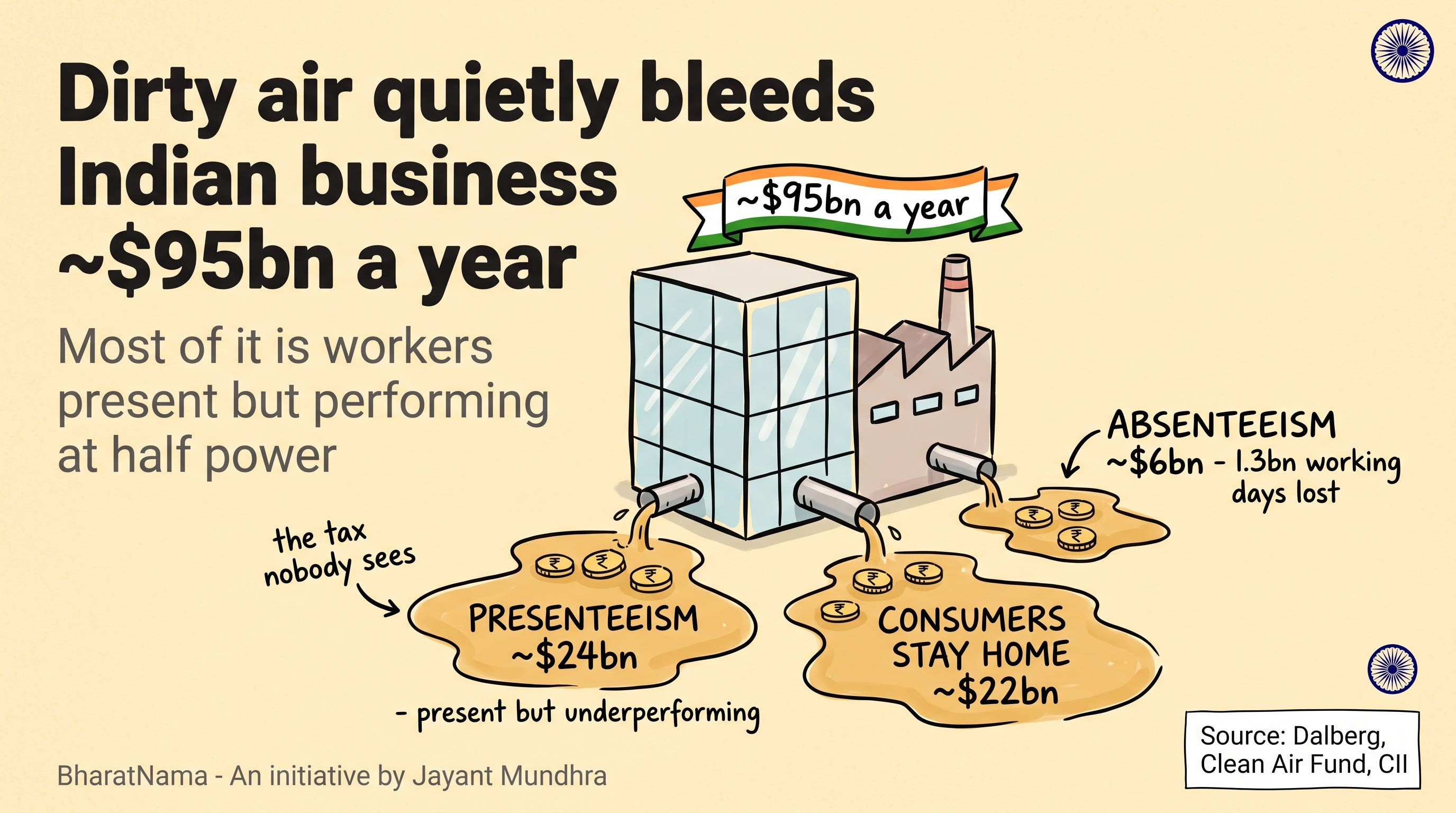
The landmark study here, by Dalberg with the Clean Air Fund and the Confederation of Indian Industry (CII), put the cost to Indian business at about $95bn a year, close to 3% of GDP.3 Break it open and it stops being abstract:
Presenteeism, ~$24bn. Employees show up but underperform, because ultrafine particles trigger inflammation that dulls stamina and cognition. This is the single biggest line, and it is roughly the size of India's entire pharma output.3
Consumer pull-back, ~$22bn. On filthy-air days people stay home, and offline, footfall-dependent businesses (restaurants, apparel retail) eat the loss.3
Absenteeism, ~$6bn. India loses about 1.3bn working days a year to pollution-related sick days and caring for sick dependents.3
Sit with the presenteeism number for a second. It is the most invisible of all, because attendance looks fine on the register. The person is at the desk. They are just thinking a little slower, all day, every high-pollution day. In a services economy that sells cognition (software, analytics, finance) that is the worst possible tax to levy, and it lands hardest on exactly the sectors India is betting its future on.
This is the sort of buried, second-order number I keep pulling on, and it is the kind of thread we go back and forth on in the BharatNama WhatsApp community, where I share a smaller India deep-dive like this with thousands of readers every morning (t.ly/h2jq1).
Where India stands: against the world, and against itself
Air pollution is not evenly spread, and this is where BharatNama's two comparisons earn their keep.
India vs the world. India carries a share of the global air-pollution death toll wildly out of proportion to its share of people.
India accounted for roughly a third of all global PM2.5 deaths in 2022, on about 18% of the world's population.1
The Indo-Gangetic Plain, stretching across India's north, is one of the single most polluted large regions on Earth. Counting it with the Himalayan foothills, close to ~1bn people breathe hazardous air there, with exposure often more than twenty times the WHO safe limit.8
China, once the poster child for the "airpocalypse", cut its national PM2.5 from 72 to 29 µg/m³ between 2013 and 2022.6 India has not managed anything close to that pace.
India vs India. The national average hides a spread that is itself the story. On the World Bank's own state numbers, the economic drag is heavily concentrated in the north and east:
Uttar Pradesh: 2.15% of state GDP. Bihar: 1.95%. Madhya Pradesh and Rajasthan: 1.70% each. Chhattisgarh: 1.55%.2
These are multiples of what cleaner southern states lose. A single national figure of 1.36% flattens a landscape where the worst-hit states bleed nearly twice as much.
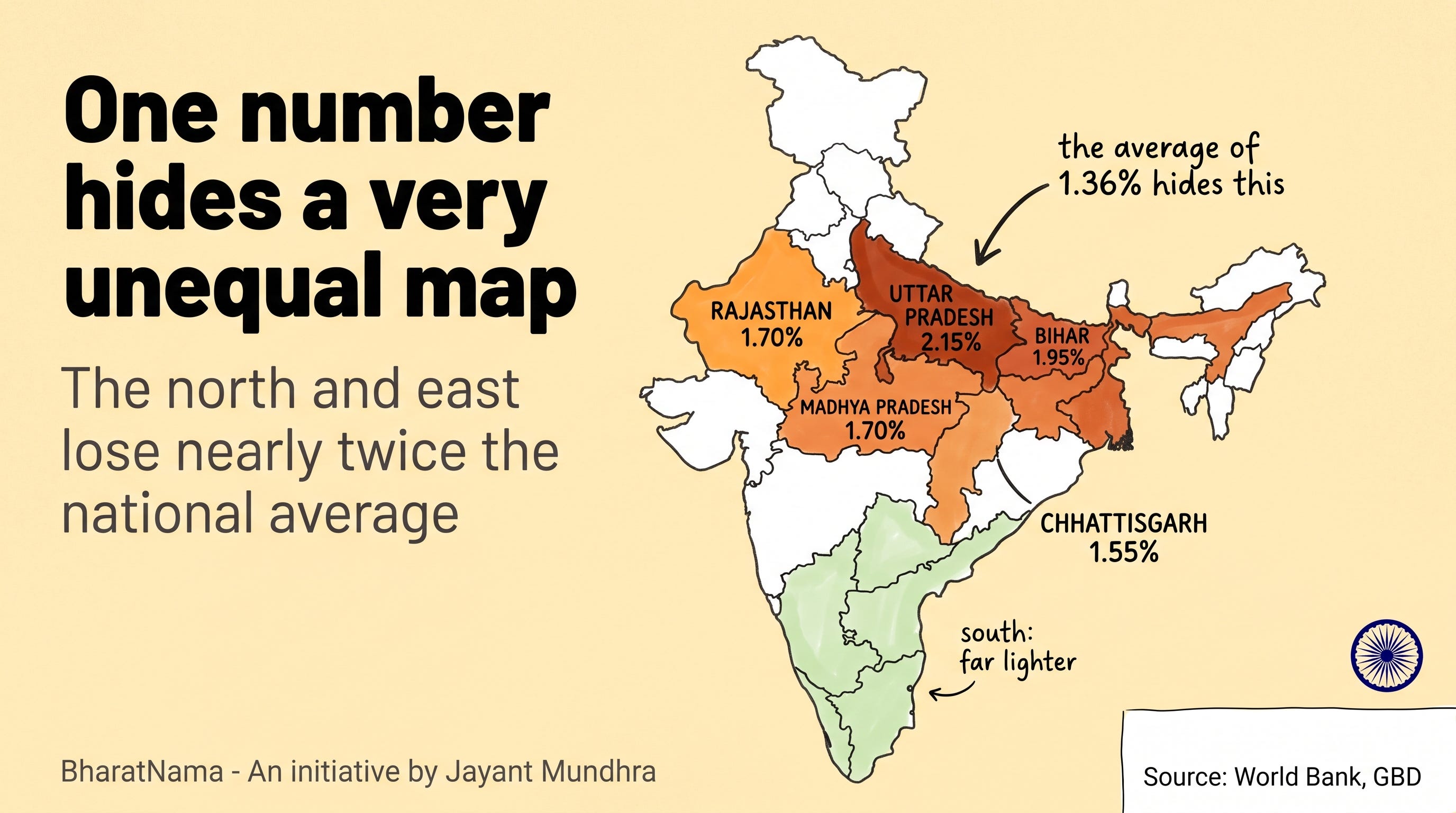
That north-heavy pattern is not a coincidence, and it points straight at why India's whole approach is built on the wrong map.
The governance gap: a city-sized answer to a regional problem
India's flagship response is the National Clean Air Programme (NCAP), launched in 2019. Its target has since been sharpened: up to a 40% cut in particulate concentration by 2025-26, against a 2019-20 baseline, across 131 "non-attainment" cities, up from the original 20-30% goal.4 Progress is tracked on a dashboard called PRANA.
The intent is right. The architecture is where it breaks, on two counts.
First, it is city-shaped, and pollution is not. NCAP hands each of 131 cities a local action plan for road dust, local traffic, and waste burning. But PM2.5 does not respect a municipal boundary.
The north's winter smog is a regional airshed problem: stubble burning in Punjab and Haryana, industrial clusters in the hinterland, weather inversions that trap it all.
A single city has no legal power to regulate an upwind farm or a power plant a hundred kilometres away. Isolating the fix to the city guarantees the fix falls short. The World Bank is now pushing India toward exactly this: its first regional airshed plan for the Indo-Gangetic Plain, spanning seven states.8
Second, the targets are advisory, and the enforcement void is glaring. Nowhere is this clearer than coal power, which is a major source of the sulphates and nitrates that become PM2.5.
Emission norms mandating Flue Gas Desulphurisation (FGD) to capture sulphur dioxide were first set in 2015, with a 2017 deadline. Deadlines were then extended, and extended again, for a decade.
Then in July 2025, the environment ministry did not just delay, it retreated. A new notification fully exempted the roughly 78% of coal units categorised "Category C" from installing FGD at all. Only ~11% ("Category A", near Delhi and big cities) must comply, by December 2027; another ~11% ("Category B") by 2028, subject to review.5
The stated reason: FGD costs about ₹1.2 crore per MW, and the ministry argued sulphur dioxide's role in PM2.5 was limited. Ten years after the first mandate, the primary source of baseload pollution got a pass.5
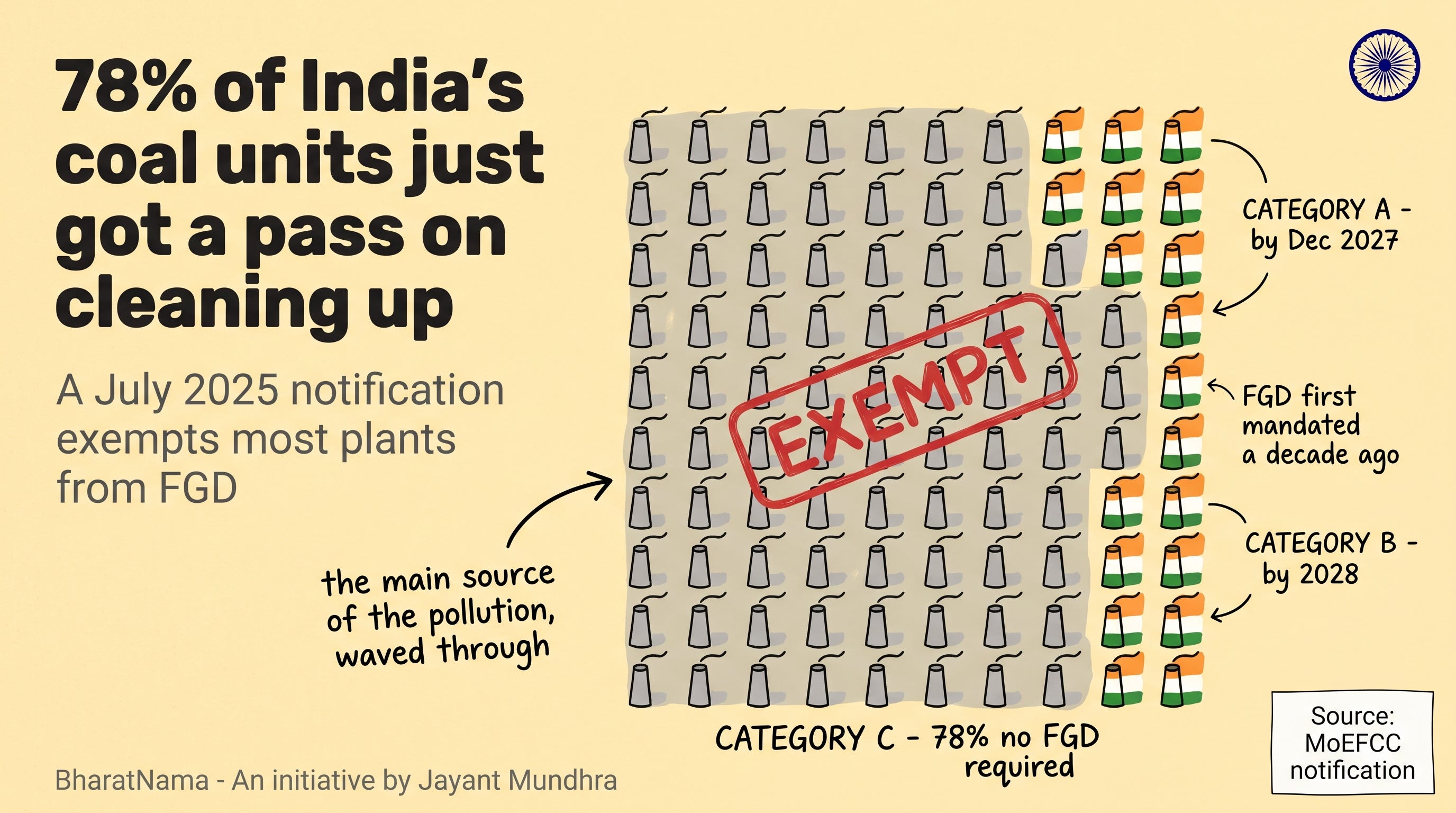
When regulatory deadlines are this soft, no heavy industry has any reason to internalise the cost of the air it fouls. The externality just stays external, and the 9.5% keeps compounding.
This state-versus-state, city-versus-airshed mismatch is the kind of structural knot I dig into daily, and it is one of the threads readers and I keep chasing in the BharatNama community (t.ly/h2jq1).
What India can learn from China
China faced a worse "airpocalypse" than India has and pulled out of it fast. The lesson is not "copy China", because much of it does not transfer. But two parts genuinely might.
What China actually did in its $270bn 2013 action plan:6
It set legally binding, region-specific targets, not city ones. Whole airsheds (Beijing-Tianjin-Hebei, the Yangtze and Pearl River Deltas) got hard numerical mandates. Beijing was told to cut PM2.5 34% from 2013 levels, full stop.6
It rewired the incentives of officials. Environmental performance was written into the "cadre evaluation" system that decides promotions. Suddenly a mayor's career depended on clean air, not just local GDP. That single move converted paper targets into aggressive local enforcement, and Beijing-Tianjin-Hebei saw particulate exposure fall by more than half.6
The result was one of the fastest air-quality turnarounds in modern history. What is portable to India: the shift from city plans to binding airshed authorities, and hard targets with real consequences. What is not portable: China's top-down control over promotions has no clean analogue in India's federal, multi-party democracy, where states guard their turf and coal towns vote.
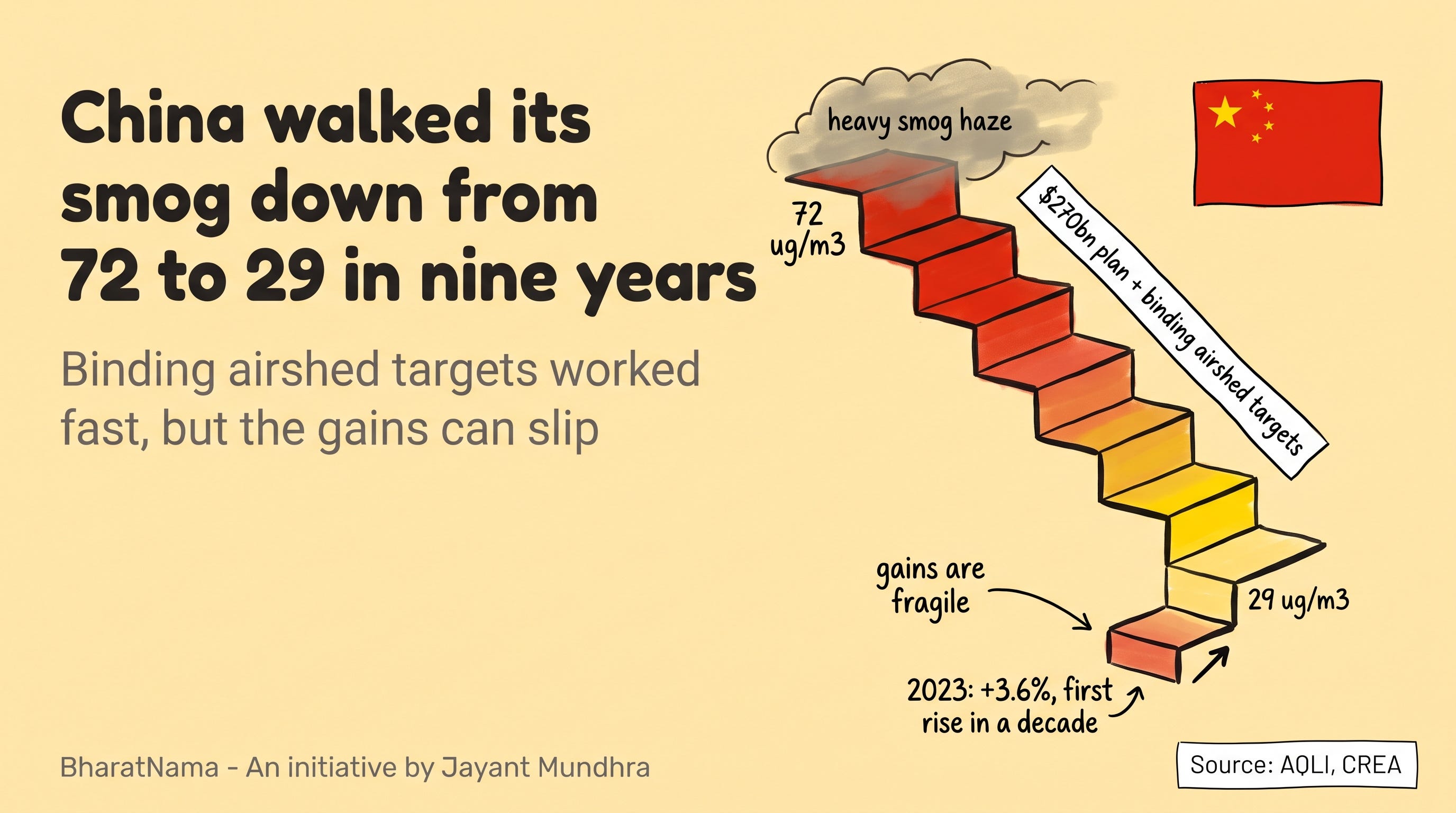
And here is the caveat India must not miss. In 2023, China's national PM2.5 rose for the first time in a decade, up about 3.6%, with 80% of provincial capitals worsening.7 The moment Beijing pivoted back to post-Covid growth, industry roared and the gains reversed.
The lesson inside the lesson: end-of-pipe fixes and temporary bans do not hold. Only a structural move off fossil fuels does. If political pressure swings back to pure GDP maximisation, dirty air comes straight back.
What to watch
Whether the Indo-Gangetic Plain airshed plan actually gets statutory teeth, or stays advisory like NCAP.
Whether any Category A coal units genuinely hit the December 2027 FGD deadline, or win yet another extension.
Whether NITI Aayog or the finance ministry start using VSL-based valuation in cost-benefit tests. That single accounting change would reprice every clean-air investment overnight.
The next Lancet Countdown, for whether India's mortality and cost figures move at all from the 2022 baseline.
The one line
India is not failing to fix its air because it cannot afford to; it is failing because its own books value the damage at a seventh of what it costs, and you do not fund a fight you have decided is cheap.
And well that is it for today's edition. That said, do check out my core WhatsApp community Biz News+ where I share 4-5 deepdives from the world of business, economics & public economics daily: https://t.ly/h2jq1
And if you want to understand where China stands and what it means for India, do check out my companion newsletter, Decoding the Dragon: https://t.ly/t7uhs
And, do check out my work on the following platforms as well: Instagram, LinkedIn and Youtube
Best,
Jayant
References
Down To Earth / Business Standard, on the 2025 Lancet Countdown on Health and Climate Change (9th edition): link
World Bank cost estimate, via Forbes; state-level shares from GBD 2019 (Lancet Planetary Health): link
Dalberg Advisors with Clean Air Fund and CII, "The Business Case for Clean Air": link
Business Standard / PIB, NCAP revised 40% target: link
Health Policy Watch, on the July 2025 FGD exemption notification: link
AQLI (EPIC, University of Chicago) and Earth.org, China's 2013 National Air Quality Action Plan: link
Centre for Research on Energy and Clean Air (CREA), China 2023 PM2.5 rebound: link
World Bank, "A Breath of Change", Indo-Gangetic Plain airshed: link
Comments
Nothing yet. Say the first thing.
Sign in to join the conversation.