
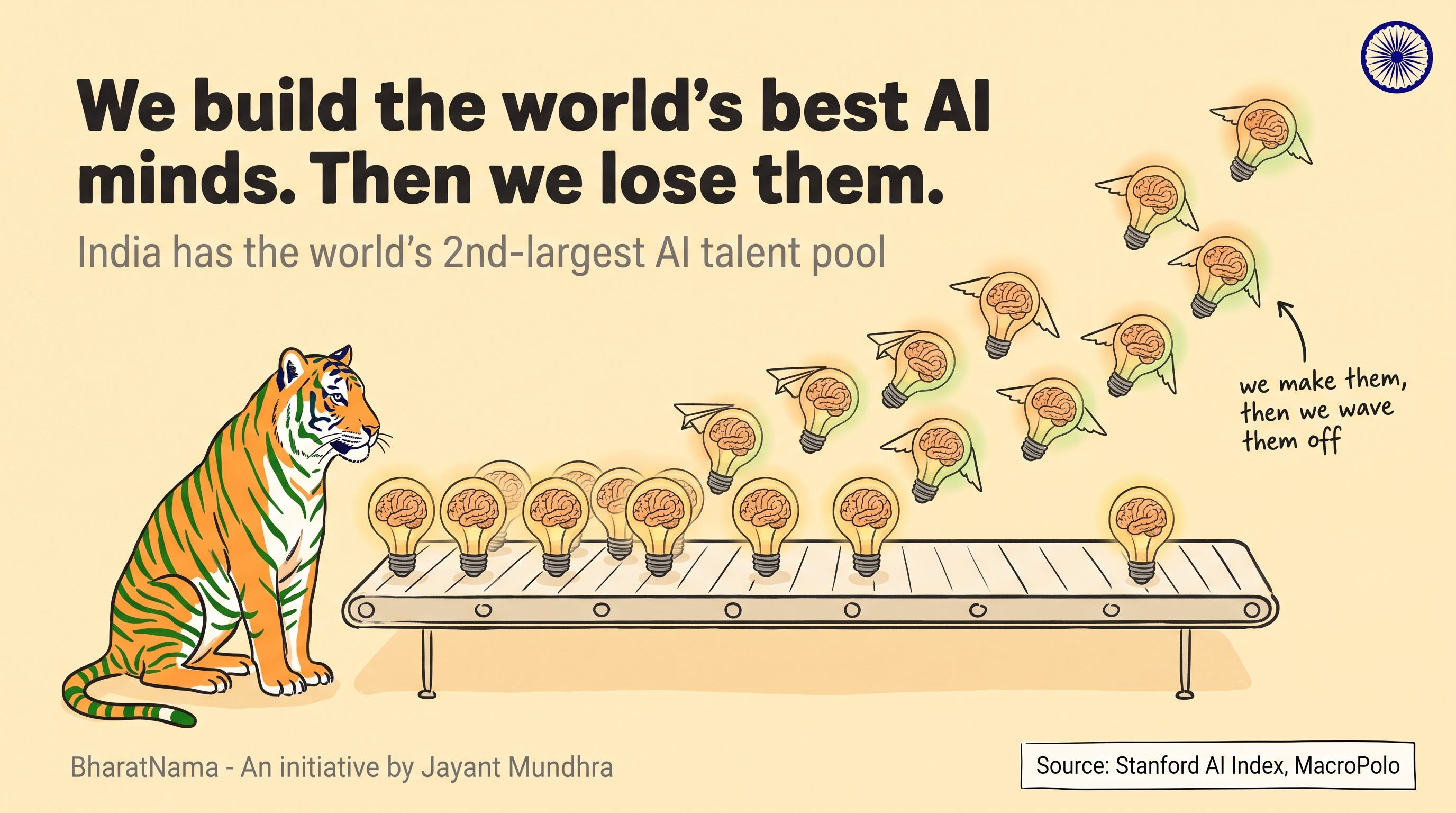
I have been staring at one number all week, and I cannot make peace with it.
India now trains the second-largest pool of top AI talent in the world, roughly 50,000 elite researchers and inventors, behind only the United States.1 And yet, at the very frontier of the field, the people publishing at NeurIPS and ICML, only about one in five of those trained in India actually work in India. Four in five have left.3
So we are the world's second-biggest factory for AI genius. And its single largest exporter of it.
That is the paradox I want to sit with today. The comfortable story, that India simply needs to produce more engineers, is wrong. We have solved the making. We have not solved the keeping.
Let me lay the numbers out, because they are stark.
Stanford's 2026 AI Index ranks India second in the world for elite AI authors and inventors, a pool of about 50,000, beaten only by the US.1
The same report finds India had the worst net outflow of AI talent of any country on earth in 2025, a net-flow score of -16.9. Germany was -2.4 and Canada -7.1. India is in a league of its own.1, 2
India's AI workforce grew 120% between 2019 and 2025, among the fastest anywhere, and India ranks first globally in AI skill penetration.1
But at the frontier, the MacroPolo Global AI Talent Tracker, built on the latest NeurIPS and ICML papers, finds India keeps only about 20% of its top-tier researchers. The rest work abroad, overwhelmingly in America.3
Here is the thing. This is not a pipeline problem. India is minting the talent. It is a demand-and-retention problem. We have built the nursery and forgotten to build the home.
And the loss compounds. When a frontier researcher leaves, India does not just lose their output. It loses the students they would have mentored, the intellectual property they would have generated, and the deep-tech company they would have founded. Run that for a decade and the top of the pyramid stays permanently hollow.
So why do they go? Not for a nicer lifestyle. They go because the modern AI frontier is gated by two things India is still short of: compute and capital.
For a frontier researcher, compute is not an IT line item. It is the medium of the work itself. Your ability to test a new architecture, train a large model, and publish at a top venue is capped directly by how many GPUs you can command.
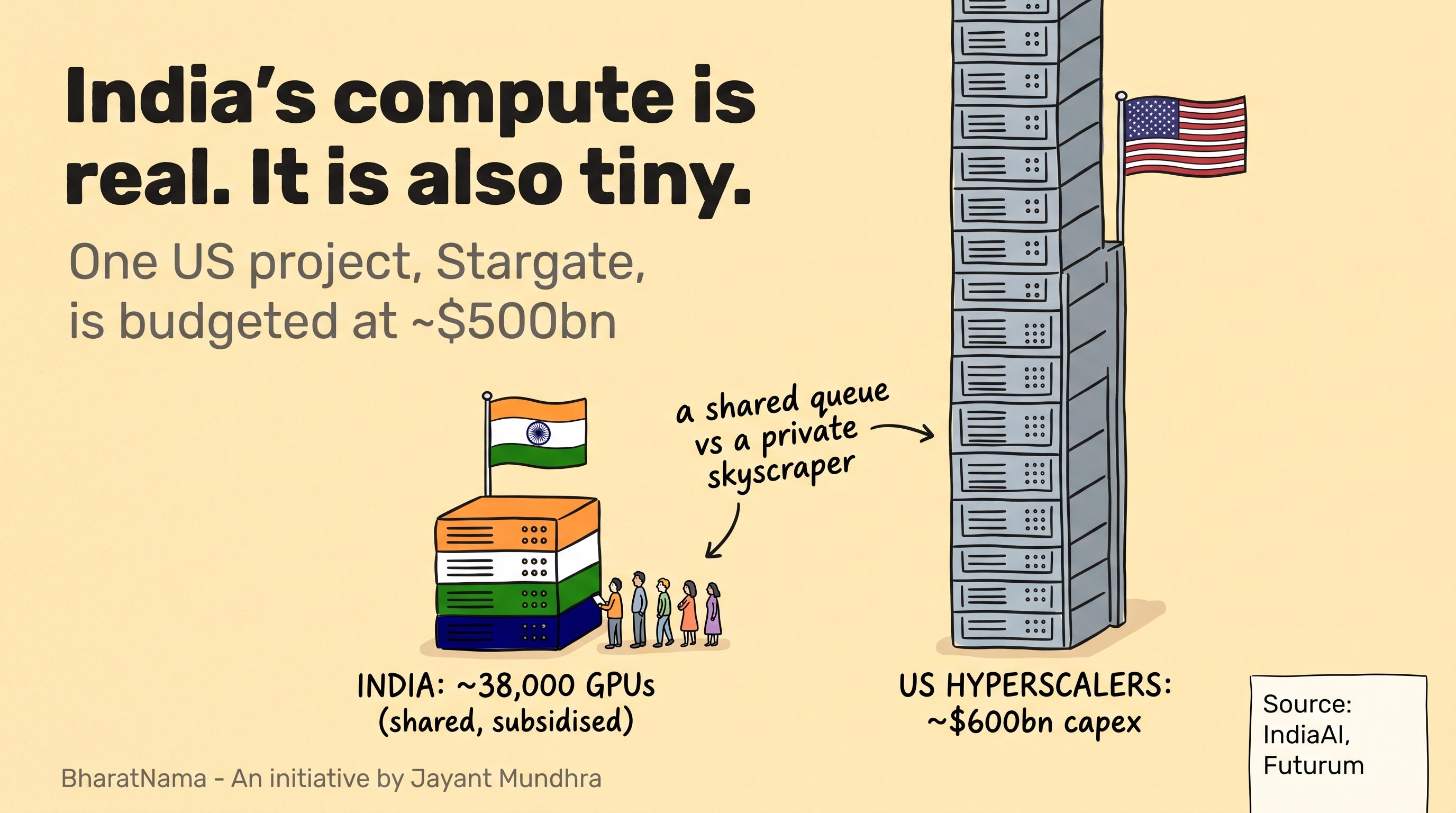
India has understood this and moved. The IndiaAI Mission, approved in March 2024 with an outlay of over ₹10,000 crore, is building shared national compute.4 Through its compute portal, India has now onboarded more than 38,000 GPUs, plus about 1,050 Google TPUs, offered to startups and academics at heavily subsidised rates.5
That is a serious national effort. Next to the frontier, it is also tiny.
The big US hyperscalers spent roughly $410bn on capital expenditure in 2025, and are guiding towards $600bn and more in 2026.6
A single US project, Stargate, is budgeted at around $500bn.6
India's entire sovereign compute pool is a fraction of what one American lab can rent on demand.
An elite researcher choosing between a subsidised queue for a slice of 38,000 shared GPUs and instant, dedicated access to tens of thousands of the newest chips will pick the second every time. Queuing for compute is fatal to the fast iteration that research runs on.
You can see the gap in the output. Take two labs.
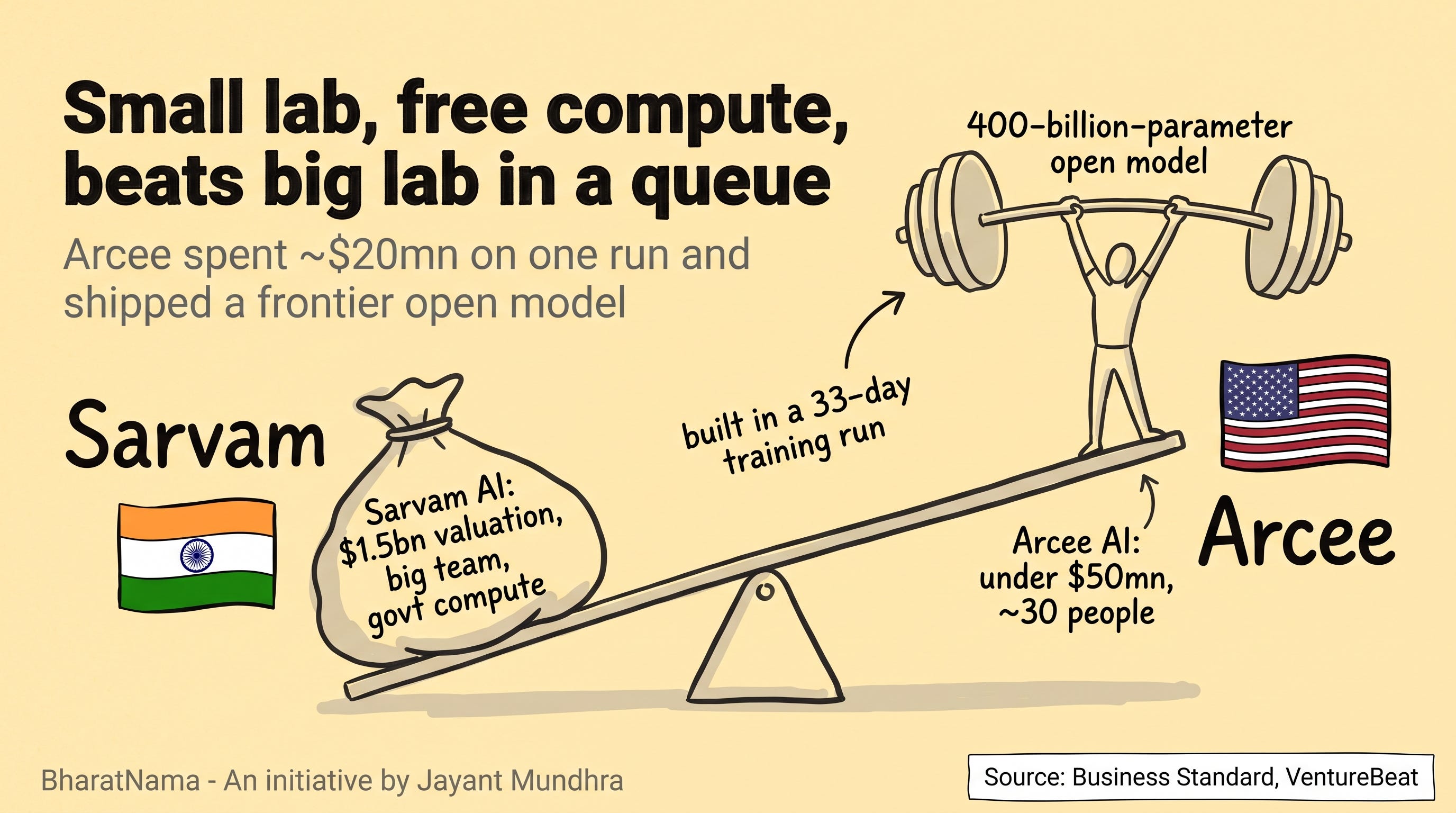
Sarvam AI, one of India's flagship sovereign-AI startups, is now valued at about $1.5bn after a Series B targeting $300mn, backed by HCLTech, Bessemer, Khosla and Peak XV.7 It has a large team and premier access to government compute.
Arcee AI, a roughly 30-person lab in San Francisco, has raised under $50mn in total.8
Yet in early 2026 Arcee spent about $20mn, nearly half its lifetime funding, on a single 33-day training run across 2,048 of NVIDIA's newest Blackwell chips, and shipped Trinity, a fully open 400-billion-parameter model that briefly became the most-used open model in the US.8
The lesson is not that Sarvam is weak. It is that a lean Western lab with unconstrained compute can outrun a better-funded, better-staffed Indian one, because it never has to queue.
The private sector is trying to close this. Yotta Data Services has committed over $2bn to build one of Asia's largest AI clusters, deploying 20,736 of NVIDIA's Blackwell Ultra GPUs by August 2026, with more than 10,000 of them committed to the IndiaAI Mission and campuses scalable towards 2GW.9
That is exactly the right direction. But racking the hardware is necessary, not sufficient. Someone still has to pay the people who will use it.
This gap between the talent we train and the compute we can actually give it is exactly the kind of thread I keep pulling at, and it is what the BharatNama WhatsApp community and I go back and forth on most mornings, where I share a smaller India deep-dive like this one with thousands of readers (t.ly/h2jq1).
India's pay for AI researchers has genuinely exploded. In 2026:
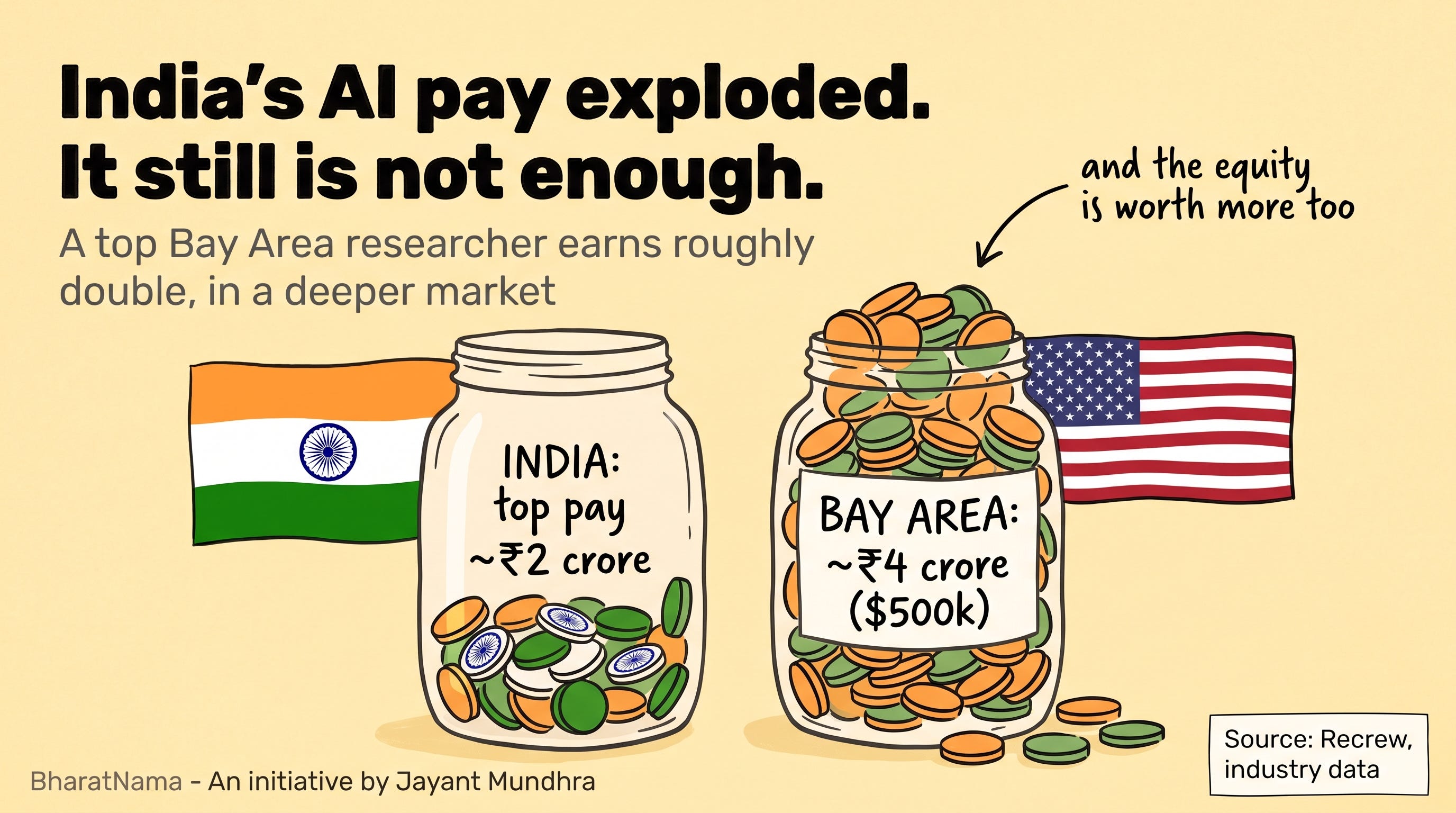
Entry-level research roles at funded startups and GCCs, the in-house "global capability centres" that foreign firms run in India, pay roughly ₹15 to 35 lakh a year.12
Senior scientists at the Indian labs of Google DeepMind, Microsoft and Meta reach ₹80 lakh to ₹1.5 crore.12
Principal researchers can cross ₹2 crore.12
For the Indian market, that is a revolution. Against the frontier, it is still no contest. A researcher publishing seminal work at NeurIPS can command $300,000 to $500,000, roughly ₹2.5 to ₹4 crore, in the Bay Area, with far richer equity in a far more liquid market.
Indian startups like Sarvam are fighting back with equity rather than cash, and for some senior engineers it is working. But equity is only worth what the market underneath it is worth. And here the Indian venture market has a specific, dangerous shape.
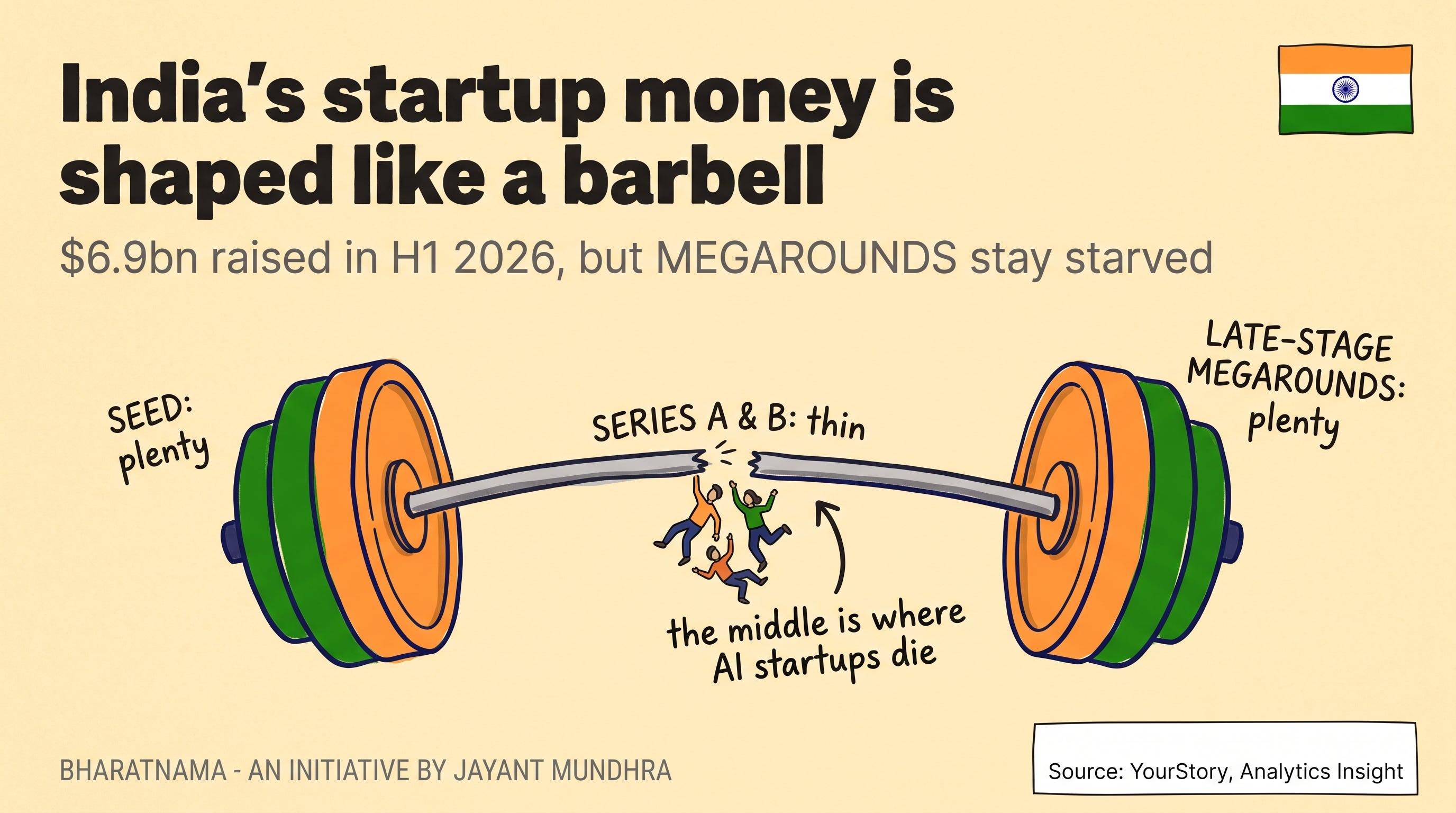
Money is flowing. Indian startups raised $6.9bn in the first half of 2026, up 21% on the year,10 and $4.37bn in the second quarter alone.11 But look at where it sits.
Heavy at the seed stage, where investors spray small early bets.
Heavy at the very top, in a few late-stage megarounds.
Thin in the middle, at Series A and B.11
That missing middle is a killing field for AI startups. A young lab that raised a seed round cannot raise the Series A it needs to buy dedicated GPU clusters and match foreign pay. So its best engineers get absorbed by a US firm or its Indian GCC, and the startup quietly dies as an independent force. The talent may stay in India. The frontier ambition does not.
India has known about this drain for years and has tried to reverse it. VAJRA, GIAN, the Ramanujan and Ramalingaswami fellowships, all designed to pull the diaspora back.
They have barely moved the needle. And the reason, as India's own policy reviews concede, is not a lack of interest from the diaspora. It is institutional inertia at home.
Frontier AI runs at a velocity that mid-twentieth-century bureaucracy cannot match. A returning star hits heavy teaching loads, tenure-based promotion, and procurement rules where buying a dataset or a GPU cluster takes months. In a field where models go stale in weeks, a six-month procurement cycle is a career-ender.
The newest attempt is the Prime Minister Research Chair scheme, opened in 2026, which offers Indian-origin researchers grants of up to ₹14 crore to return and work in priority areas including AI and semiconductors, with applications closing this July.13 It is the most generous version yet.
But money was never the binding constraint. Autonomy was. Unless the host institutions are freed from procurement rules, hiring quotas and rigid HR, a red carpet into a slow building still leads into a slow building. A scheme is not a strategy.
Set India beside itself and you see two countries.
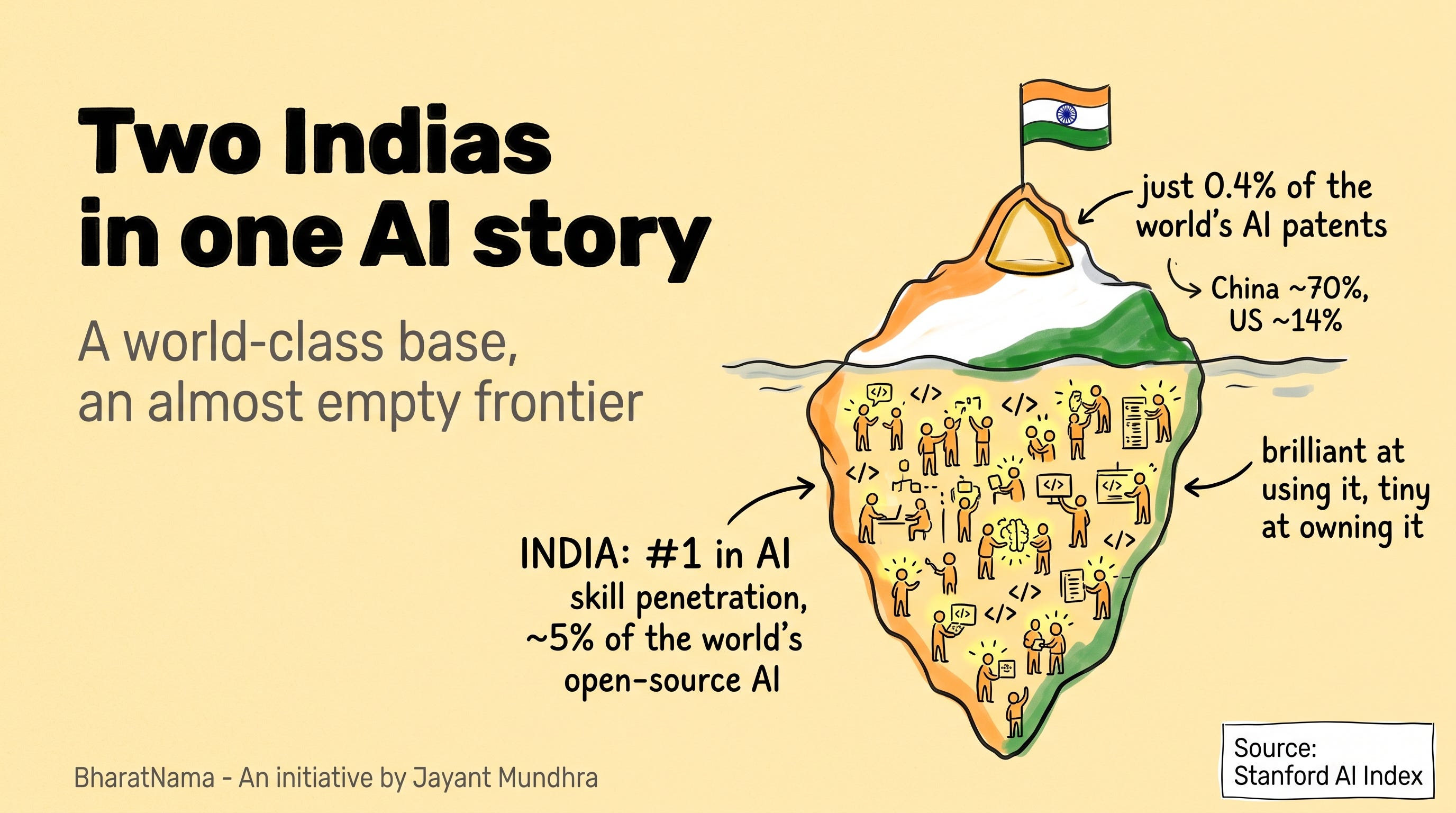
The base is extraordinary. India ranks first in the world for AI skill penetration, its AI workforce is among the fastest-growing anywhere, and the vast majority of Indian firms now use AI in some form.1
The apex is hollow. India holds just about 0.4% of the world's AI patents, against roughly 70% for China and 14% for the US.1, 14
That is the real intra-India divide in AI. Not state against state, but a broad, world-class application layer sitting on top of an almost non-existent frontier-IP layer. We are superb at using the technology and negligible at owning it.
There is one hopeful counterweight. India now accounts for about 5% of all open-source AI projects on GitHub, a far better showing than its patent share.1, 16 The talent is clearly there. It is just building in the open, and often on someone else's stack.
China's answer to the very same brain drain is the kind of comparison I find myself making constantly, one India number set honestly against the world, and it is what we dig into every morning in the BharatNama community (t.ly/h2jq1).
Here is the part that should sting, and instruct.
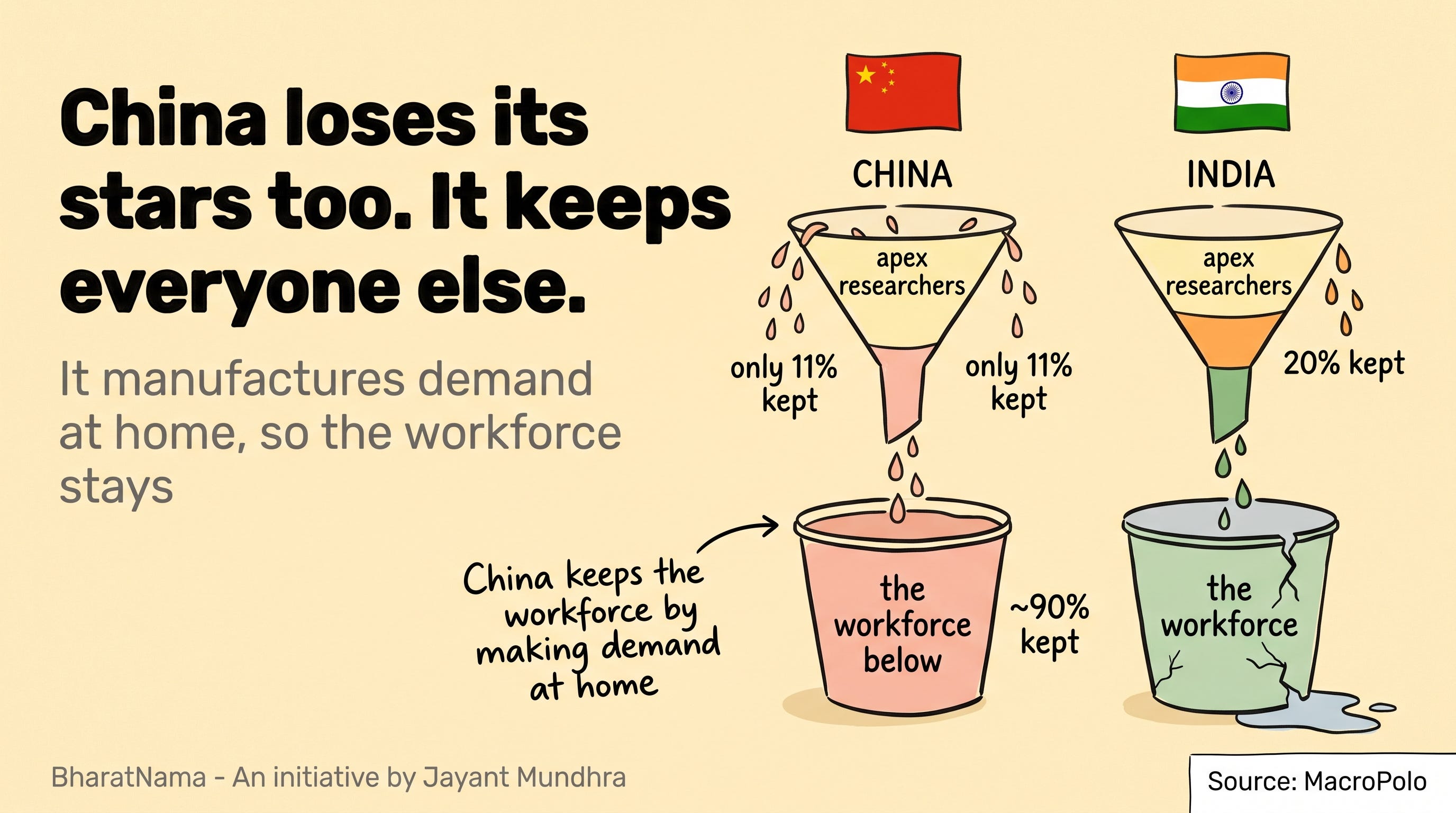
China loses its apex too. On the same MacroPolo tracker, China retains only about 11% of its very top researchers, down from 16%, and 72% of its elite work in the US.3 On the absolute frontier, America drains China even harder than it drains India.
And yet China is a genuine AI superpower. How?
Because China does not try to keep everyone. It accepts it will lose some of the top 1%, and instead retains roughly 90% of the enormous tier just below, the engineers who implement, optimise and deploy. It does this by manufacturing domestic demand.
Its new 15th Five-Year Plan, running 2026 to 2030, makes AI the organising logic of the whole economy. The plan names AI 52 times, against six in the last one, and carries a standalone "AI Plus" action plan.15
It is backed by a state venture fund of around 1 trillion yuan, roughly $140bn, for AI and related technology.15
Beijing actively subsidises the use of home-grown compute, tilting the whole ecosystem towards domestic chips and models.
The lesson for India is precise. India will not out-agglomerate Silicon Valley for the top 1%, and it is fine to admit that battle is lost. But India is losing a battle it could win, which is building a domestic frontier-adjacent layer deep enough and rich enough to keep the other 99%. China keeps its workforce by making the country thirsty for AI. India lets its talent leak because there is not yet enough at home for it to do.
Whether Yotta's Blackwell Ultra cluster actually goes live on schedule in August 2026, and how much of it reaches startups rather than sitting in a queue.9
Whether the Tata-PSMC fab at Dholera hits its first-silicon target of December 2026, India's first real step towards making its own chips rather than importing all of them.17, 18
Whether the Prime Minister Research Chair scheme attracts genuine frontier names, and whether their host institutions are actually freed from procurement and hiring rules.13
Whether Series A and B funding for deep-tech deepens, or the missing middle stays missing.
India has proven it can forge the world's best AI minds. The question of the decade is whether it can build a home worth keeping them in.
And well that is it for today's edition. That said, do check out my core WhatsApp community Biz News+ where I share 4-5 deepdives from the world of business, economics & public economics daily: https://t.ly/h2jq1
And if you want to understand where China stands and what it means for India, do check out my companion newsletter, Decoding the Dragon: https://t.ly/t7uhs
And, do check out my work on the following platforms as well: Instagram, LinkedIn and Youtube
Best,
Jayant
Stanford HAI, 2026 AI Index Report: hai.stanford.edu/ai-index/2026-ai-index-report
The Print, India leads in AI talent but also brain drain: theprint.in
MacroPolo, Global AI Talent Tracker 3.0: archivemacropolo.org
PIB, Cabinet approves over Rs 10,300 crore for IndiaAI Mission: pib.gov.in
PIB, India's common compute crosses 34,000 GPUs: pib.gov.in
Futurum, AI Capex 2026: futurumgroup.com
Business Standard, Sarvam raises $234mn from HCLTech, Bessemer: business-standard.com
VentureBeat, Arcee's open-source Trinity-Large: venturebeat.com
Yotta, to deploy 20,736 NVIDIA Blackwell Ultra GPUs: yotta.com
YourStory, Indian startups raise $6.9B in H1 2026: yourstory.com
Analytics Insight / ANI, Indian Tech Funding Q2 2026: aninews.in
Recrew, AI Research Engineer Salary India 2026: recrew.ai
InsightsonIndia, Prime Minister Research Chair Scheme 2026: insightsonindia.com
Business Standard, India's AI patent record lags far behind global leaders: business-standard.com
Strider Intel, The PRC's 15th Five-Year Plan and the AI+ agenda: striderintel.com
Open Source For You, India's open source AI boom outpaces patents: opensourceforu.com
Ananta IAS, India Semiconductor Mission and approved fabs: anantamias.com
ABHS, India Semiconductor Mission 2.0, Tata first silicon late 2026: abhs.in
Comments
Nothing yet. Say the first thing.
Sign in to join the conversation.