
I want to start with a number that stopped me cold this week.
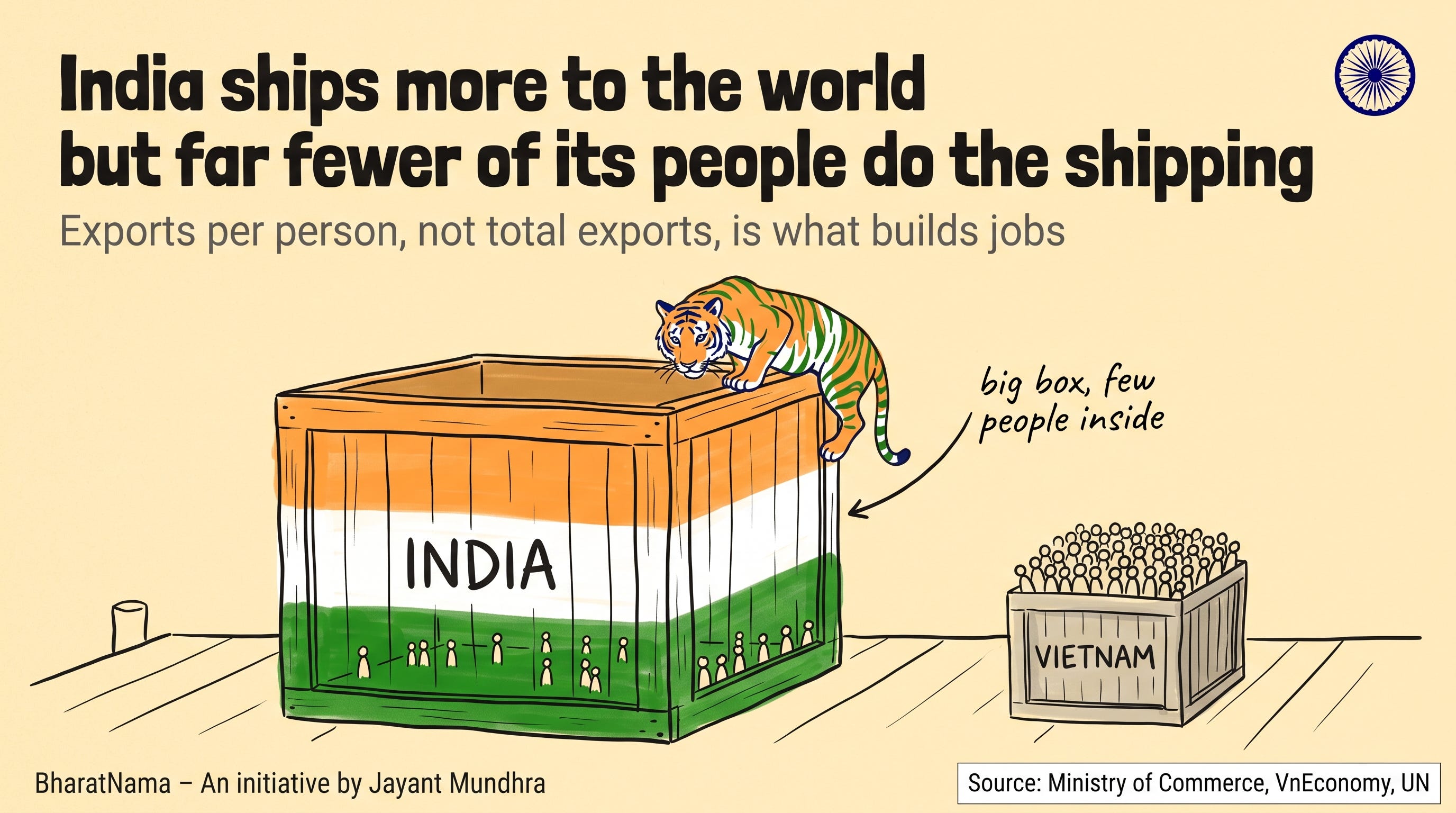
India exported a record ~$825bn of goods and services in FY25.1 Vietnam, a country you could fold into Uttar Pradesh and still have room, exported ~$471bn in 2025.2 On the headline, India wins by a mile.
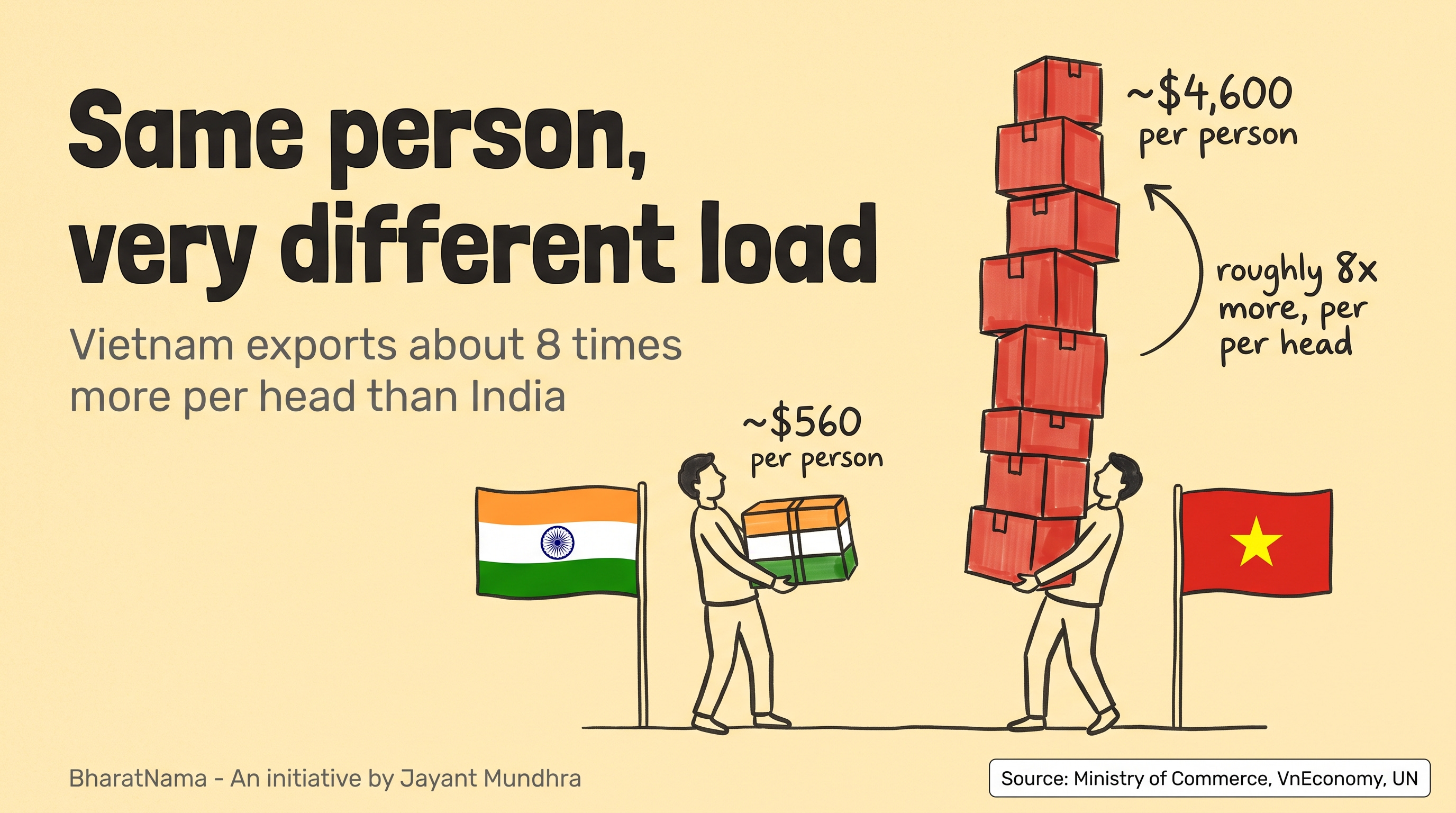
Now divide by people. India is ~1.47bn strong.3 Vietnam is ~102mn.3 That works out to roughly $560 of exports per Indian, against ~$4,600 per Vietnamese.
India: ~$825bn ÷ ~1.47bn people = ~$560 per head.1 3
Vietnam: ~$471bn ÷ ~102mn people = ~$4,600 per head.2 3
So the average Vietnamese sells about eight times more to the world than the average Indian does. That is not a rounding error. That is the difference between a country that has plugged its people into global trade and one that has not.
The metric that actually predicts jobs
Here is the thing. Aggregate exports tell you how big your economy is. Exports per person tell you how deep trade reaches into ordinary lives. And it is the second one that predicts mass jobs and the exit from poverty.
The logic is old and unglamorous. Development economists call it structural transformation: moving people off low-productivity farms and onto higher-productivity factory floors and service desks. The 1954 Lewis model made the point simply. Poor countries sit on a vast pool of surplus farm labour, and growth means draining that pool into wage work.
But a poor country's own citizens are too poor to buy all the shirts and phones its factories could make. So exports become the release valve. You employ tens of millions by selling to the rest of the world, not to yourself.
By that test, Vietnam did the classic thing and India did something very strange.
Vietnam ran the textbook. India skipped a chapter.
Vietnam took the well-trodden path: cheap labour, low-skill assembly, sell it abroad. Japan did it, then South Korea, then China, then Bangladesh, and now Vietnam.
You can even date Vietnam's takeoff. When the US-Vietnam trade agreement came into force in the early 2000s, average American tariffs on Vietnamese manufactures fell from over 30% to under 3%.15 Multinationals piled in almost overnight, and formal factory employment climbed and stayed high. Open the door to the market, and the jobs follow. That is the whole mechanism, in one natural experiment.
India, uniquely, bypassed the low-skill factory stage almost entirely. It leapt straight into high-skill exports: software, back-office services, complex pharma. Economists like Dani Rodrik and Arvind Subramanian call this India's "endowment-defying" growth, a country rich in unskilled labour specialising in skill-heavy sectors.
And on its own terms, that leap has been spectacular:
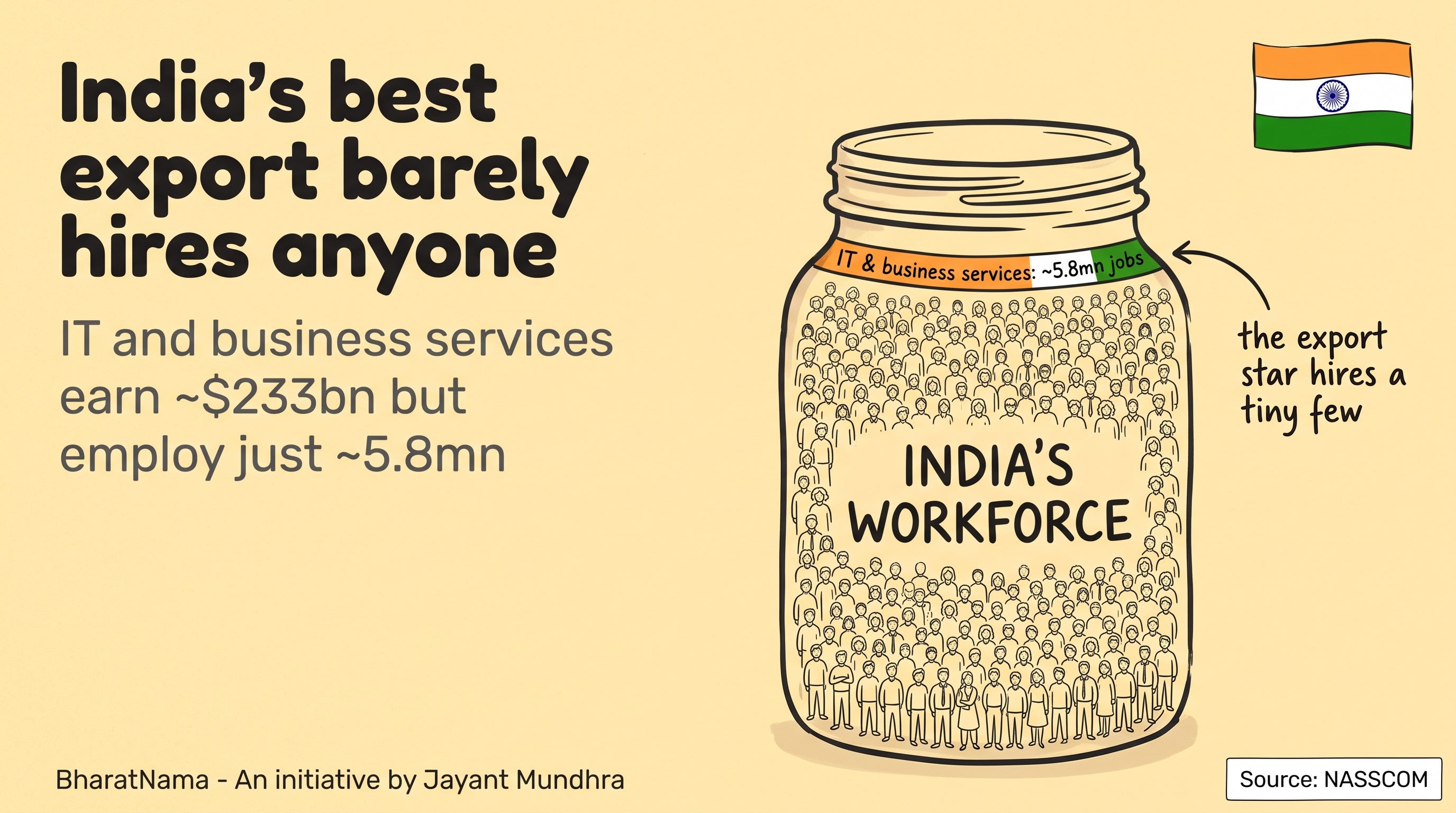
India's IT and business-services industry earned ~$283bn in revenue in FY25, with exports of ~$233bn.7
It is a genuine world-beater and a huge earner of foreign exchange.
But look at who it employs. The whole IT-BPM sector directly employs ~5.8mn people.7 In a country of ~1.47bn, with millions joining the workforce every year, 5.8mn is a rounding error. It draws almost entirely from the English-speaking, college-educated top slice, the Indians furthest from the farm.
And here is the cost of skipping the low-skill chapter. Economists who have studied India's trade pattern estimate the country is "missing" well over $100bn a year of the unskilled, labour-intensive manufacturing it should, on paper, dominate, most of it in textiles, clothing and simple goods.15 That missing activity is precisely the kind that hires people with a school certificate, not an engineering degree. It is the jobs India most needs, in the sectors India most obviously suited itself for, and it never showed up.
This is exactly the kind of thread I keep pulling in the BharatNama WhatsApp community, where I share a smaller India deep-dive like this with thousands of readers every morning (t.ly/h2jq1). The IT miracle is real. It is just not a jobs machine for the masses, and it was never going to be.
What "export depth" looks like on the ground
Vietnam's export engine is not really Vietnamese. Foreign firms drive roughly three-quarters of its exports, and in electronics, foreign-invested firms account for ~98% of the total.14 It is, in effect, a duty-free assembly floor rented out to the world's biggest manufacturers.
But that floor employs a nation. Take the anchor tenant:
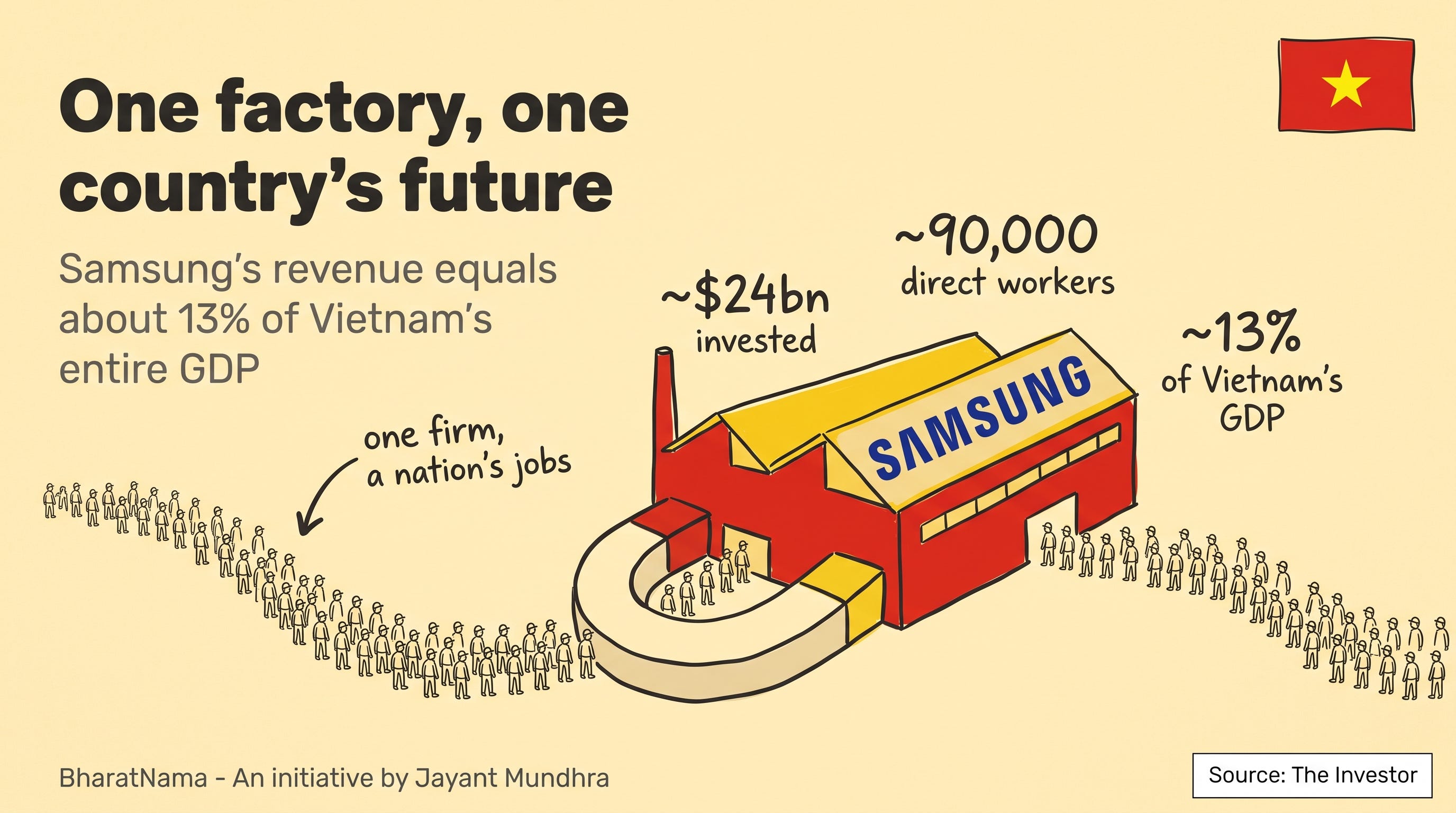
Samsung has poured in a cumulative ~$24bn and now runs some of its largest plants on earth in Bac Ninh and Thai Nguyen.5
In January 2025 alone, Bac Ninh cleared a further ~$1.2bn top-up for Samsung Display, taking that unit past ~$7.7bn.5
Samsung's Vietnam revenue is worth around 13% of the country's entire GDP, and it employs close to 90,000 people directly, before you count the ~80,000 in its supplier cluster.5
Electronics is now the spine of the whole economy:
Computers, electronics and components alone brought in ~$108bn in 2025, up an eye-watering ~48% in a single year.4
Add phones and the electronics cluster crossed ~$165bn, about 35% of all Vietnamese exports.4
Crucially, a lot of these assembly-line jobs go to women and to workers who a decade ago were in the paddy fields.
That is structural transformation you can photograph.
Where India stands, against the world and against itself
Set the two countries side by side on the metric that matters, and the picture is stark. But the intra-India split is just as revealing, because India's own success is wildly concentrated.
India vs the world (exports per person):
Vietnam: ~$4,600.2 3
India: ~$560.1 3
The gap is ~8x, and it is almost entirely a manufacturing-depth gap, not a services gap.
India vs itself (who actually exports):
India's merchandise and services exports lean heavily on a handful of clusters: IT out of Bengaluru, Hyderabad and Pune; petroleum out of Jamnagar; gems out of Surat; and, increasingly, phones out of a few plants in Tamil Nadu and Uttar Pradesh.
A short list of states, led by Gujarat, Maharashtra and Tamil Nadu, accounts for the bulk of goods exports, while the poorest and most populous states in the Gangetic belt barely feature. India's export map is a few bright dots on a dark canvas.
Smartphones became India's single largest export commodity in 2025, and India's electronics output hit ~₹11.3 lakh crore in FY25.8
Yet that same electronics push has created only ~2.5mn jobs over a decade.8 Good, but a fraction of what a Vietnam-scale assembly base would throw off.
Here is the honest part. India is finally winning the very game Vietnam plays. In smartphone shipments to the US in Q2 2025, India took the top spot with a 44% share, ahead of Vietnam's 30% and China's collapsing 25%.9 The direction of travel is genuinely good.
The problem is depth. One flagship product in one or two states is not the same as an export base wide enough to soak up the ~7-8mn young Indians entering the labour force every year.
Why India's factories cost more before they even start
If India has the cheaper labour, why is it not eating Vietnam's lunch? Because cheap wages get cancelled out by two self-inflicted costs.
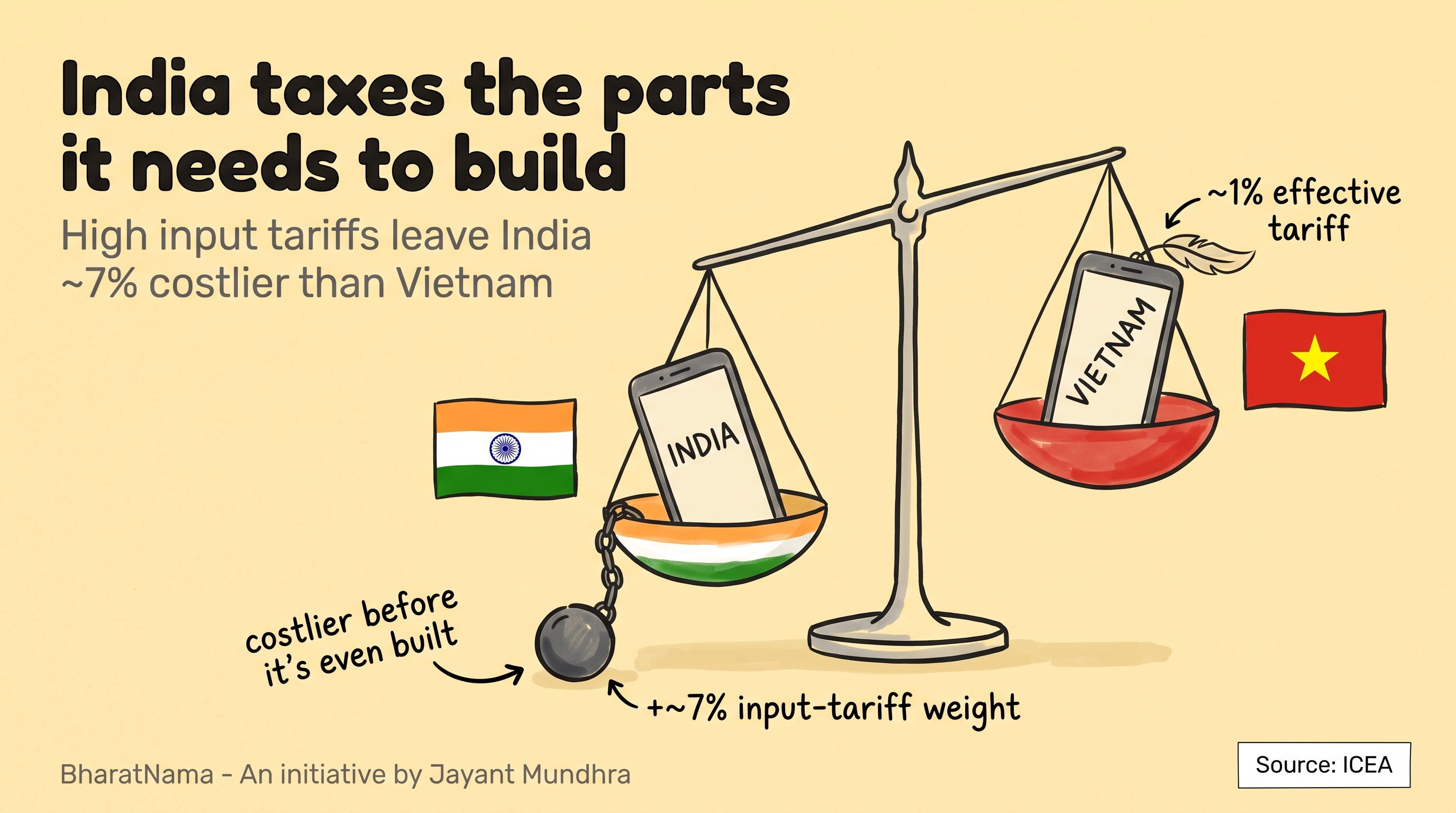
One, India taxes the parts it needs to build things. The India Cellular and Electronics Association found India runs the highest input tariffs on electronics among all its rivals.10
India's average import tariff on these components is ~9.7%, against ~3.2% in China and an effective ~1% in Vietnam, because over 80% of Vietnam's component imports come in duty-free under trade deals.10
The net result is a cost disability of ~7% versus Vietnam and ~7.5% versus China, before a single phone is boxed.10
In an industry that runs on wafer-thin margins, a 7% penalty decides where the factory gets built.
Two, India is simply further from the parts. This is geography, and it does not care about policy.
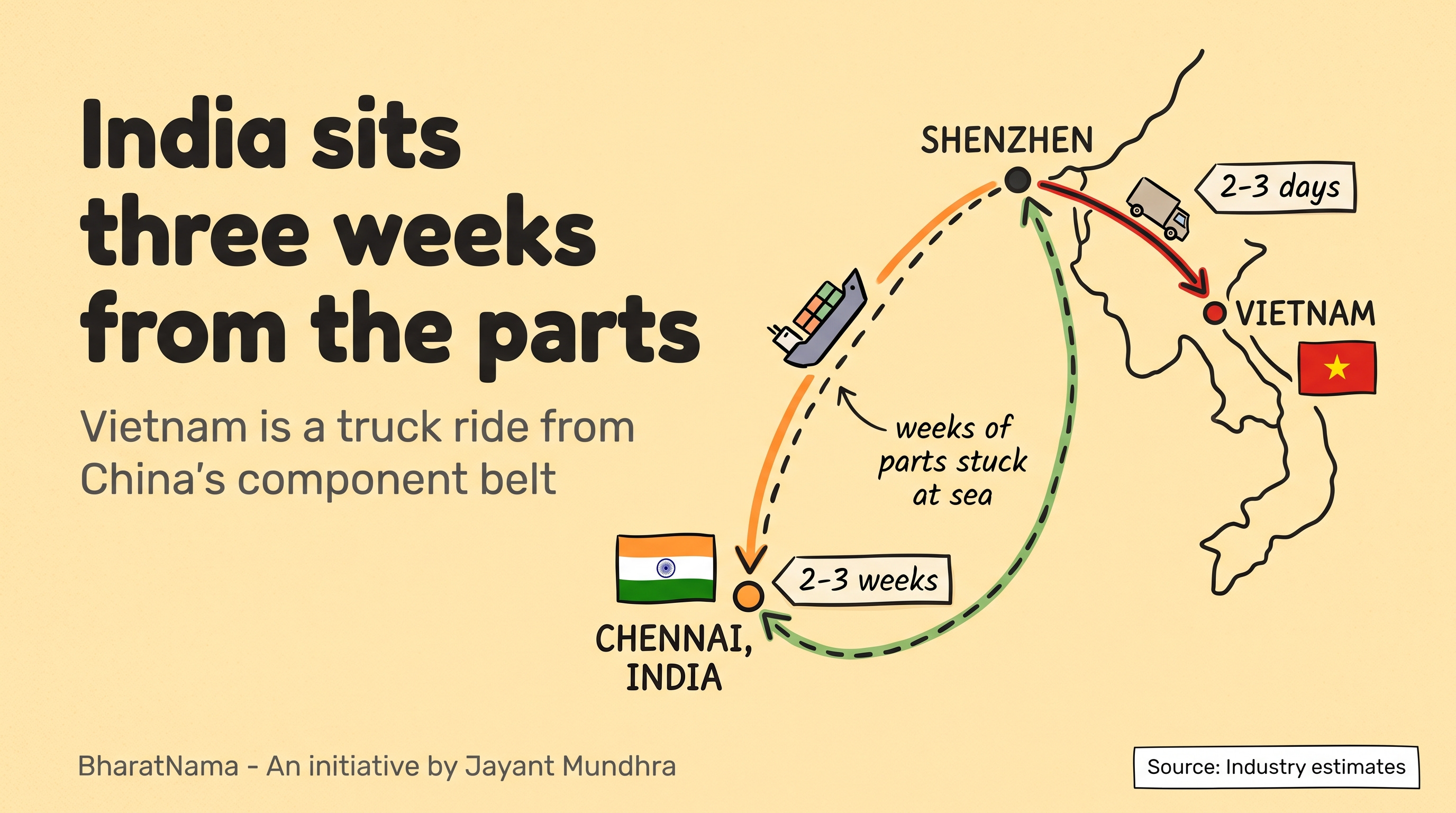
Vietnam shares a ~1,450km land border with China. Components leave Shenzhen on a truck and reach a factory in Bac Ninh in 2 to 3 days.
The same parts from Shenzhen to Chennai mean 2 to 3 weeks on a ship.
That is weeks of extra working capital tied up in inventory, on every order.
One myth worth killing here, because the note I started from repeated it and the latest official data contradicts it. India's logistics cost is often quoted at 13-14% of GDP. The first systematic government study, by DPIIT and NCAER, actually pegged it at ~8% of GDP.11 Vietnam's own logistics costs, by its government's own admission, run far higher, closer to 16-18%. So India's disadvantage in electronics is not some blanket logistics tax. It is the specific, brutal fact of sitting three weeks by sea from the world's component belt.
This kind of buried, counter-intuitive number is exactly what we go back and forth on in the BharatNama WhatsApp group (t.ly/h2jq1), and it is why I never take a widely repeated statistic at face value.
What India can learn from Vietnam
Vietnam's lesson is not "have cheaper labour". India already does. The lesson is about friction.
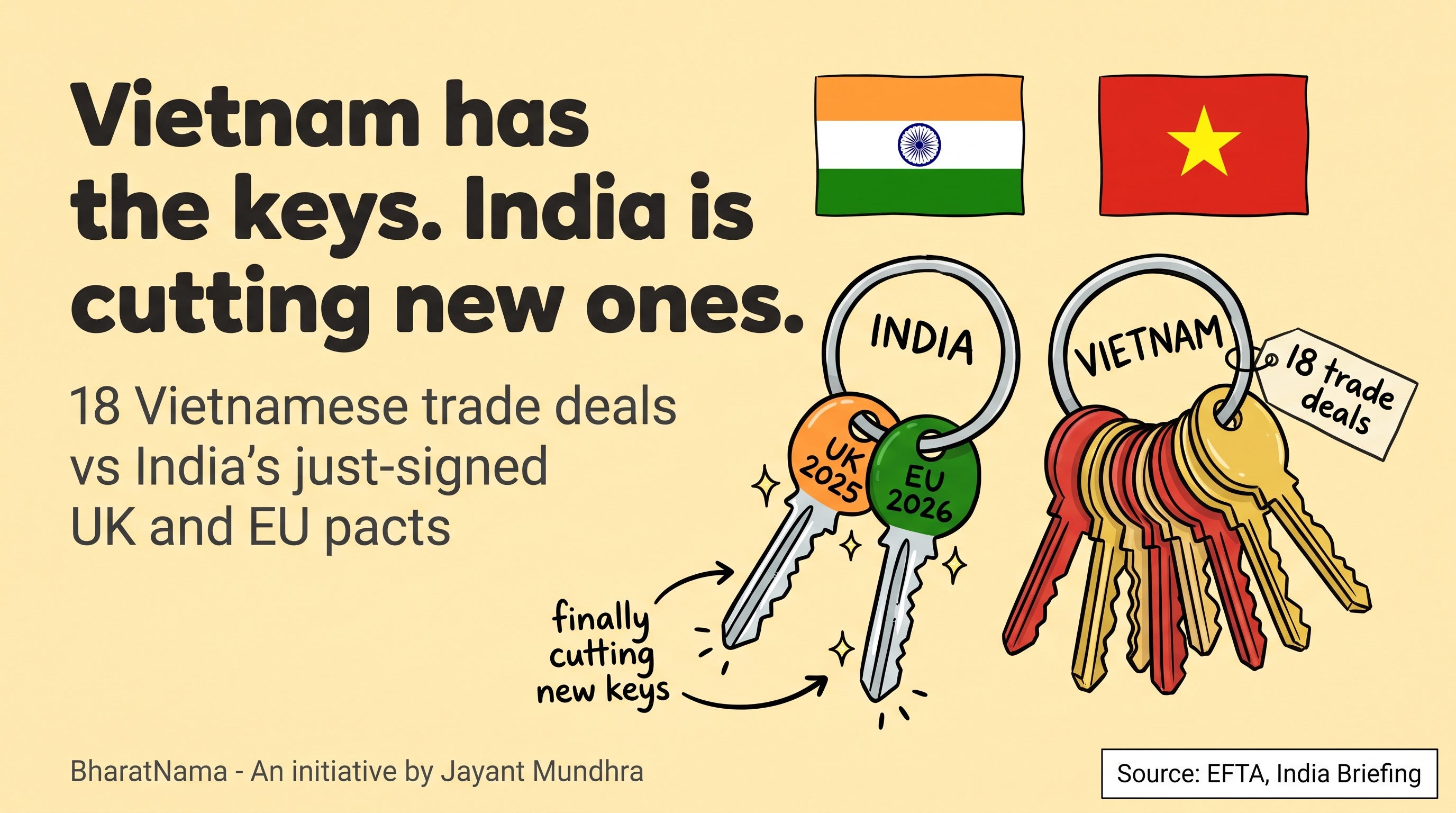
Trade agreements. Vietnam has signed ~18 free-trade agreements, and in July 2026 it wrapped up one more with the European free-trade bloc.6 That network lets it import a Chinese chip and a Korean screen tariff-free, assemble them, and ship the finished phone into the EU or Canada duty-free.
India spent years outside this game. It walked out of the RCEP bloc in 2019, and its big Western deals sat unsigned.12
But this is where the note's pessimism is now out of date, and the update is genuinely encouraging. India signed a trade deal with the UK in July 2025 and concluded one with the European Union in January 2026.12 The scaffolding is finally going up.
The other lesson is sequencing. Vietnam built the export factory first and let domestic consumption follow. India did the reverse.
Private consumption is around 60% of India's GDP, far higher than in China or Vietnam.13
So Indian manufacturing grew mostly to serve 1.4bn domestic buyers, behind a high tariff wall, rather than to win foreign markets.
India's flagship ₹1.97 lakh crore Production-Linked Incentive scheme has pulled in investment and jobs, but much of it rewards assembly for the Indian market.16
That is a walled garden. It creates jobs for the local shop, but it does not, by itself, force the ruthless global cost-competitiveness that export depth demands. The tariff cuts and the new FTAs are the way out, and India has finally started walking through the door.
What to watch
Whether India's new FTAs actually lower input costs. Watch if the UK and EU deals, plus any tariff rationalisation in the next Budget, start narrowing that ~7% cost disability the ICEA measured.
The next PLI iteration. Track whether it is tied to hard export targets rather than domestic-sales milestones.
Component ecosystems, not just assembly. Watch whether India's new electronics-component scheme actually pulls display and PCB makers onshore, the thing that would shorten those 3-week supply lines.
Vietnam's own squeeze. Its domestic value-add is still only ~5-10% per device, and US tariff pressure is rising. If Vietnam gets caught, India's window widens.
The one line: India already sells more to the world than Vietnam; it just has not yet found a way to let more than a sliver of its own people do the selling.
And well that is it for today's edition. That said, do check out my core WhatsApp community Biz News+ where I share 4-5 deepdives from the world of business, economics & public economics daily: https://t.ly/h2jq1
And if you want to understand where China stands and what it means for India, do check out my companion newsletter, Decoding the Dragon: https://t.ly/t7uhs
And, do check out my work on the following platforms as well: Instagram, LinkedIn and Youtube
Best,
Jayant
References
1. Business Standard / PIB, India total exports FY25: link
2. VnEconomy, Vietnam 2025 trade and export record: link
3. United Nations / Worldometer population data (India and Vietnam, 2025): link
4. Vietnam Investment Review, electronics exports 2025: link
5. The Investor / TNGlobal, Samsung Vietnam investment and employment: link
6. European Free Trade Association, EFTA-Vietnam FTA concluded July 2026: link
7. NASSCOM, tech industry Strategic Review FY25: link
8. PIB, electronics manufacturing and production FY25: link
9. VnEconomy (Canalys data), Vietnam second-largest smartphone exporter to US: link
10. ICEA, tariff disability study across competing economies: link
11. Business Standard, India logistics cost 7.97% of GDP (DPIIT-NCAER): link
12. India Briefing, India FTA updates (UK CETA, EU FTA): link
13. World Bank, final consumption expenditure (% of GDP), India: link
14. RMIT University / ASEAN Briefing, Vietnam electronics FDI (98% of exports): link
15. Rodrik, Subramanian, Chatterjee and related trade research on India's endowment-defying specialisation and the "missing" manufacturing: link
16. IBEF / PIB, Production-Linked Incentive scheme outlay: link
Comments
Nothing yet. Say the first thing.
Sign in to join the conversation.