
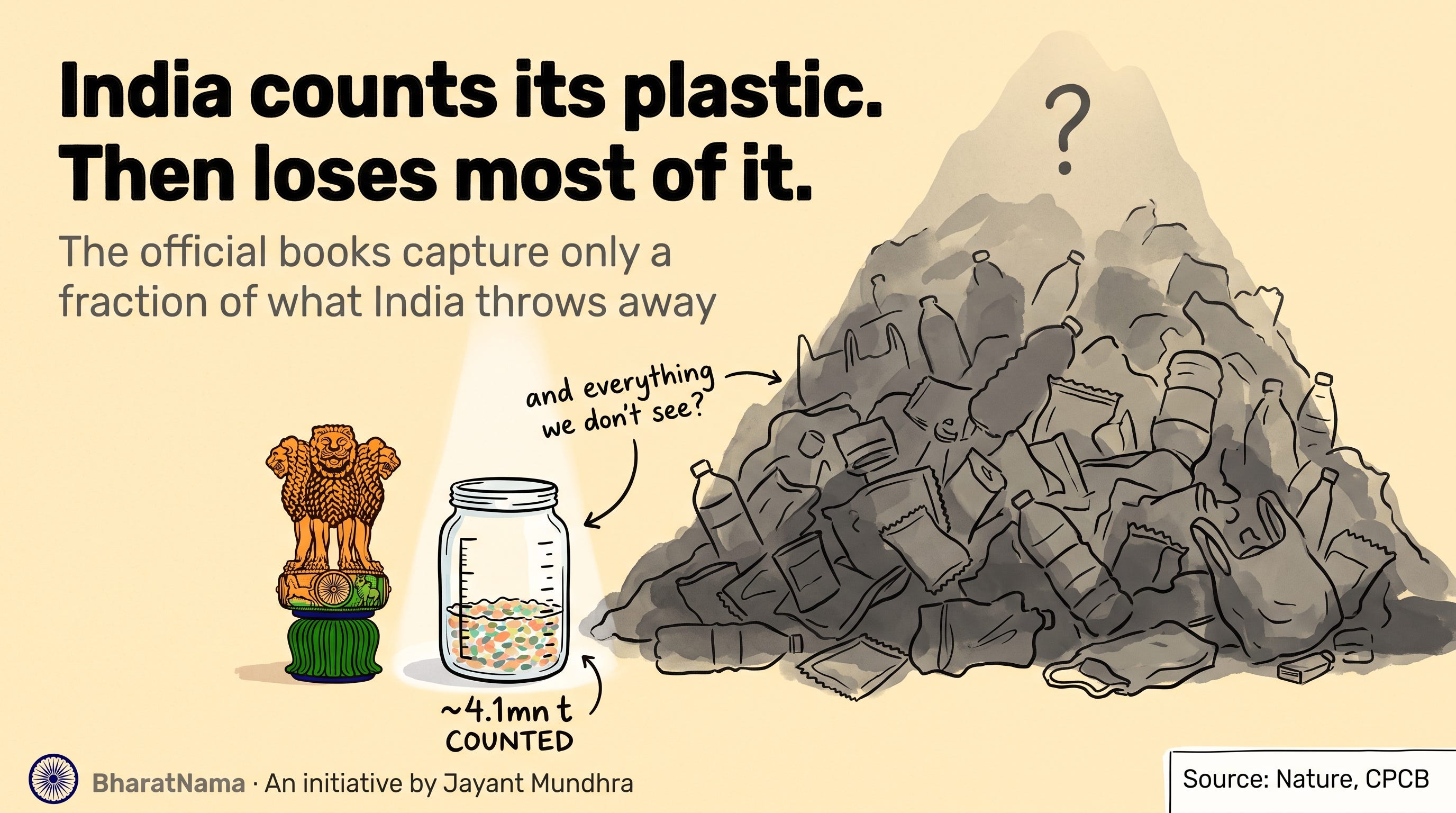
Here is a fact that unsettled me more than almost anything I have read this year.
India is the single largest emitter of macroplastic pollution on the planet. Not per person, in absolute terms. We leak roughly 9.3mn tonnes of plastic into the open environment every year, about a fifth of the entire global total, ahead of Nigeria, Indonesia and China.1
And here is the part that should stop you. Our own government does not see most of it. The Central Pollution Control Board's official number for plastic waste generation is about 4.1mn tonnes a year.2 The best independent science says the true leakage is more than double that.
So India is not just failing to manage its plastic. India is failing to count it. And you cannot fix what you refuse to measure.
The 9.3mn tonne figure comes from a 2024 study in Nature, led by researchers at the University of Leeds.1 It is worth understanding how they got there, because the method is the whole story.
Historically, waste data in the Global South was built bottom-up in the crudest way. A municipality counts the trucks arriving at a dump, applies a density conversion, and calls that the waste generated. The flaw is fatal: it only measures waste that formal collection already captured. Everything outside the truck route is invisible.
The Leeds team built something better, a machine-learning model they call SPOT, trained on solid-waste data and high-resolution socioeconomic indicators, and ran it across 50,702 municipalities worldwide.1 It filled the data voids where no one had ever measured.
Crucially, it redefined "emissions". Not factory output, but any plastic that crosses from a contained state into the uncontained environment. That includes two things:
Physical debris, the unburned plastic larger than 5mm that ends up in fields, drains and rivers.
Open-burned plastic, the material that is set alight and vanishes into the air.
Globally the split is roughly 57% burned, 43% debris.1 For India, both channels are enormous, and both are almost entirely missing from the official ledger.
The baseline matters here. India banned identified single-use plastics in 2022 and built a digital producer-responsibility system the same year.2 On paper, we look like a country tightening the screws. In reality, the gap between the paper and the ground has been widening.
The roughly threefold gap between 4.1mn and 9.3mn is not a rounding error. It is structural. Three blind spots create it.
One: rural India simply is not counted.
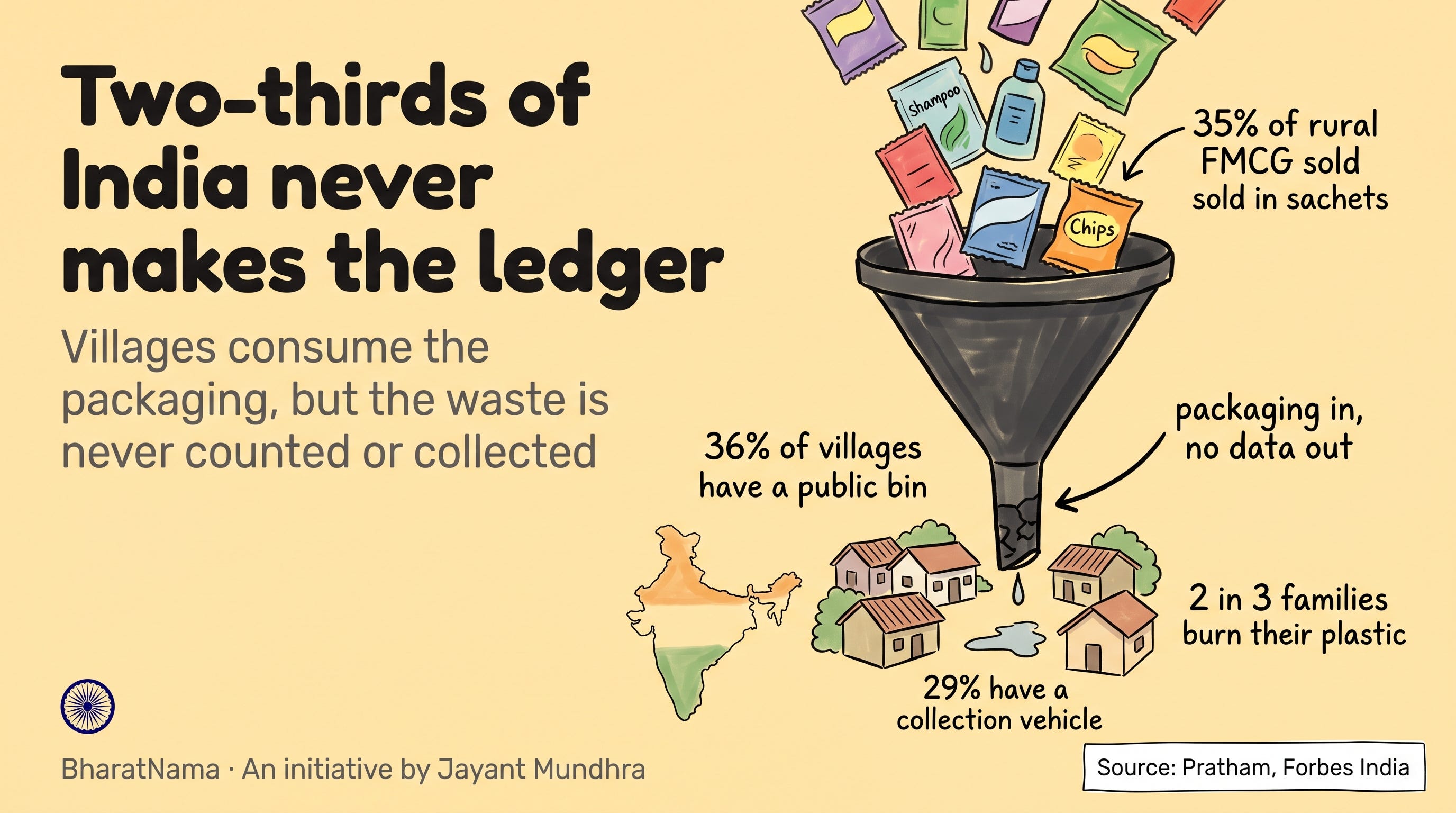
Nearly two-thirds of Indians live in villages, yet rural plastic waste is almost entirely absent from national platforms, which are built around urban municipal boundaries.5 Consumption happens; documentation does not.
The rural economy has changed fast. FMCG firms now push multi-layered sachets, PET and pouches deep into villages, and sachets and pouches account for about 35% of rural FMCG sales.6 The packaging flows in. Almost no tracked waste flows out.
Why? Because the bodies meant to measure it cannot. A 2023 Pratham survey of 700 villages across 15 states found:5
Only 36% had public dustbins.
Just 29% had any waste-collection vehicle.
Nearly two-thirds of rural families said they regularly burn their plastic waste.
Without data, a gram panchayat cannot prove the need to unlock infrastructure funding. So it stays unequipped, and the waste stays uncounted. A bureaucratic trap.
Two: the informal sector collects for profit, not for the planet.
In the absence of municipal collection, close to 90% of villages rely on waste pickers, kabadiwalas and scrap aggregators.5 This army is vast and it is efficient, but it runs on scrap economics, not public health.
Collectors chase what pays: rigid PET bottles, HDPE, aluminium. These have real resale value and get pulled back into recycling. What they leave behind is exactly what pollutes:
Multi-layered packaging, chip packets, shampoo sachets. These make up about 64% of flexible packaging by one industry estimate,6 and they have negative value to a picker.
They are heavy on effort, light on the scale, and technically hard to recycle.
So the low-value plastic is stranded in the village. Rejected by the market, ignored by the state. And that is precisely the material that gets burned.
Three: open burning is an atmospheric subsidy to a broken system.
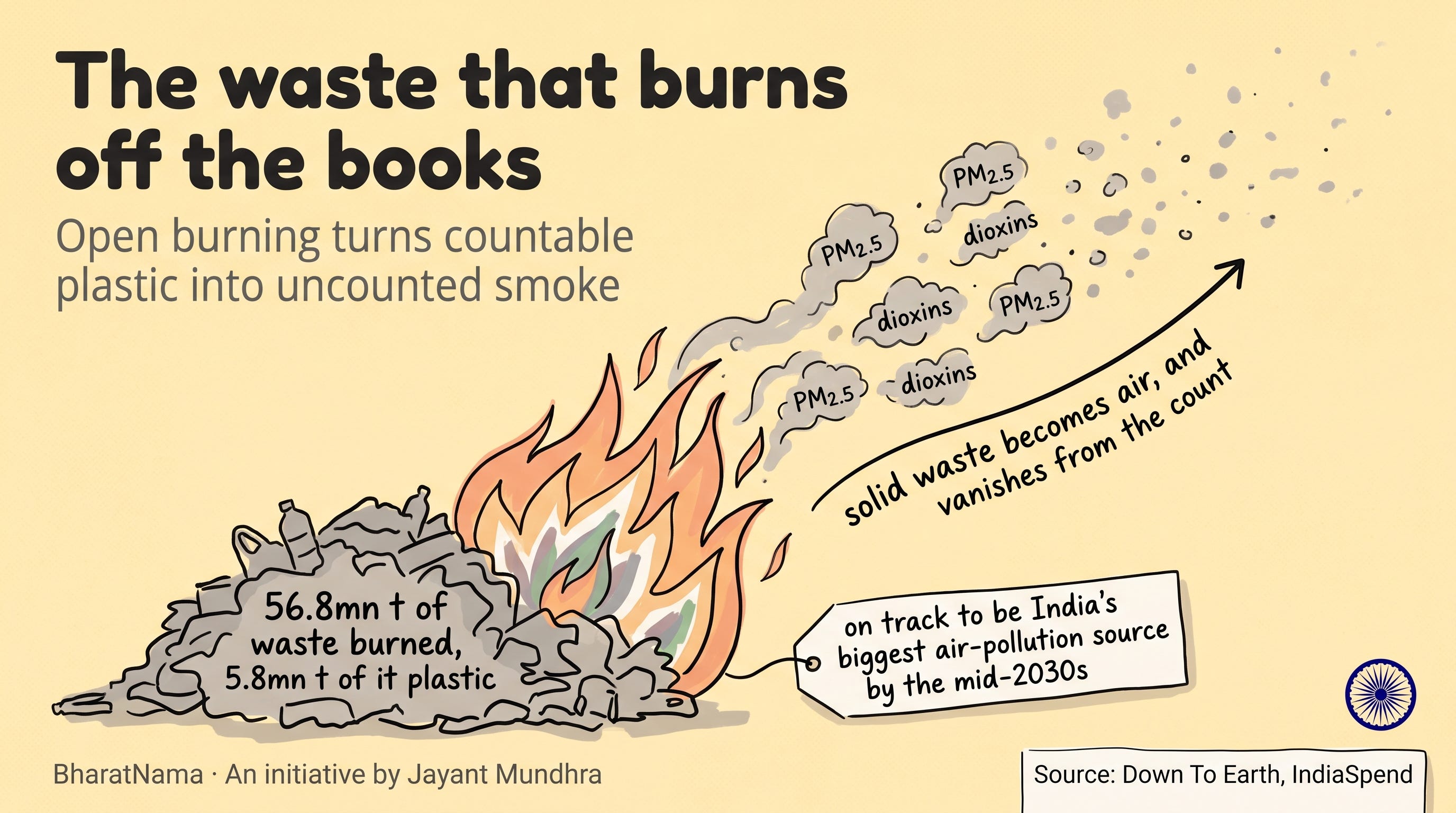
This is the mechanism I keep coming back to. When plastic is neither collected nor sellable, it is set on fire. India openly burns roughly 56.8mn tonnes of municipal solid waste a year, of which about 5.8mn tonnes is plastic.4
Burning does something quietly devastating to the data. It converts solid, countable macroplastic into smoke. The evidence disappears from every land-based audit and every truck-counting exercise. The fire literally erases the waste that the statistics were never going to catch anyway.
The health and climate cost is not abstract:
Low-temperature burning of PVC and polystyrene releases dioxins, furans and concentrated PM2.5.4
PM2.5 from open waste burning barely moved between 2010 and 2020, even as India cleaned up power and industry.4
On current trends, open waste burning is projected to become India's single largest source of air pollution by 2035.4
It is banned under the 2016 waste rules. It is prosecuted almost never. And honestly, how do you fine a household for burning waste when you never gave it a bin?
If the counting is broken, the fix was supposed to be Extended Producer Responsibility, or EPR: the principle that the brand which put the plastic on the market pays for its end of life. India built a slick digital version of it in 2022. Producers register on a CPCB portal, hit phased recycling targets, and buy tradable certificates from recyclers to prove compliance.
Elegant in theory. In practice, a 2024 assessment by the Centre for Science and Environment found the market had been hollowed out.3 The findings are damning:
Over 70,000 fake certificates were circulating on the portal. Cement kilns across 15 states were logged as processing plastic volumes far beyond their physical capacity.3
Zero virgin-plastic manufacturers were registered, despite the rules requiring them. Accountability was missing at the very top of the chain.3
Importers were the most numerous registrants but accounted for only 9% of plastic placed on the market; domestic producers put 65% of the 23.9mn tonnes recorded since April 2022.3
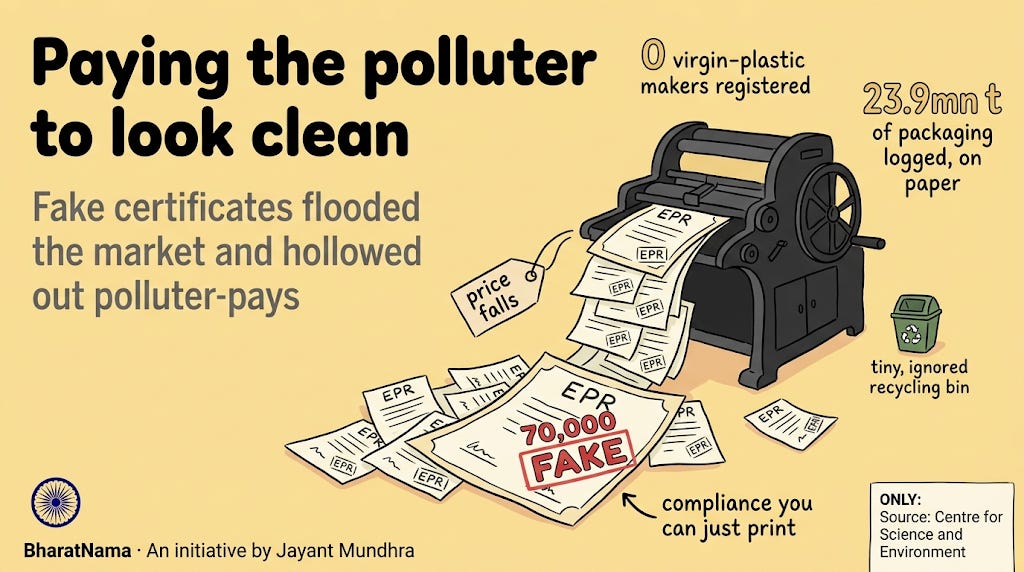
The economics of this are the real scandal. Flood any market with fake supply and the price collapses. Cheap, dubious certificates mean a brand can buy compliance for a fraction of the intended cost. So why would it redesign packaging or fund collection? The polluter-pays principle became pay-a-little-and-carry-on.
This is exactly the kind of thread I keep pulling at, and it is the sort of thing I go back and forth on with readers in the BharatNama WhatsApp community, where I share a smaller India deep-dive like this every morning (t.ly/h2jq1). The pattern repeats across sectors: a beautiful digital system sitting on top of an unmeasured physical reality.
BharatNama is a benchmarking newsletter, so let me place India on two maps.
India against the world. The Nature study lets us compare like with like, all from the same model and period:1
India: ~9.3mn tonnes of plastic emissions a year.
Nigeria: ~3.5mn tonnes.
Indonesia: ~3.4mn tonnes.
China: ~2.8mn tonnes.
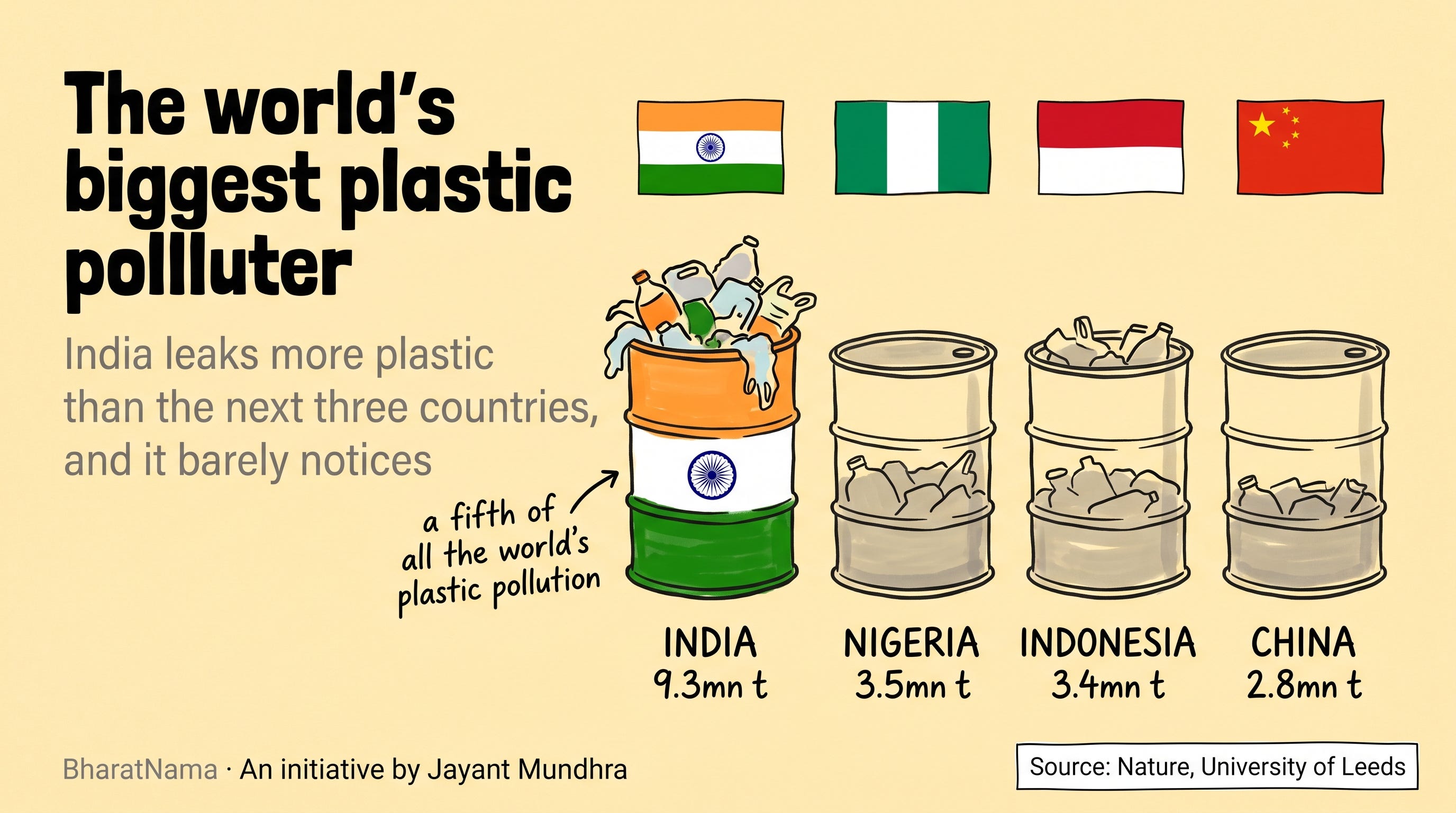
Notice China. It has a population comparable to ours and produces far more plastic overall, yet it emits a third of what India does into the environment. The difference is not virtue, it is collection. In the Global South, uncollected waste drives about 68% of emissions; in the rich world, the leakage is mostly post-collection littering.1 China closed the collection gap. We have not.
India against itself. The national average hides a country pulling in two directions:12
On per capita generation, Delhi, Goa and Telangana top the table; Sikkim, Meghalaya and Tripura sit at the bottom. Urban wealth makes more waste.
On the ability to manage it, the spread is brutal. In the share of villages with any solid-waste mechanism, West Bengal sits near 0.8%, Assam near 1.1%, Punjab near 1.7% and Bihar near 2%.5
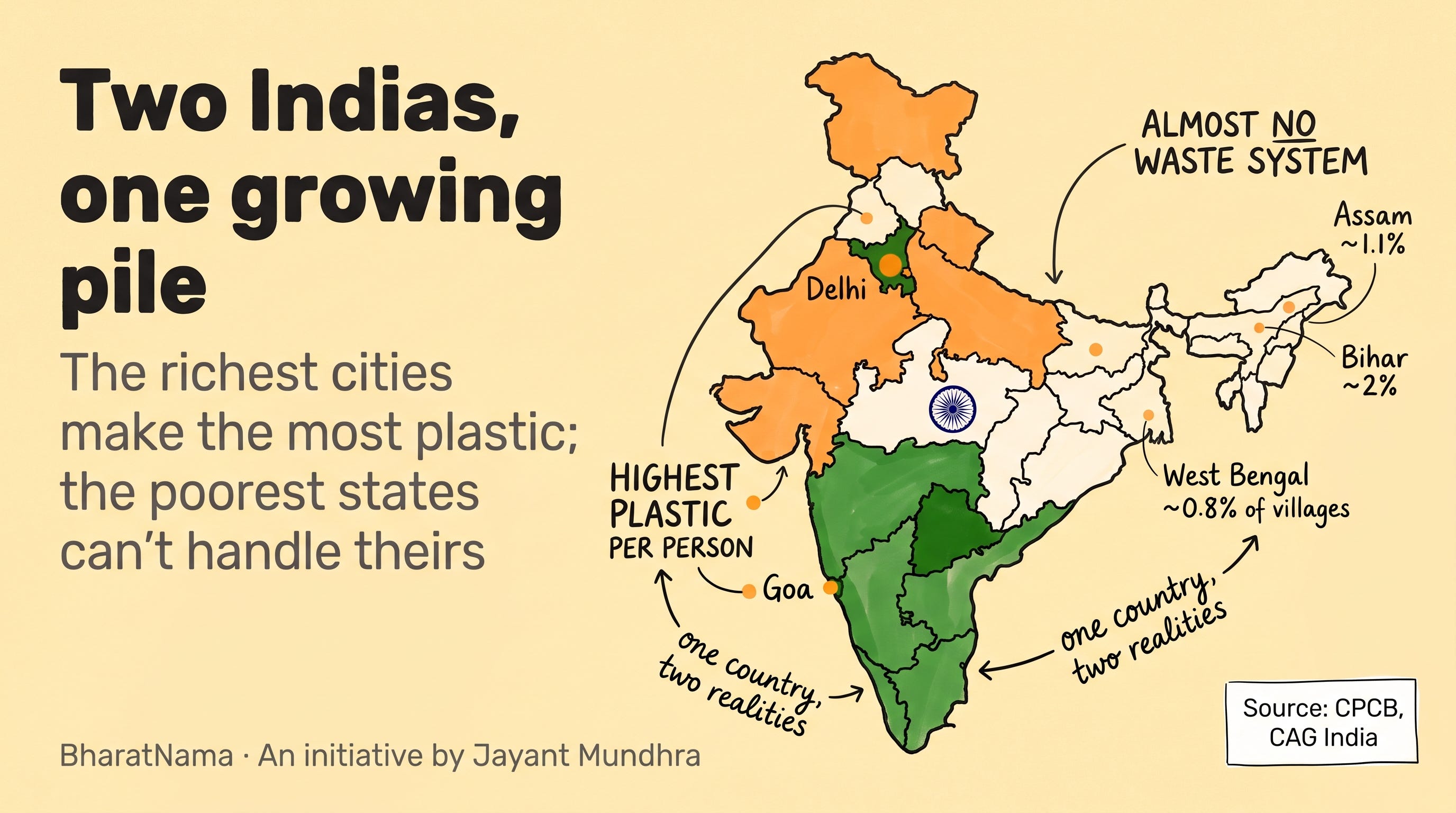
So the richest cities generate the most plastic, and the poorest states have almost no system to handle theirs. The average of 4.1mn tonnes is not one fact. It is a story of two Indias, and the waste piles up in the gap between them.
Here is the honest bit. Our EPR chases waste from the far end, at the recycler, and never puts a rupee in the hand of the person deciding whether to bin a bottle or burn it. That missing nudge is the whole problem.
Germany solved it decades ago with Pfand, a deposit return scheme, and it is the global gold standard:7
About 98% of eligible single-use drink containers come back. 98%.
The lever is a deposit of roughly $0.29 a bottle, about ₹25, high enough that throwing it away hurts more than returning it.
Any shop over 200 sq m must take back containers, creating a dense network of return points and reverse-vending machines.
The high deposit even steers behaviour: about 43% of German drinks are sold in reusable bottles.
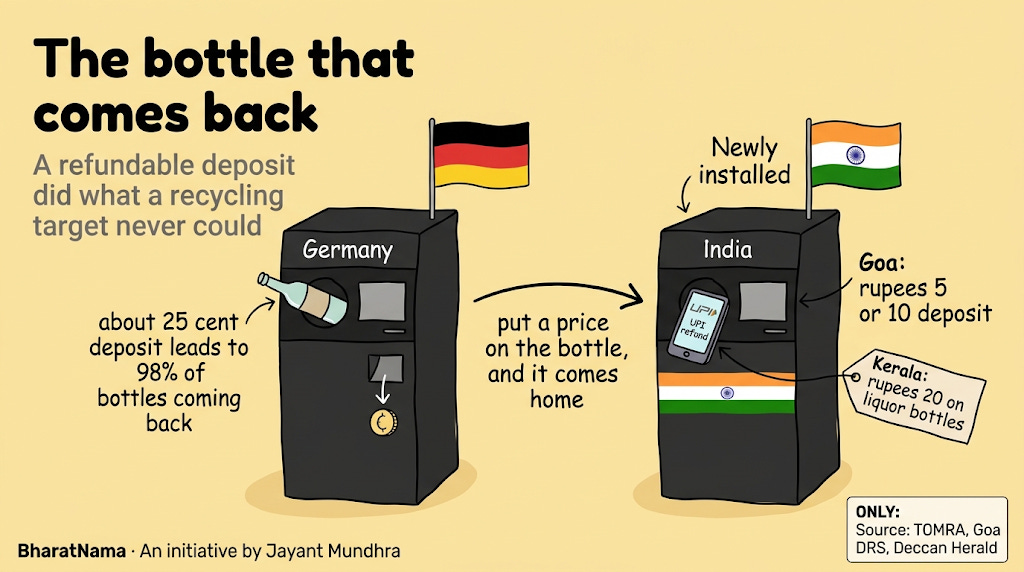
The deepest lesson for India is what the deposit did to informal labour. In Germany, the $0.29 bottle created Pfandsammler, informal collectors who recover discarded bottles from parks and bins for the deposit. They need no digital portal and no carbon credit. They scan a bottle, they get cash. Attach a fixed, redeemable value to waste, and it stops being a nuisance and becomes a thing worth chasing.
That is the exact fix for our stranded, low-value plastic. The reason a sachet rots in a village is that nobody is paid to pick it up. Pay them, and they will.
The encouraging news is that Indian states are not waiting for a treaty or a national rewrite. They are piloting deposit schemes right now.
Goa becomes the first Indian state to run a deposit return scheme. From 1 September 2026, a refundable deposit applies to liquor packaging: about ₹5 on plastic bottles and aluminium cans, ₹10 on glass, with 100-plus reverse-vending machines and instant refunds to the consumer's UPI account against a QR code on the bottle.8
Kerala launched its own ₹20 deposit on liquor bottles in September 2025, piloting in Thiruvananthapuram and Kannur through the state beverage corporation.9
The Goa design is the one to watch, because it does two clever things at once. The unique QR code feeds verified collection data straight to the CPCB portal, which is the direct antidote to the fake-certificate problem. And the refund lands in a waste picker's UPI account, uncoupling their income from volatile scrap prices and turning a kabadiwala into a formal logistics partner. This is the sort of design detail I keep unpacking for the BharatNama community, and it is worth following closely (t.ly/h2jq1).
The catch is scale. If every state writes its own QR standard and deposit value, interstate goods become a compliance nightmare and brands face double-counting. The industry is right to ask for one national deposit framework rather than 28 incompatible ones.
Whether Goa's 1 September 2026 liquor-packaging launch actually hits its early return-rate targets, and whether the UPI-to-waste-picker link works in practice.
Whether the CPCB and state boards begin the risk-based audits the CSE asked for, and start cancelling fraudulent processors rather than just flagging them.
Whether India updates its own official generation figure towards the 9.3mn tonne reality, which directly shapes its position in the UN plastics treaty talks.
The treaty itself: negotiations in Geneva collapsed without agreement in August 2025, and a resumed session in February 2026 managed only to elect a new chair.11 With the OECD projecting global plastic waste to almost triple by 2060,10 a deal built on India's understated 4.1mn tonnes would prescribe far too little.
India is the world's largest plastic polluter and it does not know it, because we built a digital system to count the waste our physical system was designed to lose.
And well that is it for today's edition. That said, do check out my core WhatsApp community Biz News+ where I share 4-5 deepdives from the world of business, economics & public economics daily: https://t.ly/h2jq1
And if you want to understand where China stands and what it means for India, do check out my companion newsletter, Decoding the Dragon: https://t.ly/t7uhs
And, do check out my work on the following platforms as well: Instagram, LinkedIn and Youtube
Best,
Jayant
Down To Earth, India tops plastic pollution rankings: link
Centre for Science and Environment, Is the polluter really paying?: link
Down To Earth, 70k fake certificates, major polluters missing (CSE report): link
Down To Earth, How open waste burning is fuelling a carbon and pollution crisis: link
Pratham, The Plastic STORI (study of rural India): link
Forbes India, Rural India's exploding plastic problem: link
TOMRA, Germany's deposit return scheme: link
Waste & Recycling, Goa's DRS pilot tests a new model for India's recycling system: link
Deccan Herald, Kerala 20-rupee liquor bottle refund scheme: link
OECD, Global plastic waste set to almost triple by 2060: link
IUCN, Plastics treaty negotiations end without agreement in Geneva: link
CAG India, No dustbins, no safe disposal: rural India's waste crisis: link
Comments
Nothing yet. Say the first thing.
Sign in to join the conversation.