
We all face moments where the “right” path feels impossible to find. Thousands of years ago, on a dusty battlefield called Kurukshetra, a warrior-prince named Arjuna faced the exact same paralysis. Caught between his duty as a soldier and his love for his family, he did what many of us do: he broke down.
The 700-verse dialogue that follows, known as the Bhagavad Gita, is not just an ancient scripture; it is a psychological roadmap for the internal conflicts we face every day. While it is technically a historical text (Smṛti), it has become the definitive manual for living a spiritual life while remaining active in the world.
The Bhagavad Gita, often referred to as the "Song of the Lord," constitutes a 700-verse philosophical and spiritual discourse that serves as the heartbeat of the Mahābhārata, the world’s most extensive epic. While technically categorized as Smṛti (historical or remembered text) rather than Śruti (divinely revealed scripture like the Vedas), the Gita has attained a status of near-canonical authority within the Hindu tradition, often regarded as the distilled essence of Upanishadic wisdom. The dialogue takes place on the battlefield of Kurukshetra, positioned between two massive armies poised for a fratricidal war. This setting is not merely a historical backdrop but an enduring allegory for the internal conflicts and moral struggles inherent in the human experience. The conversation between the warrior-prince Arjuna and his divine charioteer, Krishna, explores the fundamental nature of existence, the intricacies of duty, and the various pathways toward spiritual liberation.
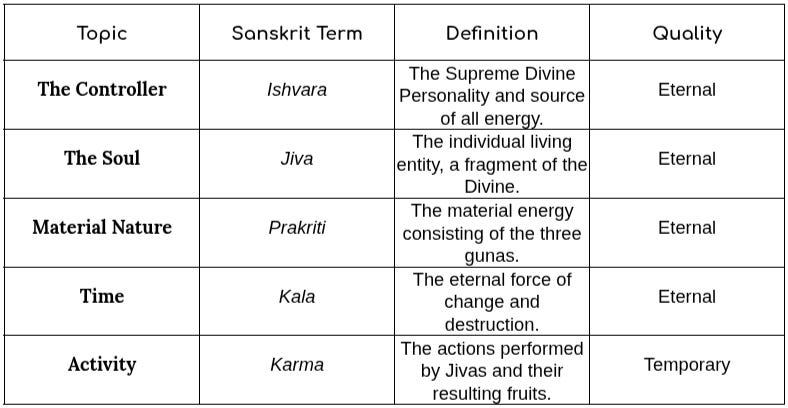
The structural foundation of the Bhagavad Gita is built upon five interconnected themes that define the relationship between the divine, the individual, and the material universe: Ishvara, Jiva, Prakriti, Kala, and Karma. These themes provide the ontological scaffolding upon which Krishna constructs his guidance to Arjuna.
Ishvara represents the Supreme Lord, the ultimate controller, sustainer, and origin of all things. The Gita posits that the intricate and organized workings of the universe imply a conscious orchestrator, an Adhyaksha who directs the cosmic manifestation. Krishna identifies himself as this Supreme Person (Purushottama), the ultimate enjoyer of all sacrifices and the benefactor of all living beings. This conception of the Divine is multifaceted, presented as the impersonal Brahman (the ocean of spiritual light), the localized Paramatma (the indwelling witness in the hearts of all beings), and the personal Bhagavan (the Supreme Personality of Godhead).
The relationship between the Divine and the creation is described through the lens of origin and sustenance. Just as a rose does not appear spontaneously but emerges from a seed, the universe manifests from Ishvara. Krishna describes himself as the source from which everything emanates, the light of the sun and moon, and the life force within all beings.
In contrast to the material body, the Jiva is the eternal living entity, the soul (Atman) that inhabits the physical form. Krishna’s first major teaching to Arjuna in Chapter 2 addresses the immortality of the Jiva. He explains that the soul is never born nor does it ever die; it is immutable, indestructible, and eternal. The relationship between the body and the soul is famously compared to a person changing worn-out clothes for new ones—the soul merely transmigrates from one physical vessel to another.
While both Ishvara and Jiva are described as eternal, a fundamental distinction remains. The Jiva is a fragment or “part” of the “whole” that is Ishvara. This relationship has been interpreted variously by different philosophical schools, ranging from total identity in Advaita Vedanta to eternal distinction in Dvaita Vedanta.
Prakriti is the material nature that constitutes the physical world. It is composed of three modes or qualities known as Gunas: Sattva (goodness), Rajas (passion), and Tamas (ignorance). These gunas interact to shape human behavior, thoughts, and the physical manifestations of the universe. Kala, or eternal time, is the unconquerable energy that governs the cycles of creation and dissolution. Krishna identifies himself as Time, the ultimate force that brings about the end of all things.
The final element, Karma, denotes activity and its subsequent consequences. Unlike the other four elements, Karma is not eternal; the chain of action and reaction can be broken through the application of spiritual knowledge and detached action. The Gita provides the methodology to alter one’s destiny by aligning Karma with spiritual principles.
The dialogue of the Bhagavad Gita is precipitated by a psychological and ethical crisis. As the battle of Kurukshetra is about to begin, Arjuna is overwhelmed by despondency, witnessing his own relatives, teachers, and friends arrayed on both sides of the conflict. This leads to a breakdown of his resolve, as he questions the righteousness of a victory that requires the slaughter of his kin.
Arjuna’s crisis is a conflict between two levels of dharma. On one hand, he is bound by kula-dharma—the familial duties and ethical obligations to protect and respect his kinsmen. On the other hand, his svadharma (personal duty) as a Kṣatriya (warrior) compels him to fight against injustice and uphold righteousness (dharma) in the kingdom.
Dharma in the Gita is not a set of rigid rules but the universal law that sustains and upholds existence. It is derived from the root dhri, meaning to hold or sustain. Krishna argues that Arjuna’s refusal to fight is not born of genuine non-violence but of a temporary delusion and attachment to the physical body.
One of the most profound teachings of the Gita is the emphasis on svadharma—performing one’s own duty according to one’s inherent nature (svabhava). In verses 3.35 and 18.47, Krishna explicitly states that it is far better to perform one’s own duty imperfectly than to attempt to perform another’s duty (paradharma) perfectly.
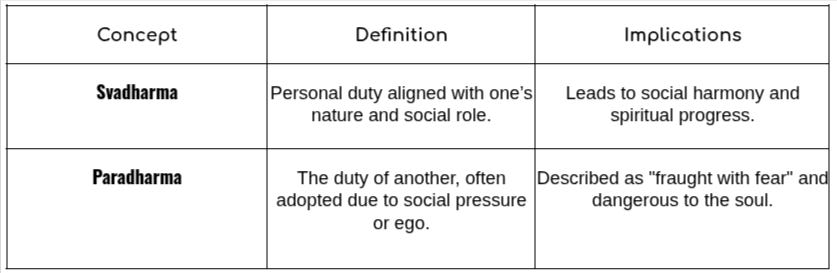
The Gita uses metaphors to explain this: every person is given a different "question paper" by life, and trying to copy another’s "answer sheet" leads to failure. Adhering to svadharma allows an individual to act from their unique position and situation, ensuring that their spiritual growth is rooted in their authentic nature. For Arjuna, as a warrior, the highest duty is to engage in a righteous battle for the protection of society.
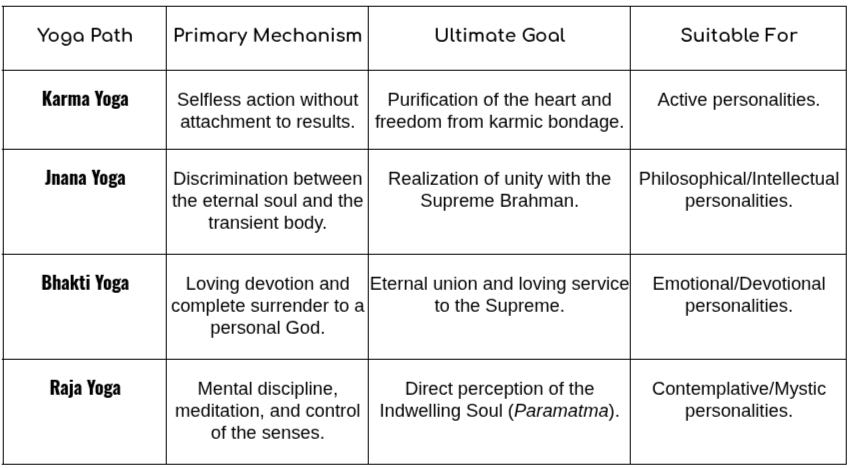
The Bhagavad Gita presents a comprehensive synthesis of spiritual paths, broadly categorized into the three Yogas: Karma, Jnana, and Bhakti. While modern interpretations sometimes treat these as separate options for different temperaments, the text suggests they are integrated rungs on a spiritual ladder.
Karma Yoga addresses the inevitability of action in the material world. Krishna explains that no one can remain inactive even for a moment, as the qualities of material nature (gunas) compel all beings to act. The secret to liberation, therefore, is not the cessation of work, but the transformation of the spirit in which work is performed.
This is articulated through the doctrine of Nishkama Karma—action performed without desire for the “fruits” or results. Verse 2.47 provides the core instruction: “You have a right to perform your prescribed duties, but you are not entitled to the fruits of your actions”. By focusing on the duty itself and relinquishing the ego of being the sole “doer,” a person breaks the bondage of karma and attains mental equanimity.
The Gita suggests that such action should be performed as a sacrifice (yajna) to the Supreme. When work is turned into an act of worship, it purifies the heart and prepares the mind for higher realization. This path is ideal for those with an active temperament, teaching them to remain “detached yet involved”.
Jnana Yoga is the path of intellectual and intuitive realization. It involves learning to discriminate between the real and the unreal, the eternal and the temporal. This path focuses on the analytical study of material nature and the realization of the soul’s distinction from the body.
Krishna teaches that knowledge is the ultimate purifier; just as a blazing fire turns firewood to ashes, the fire of knowledge burns away the reactions to all past actions. Through Jnana Yoga, the seeker learns to see the same Divine essence in all beings, whether they be a learned scholar, a cow, or an outcaste. This “equality of vision” is the hallmark of a Jnani—one who has attained true wisdom.
Bhakti Yoga is the path of loving devotion and total surrender to the Divine. It is described as the most direct and accessible path to liberation, particularly suited for those with an emotional temperament. Krishna emphasizes that he is easily obtainable for one who remembers him without deviation.
In Bhakti Yoga, the relationship between the seeker and the Divine is emphasized. Krishna promises that he carries what his exclusive devotees lack and preserves what they have. The path is characterized by simple acts of devotion: “If one offers Me with love and devotion a leaf, a flower, fruit or water, I will accept it”. This democratization of spiritual practice ensures that anyone, regardless of social standing or intellectual capacity, can attain the highest goal through sincere love.
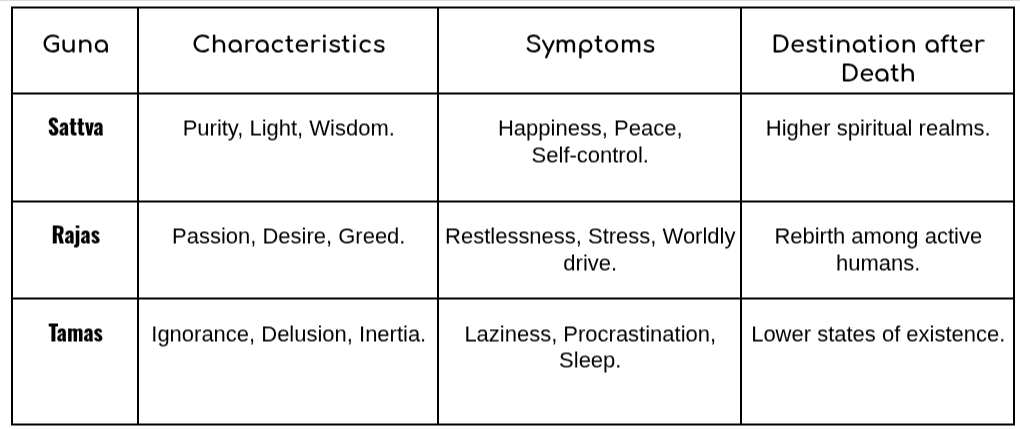
The 14th chapter of the Bhagavad Gita, “Guṇa Traya Vibhāg Yog,” offers a sophisticated analysis of human psychology and the material world through the lens of the three Gunas—Sattva, Rajas, and Tamas. These modes of nature are the fundamental qualities that bind the eternal soul to the perishable body.
Sattva is the mode of goodness, purity, and harmony. It is illuminating and full of well-being, fostering qualities like kindness, honesty, and wisdom. However, Sattva also creates a subtle form of bondage by attaching the soul to the sense of happiness and intellectual knowledge. Those situated in Sattva rise toward higher spiritual realms after death.
Rajas is the mode of passion, characterized by endless desires, ambitions, and a drive for material enhancement. It engenders restlessness and greed, binding the soul through attachment to fruitive actions and their results. A person dominated by Rajas is often stressed, competitive, and never satisfied with their achievements.
Tamas is the mode of ignorance and darkness. It leads to delusion, laziness, and sleep. Tamas clouds the wisdom of the soul and binds it in inertia and procrastination. Under its influence, individuals often avoid their responsibilities and engage in activities that are detrimental to their well-being.
While the gunas govern all material existence, Krishna urges Arjuna to rise above them. A person who has transcended the modes of nature (Gunatita) is one who sees the gunas at play but remains undisturbed and equipoised. This state is achieved through mindfulness and the realization that the true self is separate from these modes. By attaching the mind to the Supreme, who is beyond the gunas, the seeker also rises to the divine level.
The 15th chapter of the Gita, “Purushottama Yoga,” uses the striking metaphor of the Ashvattha (sacred fig) tree to describe the nature of the material world (Samsara). This tree is depicted as “inverted,” with its roots growing upward and its branches downward.
The “roots above” signify that the origin of the material world is in the spiritual realm, the Supreme Divine. The branches growing downward represent the diverse manifestations of life and the various species. The leaves of this tree are the Vedic hymns, which provide instructions for material prosperity.
Krishna explains that as long as a person is lost in the “leaves and branches”—the sensory pleasures and material results—they remain trapped in the cycle of birth and death. The only way to escape this bondage is to cut down the firmly rooted Ashvattha tree with the “sharp axe of detachment” (vairagya).
Chapter 15 distinguishes between three categories of being:
Kshara (Perishable): The material bodies of all living entities, which are subject to birth, decay, and death.
Akshara (Imperishable): The eternal soul, which remains unchanging beyond physical existence.
Purushottama (The Supreme Person): The Divine Essence that transcends both matter and spirit, sustaining and pervading the entire universe.
Krishna identifies himself as the Purushottama, the ultimate source of knowledge, memory, and forgetfulness. He is the one indweller who inspires intelligence and leads the senses. Realizing this Supreme Person within oneself and others is presented as the pinnacle of wisdom, leading to ultimate liberation.
A central theme that recurs throughout the Gita is the cultivation of Samatvam—equanimity or even-mindedness in the face of life’s dualities, such as happiness and distress, loss and gain, victory and defeat.
The second chapter concludes with Arjuna’s question about the characteristics of a person established in steady wisdom—a Sthitaprajna. Krishna describes such a person as one who has abandoned all desires arising from the mind and finds satisfaction in the self alone. The Sthitaprajna is not disturbed by adversity nor does he crave pleasure; he is free from attachment, fear, and anger.
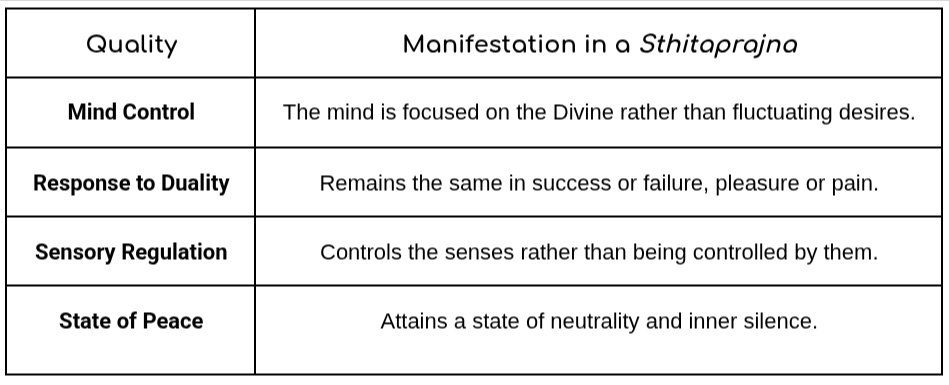
Krishna provides a psychological roadmap of how attachment leads to destruction. He explains that by contemplating sensory objects, a person develops attachment to them; from attachment comes desire; from desire comes anger (when desire is unfulfilled); from anger comes delusion; from delusion comes loss of memory; from loss of memory comes destruction of the intellect; and from the destruction of the intellect, one perishes. The practice of Yoga aims to reverse this process by fixing the mind on the higher Reality.
The depth and complexity of the Bhagavad Gita have led to various interpretations by historical and modern scholars, each emphasizing different facets of its “essence”.
Adi Shankaracharya (Advaita): Shankara’s 8th-century commentary focuses on Jnana Yoga and the concept of non-dualism. He argues that the ultimate reality is Brahman and that the individual soul is identical to it. For Shankara, the world is maya (illusion), and liberation is achieved only through the knowledge of this oneness.
Ramanujacharya (Visishtadvaita): Ramanuja emphasizes Bhakti Yoga and qualified non-dualism. He argues that the soul and the material world are parts of God (Vishnu/Krishna) but maintain a distinct identity. For him, a personal relationship with the Divine is the primary path to Moksha.
Madhvacharya (Dvaita): Madhva proposes a strictly dualistic interpretation, asserting that God, souls, and matter are eternally distinct. He argues that the soul is always the humble servant of the Lord and that liberation comes through God’s grace alone.
The Bhagavad Gita reaches its climax in the 18th chapter, “Mokṣha Sanyās Yog.” After systematically explaining the paths of action, knowledge, and devotion, Krishna provides his “most confidential” instruction in verse 18.66: “Abandon all varieties of dharmas and simply surrender unto Me alone. I shall liberate you from all sinful reactions; do not fear”.
This verse represents a significant shift in the teaching. Throughout the Gita, Krishna encouraged Arjuna to perform his material duty (Apara Dharma) as a warrior while practicing devotion. However, in this final conclusion, he reveals the principle of Karm Sanyās—the renunciation of all material roles in favor of total surrender to God (Para Dharma).
The significance of this surrender is that it absolves the individual from the “five debts” (to gods, ancestors, sages, humans, and living beings). Just as watering the root of a tree automatically waters all its branches, fulfilling one’s duty to God automatically fulfills all other responsibilities.
The call to “abandon all dharmas” does not mean adopting adharma (unrighteousness) or idleness. Rather, it means that the devotee accepts whatever helps in their surrender to Krishna and rejects whatever hinders it. This state of “absolute dependence” is characterized by utter humility and the faith that the Divine will protect and maintain the seeker.
Arjuna’s response to this teaching marks the end of his crisis: “My delusion is destroyed; I have regained my memory through Your grace. I am now firm, my doubts are dispelled, and I will act according to Your word” (18.73).
The Bhagavad Gita’s essence transcends the borders of India, having profoundly influenced Western philosophers, scientists, and writers since its first translations into European languages.
Western scholars have often marveled at the Gita’s comprehensiveness and its “perennial philosophy”.
Henry David Thoreau: He famously wrote in Walden about bathing his intellect in the “stupendous and cosmogonal philosophy” of the Gita, comparing modern literature to it as “puny and trivial”.
Ralph Waldo Emerson: He viewed the Gita as a “magnificent” book, an “empire speaking to us” with the voice of an old intelligence that had pondered the same universal questions.
Aldous Huxley: He described the text as one of the clearest and most systematic spiritual statements ever done, influencing his own exploration of reality and consciousness.
J. Robert Oppenheimer: The lead scientist of the Manhattan Project turned to the Gita during the testing of the atomic bomb. His famous quote, “Now I am become Death, the destroyer of worlds,” was a direct reference to Krishna’s revelation of his cosmic form as Time.
Albert Einstein: He expressed profound respect for the Gita, noting its influence on the spirit of mankind through its call for devotion to God manifested through action.
The Bhagavad Gita is not merely a book of theology but a practical guide for living. Its essential teachings for the modern individual include:
Detachment from Outcome: Focusing on the quality of the work rather than being anxious about the results.
Self-Awareness: Identifying the influence of the three gunas (Sattva, Rajas, Tamas) on one’s own mind and behavior to make more conscious choices.
Fulfillment of Duty: Recognizing and adhering to one’s svadharma (authentic path) rather than trying to imitate others.
Resilience: Cultivating the equanimity of a Sthitaprajna to remain steady during the inevitable ups and downs of life.
Universal Compassion: Seeing the Divine essence in all living beings, which provides a foundation for ethical and compassionate behavior.
The Bhagavad Gita concludes with a pronouncement by Sanjaya, the narrator, who states that wherever there is Krishna (the Lord of Yoga) and Arjuna (the pure devotee and archer), there will also be opulence, victory, extraordinary power, and morality. This suggests that the union of divine guidance and human effort is the ultimate formula for success in the world and beyond.
Think about it: What is one area of your life where you are chasing the “fruit” instead of focusing on the work?
Share This: If you found these insights helpful, consider sharing this post with a friend who is currently facing their own “Kurukshetra.”
Comments
Nothing yet. Say the first thing.
Sign in to join the conversation.