
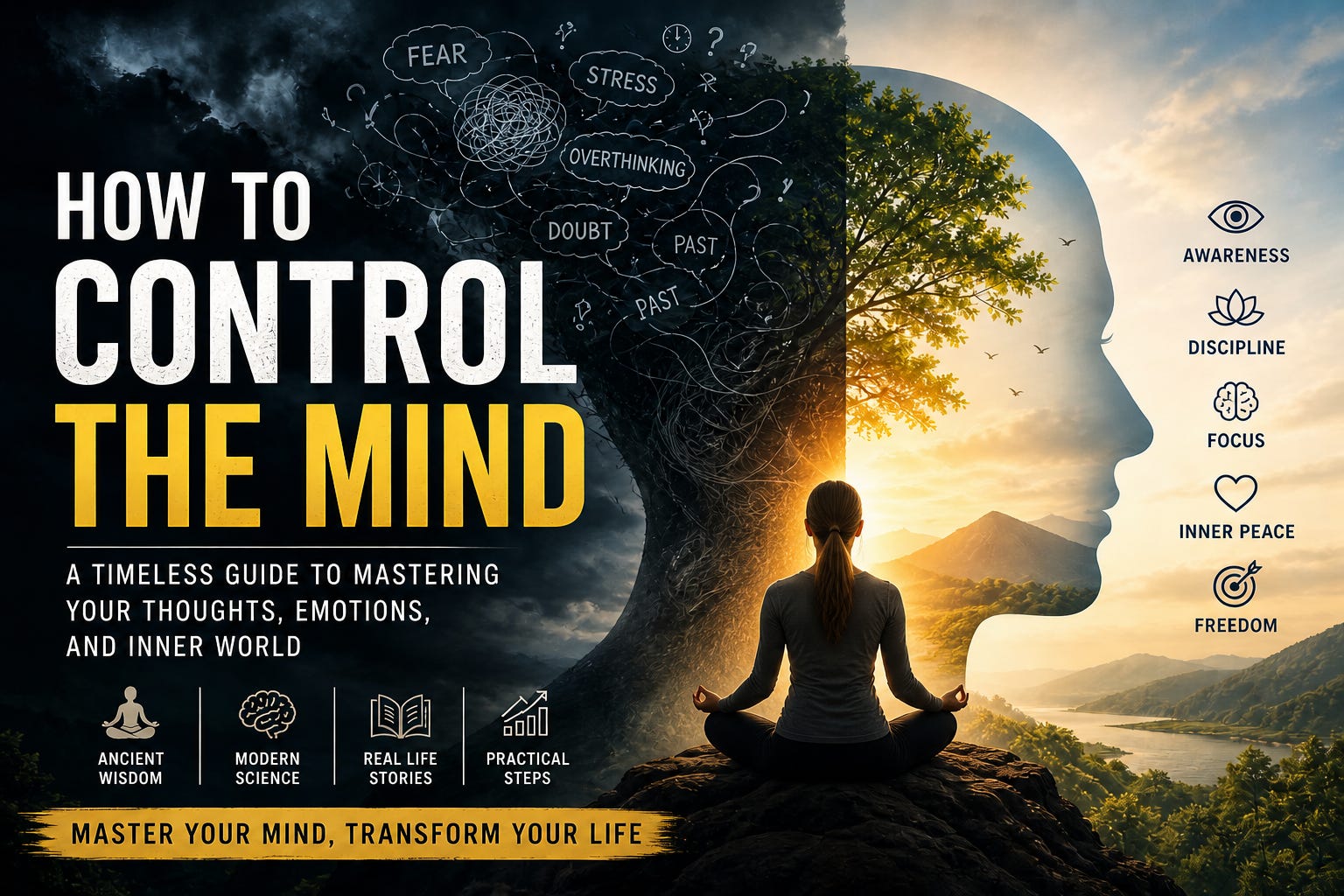
The human mind is the most powerful tool we possess — and often the most difficult to manage. It can create masterpieces or misery, peace or panic, clarity or confusion. Across thousands of years, philosophers, monks, psychologists, and neuroscientists have tried to answer one timeless question: How do we control the mind instead of letting it control us?
You cannot force the mind to be silent. You can only train it. Trying to suppress thoughts is like trying to push a beach ball underwater — it always pops back up. Real control comes from understanding how the mind actually works.
The oldest systematic teachings on mind control come from the
Bhagavad Gita and Yoga Sutras of Patanjali.
In the Gita, the warrior Arjuna says:
“The mind is restless, turbulent, strong and obstinate.”
Krishna replies:
“It can be controlled by practice and detachment.”
This single sentence summarizes the entire science of mental mastery.
Patanjali later defined yoga as:
“Yoga is the stilling of the fluctuations of the mind.”
Not stopping thoughts — but calming the storm.
Roman emperor Marcus Aurelius wrote in Meditations:
“You have power over your mind — not outside events.”
Stoics believed suffering comes not from events, but from our interpretation of them.
Gautama Buddha discovered:
The mind creates suffering through craving and resistance.
His solution? Mindfulness.
Observe thoughts. Don’t fight them.
Your mind has two layers:
Analyzes
Worries
Plans
Replays the past
This part creates 90% of stress.
Watches thoughts
Is calm and silent
Exists beneath the noise
Mind control = strengthening the observer.
A student before an exam thinks:
“What if I fail?”
“Everyone is better than me.”
“My life will be ruined.”
Reality: The exam hasn’t even started.
The suffering exists only in thoughts. Once the student learns to observe the thoughts instead of believing them — anxiety drops.
Nothing external changed. Only the relationship with the mind changed.
People believe: Thought → Must be true
Reality: Thought → Just mental activity
Your brain produces thoughts like the heart produces beats.
Step 1 — Awareness (Catch the Mind in Action)
You cannot control what you don’t notice.
Start observing:
What triggers your stress?
What loops repeat daily?
What thoughts appear automatically?
Most people run on mental autopilot.Awareness breaks autopilot.
Step 2 — Label the Thought
Instead of:
“I’m going to fail.”
Say:
“I’m having the thought that I might fail.”
This creates distance between you and the mind.
This technique is used in Cognitive Behavioral Therapy.
Step 3 — Stop Fighting Thoughts
Paradox:
The more you resist thoughts, the stronger they become.
Example:
Try NOT thinking of a pink elephant.
You just did.
Acceptance weakens thoughts. Resistance strengthens them.
Step 4 — Train Attention (The Real Skill)
The mind wanders because attention is weak.
Attention is like a muscle.
Training tool:
Meditation
Deep breathing
Focused work
Reading
Even 10 minutes daily changes brain structure.
Step 5 — Replace Mental Habits
The mind runs on patterns.
Negative loops:
Catastrophizing
Overthinking
Self-criticism
Replace them with:
Problem solving
Neutral observation
Gratitude
New thoughts create new neural pathways.
Mind control is not about becoming emotionless. It is about becoming the driver instead of the passenger.
Thoughts still appear.
Emotions still arise.
But they no longer control your actions.
Across all history and science, the same formula appears:
Practice + Detachment + Awareness = Mental Mastery
The mind becomes peaceful not by force, but by training, understanding, and patience. And once mastered, it becomes your greatest ally.
Thank you for reading. Your time and attention mean a great deal, and I hope this article gave you something valuable to reflect on, practice, and carry into your daily life. May your mind grow calmer, your focus grow stronger, and your inner world become a place of peace, wisdom, and strength. 🌱
Comments
Nothing yet. Say the first thing.
Sign in to join the conversation.