
Last week I sat through a two-and-a-half-day Notified Body surveillance audit. All sessions, start to finish.
My role was to cover Regulatory Affairs topics: Regulatory Intelligence, Post-Market Surveillance, and Vigilance. But I stayed for all of it.
Because I treat audits as a free masterclass. A chance to watch how an auditor thinks, how they probe, and how an experienced Quality Manager handles the pressure in real time (and to think would I like to be an auditor!?). That is not something you learn from a course.
So this week, the career section is about exactly that; the must-have qualities of RA professionals and auditors. What it actually takes, beyond the job description.
Today you will read in this issue:
a quote worth reflecting on
news worth reading
a career advice worth exploring
Share Beyond Regulation with Ceren: Insights, Career & MedTech
A quote worth reflecting on
"Judge a man by his questions rather than his answers." Voltaire
I watched an auditor work for two and a half days last week. And one thing stayed with me: the way she asked.
Every question was deliberate.
Every follow-up had a purpose.
She was not testing knowledge, but in essence she was evaluating how people think. How they handle pressure. How they respond when the answer is not clean.
And it reminded me that the same is true in an interview room.
The best RA professionals and the best auditors share one quality above everything else: they ask better questions than everyone else in the room.
Share Beyond Regulation with Ceren: Insights, Career & MedTech
News worth reading
This week brought a major update that will shape the daily lives of Regulatory Affairs and Quality professionals.
New EU Implementing Regulation on conformity assessment procedures:
Commission implementing regulation (2026/977) goes into effect on 25 February 2027, reshaping how we work with our Notified Body on medical device certifications.
What is a commission implementing regulation:
a legally binding European Union act adopted by the European Commission to ensure uniform application of EU laws across all member states
Here’s what’s changing for our timelines and budgets.
Better Budget Control
Notified Bodies must now provide detailed quotations upfront, including cost breakdowns and surveillance fees. If costs exceed 10%, they must justify the increase in advance.
Benefit?
More predictable budgets, but we need to ensure our initial submissions contain all required information to avoid delays.
Clear Timelines With Defined Interruptions
The regulation sets maximum timelines for each phase, plus limits on how many times the Notified Body can request clarifications:
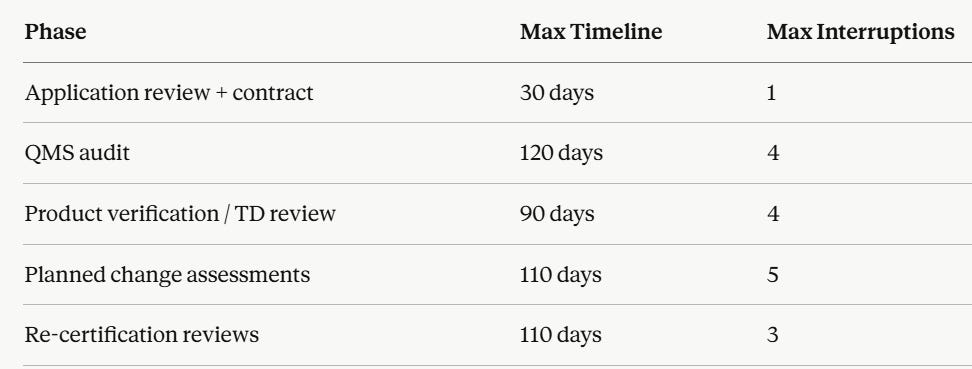
These timelines enable a realistic planning horizon for product launches and lifecycle changes. The interruption limits protect us from excessive back-and-forth requests.
Re-certification Gets Stricter
Expect a streamlined re-certification process, but with a critical point: Notified Bodies won’t repeat the initial assessment. Instead, they’ll focus on Post-Market Surveillance data, Clinical Evaluation Reports, risk file updates, and state-of-the-art alignment.
This means our PMS and clinical evaluation files must be continuously maintained. Last-minute updates won’t work anymore.
Increased Transparency
Notified Bodies must publish annual reports on actual timelines and costs, enabling us to benchmark providers and make informed decisions about our certification strategy.
Transition Timeline
Before 25 Feb 2027: Existing contracts exempt; old rules apply
After 25 May 2027: Monitoring/reporting obligations begin
Before 25 Nov 2027: Re-certification rules don’t apply to expiring certificates
My take: Finally, clear timelines that the industry has been asking for. Coming from pharma, the lack of defined timelines in medical devices was one of my first shocks. This regulation addresses a real pain point and brings much-needed predictability to our certification planning. It’s a win for both companies and regulators.
That said, let’s wait and see what Notified Bodies are actually thinking about all this.
Share Beyond Regulation with Ceren: Insights, Career & MedTech
A career advice worth exploring
This week I talk about Must-have qualities of an RA professional and Must-have qualities of an auditor. Read through them slowly and honestly evaluate where you stand.
Must-have qualities of an RA professional
Regulatory affairs is about knowing how to apply the regulations under pressure, across teams, and in situations no regulation fully anticipated.
After years in the field and sitting through audits, these are the qualities that consistently separate good RA professionals from great ones:
Curiosity over compliance: You do not just follow the regulation, you understand why it exists
Structured thinking: You can break down a complex requirement and explain it clearly to someone who has never read an Annex
Cross-functional communication: You translate between R&D, clinical, marketing, and quality without losing the message
Comfort with ambiguity: Regulations leave gaps. You navigate them without freezing
Proactive mindset: You flag risks before they become findings
Continuous learning: The regulatory landscape changes. You change with it
Attention to detail without losing the big picture: You catch the error in Annex I while keeping the submission timeline in sight
The best RA professionals are people who know how to think in ambiguity and can show it when it matters.
Must-have qualities of an auditor
Sitting through a two-and-a-half-day Notified Body audit gave me a close look at what makes an auditor genuinely effective.
An auditor’s role is not to find gaps. Rather, their role is to ask the right questions to understand whether a system actually works
These are the qualities I observed:
Precision in questioning: They do not ask vague questions. Every question has a purpose and leads somewhere
Active listening: They notice what is not said as much as what is
System thinking: They are not just checking boxes. They are evaluating whether the whole quality system holds together
Composure: They stay neutral, even when responses are incomplete or inconsistent
Depth over breadth: When something catches their attention, they go deeper. A good auditor follows the thread
Fairness: They distinguish between a documentation gap and a systemic failure
Clarity in findings: A well-written finding leaves no room for interpretation. It is specific, evidenced, and actionable
A great auditor does not make you feel interrogated. They make you think. And when the session ends, you leave with a clearer picture of your own system than when you walked in.
That is it for this week! :)
If you have any questions or comments, feel free to send me a DM or write in the comments section.
Have a great week and see you in the next issue!
Thanks for reading Beyond Regulation with Ceren: Insights, Career & MedTech! Subscribe for free to receive new posts and support my work.
Share Beyond Regulation with Ceren: Insights, Career & MedTech
Comments
Nothing yet. Say the first thing.
Sign in to join the conversation.