
Over the last few weeks, I ran a couple of quizzes here. And many of you answered. Thank you. Genuinely!
Your responses told me something useful: a lot of people are navigating the job market, preparing for interviews, or trying to translate their background into a CV that actually gets noticed.
I will keep sharing what I know here, for free, that is not changing. (This week in career section: how to use ChatGPT for interview prep).
But several of you asked for something more concrete. A structured guide. A framework you can actually sit down with and work through. So I am exploring building exactly that low-cost solution.
Nothing overcomplicated. Just the kind of focused, hands-on material that is hard to find in this field.
If that sounds useful to you, let me know in the quiz below. Your response will directly shape whether I build it and what goes in it.
Today you will read in this issue:
a quote worth reflecting on
a career advice worth exploring
a linkedin post worth reading
Share Beyond Regulation with Ceren: Insights, Career & MedTech
A quote worth reflecting on
“Before anything else, preparation is the key to success.” — Alexander Graham Bell
I came from a PhD, with no industry experience and no network to call like most of you.
What I had was publicly available resources (guidelines, regulations and guidance from FDA/EMA) and a couple of courses.
I read them. Without ChatGPT, without AI summaries. Just the documents and a lot of patience.
When interviews came, I knew what to talk about and how to show the hiring manager how I think.
You already have more tools than I did. Use them.
Share Beyond Regulation with Ceren: Insights, Career & MedTech
A career advice worth exploring
How to use ChatGPT for interview prep?
When preparing for an entry-level Regulatory Affairs interview, it is tempting to focus on memorizing definitions.
What is IVDR or MDR?
What is a technical file?
What is risk management?
But interviews are rarely about repeating textbook answers. Even at entry level, hiring managers are trying to understand something else:
How do you think?
How do you structure your answers?
And how do you handle questions when you are not completely sure?
This is where using ChatGPT as a roleplay tool becomes very useful.
Use ChatGPT as a way to practice thinking out loud in a structured, professional way.
Step 1: Set up the roleplay
For entry-level roles, the goal is to show that you understand the basics and can approach problems logically.
So define the scenario clearly:
“Act as a hiring manager in an IVD/MD/pharma company in Europe. You are interviewing me for a junior Regulatory Affairs role. Ask me questions about;
IVDR/MDR/510k/PMA and etc, risk management, classification, and technical documentation
Pharmaceutical regulation in EU/US/India and etc, registration and life-cycle management
Keep the level appropriate for an entry-level candidate, but challenge my answers with follow-up questions.”
This creates a safe but realistic practice environment.
Step 2: Focus on structure, not perfection
Once the roleplay starts, treat it like a real interview.
You might get a question like:
“How would you approach classification of an IVD under IVDR?”
At this stage, you are not expected to know every rule by heart. What matters more is how you approach the question:
Start by explaining that classification is based on IVDR rules
Mention that you would review intended purpose first
Refer to classification rules in a general way
Explain that borderline cases may require justification
Even a simple, structured answer shows much more than a memorized sentence.
Step 3: Get comfortable with follow-up questions
A good hiring manager will not stop at your first answer.
You can encourage ChatGPT to behave the same way:
“Ask me follow-up questions and challenge my answers.”
You might then hear questions like:
“What information do you need to define intended purpose?”
“Where would you document your classification decision?”
“Who would you involve in this process?”
This is where many candidates struggle, as they are not used to explaining their thinking step by step.
This exercise helps you build that skill.
Step 4: Ask for feedback and identify gaps
After a few questions, pause and ask:
“Evaluate my answers for an entry-level RA candidate. Where am I too vague? What should I improve?”
Look for patterns:
Are your answers too general?
Are you missing basic regulatory references?
Are you jumping to conclusions without explaining your reasoning?
In Regulatory Affairs, even at junior level, a strong answer is one that is clear, structured, and shows awareness of the bigger picture.
What this exercise really builds
Using roleplay like this does more than prepare you for one interview.
It helps you develop confidence in how you communicate.
You start to:
Organize your thoughts more clearly
Explain your reasoning step by step
Stay calm when you get unexpected questions
Recognize where your knowledge is still developing
And most importantly, you become comfortable saying:
“This is how I would approach it based on what I know.”
That is exactly what hiring managers expect at entry level.
A small but important warning about role-play
It is very easy to misuse tools like ChatGPT.
If you only ask for “perfect answers” and try to memorize them, it will show very quickly.
Regulatory Affairs interviews are not about sounding perfect. They are about showing how you think.
So use ChatGPT as a practice partner, not as a script generator.
Final thought
For entry-level Regulatory Affairs roles in MedTech, you are not expected to know everything.
You are expected to show potential.
That means being structured, being honest about what you know, and being able to explain your thinking.
Practicing with ChatGPT will not make you an expert overnight.
But it can make you clearer, more confident, and better prepared for the kind of conversations you will actually face.
And that is often what makes the difference.
Good luck with your interviews!
If you want to get a GPT for your interview prep, let me know in the quiz above, so that I can work on a solution!
A Linkedin post worth reading
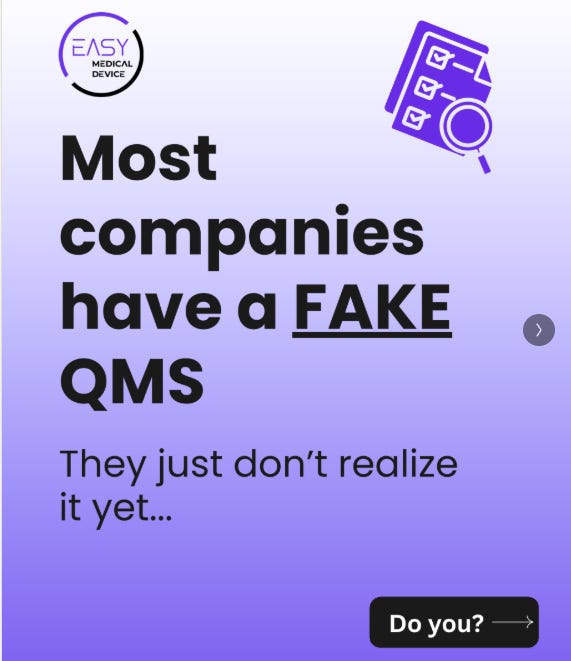
Easy Medical Device discussed the signs of a fake QMS system Here is the original post.
Below is the short summary:
Companies fail to explain how CAPA works in practice
Risk management does not link to post-market data, with no structured updates and no traceability of changes
It happens when procedures exist but are not followed, when teams do not understand the system, and when processes are not used in daily work
It is driven by pressure to reach CE marking fast, a mindset of buying ready-made templates, lack of operational ownership, and no proper training or transfer
That is it for this week! :)
Have a great week and see you in the next issue!
Thanks for reading Beyond Regulation with Ceren: Insights, Career & MedTech! Subscribe for free to receive new posts and support my work.
Share Beyond Regulation with Ceren: Insights, Career & MedTech
Comments
Nothing yet. Say the first thing.
Sign in to join the conversation.