
Did you also finish your school year and enter the summer holidays by mid-June? I did!
Where I grew up, in Türkiye, the summers start early and, with the heat, it is impossible to concentrate anymore. So, we used to finish school and the uni academic calendar by mid-June at the latest. But that only meant one thing besides chilling as much as possible, summer homework.
As you all know, Q4 is one of the quarters when companies hire the most. So, you should go into Q4 with enough preparation. Therefore, in this week’s career section, I am asking you a couple of questions to assess your needs to prepare for interviews and providing a few prep tools to help building your technical knowledge.
Enjoy the read!
a recall worth learning from
career advice worth exploring
a course worth doing (this week multiple suggestions)
linkedin post worth reading

This week on my radar: ORBIS Anesthesia by DH Healthcare / Dedalus- a clinical information system module for anaesthesia documentation, including perioperative medication management.
The software was not buggy. The logic was not broken. The system behaved exactly as designed.
The manual just didn’t explain how to use it correctly.
One missing step. In an anaesthesia setting.
Here’s what happened: when a user sets a medication to “to be stopped” in the finalisation dialogue, that’s not actually the stop. There’s a mandatory second confirmation in the Patient Chart. Without it, the prescription stays visually active, continuous blue line, still running, while the clinical team believes it’s been discontinued.
Unintended continuation of anaesthetic agents or vasopressors. In a perioperative patient…
No confirmed harm reported. But an Urgent FSN still went out because the risk cannot be excluded, and in this context, “probably fine” is not a clinical standard.
The fix? A corrected user manual soon.
Until then: the interim risk control is staff awareness.
Take away from this case:
For Medical Device Software, the IFU is part of the device and an incomplete workflow description is a device deficiency.
Combined-use scenarios require integrated validation; neither module alone would have caught this
When a software fix is a few months away, the FSN is the risk control and that places real burden on clinical teams
No bug. No hardware failure. Just one undescribed step and a mandatory FSCA in multiple countries.
Share Beyond Regulation with Ceren: Insights, Career & MedTech
While preparing for interviews, there are two sides to focus on: technical knowledge and application preparation.
Have you polished your CV mapping your past experiences to regulatory affairs language?
Have you decided which product group are you targeting and is it matching your background/experience? If not matching, what have you done to compensate the gap?
Are you aware of the soft skills that makes a great RA professional? And have you mapped these skills to your background with STAR method?
Have you identified your target companies and researched their product portfolio and recent regulatory submissions or approvals?
Are you aware of the principles of ISO 13485 or any other standard the job description is asking for? If not, check the Issue 7 for free ISO 13485 course.
Are you aware of the principles of IVDR/MDR/FDA regulations? If not, check the career section for free resources.
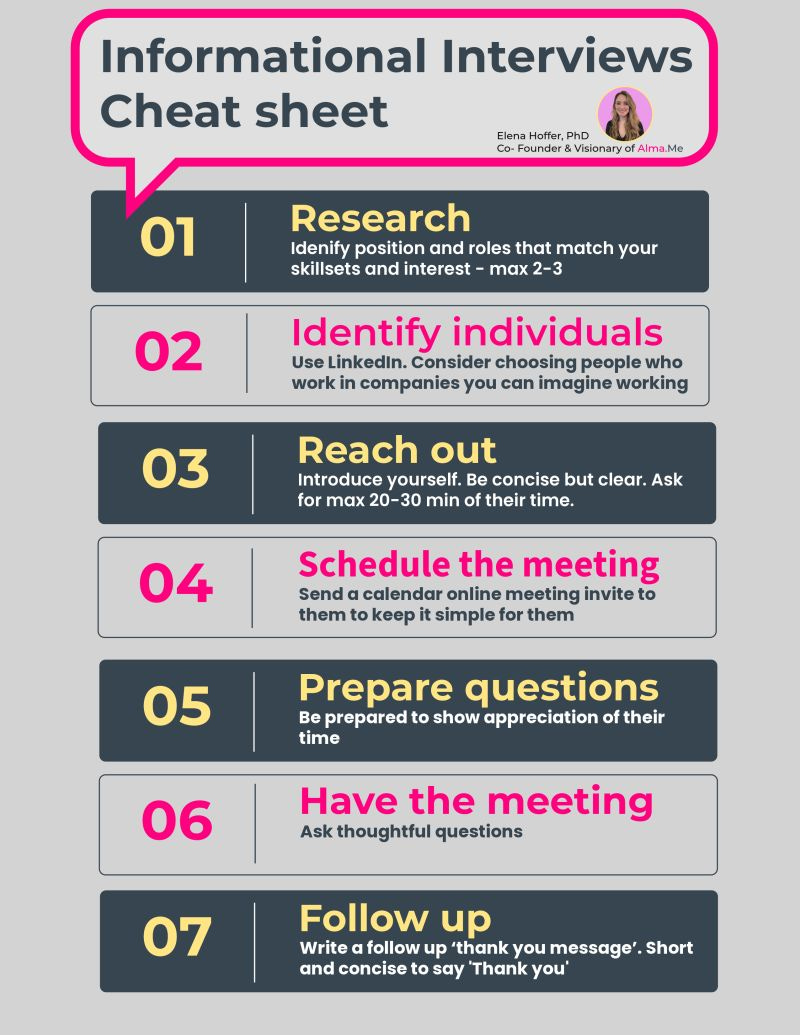
This week I want to highlight a post from Elena Hofer, PhD. She crated a great cheat sheet for coffee chats/informational interviews.
Here is the original post.
Here is the youtube video that she walks you through her tips.
Below is the cheatsheet.
That is it for this week! :)
Have a great two weeks and see you in the next issue!
P.S: You can always comment your questions in the comment section of this article. I am reading them all!
Share Beyond Regulation with Ceren: Insights, Career & MedTech
No posts
Comments
Nothing yet. Say the first thing.
Sign in to join the conversation.