
Regulatory affairs moves fast. Guidelines get updated, deadlines shift, and new frameworks come into force before most courses have a chance to cover them.
That is exactly why this newsletter covers important regulatory news. The goal is to make sure you walk into an interview prepared, aware, and confident when these topics come up.
And they will come up. Interviewers want candidates who follow the field, notice when something changes, and understand why it matters in practice.
Staying current is one of the simplest ways to show you are serious about a career in regulatory affairs, and one of the most overlooked.
Every time a major update lands, you will find a breakdown here, written to help you understand it and talk about it with confidence.
Important annoucement : As we head into the summer months in the Northern Hemisphere, I am switching gears. You will now receive this newsletter twice a month. The content and quality will stay the same, while I take some time to recharge over the summer.
Today you will read in this issue:
news worth reading
career advice worth exploring
Linkedin post worth reading
The big EUDAMED deadline is almost here. What do you need to know for your interviews?
The first four EUDAMED modules become mandatory to use as of 28 May 2026. That isa few days away and if you are interviewing for a regulatory role right now, you should expect it to come up.
EUDAMED is the European Union’s central database for medical devices, established under the MDR and IVDR. After years of delays, the European Commission confirmed in November 2025 that four modules are fully functional and set a hard deadline for mandatory use. Those four modules are
Actor Registration,
UDI and Device Registration,
Notified Bodies and Certificates,
and Market Surveillance (for competent authorities)
From 28 May 2026, EUDAMED is no longer optional. If an obligation is linked to one of the four modules, it must be fulfilled in EUDAMED. Parallel national systems or alternative processes are no longer sufficient.
In practical terms: all economic operators, including manufacturers, authorised representatives, and importers, must be registered in EUDAMED by 28 May 2026. New devices placed on the market from that date must be registered in the UDI and Device module before first placement.
Devices placed on the market before 28 May 2026 that will continue to be sold afterwards have until 28 November 2026 to complete EUDAMED registration.
You do not need to know every technical detail. What interviewers want to see is that you understand the regulatory significance of this transition, not just that a deadline exists.
Be ready to explain what EUDAMED is,
which modules are going live,
what it means for manufacturers operationally
registration of manufacturers and other relevant operators
registration and maintenance of devices in EUDAMED
you can ask what is their EUDAMED strategy and who is the owner of this process or will you be involved in this process at all
and why it matters for traceability and post-market surveillance across the EU.
single source of truth for the entire EU, so if a serious incident occurs, authorities can immediately trace which devices are on the market, who placed them there, and whether certificates are still valid.
Take away:
Showing that you follow regulatory developments in real time rather than only knowing what is in a textbook is exactly the kind of awareness that makes a strong impression at entry level.
Share Beyond Regulation with Ceren: Insights, Career & MedTech
One question keeps coming up in my DMs: small company or corporate? Here is what I think and my own experience at the end of the section.
In a large company, the structure is already there. Processes are defined, teams are specialized, and your role has clear boundaries. You go deep in one area. That can be valuable, especially early on, when learning from established systems builds a solid foundation.
In a small or mid-size company, the boundaries blur. You might be writing a submission in the morning and sitting in a product development meeting in the afternoon. The regulatory team is often small, sometimes just you. You make decisions with less backup and less precedent. That is uncomfortable. It is also where you grow fast.
Neither is better. It depends on what you need at your stage.
If you want depth and mentorship, a larger company gives you that structure. If you want breadth and ownership early, a smaller company will push you there faster, sometimes before you feel ready.
The mistake is assuming corporate means better for your career. Some of the sharpest RA professionals I know built their foundation in companies most people have never heard of.
Know what you are optimizing for. Then choose accordingly.
I speak from experience here.
In my mid-size generic pharma company, three years taught me more than I could have imagined.
I submitted new applications and managed variations across multiple therapeutic areas, with over 60 projects running at the same time. I communicated directly with EU authorities for national procedures and MRP/DCPs, coordinated with consultants and national affiliates, and worked closely with the operations team to organize submissions. On the quality and safety side, I covered pharmacovigilance and quality variations. And beyond the purely regulatory work, I joined product development meetings, strategy sessions with newly built affiliates, and business discussions I had no idea I would be part of at that stage.
Nobody handed me a narrow job description. I just had to figure it out.
Fair warning: this kind of environment is not for everyone. You need to be mentally strong, comfortable making decisions with incomplete information, and genuinely at peace with not knowing every detail. When your role covers everything, depth in any one area becomes a luxury. What carries you through is adaptability and the willingness to learn fast.
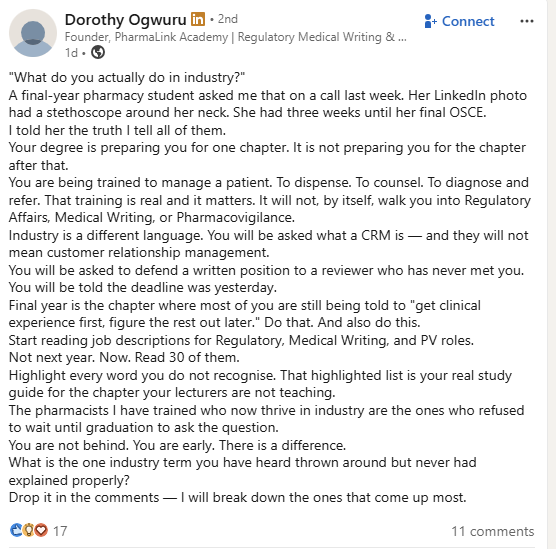
Dorothy Ogwuru gave us an amazing tip in her recent post.
Use the job descriptions to identify the gaps you have.
She says “…Highlight every word you do not recognize. That highlighted list is your real study guide…”
Would you implement her tip in your job search?
Read the full post below!
That is it for this week! :)
Have a great two weeks and see you in the next issue!
Share Beyond Regulation with Ceren: Insights, Career & MedTech
No posts
Comments
Nothing yet. Say the first thing.
Sign in to join the conversation.