
🎧 Beyond the Pass — Operator Podcast (1:44)
How to Calculate your true market break-even point
0:00
-1:44
Prefer reading? The full breakdown is below.
Over the last three posts we’ve taken apart the three things that quietly drain a street food operation. The unpaid prep hours that turn a £960 Saturday into a £180 day. The portion sizes that leak margin the customer never notices. The price bands that punish you for crossing the wrong edge.
This final post pulls them together into the one calculation that decides everything: your true break-even per market day. Not your revenue target. Not your “good day.” The number below which attending a market actively costs you money.
Almost no trader calculates this properly, and it’s the single most important figure in the entire operation. Because once you know it, every decision gets easier. Which markets to keep. Which to drop. Which events to say no to. Whether a rainy Thursday is worth loading the van for. The break-even answers all of them.
Here’s how to calculate it honestly, and why the honest version is so much higher than the one most traders carry in their heads.
Ask a typical street food trader their break-even and you’ll get something like: “I need to cover my pitch fee and my ingredients, so about £150 of sales and I’m fine.”
That number is wrong by a factor of two or three, because it counts only the costs the trader can see on the day. It ignores everything structural, everything amortised, and everything that happens away from the pitch. The result is a break-even that feels achievable and is actually a loss line.
The honest break-even includes nine cost categories. Most traders count two.
Take a single market day and add up every cost it actually carries.
1. Pitch fee. The obvious one. What you pay to be there.
2. Ingredient cost. The food you’ll sell. Include over-prep, spoilage, and the stock you bring and don’t sell. Not just the theoretical cost of sold portions.
3. Variable consumables. Packaging, napkins, gas, sauces, sundries. Per portion, times expected volume. Small per unit, real in aggregate.
4. Vehicle. Fuel and parking, plus mileage costed properly. A 40-mile round trip in a van isn’t free even if the fuel feels like the only cost. Wear, servicing, and depreciation are real.
5. Equipment depreciation. This is the one nobody counts. If your kit cost £4,000 and lasts three years over roughly 200 trading days, that’s £6.67 of kit cost on every single trading day, whether you sell one portion or two hundred. It’s a real cost of being open.
6. Fixed overheads, daily share. Insurance, licensing, food hygiene certification, public liability, any storage or commercial kitchen rental, phone, admin. Add the annual total and divide by your trading days. Every market day carries its share.
7. Unpaid prep labour. Every hour of prep specific to that market, costed at £15/hour minimum. The Friday cook, the sauce, the packdown, the loading. This is usually the single biggest hidden cost and the one traders refuse to count because it doesn’t feel like money leaving their pocket. It is.
8. Service labour. Your own hours on the pitch, also at £15/hour. If you wouldn’t work the day for free for someone else, you can’t work it for free for yourself and call the difference profit.
9. Rain risk. This is the category that separates traders who survive from traders who slowly drown. Some proportion of your market days will be washouts: you load the van, you drive out, you set up, and the weather kills footfall so you take £180 instead of £500. If one day in five is a washout, that risk has to be spread across all your days. A market day that looks profitable in isolation may be subsidising four others that aren’t.
Add all nine. Divide by your average portion price. That’s the number of portions you need to sell on that day just to break even. Not to profit. To not lose money by being there.
In the first post of this series, the brisket trader thought his break-even was around 30 portions. Anything above that felt like a good day.
When we ran the nine costs honestly, his real break-even came out at 62 portions.
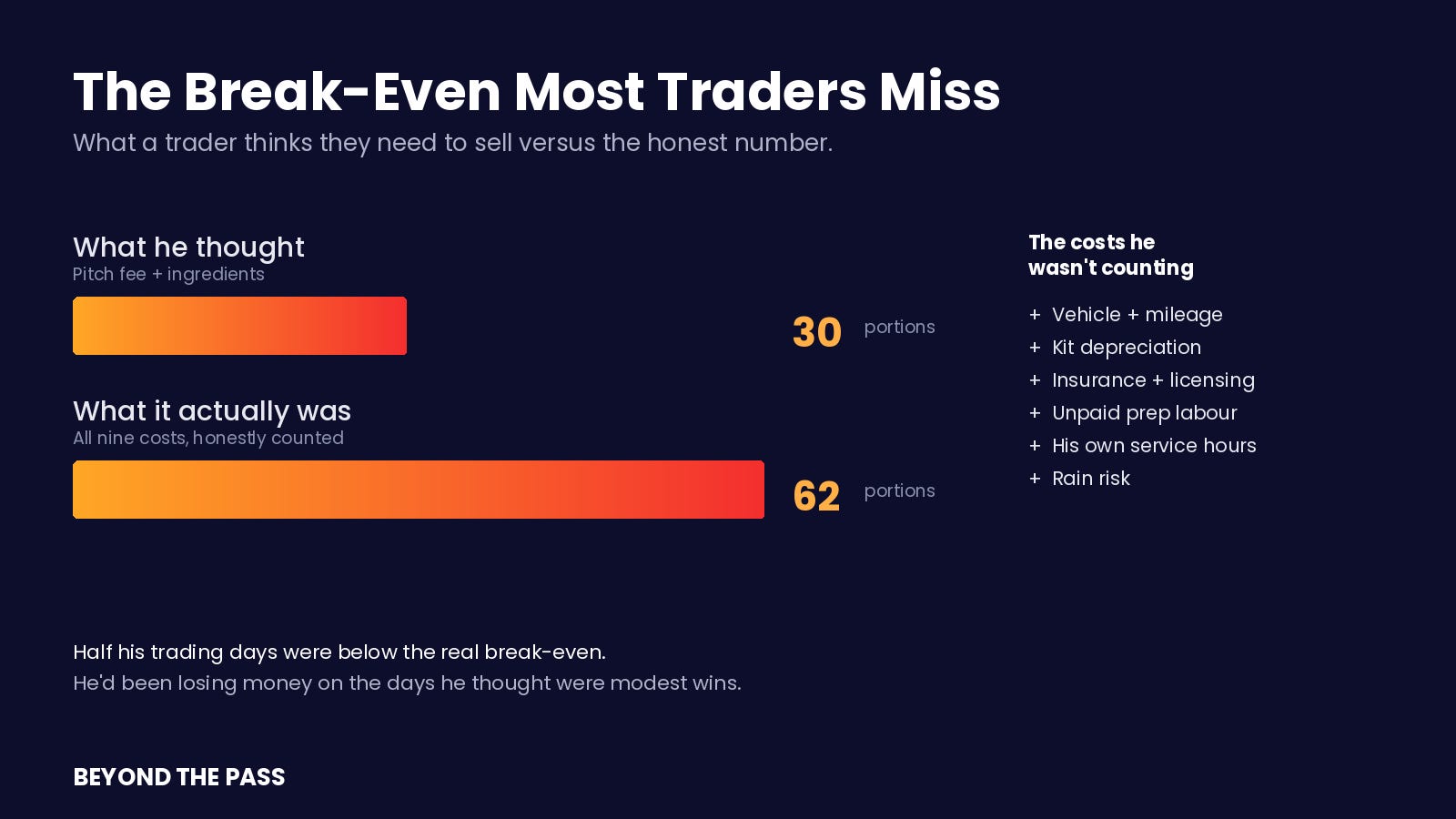
Suddenly two years of confusion made sense. His sold-out Saturdays at 80 portions were genuinely good days, but the £200-250 of real profit was far less than the £700 he imagined. His midweek days at 35 portions, which he’d thought of as modest wins, were losing days. And the rainy Thursdays at 18 portions weren’t disappointing days. They were days he paid for the privilege of attending.
He’d been running at a loss on more than half his trading days and accumulating debt while telling himself the busy Saturdays meant the business worked.
Once you have an honest break-even, two decisions that used to be agonising become obvious.
Which markets to drop. Any market where your average sales sit below your break-even is costing you money to attend. Not underperforming. Costing. The brisket trader’s Tuesday averaged 35 portions against a 62 break-even, which meant every Tuesday he traded, he lost money and called it being busy. Dropping it didn’t reduce his profit. It increased it, because he stopped subsidising a loss-making day with his Saturday earnings.
Which events to say no to. Event organisers love to offer street food traders “great exposure” at festivals and markets with high pitch fees and uncertain footfall. The break-even calculation turns this from a gut decision into a number. If an event has a £400 pitch fee, your break-even on that day might be 90 or 100 portions before you make a penny. If you can’t realistically sell that in the hours available, the event is a loss dressed up as an opportunity, no matter how good the exposure sounds. The brisket trader started asking every organiser for a guaranteed minimum, and walking away from anyone who wouldn’t offer one.
Rain risk deserves its own attention because it’s the cost traders most want to ignore, and the one that quietly kills outdoor operations.
The instinct is to treat a washout as bad luck. A one-off. Something that happened, not something to plan for. But over a season, washouts aren’t random noise, they’re a predictable percentage of your trading days, and they have to be costed in.
The calculation is simple. Over a full season, what fraction of your market days were significantly hit by weather? If it’s one in five, then 20% of your days produce a fraction of normal revenue while carrying close to full cost (you still paid the pitch, still did the prep, still drove out, still depreciated the kit). That loss has to be absorbed by the other four days. Which means your break-even on a good day isn’t really the good day’s costs alone. It’s the good day’s costs plus a share of the washout you’ll have later that month.
Traders who price and plan as though every day will be dry are running a business that only works in a climate they don’t have. Building the rain risk into the break-even is what turns a fragile operation into a durable one.
This is the calculation that ties the whole series together. Twenty to thirty minutes with your invoices, your calendar, and an honest frame of mind.
Step 1. List all nine costs for a single typical market day. Don’t skip depreciation. Don’t skip your own labour. Don’t skip rain risk. The categories you most want to leave out are exactly the ones hiding the loss.
Step 2. Total them and divide by your average portion price. That’s your true break-even in portions.
Step 3. Compare it to your actual average sales, market by market. Every market where your average sits below break-even is a loss-maker. Every one above is genuinely profitable. Most traders find at least one market they’ve been attending out of habit that’s been costing them money the whole time.
When the brisket trader did this across his four markets, two were comfortably profitable, one was marginal, and one (the Tuesday) was a consistent loss. He dropped the Tuesday, renegotiated the marginal one, and put the freed-up day into prep efficiency for the two that worked. Same gross revenue, far better profit, and ten fewer hours of work a week.
Four posts, four ways street food quietly loses money, and one thread connecting all of them: the costs that matter most are the ones you can’t see on the day.
The unpaid prep. The invisible portion margin. The price band you can’t cross. The depreciation, the rain risk, the share of overhead that rides on every market day whether you sell out or get rained off. None of it appears in the simple “pitch fee plus ingredients” maths most traders run, and all of it is the difference between a business and a job that pays below minimum wage.
The traders who last aren’t the ones with the best food or the longest queues. Plenty of brilliant cooks with great products have gone under. The ones who last are the ones who know their real break-even, drop the markets below it, and protect the margin on the days above it.
Run the three numbers from this series. Your prep-to-service ratio, your true break-even, and your real hourly take-home. They take half an hour between them and they’ll tell you, honestly, whether you’re running a business or paying for a hobby.
That’s the diagnosis. Fixing it, dish by dish and market by market, is the work, and it’s exactly what the toolkit is built to do: every calculation from this series, set up to run on your own numbers, so you can find the leaks and close them without doing the maths by hand each time.
But run the numbers first. Even if you never buy a thing, you’ll know where you stand, and knowing where the money goes is the whole game.
That closes the street food series. The free 15-minute diagnostic runs these calculations on your own numbers. The full toolkit is there for traders ready to fix what they find.
Thanks for reading Beyond the Pass! This post is public so feel free to share it.
No posts
Comments
Nothing yet. Say the first thing.
Sign in to join the conversation.