
🎧 Beyond the Pass — Operator Podcast (1:56)
Why nine pounds kills your sells
0:00
-1:56
Prefer reading? The full breakdown is below.
A trader at a market in Manchester. Loaded fries, fully built, the kind of thing that photographs well and sells on impulse. He’d been at £8 for two years and was getting squeezed. Supplier costs up, packaging up, pitch fees up. His margin had quietly eroded to almost nothing.
He did the obvious thing. He moved the price to £9.
Within a month his volume dropped about 25%. Same product, same pitch, same footfall. A single pound on the price and a quarter of his customers stopped buying.
He panicked and moved it back to £8. The volume came back. And he was stuck exactly where he started, squeezed on margin, convinced he simply couldn’t charge more.
He was half right. He couldn’t move from £8 to £9. But not for the reason he thought. The problem wasn’t the pound. It was the band he crossed.
This is the most misunderstood thing in street food pricing, and it costs traders more than almost any other pricing mistake. Customers don’t experience price on a smooth line where £9 is simply “one more than £8.” They experience price in bands, and the bands have hard edges. Cross an edge and demand falls off a cliff. Move within a band and demand barely notices.
Understanding where those edges sit is the difference between a price increase that works and one that costs you a quarter of your customers.
There’s a body of behavioural pricing research, going back decades, on how people process prices in casual purchase contexts. The short version: for low-commitment, impulse-driven purchases, customers don’t evaluate price precisely. They assign it to a mental category, and the category drives the buying decision more than the actual number.
For a single hot item from a street food unit, the categories sit roughly like this:
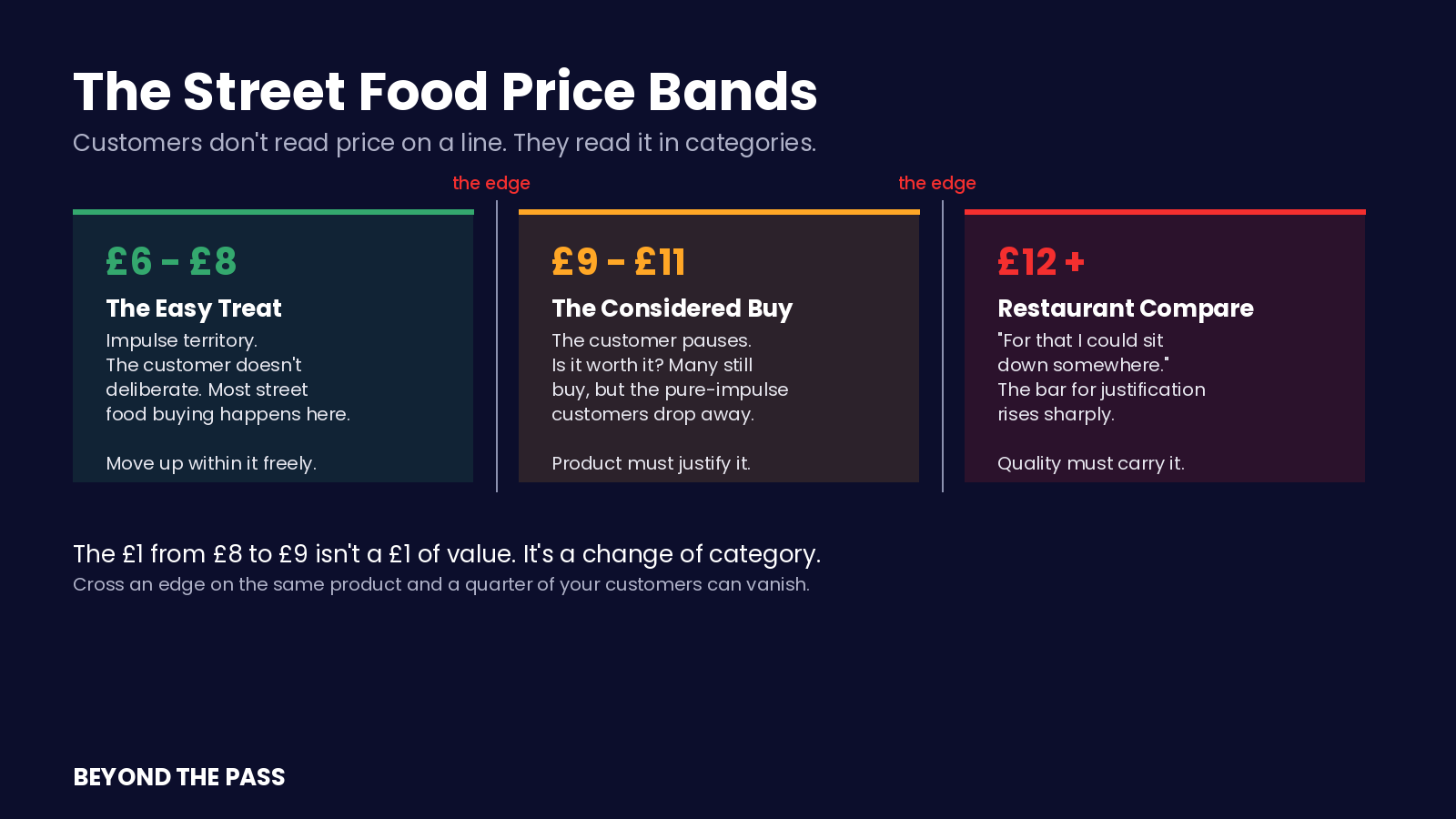
The £6 to £8 band: the easy treat. This is impulse territory. The customer is buying lunch or a treat, the price is low enough that they don’t really deliberate. It feels like a casual, low-stakes purchase. Most street food buying happens here, and the decision is fast.
The £9 to £11 band: the considered purchase. Cross into £9 and something shifts. The purchase stops being automatic and becomes a small decision. The customer pauses, even briefly, and asks themselves whether it’s worth it. Many still buy. But the ones who were buying on pure impulse, the marginal customers, drop away. This is the band where “premium street food” lives, and customers will pay it, but only when the product clearly justifies the step up.
The £12 and up band: restaurant comparison. At £12 and above, the customer starts unconsciously comparing your street food unit to a sit-down meal. “For twelve quid I could get a proper lunch somewhere with a chair.” The bar for justification rises sharply. Product quality, portion, and brand all have to carry more weight.
The Manchester trader’s mistake was moving from £8, near the top of the easy-treat band, to £9, the bottom of the considered-purchase band. He didn’t raise his price by a pound. He moved his product into a category where customers stop and think, and a quarter of them, the pure-impulse buyers, decided not to.
Here’s what trips traders up. They think about price increases in terms of magnitude. “I’m putting it up by a pound, that’s about 12%, customers should accept that.” They reason about it as a percentage and assume the resistance is proportional to the size of the rise.
It isn’t. The resistance is almost entirely about whether the increase crosses a band edge.
Moving from £7 to £8 is a pound, and it usually barely registers, because both prices are inside the easy-treat band. Moving from £8 to £9 is the same pound, and it can cost you a quarter of your volume, because it crosses the edge into considered-purchase territory. The magnitude is identical. The effect is completely different.
This works in your favour as well as against you. If you’re sitting at the bottom of a band, you often have room to move up within it with almost no resistance. A trader at £6.50 can frequently move to £7.50 with negligible volume loss, because both numbers live in the same easy-treat category. The customer doesn’t recategorise the purchase, so they don’t reconsider it.
The skill is knowing where you sit relative to the nearest edge, and pricing accordingly.
He had three real options, and “move to £9 and hope” was the worst of them.
Option one: move up within the band. He was at £8, the top of the easy-treat band. There wasn’t much room left below the £9 edge. But if he’d been at £7, the right move would have been £7.50 or even £7.80, capturing margin without crossing the edge. Always check how much room you have inside your current band before you assume you need to cross out of it.
Option two: hold the price and fix the structure underneath. This is the lever from the last post. He was at the top of his band with no room to move up and a real margin problem. The answer wasn’t a price rise, it was a cost reduction the customer couldn’t see. A slightly smaller portion of the expensive topping, a cheaper but equally good base, a packaging supplier switch. Recover the margin without touching the number that customers use to categorise the purchase.
Option three: if you must cross the band, cross it properly and justify it. Sometimes a trader genuinely needs to move from the easy-treat band into the considered-purchase band. If so, the move can’t be a quiet £1 bump on the same product. Crossing into £9-£11 territory means the customer will now stop and evaluate, so the product has to visibly justify the new category. A better build, a more premium ingredient, a clear upgrade in presentation, something that makes the customer’s pause end in “yes, worth it” rather than “no, too much.” You don’t cross a band edge with the same product. You cross it with a better one.
The Manchester trader took option two. He held the £8 price, switched his fries base to a supplier that cost 30% less for a product his customers couldn’t distinguish, reduced the premium cheese portion slightly, and renegotiated his packaging. His margin recovered to a healthy level. His volume stayed exactly where it was. He never crossed the edge.
Traders often ask about pricing just below an edge. Is £8.50 safe? What about £8.95?
The honest answer is that the edges are fuzzy, not exact, and they vary by location, product type, and customer base. £8.50 at a premium city-centre market with affluent lunch customers behaves differently from £8.50 at a suburban weekend market. The bands are real but their exact position shifts with context.
What’s reliable is the principle, not the precise number. Within roughly a pound, you can usually move without crossing into recategorisation. Push toward and past the psychological round number that starts the next band (£9, £12), and you risk the cliff. The closer you are to an edge, the more carefully you test, ideally one small move at a time, watching volume for two to three weeks before deciding whether it held.
What you should never do is the Manchester trader’s original move: a blind jump across an edge on the same product, then a panic reversal when volume drops. That sequence teaches you nothing except a false belief that you “can’t raise prices,” when the truth is you crossed the wrong edge the wrong way.
Three steps. Twenty minutes with your current prices and a clear head.
Step 1. Map every item to its band. Easy-treat (£6-£8), considered (£9-£11), restaurant-comparison (£12+). Write down where each item currently sits and how close it is to the nearest edge above it.
Step 2. Identify your within-band headroom. For any item sitting in the lower or middle part of a band, you likely have room to move up toward the edge with minimal resistance. An item at £6.50 has room to £7.80. An item at £9 has room toward £10.50. This is the safest margin available to you and most traders never take it.
Step 3. Flag your edge-sitters. Any item sitting right at the top of a band (£7.80, £10.80, £11.50) is a trap. You can’t raise it without crossing the edge, so the only margin move available is structural: reduce cost underneath, hold the price. Don’t cross the edge unless you’re genuinely upgrading the product to justify the new category.
Most traders find they’ve left real money inside their current bands, items priced well below the edge that could move up with almost no volume loss, while also sitting on one or two edge-traps they’ve been trying to solve with price when the answer is cost.
The deeper lesson is that price isn’t a number to a customer. It’s a signal that tells them what kind of purchase they’re making. £8 says “easy treat, buy it without thinking.” £9 says “considered purchase, is it worth it?” The pound between them isn’t a pound of value. It’s a change of category.
Once you see pricing this way, the whole game changes. You stop asking “how much can I charge?” and start asking “what category is this purchase, and where’s the edge?” The traders who understand the bands extract margin their competitors leave on the table, and avoid the cliff their competitors fall off, all while charging prices that feel completely normal to the customer.
The Manchester trader is still at £8. He’s just making proper money at £8 now, which is something he didn’t believe was possible when he was convinced his only option was £9.
Free 15-minute diagnostic that surfaces these numbers for your own operation here.
Thanks for reading Beyond the Pass! This post is public so feel free to share it.
No posts
Comments
Nothing yet. Say the first thing.
Sign in to join the conversation.