
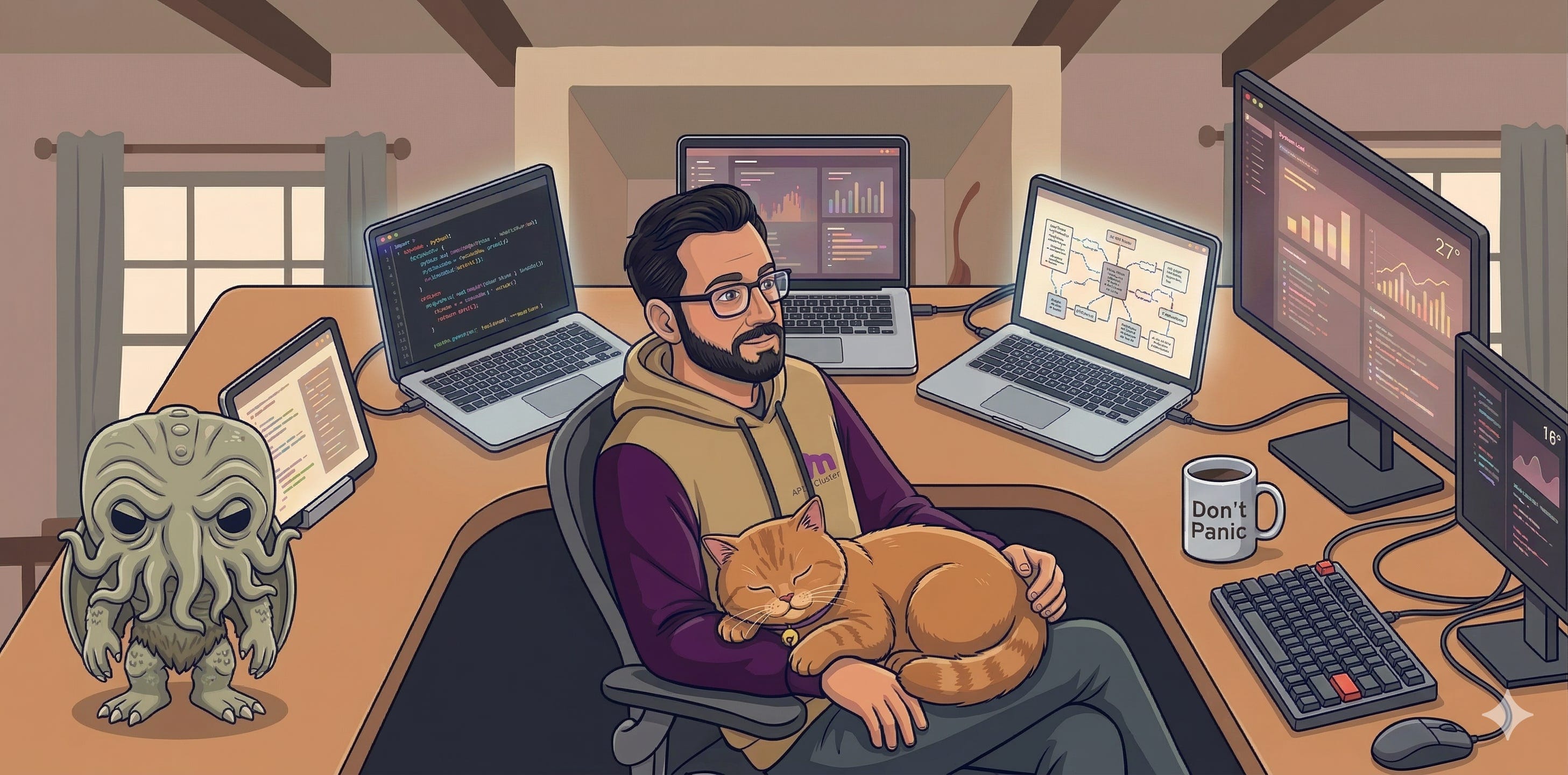
I paused this newsletter for months (well… 1 year actually…).
I told myself it was because I was busy. And I was, genuinely, measurably busy. There were client projects, strategy sessions, late-night Teams threads, and the constant low-grade hum of too many things running in parallel. Writing Beyond The Code didn’t disappear from my list. It just kept getting pushed. Week after week, it sat there, a small accusation at the bottom of my to-do list.
What I didn’t want to admit, not to you and honestly not to myself, was that the reason I couldn’t find time to write wasn’t really about time. It was about a story I’d been telling myself for years. The same story most of us in tech leadership tell ourselves, because it feels like a superpower and it sounds like ambition.
The story is called multitasking. And it’s a myth.
Thanks for reading Beyond The Code: Leadership, Strategy, and Mindset! This post is public so feel free to share it.
The research has been clear for at least two decades. Humans don’t multitask. We task-switch. Every time we jump between contexts, from a strategy document to a message to a code review to a newsletter draft, we pay a cognitive tax. Attention takes time to warm up. Deep thinking requires a runway. And every interruption resets the clock.
I knew this. I’ve read the studies. I’ve cited them in conversations with clients who were proud of their ability to juggle. I’ve nodded along to talks about deep work and flow states and the hidden cost of constant context-switching.
And then I’d close the browser tab and go back to having seven things open at once, convinced that my version of multitasking was different. That experience, or discipline, or sheer will had somehow made me immune to the laws of cognitive physics.
It hadn’t. It never does.
The newsletter paid the price. Not because I didn’t value it, but because in the hierarchy of things that feel urgent, writing a thoughtful weekly letter for people who trust me with their attention kept losing to everything else. This is what the multitasking myth actually costs you: not the things you do badly, but the things you quietly stop doing.
When AI tools became genuinely useful, and I mean genuinely, not in the impressive-demo sense, I did what most people did. I integrated them into my workflow and felt a satisfying speed increase. Drafts got faster. Research got faster. Summarising long documents, generating options, stress-testing ideas: all faster.
I became more productive. I was quietly proud of it.
But here’s what I didn’t notice for an embarrassingly long time: I was using these tools the same way I’d used every tool before them. Sequentially. One thing at a time. Prompt, wait, read, respond, repeat. A smarter typewriter. A faster search engine. A very patient colleague who never complains about the volume of requests.
I was getting more done, but I was still doing one thing at a time. The bottleneck had moved, but it hadn’t disappeared. The bottleneck was still me.
I’ll admit: I had to read about this to notice it. Someone smarter, or at least more observant, had probably figured it out months earlier. But I needed to see it written down before the obvious became visible.
The thing I’d been ignoring is this: AI tools, and I’m talking about the kind of agent-capable sessions most of us now have access to, can run in parallel.
Not metaphorically. Literally. You can open multiple sessions simultaneously, give each one a different task, and let them work while you do something else entirely. Or while you brief the next one.
One session is drafting a competitive analysis. Another is restructuring your team’s onboarding documentation. A third is synthesising three months of customer feedback into a set of strategic themes. None of them are waiting for you. You’re not waiting for them.
This is, if you think about it clearly, as close to real multitasking as most of us will ever get.
And here’s the part that should have been obvious to me immediately, because I spent years managing engineering teams before I moved into strategy: this is just delegation.
When you lead a team, you don’t complete tasks sequentially and hand them off one by one. You brief multiple people, give each one a clear objective, set expectations for output, and then you check in, integrate, and steer. The parallelism isn’t a trick. It’s the whole point of having a team.
The reason I’d never thought to apply the same mental model to AI sessions is that I’d been relating to these tools as tools, not as a working structure. As instruments I operated, not as a system I could architect.
The shift isn’t technical. It’s conceptual. And once you make it, it’s hard to unsee.
This isn’t a productivity hack. Or at least, it shouldn’t be reduced to one.
The more interesting implication is about how we think about AI in our work. Most leaders, myself included until recently, have been asking: “How can AI help me do my tasks faster?” That’s a reasonable first question. But it’s a first question.
The better question is about structure, not speed: how do I position myself at the level of direction and integration, rather than execution? That’s what good managers ask about their teams. It’s what good architects ask about their systems. And it’s what I think we should start asking about AI, not as a speed multiplier, but as a structural shift in how knowledge work gets done.
This is also, incidentally, why I’m writing again. Not because I suddenly found more hours in the day. But because I stopped waiting for a gap in the sequence and started treating this newsletter as one thread in a parallel structure, something that can develop alongside everything else, rather than waiting its turn in a queue that never clears.
The multitasking myth persists because it flatters us. It makes busyness feel like capability. But the leaders I most respect aren’t the ones who do the most things. They’re the ones who’ve learned to think in systems, to set things in motion, create conditions for progress, and integrate results rather than generate them alone.
We have, right now, a genuinely new way to apply that kind of thinking to individual work. Most of us haven’t started yet. I hadn’t, until recently. And the gap between knowing something and actually restructuring how you work around it turns out to be wider than it looks.
If this resonated, forward it to someone who’s been putting off something important because everything else keeps feeling more urgent. They might need to hear this as much as I did.
Comments
Nothing yet. Say the first thing.
Sign in to join the conversation.