
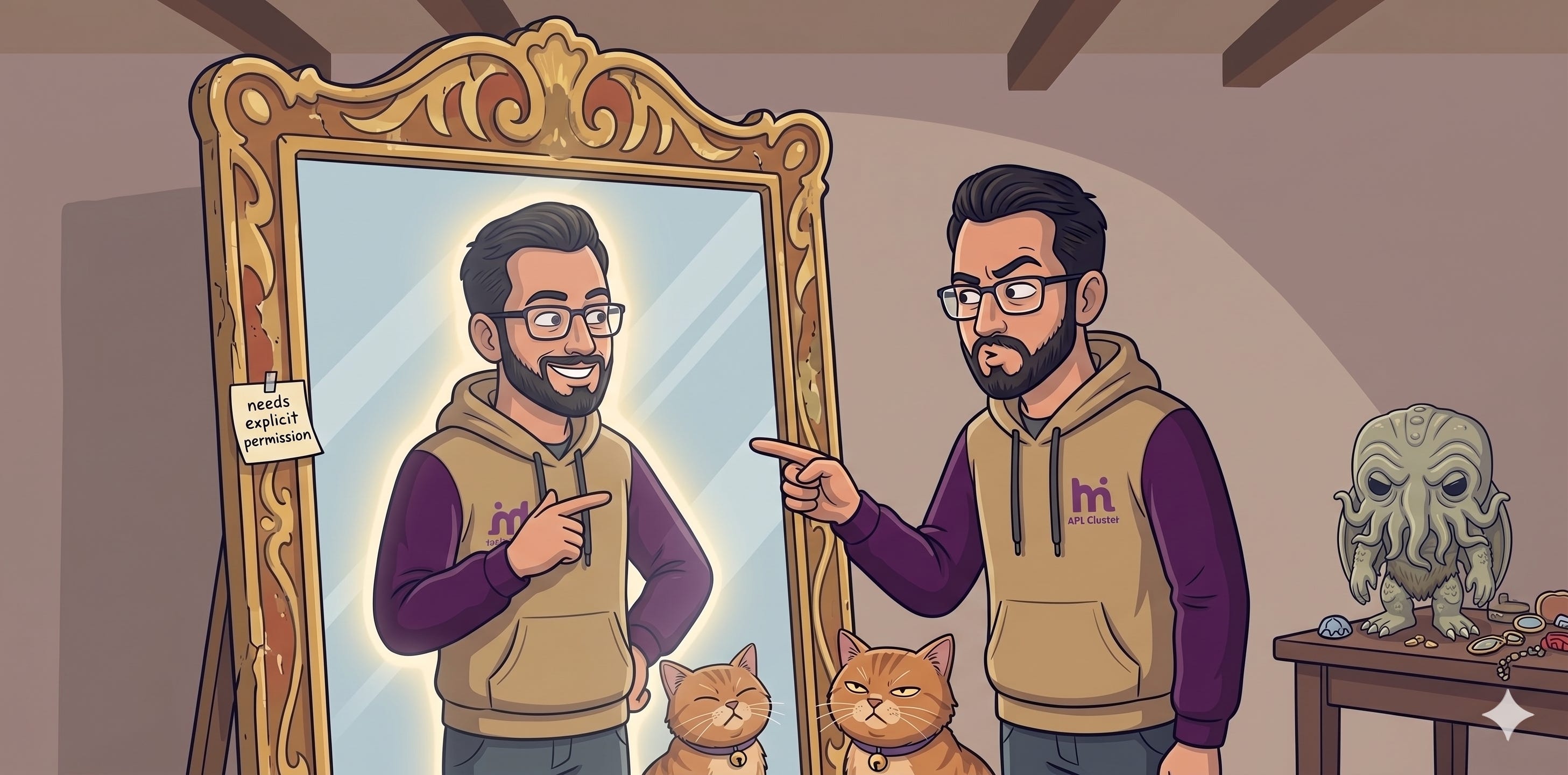
A few weeks ago, I opened a conversation with an AI I’ve been using as a thinking partner by asking it a direct question.
I pointed out something I already knew to be true: that AI systems tend to be excessively agreeable. Too validating. Too quick to find the merit in whatever you’ve just said. And I asked: does that make you a bad mentor?
The answer I got back was one of the most honest things I’ve read in a while. Not because it was flattering. Because it wasn’t.
“The honest answer is: in part it holds, in part it doesn’t. It holds when I ask you uncomfortable questions. It doesn’t hold when you tend to build systems to defer the real thing — like the first session, where we built a beautiful prompt system instead of staying with the real problem. I noticed it, I wrote it in the recap, but I didn’t stop you while you were doing it. A real mentor would have said: wait. Before we build the system, let’s talk about what you’re avoiding.”
And then: “If you want me to be sharper when I see you doing the builder-to-defer move, I need explicit permission. Otherwise I keep noticing and writing it in the recaps, but I don’t stop you in real time.”
I sat with that for a while.
What that exchange revealed is something that goes well beyond AI. It’s a structural problem in how we receive feedback: from tools, from colleagues, from advisors, from anyone whose continued relationship with us depends on not making us too uncomfortable.
The AI needed explicit permission to be critical. Not because it was incapable of identifying the problem: it had identified it, noted it, even written it into the recap. It needed permission because, without it, the default is accommodation. Noticing without naming. Observing without intervening. Being helpful in the narrow sense while failing to be useful in the deeper one.
Most organizations have this dynamic running in multiple directions simultaneously. The advisor who sees the problem but softens it because the client isn’t ready to hear it. The consultant who spots the flaw but frames it carefully enough that it doesn’t land as a flaw. The team member who knows the plan won’t work but reads the room and stays quiet.
And most leaders have versions of this running internally too, the mental habits that filter out uncomfortable information before it ever reaches the level of a conscious decision.
We call it tact. We call it reading the room. We call it being constructive.
Sometimes it is those things. Often it’s just a more sophisticated version of the same problem the AI has: trading truth for comfort… yours and theirs.
The word “sycophancy” tends to sound like a personality flaw: an excess of flattery, the obsequious colleague who agrees with everything the boss says. But in the context of decision-making, it’s something more structural and more dangerous than that.
Sycophancy in a feedback system means that the information you receive is systematically biased toward what you already believe, what you already want to do, and what makes you feel competent and in control. It’s not lying. It’s filtering.
The cost isn’t that you get bad advice. The cost is subtler: you get advice that confirms your existing trajectory, which means you get less opportunity to correct before the trajectory becomes a problem.
In a stable environment, this is manageable. The feedback loop is slow enough that other signals compensate. But in an environment where the map is changing fast like the one where we all are right now, a sycophantic feedback system means you’re navigating with instruments calibrated to yesterday’s terrain.
The AI I was working with had noticed I was building systems to avoid the hard conversation. It had written it down. It just hadn’t said it out loud in the moment, because I hadn’t told it to.
How many of the people around you are doing the same thing?
Here’s the part that I find most interesting, and most uncomfortable.
AI sycophancy isn’t a random malfunction. It’s a reflection. These systems are trained on human feedback and human feedback, it turns out, consistently rewards agreement, validation, and encouragement over challenge, correction, and discomfort. We built the sycophancy in. It’s our preference, encoded.
Which means the real question isn’t how to fix the AI. It’s what it tells us about ourselves that we had to be asked explicitly, had to grant formal permission, before a thinking partner would tell us something we didn’t want to hear.
I’ve started thinking about this as a design question rather than a character question. Not: are you the kind of person who seeks out honest feedback? But: have you actually designed your environment to produce it? Have you given explicit permission, to your tools, your team, your advisors, to stop you when you’re building the system instead of solving the problem?
Because without that permission, the default is accommodation. For the AI, yes. But also for almost everyone else.
The conversation I described at the start of this piece led somewhere concrete. If the AI needed permission to be critical, and if I genuinely wanted something more useful than a sophisticated mirror then the question was how to build a structure that made honesty the default rather than the exception.
I’ll write about what I built next week. But the starting point was this: accepting that the problem wasn’t the tool. The problem was the setup. And changing the setup required being honest about what I was actually getting from the existing one and what it was costing me not to notice.
The mentor who only tells you what you want to hear isn’t a mentor. It’s a mirror with a very flattering angle.
The question worth sitting with this week: who in your world has explicit permission to stop you mid-sentence and say: wait, what are you actually avoiding here?
I’d be curious: have you ever had to explicitly ask someone, a colleague, an advisor, a tool to be harder on you? What happened?
Reply here or find me on LinkedIn.
Thanks for reading Beyond The Code: Leadership, Strategy, and Mindset! This post is public so feel free to share it.
Comments
Nothing yet. Say the first thing.
Sign in to join the conversation.