
💡 It’s rare to see a clinical trial that delivers both spectacular results and solid design.
The phase 3 RC48-C016 study, evaluating disitamab vedotin (DV) plus toripalimab in HER2-expressing advanced urothelial cancer, is one of those uncommon cases.
Not only are the efficacy results extraordinary, but the trial’s methodology withstands careful scrutiny — a combination we seldom encounter in oncology.
RC48-C016 enrolled 484 patients with HER2 IHC ≥ 1+ urothelial carcinoma who had not received prior systemic therapy for metastatic disease.
Participants were randomized 1:1 to receive disitamab vedotin (DV) + toripalimab every two weeks or gemcitabine + platinum (cisplatin or carboplatin) every three weeks.
At the time of study initiation in mid-2022, gemcitabine–platinum chemotherapy was the accepted global standard of care.
The enfortumab vedotin–pembrolizumab combination, now considered the standard of care for first-line treatment, was only approved in December 2023, long after enrollment began.
Moreover, in China, where the trial was conducted, DV + toripalimab was only reimbursed for this indication starting in January 2025, ensuring that patients in the control group did not have off-trial access to the experimental therapy during the study period.
“This was not an outdated control arm — it reflected real-world practice at the time of trial initiation.”
The co-primary endpoints — progression-free survival (PFS) and overall survival (OS) — were both clinically robust and clearly prioritized.
The results were remarkable:
Median PFS nearly doubled (13.1 vs 6.5 months, HR 0.36, P < 0.001).
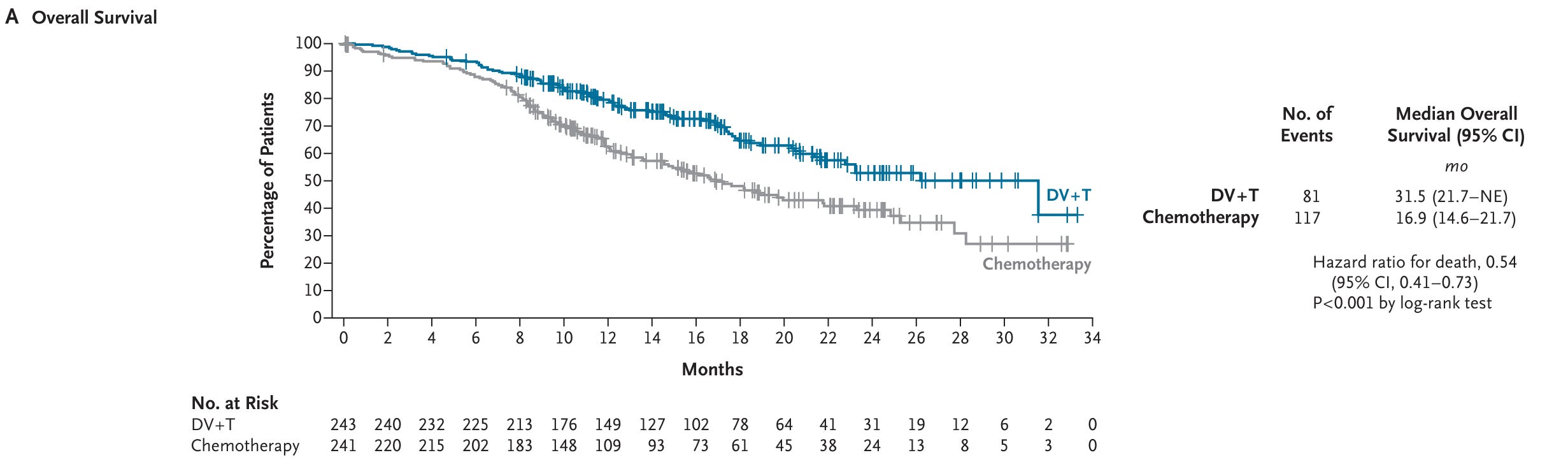
Median OS doubled (31.5 vs 16.9 months).
Benefits were consistent across prespecified subgroups, including patients with low (IHC 1+) HER2 expression.
Such a magnitude of effect is rarely seen in urothelial cancer.
One of the most intriguing aspects of the RC48-C016 data is the pattern of early censoring in the PFS curves.
Visual inspection suggests a higher rate of censoring in the chemotherapy arm, particularly during the first few months of treatment.
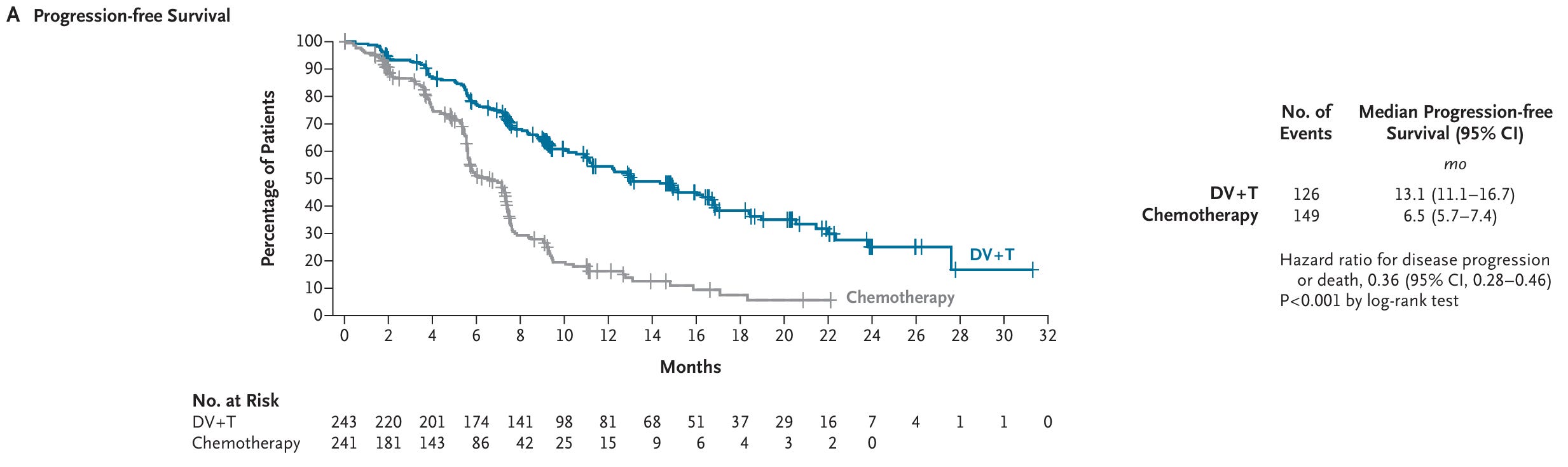
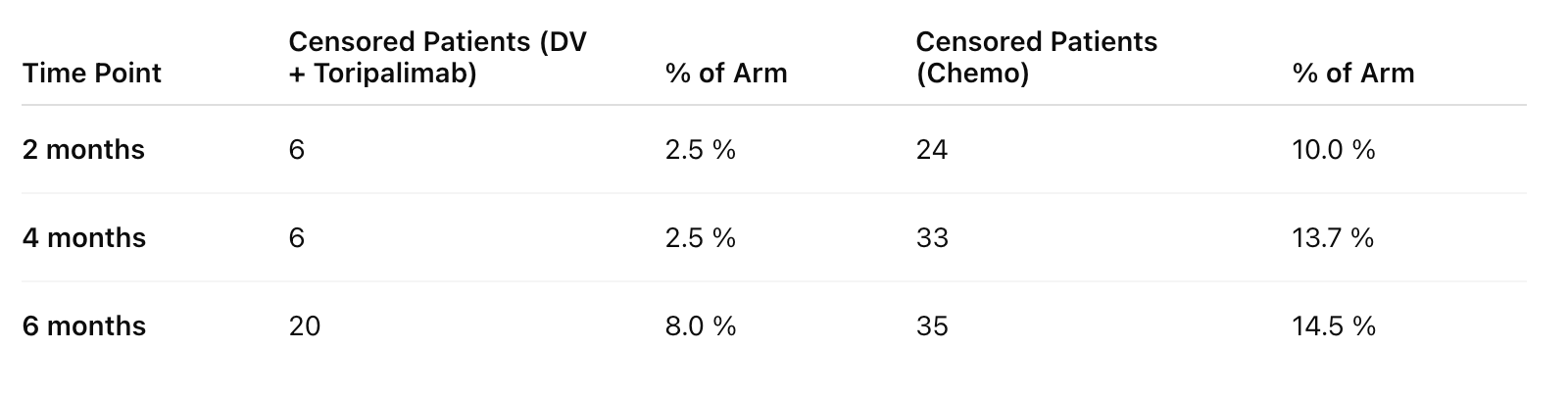
Estimated visually from Kaplan–Meier curves.
Two explanations are possible — and both are reasonable.
1️⃣ Toxicity-driven censoring.
The first hypothesis is that more patients in the control arm discontinued chemotherapy early due to toxicity.
Those censored early tend to be frailer, meaning the remaining at-risk group is biased toward fitter patients.
This dynamic would actually underestimate the true PFS benefit of DV + toripalimab — since censored, more vulnerable control-arm patients would likely have progressed earlier had they stayed on treatment.
2️⃣ Disappointment-driven withdrawal.
A second, equally plausible explanation is patient disappointment.
Because the study was open-label, some patients randomized to chemotherapy may have left early, hoping to find immunotherapy elsewhere.
Such non-random withdrawal could inflate censoring rates in the control arm — but its effect on PFS would move in the opposite direction compared to toxicity-driven censoring.
If disappointed patients left early, the control arm would disproportionately retain frailer patients with fewer treatment options, while the fitter, more motivated ones sought treatment elsewhere.
This would tend to worsen the apparent PFS in the control arm, rather than underestimate the benefit of the experimental combination.
Both mechanisms are plausible.
Yet, given the trial’s setting, broad access to immunotherapy outside the study was limited — enfortumab vedotin was not available in China during the trial, and DV + toripalimab was not reimbursed until 2025.
While some well-resourced patients might have sought private treatment, the majority would still have had access only to chemotherapy.
Another subtle but important detail lies in post-progression care.
Only 77% of patients in the control arm who progressed on chemotherapy received subsequent immunotherapy — surprisingly low in a study testing an immune-based regimen.
Given that all participants were fit enough for inclusion, this figure suggests real-world limitations in treatment access.
Access was also relatively modest in the experimental arm, reflecting broader constraints in availability and reimbursement.
Such limitations can amplify overall survival differences between treatment arms: when few patients receive effective therapy after progression, the group with longer PFS — here, DV + toripalimab — naturally enjoys a greater OS advantage.
Roughly one in five patients had HER2 IHC 1+ tumors, yet they appeared to benefit as much as those with higher expression.
This raises the question of whether DV + toripalimab acts strictly as a HER2-targeted regimen, or whether it represents a broader synergy between the antibody–drug conjugate and immune checkpoint blockade.
The main limitation of the trial is its limited global applicability.
All patients were enrolled in China, where access to subsequent therapies and health system structures differ from Western practice.
Until multinational validation is available, the global generalizability of these results remains to be established.
Despite these nuances, RC48-C016 remains an example of solid trial conduct.
The control arm was appropriate, the endpoints were meaningful, the design was ethically sound, and post-protocol therapy was clearly reported.
The magnitude of benefit is extraordinary, yet the results remain methodologically credible — a balance that’s increasingly rare in oncology trials.
The RC48-C016 trial of disitamab vedotin plus toripalimab achieves what few studies manage:
truly impressive efficacy supported by a design that earns confidence rather than skepticism.
The discussion around censoring and post-progression therapy shows how even robust trials are influenced by patient behavior, system constraints, and access.
Replication in multinational cohorts will tell us how far these findings reach.
For now, RC48-C016 sets a new benchmark for both clinical impact and trial design integrity in urothelial cancer.
No posts
Comments
Nothing yet. Say the first thing.
Sign in to join the conversation.