
This study appeared almost silently in The Lancet, with surprisingly little noise on X/Twitter or at the latest European oncology meetings. No viral threads. No panel debates. No “biopsy revolution” headlines. But it deserves them. Because, despite the quiet release, the design is strong, the question is clinically relevant, and the conclusions are both easy to interpret and potentially practice-changing.
What SEXTANT-PRO asks is simple:
In the MRI era, do we still need 12 systematic cores — or can we safely do less?
The SEXTANT-PRO trial is a single-center, prospective, non-inferiority randomized controlled trial comparing MRI-Targeted Biopsy (TB) plus 6-core systematic biopsy (SB) (TB + 6SB) versus classical TB plus 12-core systematic biopsy (TB + 12SB) in biopsy-naïve men with a single MRI-visible lesion (PI-RADS ≥3). The primary endpoint was the detection of clinically significant prostate cancer (csPCa).
csPCa detection was 54.3% (TB + 6SB) vs 54.8% (TB + 12SB) — virtually identical.
RD (rate difference) = –0.5%, with a 95% CI: –9.2% to +8.3% → comfortably above the non-inferiority threshold, I will come back on this point below.
Procedure time, number of cores, cost, pain, and complication burden were all lower in the 6-core strategy.
Crucially, there was minimal upgrading, and underdiagnosis of csPCa was rare in both groups, supporting oncological safety when reducing systematic cores — but only in MRI-positive patients.
In a non-inferiority trial, the investigators must predefine a non-inferiority margin — this margin represents the maximum acceptable difference by which the new strategy can perform worse than the standard, while still being considered clinically acceptable.
This is crucial:
A trial may be statistically positive for non-inferiority, but still clinically unacceptable if the margin is set too wide.
In other words, the margin reflects judgment rather than pure statistics. If authors allow a very broad margin (e.g., –20%), the trial might technically prove “non-inferiority,” yet the new strategy could still be substantially worse in clinical practice. Therefore, the choice of margin must be scientifically justified and clinically defensible before the trial begins.
The non-inferiority approach is well-suited here — the study asks a pragmatic question:
“Can we safely do less without compromising detection of clinically significant disease?”
In such settings, proving non-inferiority is powerful, because once you show that reduced sampling does not harm detection, every subsequent endpoint naturally favors the less-invasive strategy (time, cost, pain, workflow, histopathology load, etc.).
The rate difference (RD) represents the absolute difference in csPCa detection between the two groups (TB + 6SB minus TB + 12SB). A 95% confidence interval (CI) was calculated around this RD; non-inferiority was established when the lower bound of this CI remained above –15%, indicating that—even in the worst-case statistical scenario—the 6-core approach is not more than 15% inferior to the standard 12-core scheme.
RD reflects the absolute difference in csPCa detection between groups.
The chosen non-inferiority margin of –15% is arguably high, but since the lower CI bound was only –9.2%, the result remains statistically solid and clinically acceptable.
Therefore, the study convincingly shows that less can be safely considered enough in MRI-visible disease.
Across secondary outcomes, the 6-core approach consistently outperformed the 12-core scheme:
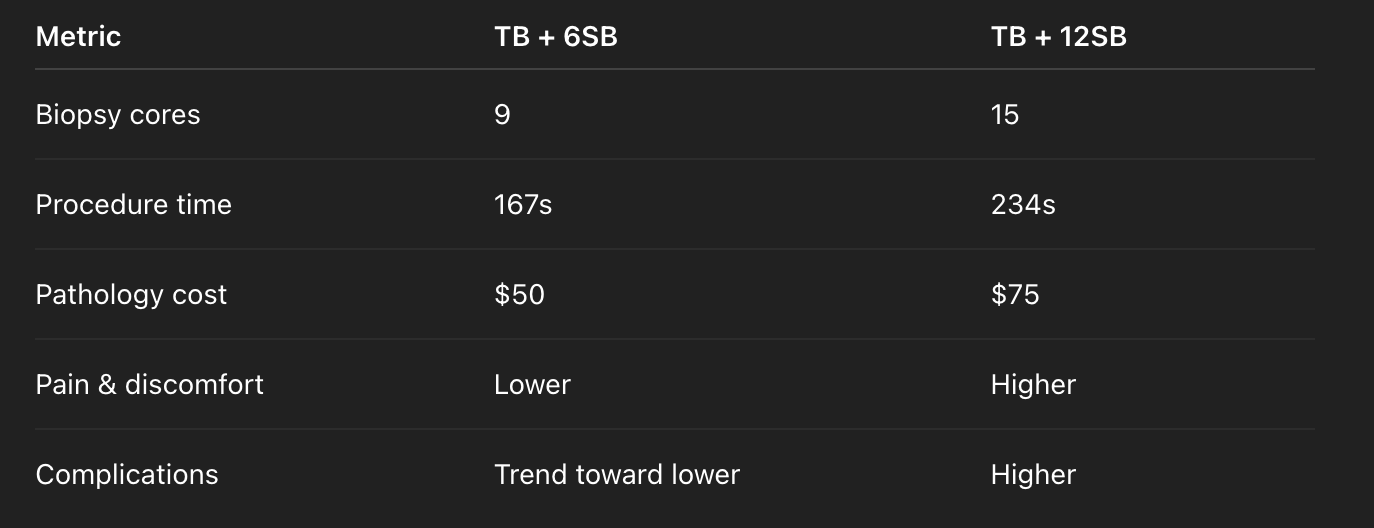
Thus, non-inferiority in oncologic yield, but superiority in procedural metrics. This aligns with the principle:
Once safety is proven, efficiency becomes the new benchmark.
A key anxiety when reducing systematic cores is the risk of missing clinically significant lesions or under-grading tumors. This is addressed in the following table, which I edited to make it clearer:
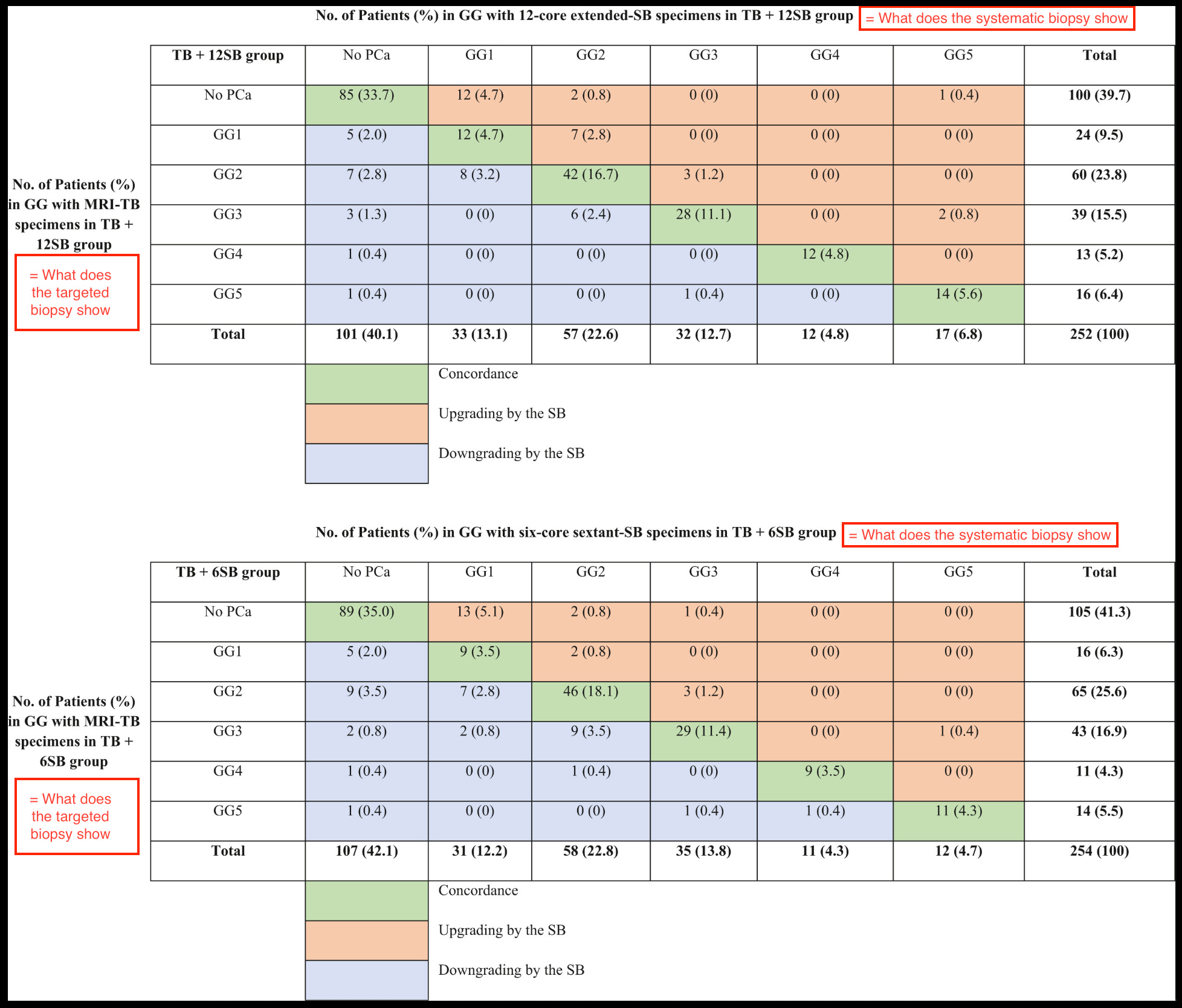
This table compares the Grade Group (GG) from MRI-targeted biopsy (x-axis) with the final GG after adding systematic biopsy (y-axis).
X-axis (columns):
→ Grade Group from MRI-targeted biopsy alone (MRI-TB)
→ Shows what we would have concluded if no systematic cores were added.Y-axis (rows):
→ Grade Group after combining MRI-TB + systematic biopsy (SB)
→ Represents the final biopsy result used to guide treatment.
So every cell in the grid shows how many patients were reclassified after adding systematic cores — either upgraded, downgraded, or unchanged.
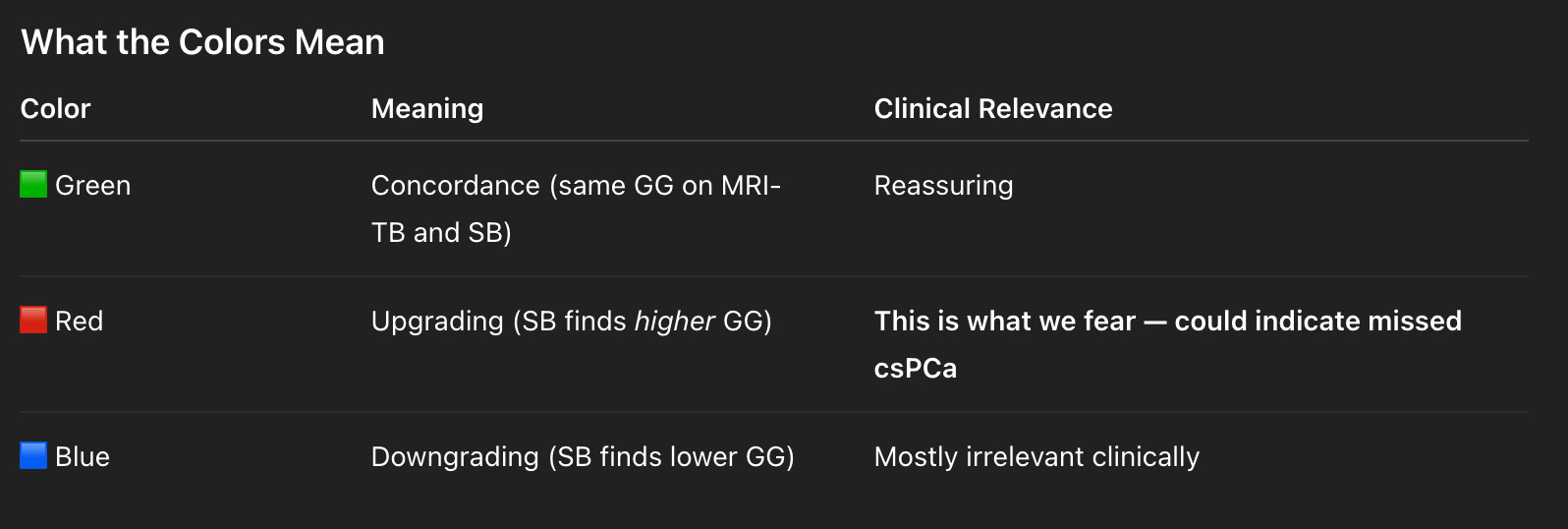
A red cell means:
The MRI-targeted biopsy alone underestimated the tumor — and systematic sampling corrected it.
This reflects potential underdiagnosis — and is the key reason people are reluctant to reduce SB cores. But in this trial, that risk did not increase when reducing from 12 to 6 cores.
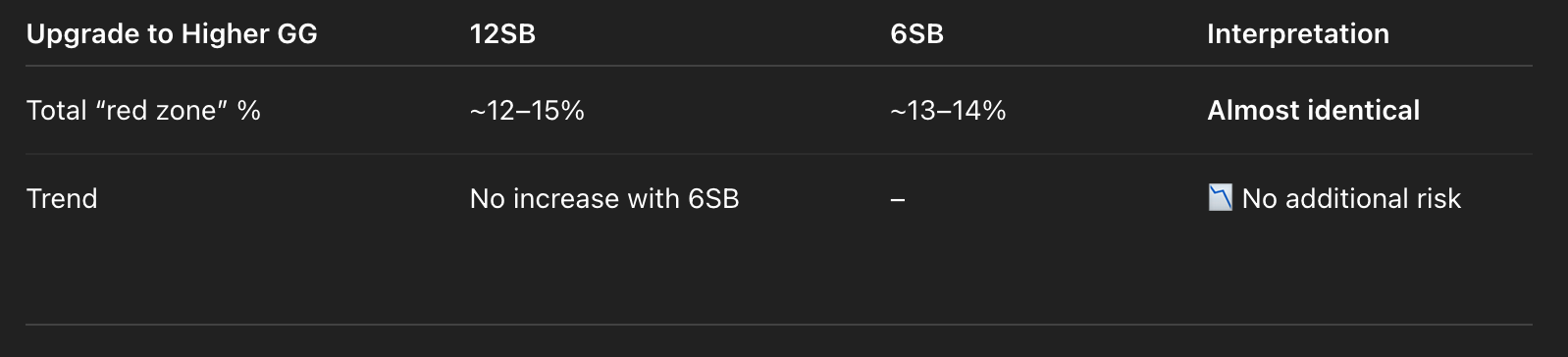
Blue zones represent downgrades — SB finds a lower grade than MRI-TB.
But in modern practice, this does not influence treatment, because:
The highest Grade Group determines management — not the lowest.
This means downgraded cores have little to no clinical weight in MDTs, treatment planning, or risk stratification.
For MRI-positive patients with a single lesion, routine use of 12-core systematic sampling may no longer be required. The 6-core strategy did not compromise detection of clinically significant prostate cancer and did not increase clinically meaningful upgrading. These results support a simplified biopsy pathway where MRI guides targeting and systematic sampling are scaled down, rather than discarded.
Once oncologic safety is preserved, the advantages of core reduction become clear:
Shorter procedure time
Less discomfort and anxiety for the patient
Lower complication risk (bleeding, pain, urinary symptoms)
Reduced pathology workload and cost
More streamlined workflow in busy biopsy clinics
The evidence does not yet support reducing systematic cores in MRI-negative men.
But for MRI-visible disease, less is more.
No posts
Comments
Nothing yet. Say the first thing.
Sign in to join the conversation.