
The CAPItello-281 trial investigated whether adding the AKT inhibitor capivasertib to abiraterone + ADT (Androgen Deprivation Therapy) improves outcomes in men with PTEN-deficient metastatic hormone-sensitive prostate cancer (mHSPC).
PTEN loss occurs in roughly a quarter of advanced prostate cancers and is associated with more aggressive biology.
The pathophysiological rationale is straightforward: PTEN loss activates the PI3K/AKT pathway, potentially allowing tumors to grow independently from AR pathway inhibition. If both pathways are blocked simultaneously, perhaps disease progression could be delayed.
The trial was a large, global, double-blind, randomized phase III study. PTEN deficiency was centrally defined using an immunohistochemistry cutoff of ≥90% absence of cytoplasmic PTEN staining. Patients were randomized to
Thanks for reading Beyond The Abstract: Urology! Subscribe for free to receive new posts and support my work.
Capivasertib + abiraterone + prednisone + ADT or
Placebo + abiraterone + prednisone + ADT
Crossover was not allowed, as Capivasertib has not demonstrated clinical benefit in the later-line setting.
The primary endpoint was investigator-assessed radiographic progression-free survival (rPFS), and overall survival (OS) was a key secondary endpoint.
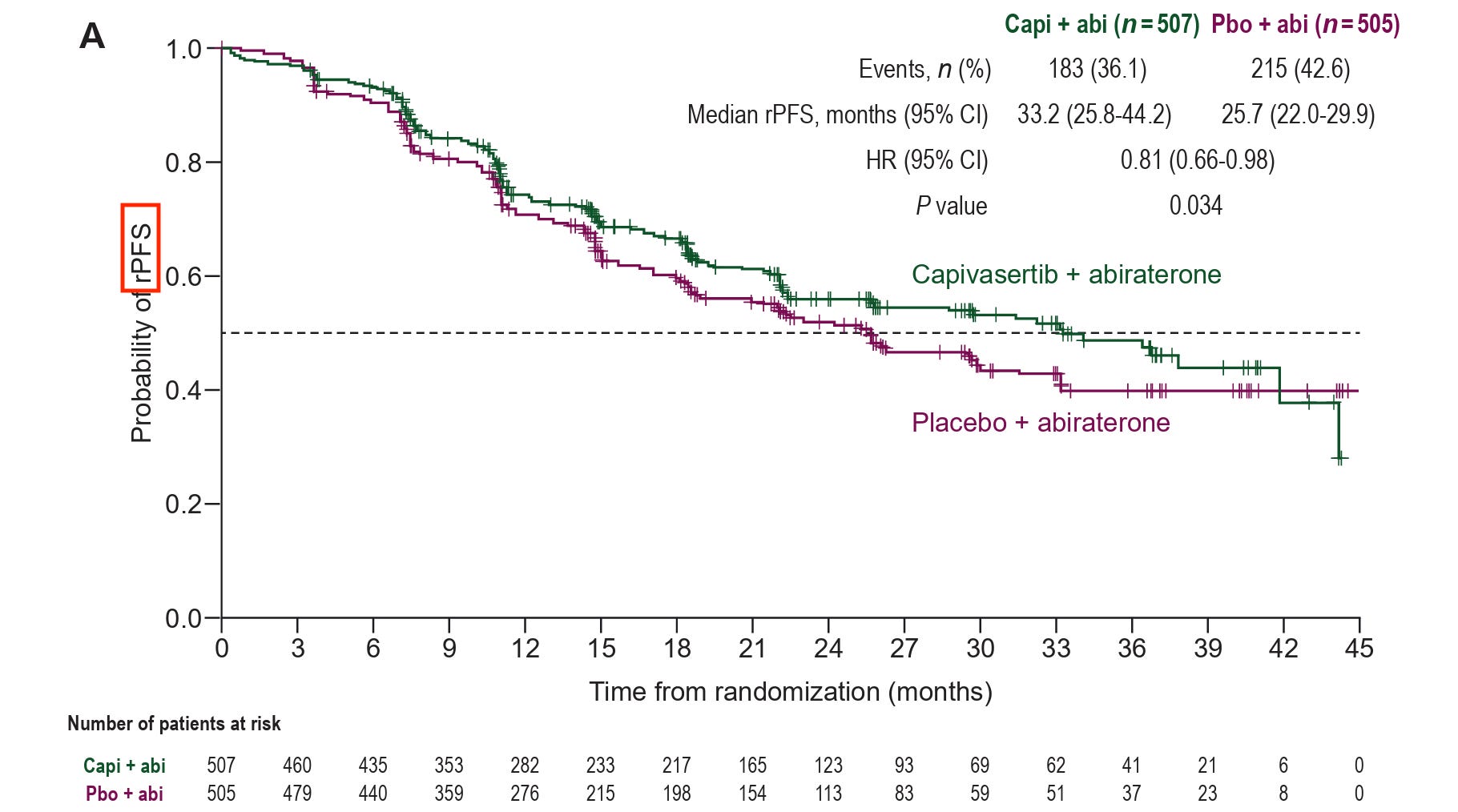
At the primary analysis, rPFS favored capivasertib:
median 33.2 vs 25.7 months, HR 0.81, 95% CI 0.66–0.98, p = 0.034.
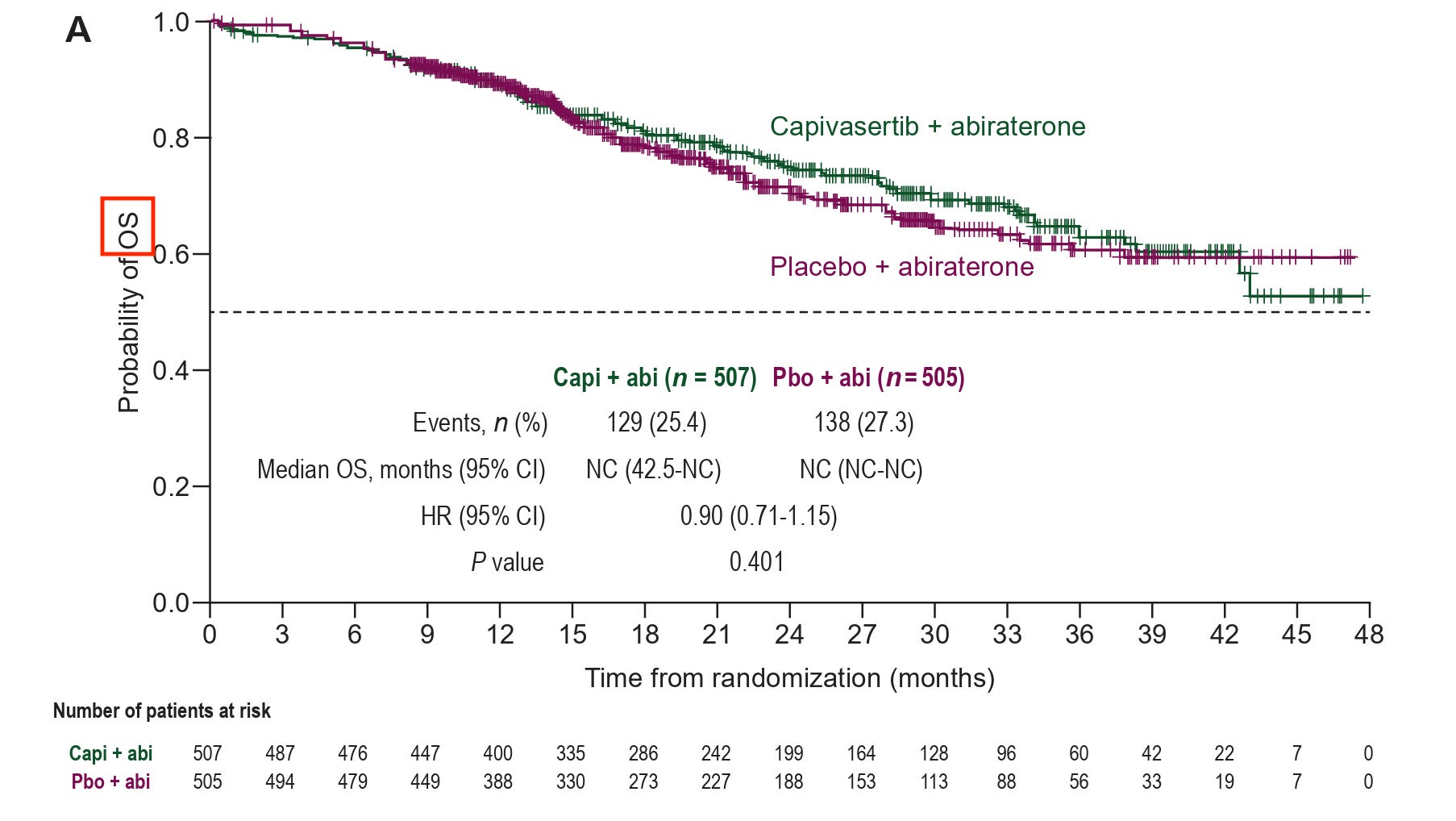
Interim OS analyses, however, showed no statistically significant benefit (HR 0.90, 95% CI 0.71-1.15, p = 0.401).
At face value, this appears promising. Yet a closer look reveals a picture that is far from practice-changing.
A fragile PFS result, much smaller than the trial anticipated
The reported hazard ratio (HR) for rPFS was 0.81, with a 95% confidence interval of 0.66–0.98. The effect size is substantially smaller than the expected HR=0.70, for which the study was powered, and statistical significance is achieved only because the upper boundary of the confidence interval (0.98) narrowly excludes 1.0. This is a fragile result and far from the robust effect the trial design anticipated.
Put simply:
The trial shows statistical significance only because the CI barely excludes 1.0.
The effect size is modest, smaller than expected, and nowhere near the magnitude needed to justify widespread upfront use.
Complicating interpretation, the control arm performed unusually poorly: median rPFS with abiraterone was 25.7 months here, compared with 33 months in LATITUDE’s unselected high-risk population. The authors acknowledge this discrepancy. Whether this reflects differences in patient biology, regional variations, imaging frequency, or other factors is unclear.
What we can say is that if the control arm had performed better, as in LATITUDE, there might not have been a PFS benefit at all.
Toxicity that will matter enormously in real practice
Capivasertib’s toxicity profile is significant, particularly considering this is a front-line therapy for otherwise treatment-naïve patients.
Diarrhea in 51.9% of patients
14% grade ≥2, meaning 4–6 additional stools per day
31% grade 1, still requiring treatment and affecting daily life
Hyperglycemia in 38%, including cases of diabetic ketoacidosis (one fatal)
Rash in 35%, with 12% grade ≥3
These toxicities occurred early and often, leading to high rates of dose interruptions (62.8%) and treatment discontinuations (18.3%).
And these numbers come from a carefully selected population where the majority of patients were ECOG 0. In real-world settings, where ECOG 2 patients are common, tolerability will almost certainly be worse.
PTEN loss as a biomarker: not ready for prime-time
The trial explored stricter PTEN cutoffs (≥95%, ≥99%, 100%). Hazard ratios were numerically more favorable at higher cutoffs; however, the difference is modest to say the least:
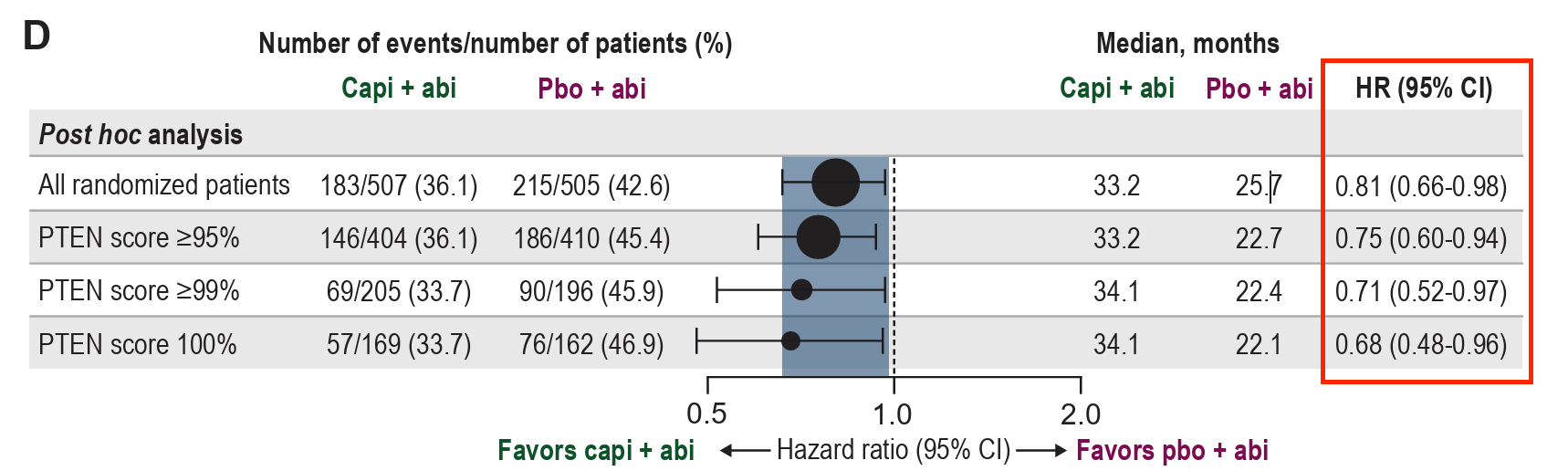
Forest plot of rPFS for each subgroup, HR goes from 0,75 to 0,68 with increasing PTEN score
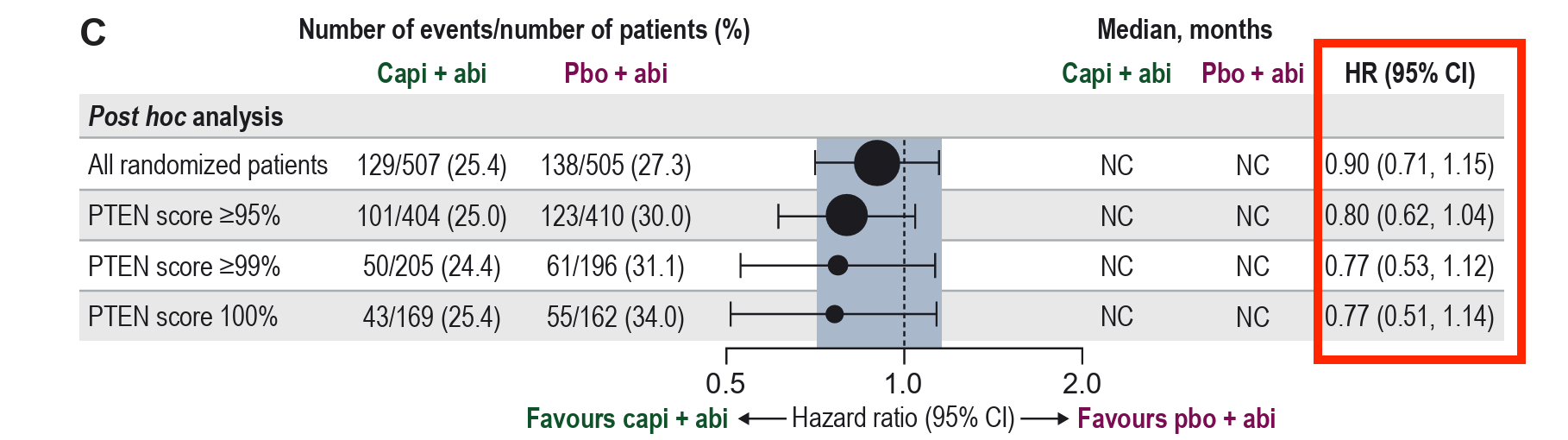
For OS, the picture is even clearer: no subgroup shows a significant effect, and hazard ratios are nearly identical across PTEN thresholds.
Censoring: the missing data that could explain the entire PFS result
The trial does not report censoring distributions for rPFS:
no cumulative censoring curves,
no breakdown of reasons for censoring,
no timing of censoring,
no sensitivity analyses.
This is a critical omission. When an experimental arm has substantial early toxicity—leading to treatment withdrawal and potential early censoring—and the control arm has minimal toxicity, the risk of informative censoring becomes real (patients who experience no side effects might expect they are on a placebo). This is especially suspicious because of the >50% risk of diarrhea when treated with Capivasertib.
At the same time, placebo recipients who experience very few side effects may suspect they are on a placebo and withdraw early to receive another ARPI outside the trial (“disappointment censoring”).
Reason for this? If they don’t get the potential benefit from the interventional drug, they might opt for an ARPI (enzalutamide or apalutamide) that lacks the need for concomitant prednisone use.
This combination can produce exactly the pattern seen here:
a modest PFS advantage,
no OS benefit,
curves that nearly overlap,
and wide uncertainty around the clinical relevance.
If the sponsor ever seeks reimbursement based solely on PFS, full censoring transparency will be essential when we use this drug in the upfront setting.
Post-progression therapy: another gap undermining OS interpretation
The publication provides no information on what therapies patients received after progression. In a global mHSPC study spanning 32 countries with uneven access to established mCRPC therapies, this omission makes the OS result impossible to contextualize.
Without knowing:
who received docetaxel,
who received second-line ARPIs,
who received cabazitaxel, PARP inhibitors, radioligand therapy,
how sequencing differed across arms,
…we cannot determine whether survival equality reflects a true lack of benefit or imbalances in downstream treatment.
A cost profile that is completely out of proportion to the benefit
Capivasertib is extraordinarily expensive:
UK: £5,850 per month (~£70,000/year)
Belgium: €6,890 per month (~€82,680/year)
Given modest PFS benefit, no confirmed OS improvement, significant toxicity, and unclear long-term benefit, there is no economic justification.
Ethical considerations: testing first-line without late-line evidence
One feature of the trial was the absence of cross-over, which is methodologically sound because Capivasertib has not yet proven a benefit in a later-line prostate cancer setting. Although the lack of a crossover design is ethically correct, the immediate implementation in the first-line setting may be questioned.
Instead of proving benefit where patients have exhausted established therapies, the drug was moved directly into first-line mHSPC, one of the healthiest, longest-surviving prostate cancer populations.
This reverses the usual ethical progression of oncology drug development, where new agents are vetted in later lines before exposing large, fit populations to toxicity and cost.
All of this is based on the observation that blocking the androgen receptor might enhance PI3K/AKT pathway activity through crosstalk, thereby increasing reliance on this AKT-driven proliferative mechanism.
Conclusion: not a game changer at all
CAPItello-281 reports a statistically significant but clinically modest PFS effect, achieved with a fragile confidence interval and an unexpectedly weak control arm. It shows no OS benefit, has substantial toxicity, lacks censoring or post-progression data, and relies on a biomarker that appears more prognostic than predictive. Its first-line positioning is difficult to justify, its cost is extremely high, and its real-world tolerability is uncertain.
If the final OS analysis remains negative, capivasertib should not be used in the upfront setting. The modest rPFS benefit does not outweigh the toxicity, financial burden, and methodological gaps. At present, nothing in CAPItello-281 supports capivasertib as a meaningful addition to first-line therapy for PTEN-deficient mHSPC.
Thanks for reading Beyond The Abstract: Urology! Subscribe for free to receive new posts and support my work.
Comments
Nothing yet. Say the first thing.
Sign in to join the conversation.