
Introduction
The recent publication of the 23-year results of the European Study of Prostate Cancer Screening (ERSPC) has generated distinctly divided reactions. Some interpret the findings as confirmation that PSA-based screening has lost its purpose; others view the results more favorably.
In this piece, I aim to put the ERSPC data into proper context and highlight how the urological community has already evolved its practice to improve outcomes.
Trial Overview
The ERSPC was launched in 1993 to assess whether population-based PSA screening reduces prostate cancer mortality. Men aged 50–74 were randomized to either PSA screening or no screening invitation. In most centers, a PSA ≥3 ng/mL triggered transrectal ultrasound-guided biopsy. The primary endpoint was prostate cancer–specific mortality; secondary endpoints included incidence.
Thanks for reading Beyond The Abstract: Urology! Subscribe for free to receive new posts and support my work.
A total of 162,236 men in a pre-specified core age group (55–69 at randomization) were included: 72,888 in the screening arm and 89,348 in the control arm.
Key Results (Core Age Group)
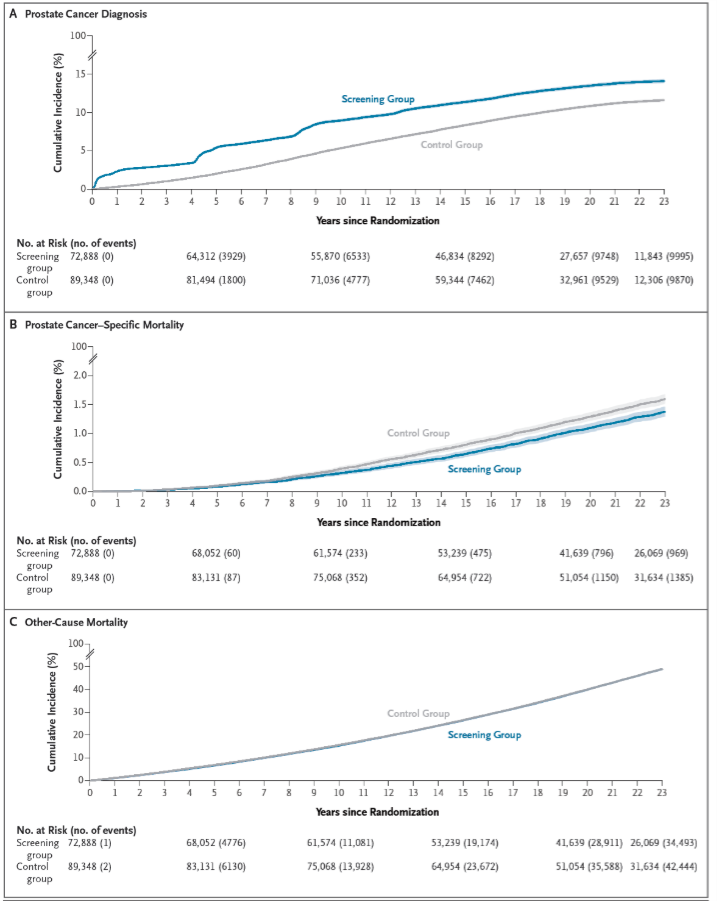
Incidence of prostate cancer
14% (screening)
12% (control)
Prostate cancer mortality
1.4% (screening)
1.6% (control)
→ Risk ratio: 0.87 (13% relative risk reduction in the screening group)
Absolute risk reduction: 0.22%
Number needed to invite: 456
Number needed to diagnose: 12
→ To prevent one prostate cancer death
Interpreting the Data
At face value, an absolute mortality reduction of 0.22% over 23 years is underwhelming. For a random man aged 55–69, PSA screening reduces the risk of prostate cancer death by just 0.22 percentage points. Even among men diagnosed via screening, the benefit translates to only a 13% relative reduction in prostate cancer mortality.
As Vinay Prasad would say, if you can fit your laser pointer between the curves, you can give the plenary session. One would need a very small laser pointer and an extremely steady hand to get on the podium...
Viewed this way, the results seem discouraging—almost humiliating for practicing urologists.
But this interpretation is incomplete. These data require context, and fortunately, plenty is available.
Contextualizing the ERSPC
The trial design was intentionally simple:
Invite men to have a PSA test;
biopsy if PSA exceeds a pre-defined threshold;
diagnose and treat accordingly.
This reflects a classic model of population screening: a cheap, minimally invasive test that flags those needing further work. However, such simplicity comes with major limitations—especially the risks of overdiagnosis and overtreatment.
Luckily, much has changed since 1993.
1. Contamination of the Control Arm
In the ERSPC, 83% of the screening arm underwent at least one PSA test—a reasonable participation rate compared with mammography-based screening in breast cancer.
However, if we really want to isolate the effect of a screening test, we need to ensure the test is not performed on the control group. And in the case of ERSPC (as in another prostate-cancer screening trial), the assumption that the control group received no screening does not hold. This kind of opportunistic screening in the control group is what we call contamination, and it was high:
Sweden: up to 50%
Finland: 63%
Spain: 66%
If half of the control group underwent PSA screening anyway, interpreting the trial as “screening vs. no screening” becomes impossible. This inevitably obscures the true effect size.
2. PSA Alone Is No Longer the Gatekeeper
In the ERSPC, a PSA ≥3 ng/mL led directly to biopsy.
This fast-track pathway is outdated, prone to overdiagnosis, and no longer reflective of real practice. Today, PSA is contextualized.
PSA density
PSA must be interpreted relative to prostate volume: we know that the bigger the prostate, the higher the PSA can be. PSA density reduces unnecessary biopsy referrals and improves risk stratification. This alone significantly reduces overdiagnosis.
Clinical examination
The ERSPC did not incorporate digital rectal examination (DRE) by a trained urologist. A low PSA density and negative DRE provide strong reassurance that biopsy is unnecessary.
Confirmatory PSA
Current guidelines recommend repeat PSA testing to confirm an elevated PSA; the ERSPC did not.
MRI before biopsy
This is the biggest step forward.
Prostate MRI has a sensitivity of ~91% for clinically significant disease. In other words, with its high negative predictive value, a negative MRI is a very reliable tool to avoid biopsy.
MRI also allows targeted biopsy rather than systematic sampling—further minimizing overdiagnosis of low-risk disease.
Together, PSA density, repeat testing, DRE, and MRI have reshaped prostate cancer diagnostics, and none of these refinements are represented in ERSPC.
3. Safer Biopsy Techniques
In ERSPC, all biopsies were performed using a transrectal approach, which necessitated antibiotic exposure and, despite prophylaxis, posed meaningful risks of infection and sepsis. The shift to transperineal biopsy has eliminated the need for antibiotics while simultaneously reducing the risk for urosepsis from 0.9% to 0.1%.
Thus, even when biopsies are necessary, their safety profile has improved.
4. Overtreatment Remains a Central Concern
Screening should avoid treating cancers that would never cause harm. In prostate cancer, overtreatment carries significant morbidity such as urinary incontinence, erectile dysfunction, lower urinary tract symptoms, bowel dysfunction, treatment-related mortality (rare but real), fatigue, hot flushes, etc.
While multiple attempts are being made to reduce the risk of treatment-induced morbidity and mortality by implementing new surgical & radiational techniques, and the development of new drugs, the best way to reduce the risk of complications is to reduce the number of patients we unnecessarily expose to treatment.
In other words, we need to avoid treating indolent disease.
This is where the concept of active surveillance has transformed outcomes.
Active surveillance prevents unnecessary radical therapy for low-risk tumors and delays treatment to a point where the tumor is evolving, in ideal circumstances, without compromising outcome.
What the ERSPC Tells Us About Prostate Cancer
Despite its limitations, ERSPC is reassuring in one regard: prostate cancer is largely indolent. The cumulative prostate cancer mortality at 23 years was 1,4% in the screening group and 1,6% in the control group, while cumulative other-cause mortality at 23 years was 49% in each of the two groups.
In other words, men are far more likely to die of something other than prostate cancer.
Screening should therefore be applied only to men with good life expectancy and discontinued as overall health declines.
Future Directions
Reducing overdiagnosis
Although MRI shows excellent sensitivity and a strong negative predictive value for clinically significant prostate cancer, it remains too time- and resource-intensive to serve as an initial screening tool for the general population. Nevertheless, the development of biparametric (instead of multiparametric) MRI protocols and growing implementation of artificial intelligence have the potential to increase accessibility, streamline acquisition and interpretation, and ultimately lower costs.
Reducing overtreatment
Active surveillance will continue to play a central role in minimizing overtreatment. Although currently limited to low-risk and carefully selected intermediate-risk cases, there are gains to be made by increasing the implementation of active surveillance in its current settings, as a realistic potential to further expand the indications.
Together, these developments signal a future in which early detection is paired with carefully modulated intervention—seeking not only to detect high-risk cancer earlier but to treat only when clinically meaningful.
Conclusion
Although we must acknowledge that the ERSPC demonstrates only a marginal reduction in prostate cancer–specific mortality, its findings must be interpreted in light of substantial contamination of the control group and a study design that no longer reflects contemporary diagnostic pathways.
If the major concerns surrounding population-based screening are overdiagnosis and overtreatment, the ERSPC confirms that these concerns are real in prostate cancer.
Yet the field has changed dramatically since the trial was conceived. PSA is no longer used in isolation; MRI and PSA-based risk stratification have reshaped the diagnostic landscape, reducing unnecessary biopsies and improving the detection of only clinically significant disease. At the same time, the widespread adoption of active surveillance has helped ensure that men with indolent tumors are not exposed to the morbidity of radical treatment.
Ultimately, in my opinion, the ERSPC should not be viewed as an indictment of prostate cancer screening, but rather as a reminder of how essential it is to approach screening thoughtfully.
Modern screening must be targeted to men with sufficient life expectancy and must be coupled with careful diagnostic triage and restraint in treatment. Prostate cancer remains a common yet often indolent disease; our task is not merely to detect it, but to do so in a way that preserves the balance between benefit and harm.
Thanks for reading Beyond The Abstract: Urology! Subscribe for free to receive new posts and support my work.
Comments
Nothing yet. Say the first thing.
Sign in to join the conversation.