
Introduction
The long-term outcomes of the HYPO-RT-PC trial were recently published in The Lancet Oncology.
The headline result is clear: ultra-hypofractionated radiotherapy demonstrates noninferiority to conventional fractionation for long-term oncologic control.
The subheadline is less comfortable: the absolute burden of late urinary and bowel toxicity is high, and the way toxicity was captured likely underestimates what patients actually experience.
Thanks for reading Beyond The Abstract: Urology! Subscribe for free to receive new posts and support my work.
This post focuses on what lies beyond the primary endpoint—how toxicity was measured, what may be missing, and why the absolute numbers warrant greater attention in daily counselling.
Trial design
Multicentre, randomised, open-label phase 3 non-inferiority trial.
Population: Men with localised, predominantly intermediate-risk prostate cancer eligible for external-beam radiotherapy; only a small minority were high-risk. No androgen-deprivation therapy was allowed
Intervention:
Ultra-hypofractionated radiotherapy — 42.7 Gy in 7 fractions
(high dose per fraction, short overall treatment time).
Comparator:
Conventional fractionated radiotherapy — 78.0 Gy in 39 fractions
(standard daily schedule over ~8 weeks).
Randomisation: 1:1 allocation across multiple centres; treatment was not blinded.
Primary endpoint: Failure-free survival, a composite including biochemical failure (PSA rise), clinical recurrence, start of salvage androgen-deprivation therapy, or prostate-cancer–related death.
Key secondary endpoints: Late genitourinary (GU) and gastrointestinal (GI) toxicity, overall survival, and other oncologic outcomes.
In essence, the study asked whether delivering prostate radiotherapy in seven large fractions could achieve cancer control not meaningfully worse than the traditional 39-fraction schedule, while also tracking long-term side effects.
Outcomes
From a trial-design perspective, the non-inferiority margin (4%) was appropriate, and the primary endpoint was met. Ultra-hypofractionation does what it set out to do: similar cancer control with fewer treatment sessions.
However, once you step away from comparative statements and look at absolute long-term morbidity, the picture is different:
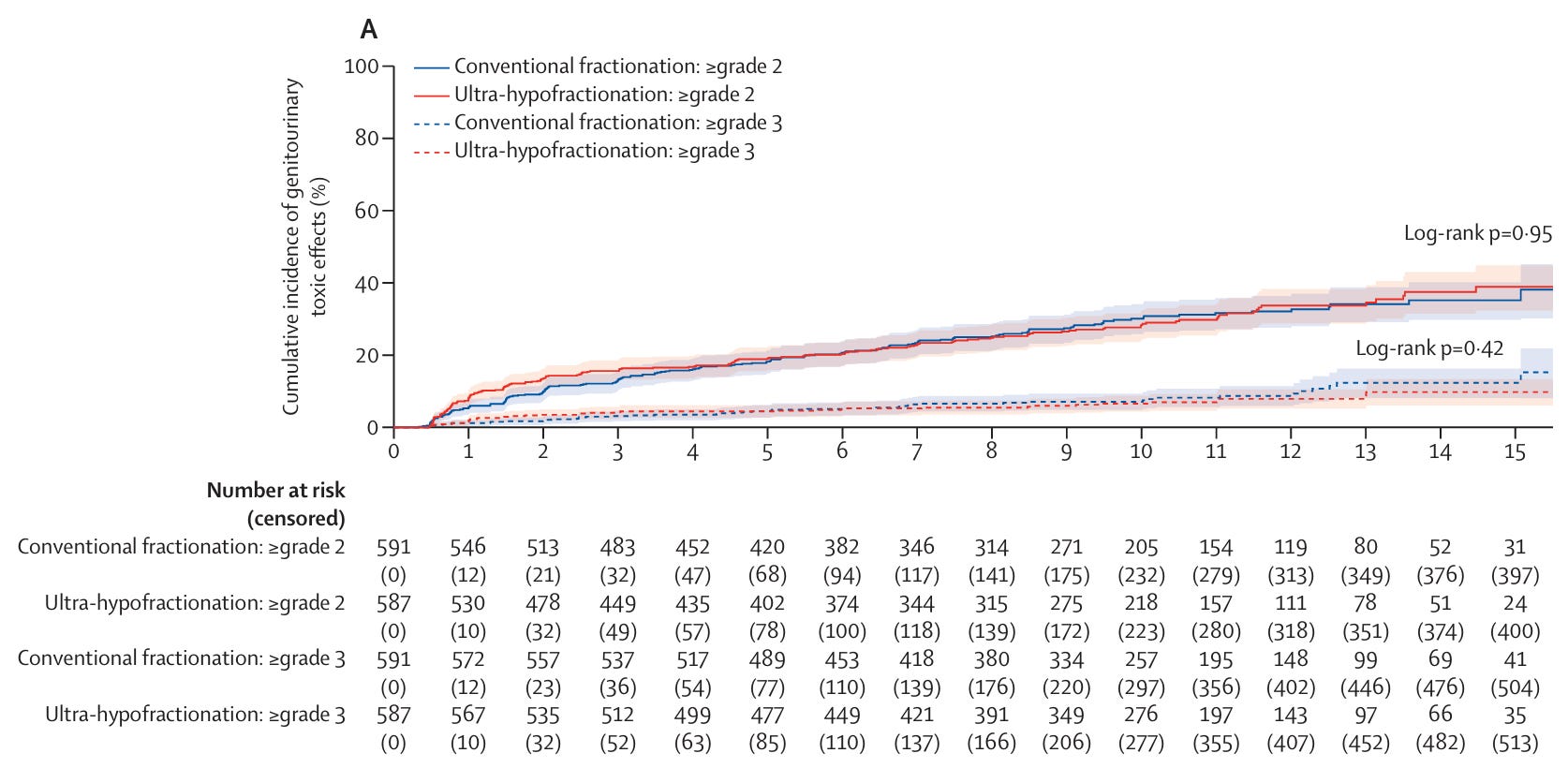
~30% grade ≥2 genito-urinary (GU) toxicity at 10 years
~14% grade ≥2 gastro-intestinal (GI) toxicity at 10 years
~7% grade 3 GU toxicity at 10 years (supplementary data)
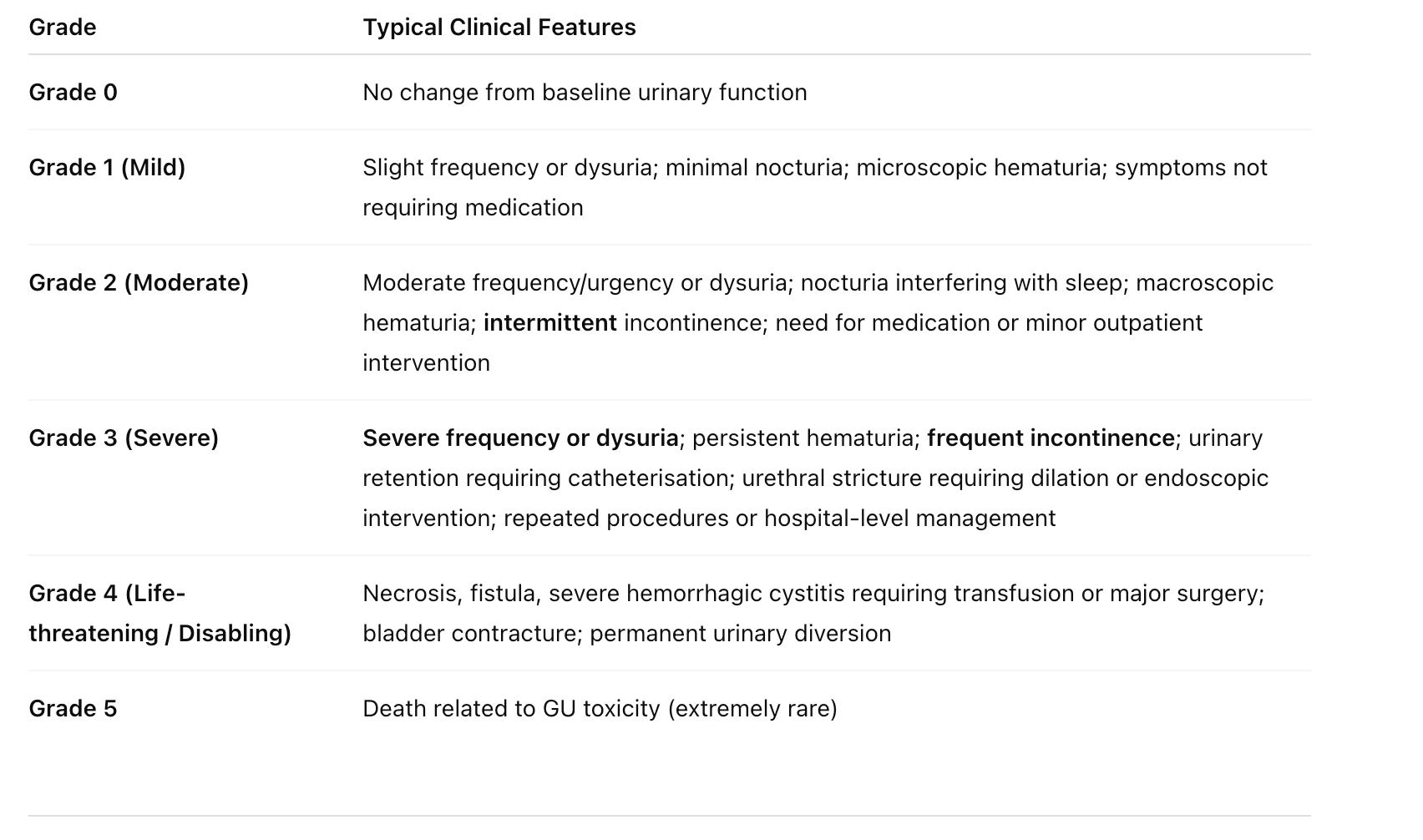
Overview of the RTOG scoring system
Grade 3 GU events are rarely trivial. They often imply invasive management—repeated catheterisation, endoscopic procedures, or hospital-level care. This is not a “borderline symptom” signal; it represents severe morbidity in roughly 1 in 14 patients a decade after treatment. The key point: schedule shortening does not eliminate serious late urinary harm.
Why the real toxicity rate may be higher
Two methodological features nudge the cumulative incidence downward.
A. Physician-reported toxicity
Late GU/GI events were recorded by physicians using RTOG criteria, frequently via telephone follow-up. Physician scoring is known to be conservative for moderate symptoms (urgency, frequency, minor bleeding), especially when contact is brief or remote.
Moreover, the trial does not state who the “physician” is.
Urologists and radiation oncologists view urinary symptoms through different clinical lenses: urologists may recognise and document moderate morbidity earlier, whereas radiation oncologists may interpret similar complaints as expected post-treatment effects.
The unblinded design further increases the risk of reporting bias for treatment-related side effects if the physician is a radiation oncologist, since they will be biased towards underreporting of toxicity.
This creates a systematic difference in detection thresholds, primarily affecting grade 2 toxicity, whereas grade 3 events are less susceptible because they typically require procedures.
No conclusions can be drawn because the trial does not report the physician's subspecialty; however, this should be kept in mind, as it may influence the toxicity outcome.
B. Censoring at metastatic progression
Patients were censored for late toxicity at the time of regional or distant metastasis.
In other words, patients who are progressive no longer contribute to the cumulative incidence numbers.
The assumption is that those who progress would have had a toxicity profile similar to those who do not—an assumption that is methodologically convenient but clinically uncertain.
Probably, there will again be no difference in toxicity between both arms concerning the patients who progress; however, it is possible that these are more frail patients who will experience more toxicity in the long term. This assumption would lead to an underestimation of the long-term toxicity.
Open-label design and management discretion
The trial was open-label. As discussed above, this may have an impact on the reporting of toxicity.
However, a clear example of a related signal of open-label bias appears in the management of biochemical recurrence.
There was no strict protocol-defined PSA threshold for initiating salvage androgen-deprivation therapy, and the reported median PSA at ADT start was numerically higher in the ultra-hypofractionated arm (9.2 ng/mL vs 8.4 ng/mL).
This does not prove bias, but it suggests that clinician discretion—potentially influenced by knowledge of treatment allocation—may have delayed salvage therapy in one arm, since time to initiation of ADT was included in the composite primary endpoint. In other words, try to delay ADT initiation as long as possible, and you might get a better outcome in the intervention arm.
What we still do not know
Patient-Reported Outcomes (PROs) are pending.
This is not a minor add-on. PROs will likely reshape the interpretation of grade 2 toxicity, where patient experience and clinician scoring often diverge the most. If physician-reported rates already approach one-third for GU toxicity, PRO data may reveal an even larger symptomatic burden—or, less likely, reassure us that many clinician-graded events were clinically negligible. Until PROs are available, any statement about the true lived impact of late toxicity remains provisional.
We have PROs regarding this trial, including a 6-year follow-up.
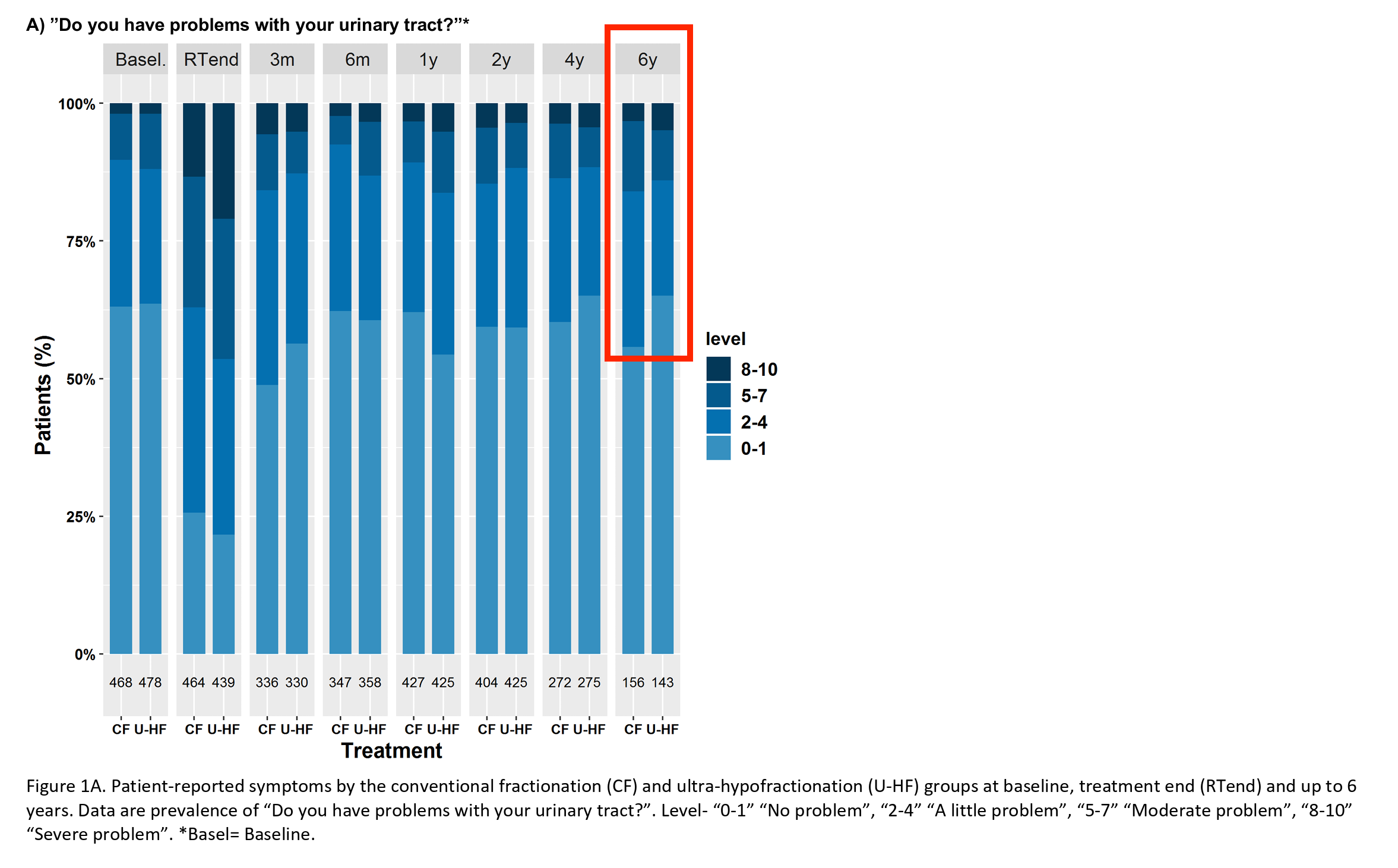
A scoring system different from the RTOG toxicity scale is used.
However, as shown in the red square, approximately 40% of patients report urinary tract problems, and approximately 15% report moderate to severe problems.
We expect this number to increase with longer follow-up, given the physician-reported evolution in cumulative RTOG toxicity.
Practical take-home for counselling
This trial proves that ultra-hypofractionation is a valid alternative to conventional fractionation for cancer control, with clear benefits for patients.
If radiotherapy is the treatment of choice for a patient, we should aim towards ultra-hypofractionation.The absolute long-term toxicity is substantial, with severe urinary morbidity around 7% at 10 years and moderate-to-severe GU symptoms in roughly one-third of patients.
A systematic review published in 2022 showed a pooled RTOG ≥ 2 incidence of 17% at 5-year follow-up. We now have prospective data showing double-trouble at 10 years of follow-upMeasurement methods probably undercall symptoms, and censoring rules may further lower reported cumulative incidence.
For me, this substantial toxicity is particularly relevant for younger men and those with long life expectancy, where a decade-scale horizon is clinically meaningful.
Bottom line:
Ultra-hypofractionation is convincingly non-inferior to conventional fractionation for cancer control, but the long-term burden of urinary and bowel morbidity after radiotherapy remains substantial. These prospective data therefore confirm the view that, in men with a long life expectancy, radiotherapy should not automatically be the default local treatment and that surgery will often be the preferred option.
This is not to suggest that surgery is without harm—prostatectomy carries clear risks of incontinence and erectile dysfunction—but rather that the long-term side-effect profile of radiotherapy deserves equal weight in treatment selection and patient counselling.
Thanks for reading Beyond The Abstract: Urology! Subscribe for free to receive new posts and support my work.
Comments
Nothing yet. Say the first thing.
Sign in to join the conversation.