
Immunotherapy has been trying to break into metastatic castration-resistant prostate cancer (mCRPC) for more than a decade. The biological rationale keeps getting recycled; the clinical results do not improve.
We already had the results of KEYNOTE-921 (pembrolizumab + docetaxel), but now there is no more escaping reality thanks to the publication of CheckMate 7DX (nivolumab + docetaxel) in the Lancet Oncology this month.
Both trials enrolled patients with mCRPC who had progressed on androgen deprivation therapy and at least one androgen receptor pathway inhibitor (ARTA). Both were chemotherapy-naïve in the mCRPC setting. Both used docetaxel plus prednisone as the control arm, which is exactly what these patients receive in real life. There is no straw-man comparator here.
This matters because when a negative trial uses the right control arm, the result is informative. These studies were not undercut by design flaws that would excuse failure.
In CheckMate 7DX, nivolumab added nothing to docetaxel. Median radiographic progression-free survival was 9.4 vs 8.7 months (HR 0.96, p=0.59), and overall survival was 18.7 vs 18.9 months (HR 1.09, p=0.36). The Kaplan–Meier curves never meaningfully separate, and the hazard ratios hover around 1.0 throughout follow-up.
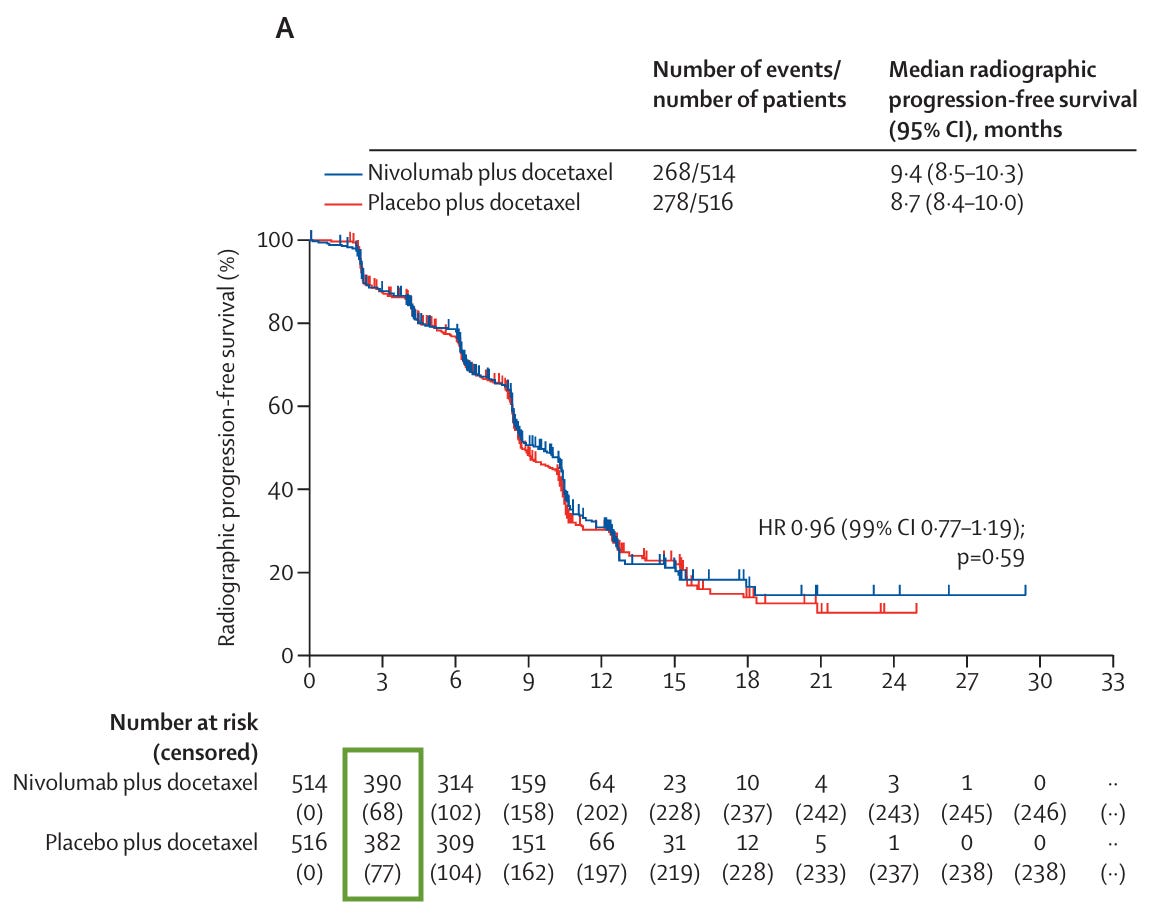
KM curve for PFS: complete overlap, no significant difference in early censoring (green square).
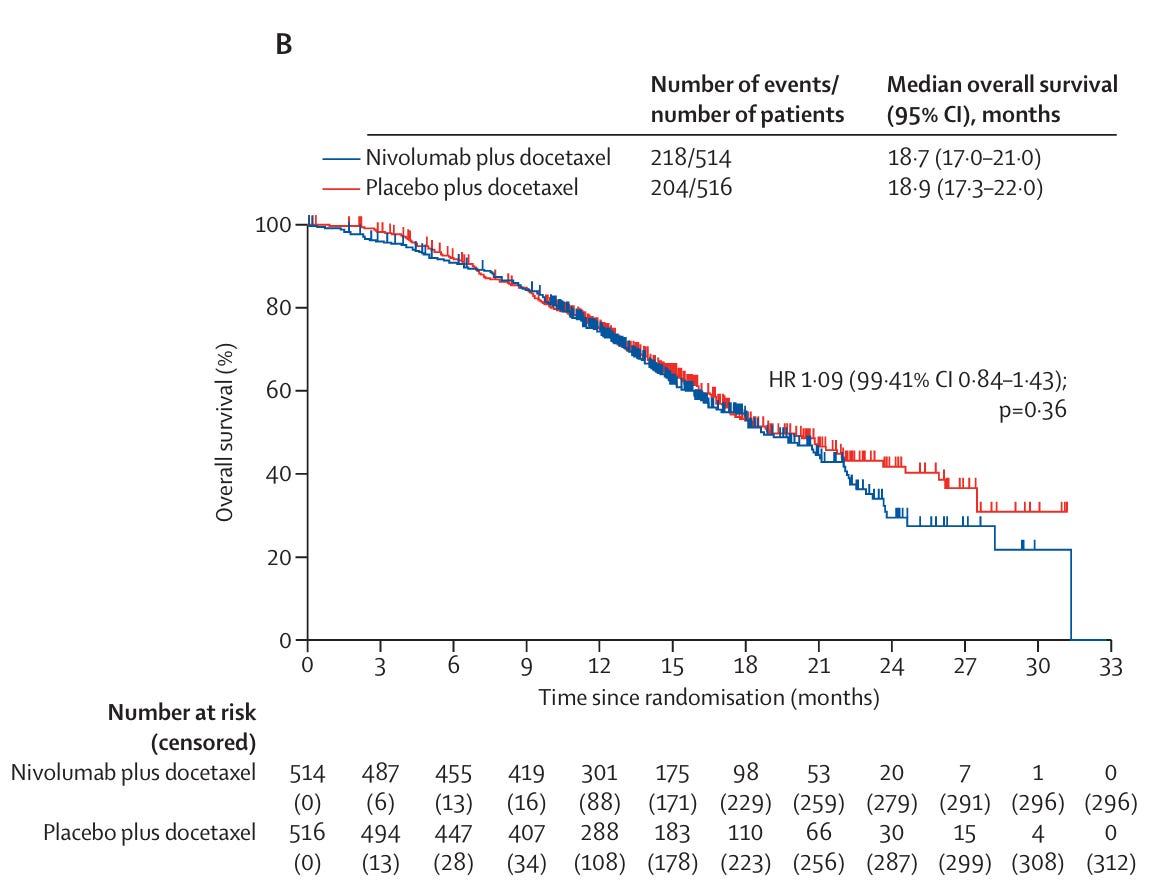
KM curve for OS: complete overlap, you can forget about the tail of the curve, even if it’s in favor of the placebo.
KEYNOTE-921 tells the same story with a different PD-1 inhibitor. At the interim analysis, rPFS failed to meet the prespecified boundary despite a numerically favorable HR (0.85). At final analysis, overall survival was 19.6 vs 19.0 months (HR 0.92, p=0.17). No statistical success, no clinical signal.
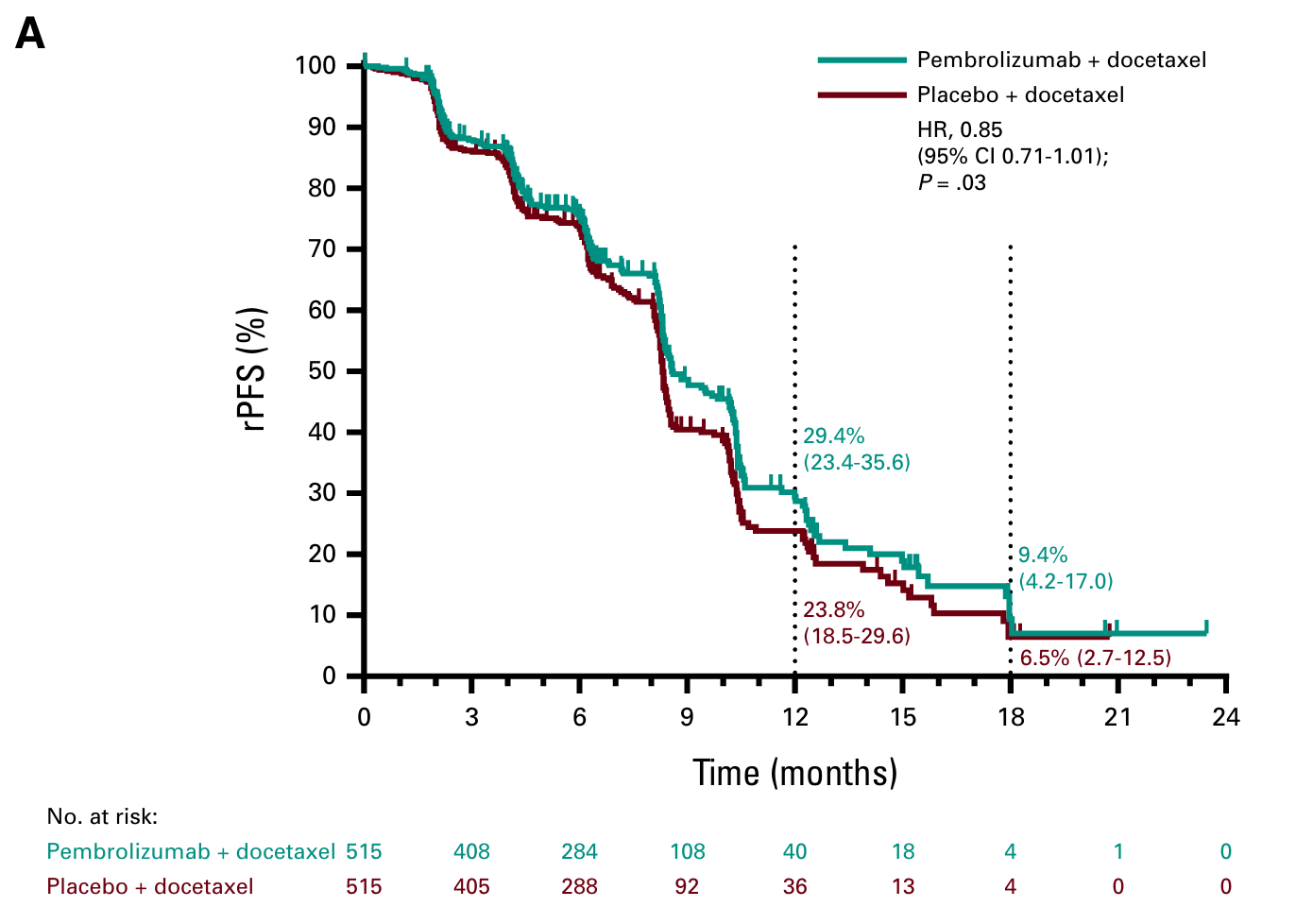
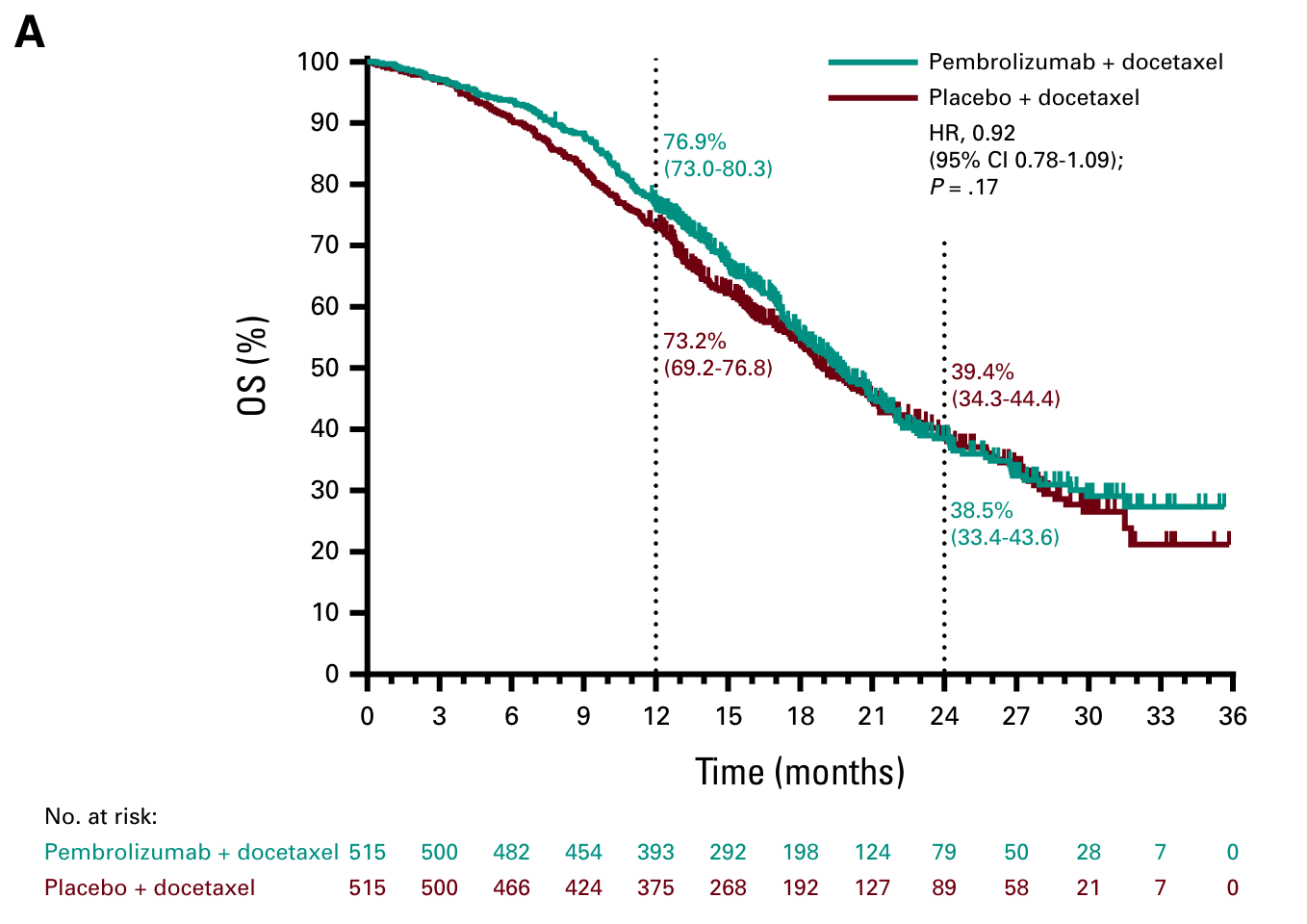
When primary endpoints fail, authors often pivot to secondary outcomes. That strategy fails here.
Across both trials:
PSA response rates were virtually identical between arms.
Objective response rates in measurable disease were the same, with no improvement in depth or durability of response.
Time to PSA progression, time to pain progression, and time to subsequent therapy showed no meaningful differences.
Toxicity increased modestly but consistently with PD-1 addition, including immune-mediated events and treatment-related deaths, without any offsetting benefit.
There is no secondary endpoint that plausibly changes the interpretation.
Both trials performed extensive subgroup and biomarker analyses—PD-L1 expression, disease burden, prior ARPI exposure, visceral metastases. The result is monotony. Forest plots center on unity. Occasional numerically favorable subgroups (e.g., PD-L1–positive patients in KEYNOTE-921) fail interaction testing and collapse under multiplicity and post-hoc selection.
If a therapy only works when sliced thin enough, it does not work.
Taken together, these trials are not just two failures. They are a replicated negative experiment. Different sponsors, different antibodies, different geographies—same outcome. The hypothesis that taxane chemotherapy “primes” prostate cancer for PD-1 blockade is no longer untested. It has been tested at scale and rejected.
The problem is not trial execution. It is not patient selection within the current framework. It is the assumption that unselected mCRPC is meaningfully sensitive to PD-1 inhibition when layered onto docetaxel. And it is clearly not.
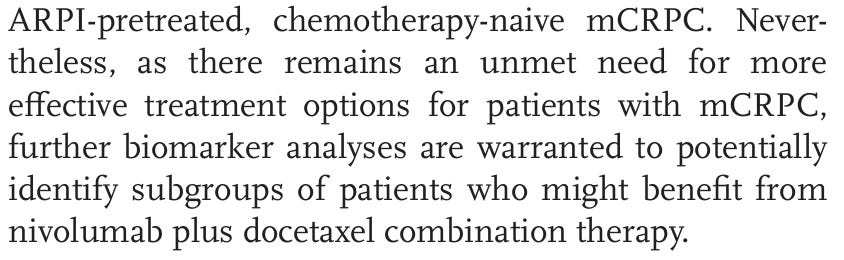
The authors of CheckMate 7DX, or at least the funded writers, try to save the trial by hoping nivolumab would be beneficial in a subgroup of patients.
Personally, I don’t buy it. For me, if the trial is completely negative in an all-comer population, there won’t be a big effect size from one or the other subgroup without at least a signal in the curves.

Both CheckMate 7DX and KEYNOTE-921 are unequivocally negative. No improvement in progression-free survival. No improvement in overall survival. No rescue by secondary endpoints. No convincing subgroup. Just more toxicity layered onto standard chemotherapy.
At this point, repeating this strategy in unselected mCRPC is not perseverance—it is inertia.
No posts
Comments
Nothing yet. Say the first thing.
Sign in to join the conversation.