
The final overall survival (OS) results of the EMBARK trial were recently published in The New England Journal of Medicine. The study included three arms, but for simplicity, I’ll focus mainly on the two most clinically relevant: enzalutamide plus leuprolide versus leuprolide alone.
The EMBARK trial enrolled men with biochemical recurrence (BCR) after definitive local therapy — radical prostatectomy, radiotherapy, or both — without evidence of disease on conventional imaging (i.e., no metastases on CT or bone scan). This means no PSMA, and at enrollment, patients were not receiving androgen deprivation therapy (ADT).
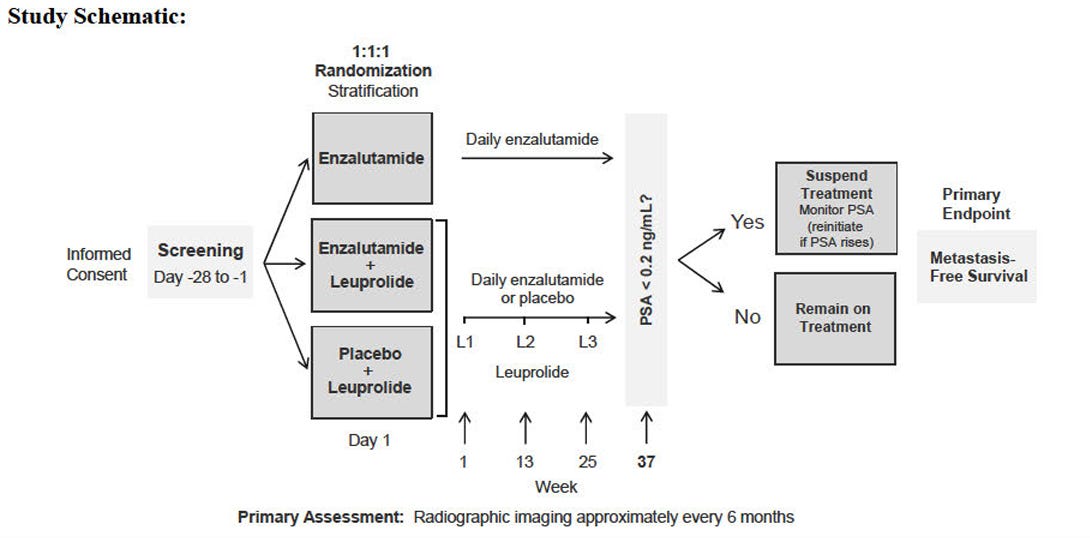
Patients were randomized into three groups:
Enzalutamide + leuprolide
Enzalutamide monotherapy
Placebo + leuprolide
Importantly:
Treatment was suspended if PSA dropped below 0.2 ng/mL, and restarted upon PSA relapse to a predefined level.
No crossover was allowed; patients on placebo + leuprolide could not receive enzalutamide within the trial.
No PSMA PET was used — appropriate, as the trial began in 2015. I will not get into the discussion of we should or should not use PSMA in this setting.
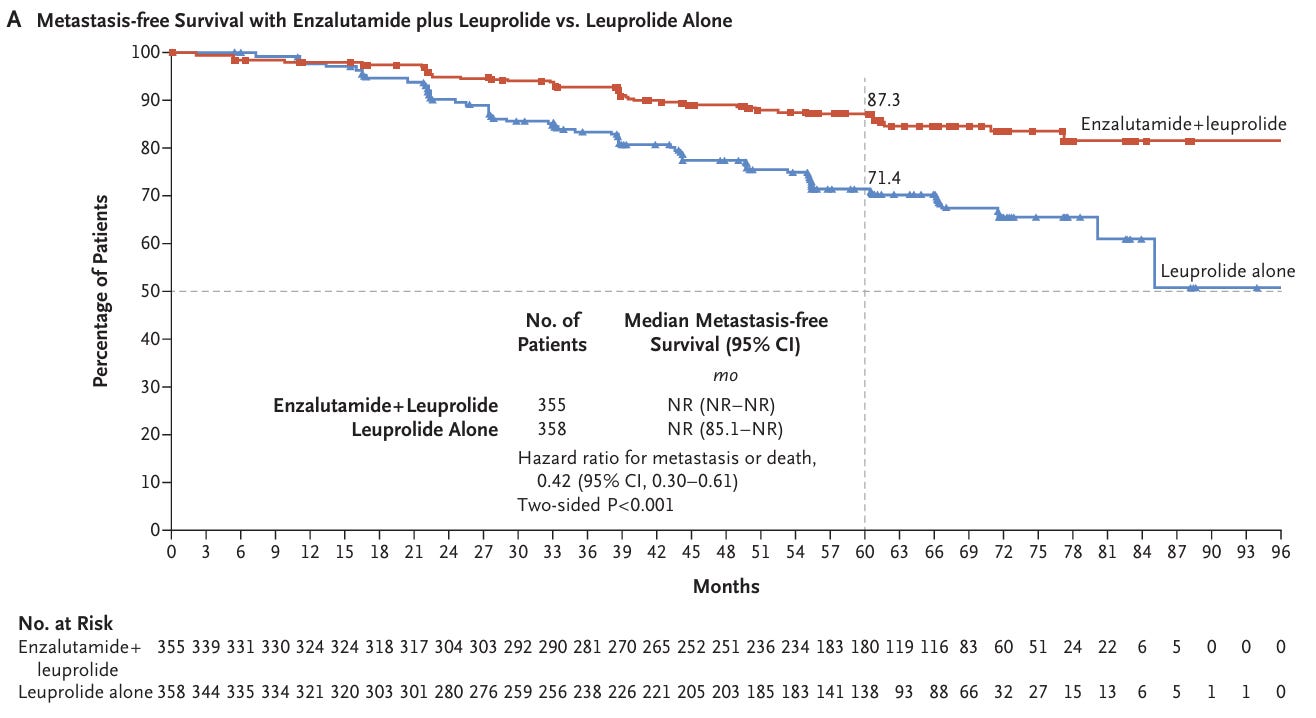
The primary endpoint was metastasis-free survival (MFS) in the combination arm compared with leuprolide alone. This endpoint had already been reported as positive.
At 5 years:
Enzalutamide + leuprolide: 87.3% (95% CI, 83.0–90.6)
Leuprolide alone: 71.4% (95% CI, 65.7–76.3)
Enzalutamide monotherapy: 80.0% (95% CI, 75.0–84.1)
The combination significantly improved MFS (HR for metastasis or death, 0.42; 95% CI, 0.30–0.61; p<0.001).
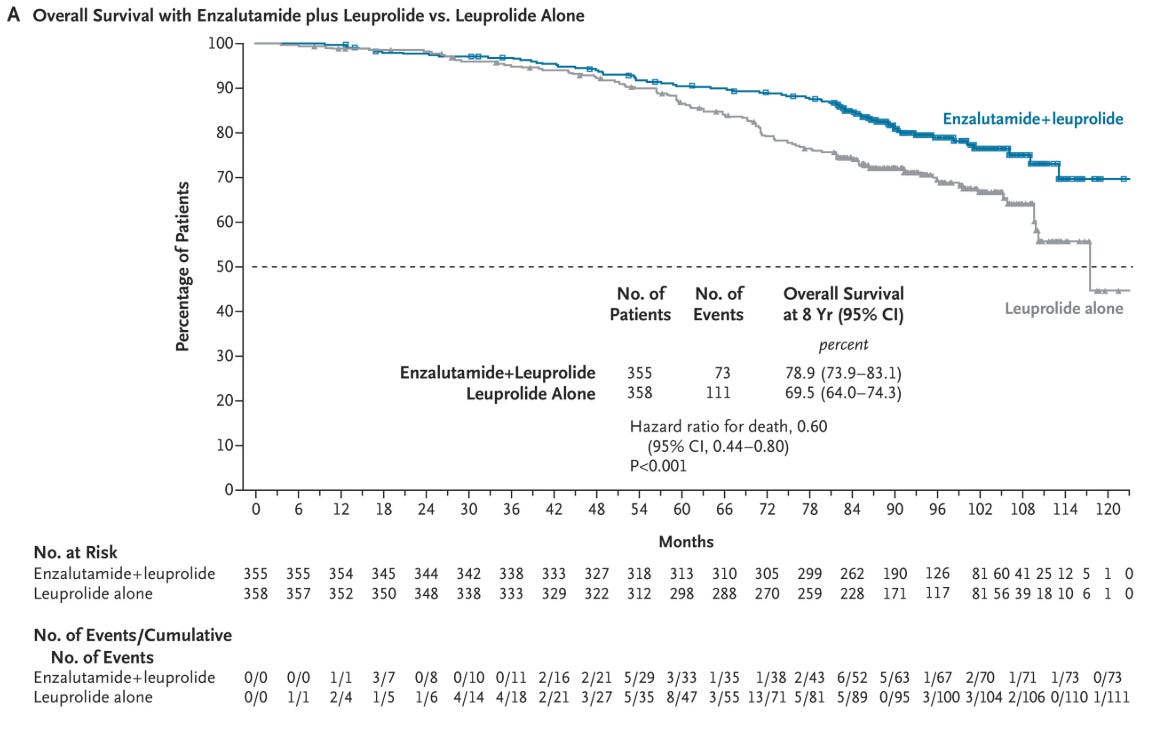
In the newly reported data, overall survival (OS) was also longer with the combination:
At 8 years:
Enzalutamide + leuprolide: 78.9% (95% CI, 73.9–83.1)
Leuprolide alone: 69.5% (95% CI, 64.0–74.3)
Enzalutamide monotherapy: 73.1% (95% CI, 67.6–77.9)
The hazard ratio for death was 0.60 (95% CI, 0.44–0.80; p<0.001).
There were no new safety signals, and previous analyses showed that combination therapy did not negatively affect health-related quality of life. Interestingly, sexual-activity–related quality of life was better with enzalutamide monotherapy than with leuprolide alone.
Enzalutamide is already established across multiple stages of prostate cancer: mCRPC, non-metastatic CRPC, and hormone-sensitive metastatic disease. While the sponsor will frame EMBARK as an effort to further improve survival and quality of life, it’s clear that commercial strategy also plays a major role.
Each time a drug moves earlier in the disease continuum, the treatable population expands — and so does the market. With the metastatic settings already covered, the next frontier was obvious: non-metastatic biochemical recurrence. Moreover, this niche currently lacks competition from other androgen receptor pathway inhibitors (ARPI) like apalutamide (Erleada) or darolutamide (Nubeqa), giving enzalutamide a potential first-mover advantage.
That said, credit where it’s due — the decision to allow treatment suspension for patients achieving deep PSA responses (<0.2 ng/mL) deserves acknowledgment. This approach offers patients a treatment break, despite providing no financial upside for the sponsor.
The OS benefit reported here is important — especially since these are asymptomatic, non-metastatic patients. Starting systemic therapy in this context requires clear justification: if we compromise quality of life, which we will with hormonal therapy, it must be in exchange for a tangible survival benefit.
However, two key concerns remain:
Post-progression treatment data are missing.
Perhaps the most significant limitation — and one that has become frustratingly common — is the absence of detailed post-progression treatment data.
Once patients progress on their assigned arm, we need to know what therapies they received and if there is an inbalance in post-protocol treatments between the arms.Without these details, the observed OS advantage becomes much harder to interpret.
The absence of this data always raises eyebrows. Sponsors know it’s essential for interpretation, yet often withhold it — either because it weakens the conclusion, or because it wasn’t properly collected. Neither explanation is reassuring.No crossover.
Patients in the leuprolide-alone arm who progressed could not receive enzalutamide within the trial — even though enzalutamide is a well established treatment option in the castration-resistant setting.
This design element virtually guarantees an OS advantage for the experimental arm — not necessarily because the drug is more effective in an earlier line, but because the control group was denied optimal post-progression therapy.Geographic disparities compound this problem. EMBARK enrolled patients across 17 countries, including three (Brazil, Poland, and Slovakia) where reimbursement for ARPIs remains limited.
In those regions, patients progressing in the control arm may have been limited to chemotherapy or best supportive care.
If a significant number of patients refuses chemotherapy, this would inevitably depress survival in the control arm, exaggerating the relative OS benefit.And since we have no data on post-protocol care (cfr above) this remains speculation.
The EMBARK trial confirms that enzalutamide plus ADT significantly improves both metastasis-free and overall survival in men with high-risk biochemical recurrence after local therapy. Clinically, it’s a meaningful advance — but scientifically, some caution is warranted.
Before we rush to change practice, we should demand transparent post-progression data and consider the implications of restricting crossover in trials of life-prolonging therapies.
Ultimately, EMBARK extends the reach of enzalutamide into yet another disease state — but whether it truly transforms outcomes, or simply expands the drug’s territory, depends on how we interpret the data beyond the abstract.
No posts
Comments
Nothing yet. Say the first thing.
Sign in to join the conversation.