
If you’re not familiar with the trial design, I covered it in an earlier ESMO preview on The Oncology Shot Substack, where I discussed what we expected from this study.
Trial Summary
POTOMAC investigated the use of Durvalumab (a PD-L1 inhibitor) in BCG-naive, high-risk non–muscle-invasive bladder cancer.
Patients were randomized into three arms:
Thanks for reading Beyond The Abstract: Urology! Subscribe for free to receive new posts and support my work.
BCG for 2 years (control group)
Durvalumab for 1 year + BCG for 2 years
Durvalumab for 1 year + BCG induction only
The primary endpoint was disease-free survival (DFS).
Key secondary endpoints included:
Proportion of patients alive and disease-free at 2 years
Overall survival (OS) at 5 years
Safety and tolerability
Health-related quality of life
Results
A total of 1,018 patients underwent randomization.
For DFS assessment, patients were followed with cystoscopy, cytology, and CT urography every 3 months until month 36, then every 6 months.
1. Disease-Free Survival
The risk of recurrence or death was 32% lower in the Durvalumab + BCG induction and maintenance arm than in the control arm:
HR 0.68 (95% CI 0.50–0.93); p = 0.015.The estimated proportion of patients alive and disease-free at 24 months was:
86.5% (95% CI 82.2–89.8) with Durvalumab + BCG induction and maintenance
81.6% (95% CI 76.9–85.3) with BCG alone
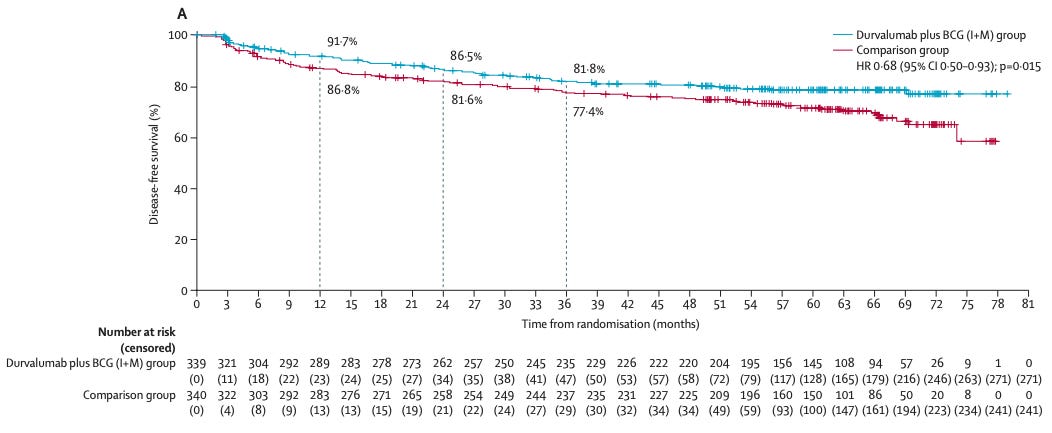
So, a statistically significant — but modest — difference.
Before we do the deep dive, let’s look at the rest of the results.
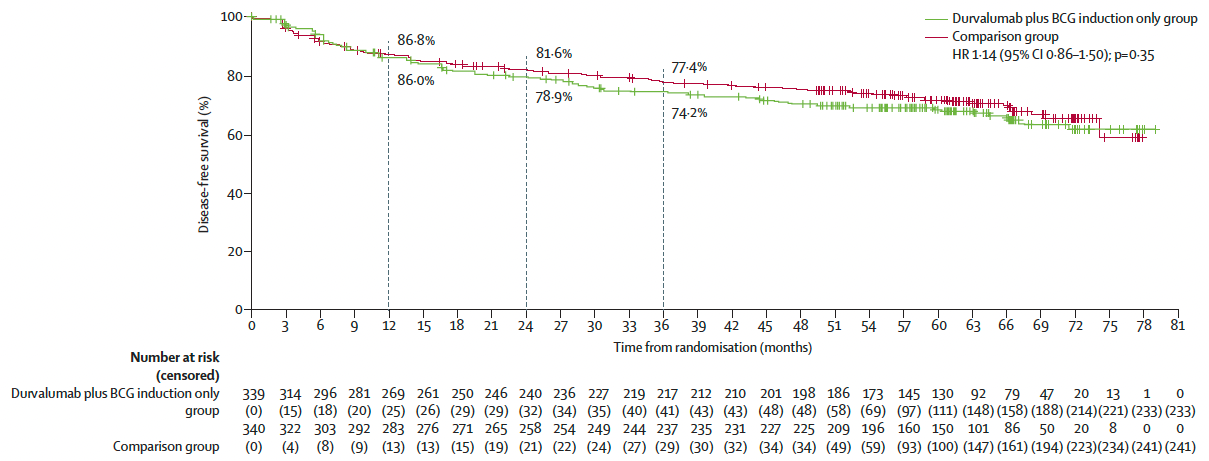
2. Durvalumab + BCG Induction Only
No difference in DFS compared to BCG induction + maintenance:
HR 1.14; p = 0.35.
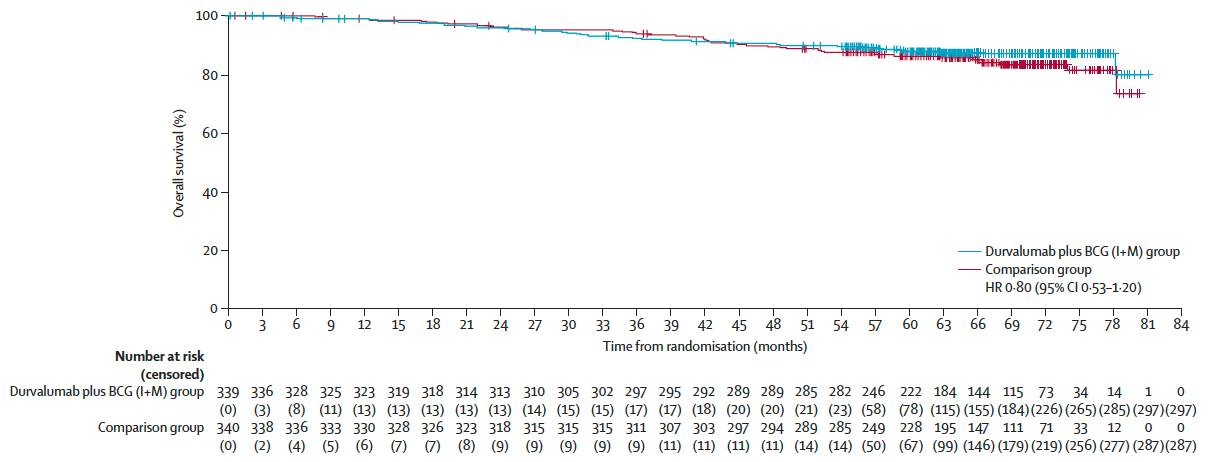
3. Overall Survival
No significant difference between Durvalumab + BCG (I & M) and BCG alone:
HR 0.80 (95% CI 0.53–1.20).
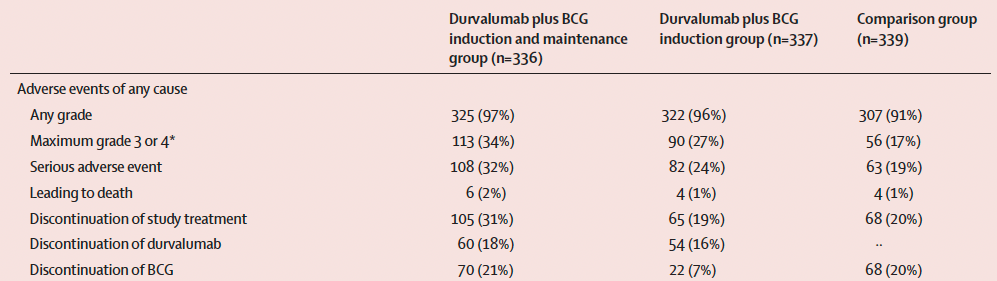
4. Adverse Events
As expected, patients receiving Durvalumab experienced more adverse events, consistent with its known toxicity profile.
The authors describe side effects as tolerable and manageable.
Authors’ Conclusions
According to the investigators:
Adding Durvalumab to BCG (I & M) improves disease-free survival.
There is no detriment to overall survival.
The safety profile is consistent with known data for each therapy; side effects were tolerable and manageable.
What They’re Not Telling Us
Now we go “Beyond the Abstract”
Let’s look more closely at the DFS Kaplan–Meier curve — there’s a story in the censoring pattern, let me know if you agree or not.
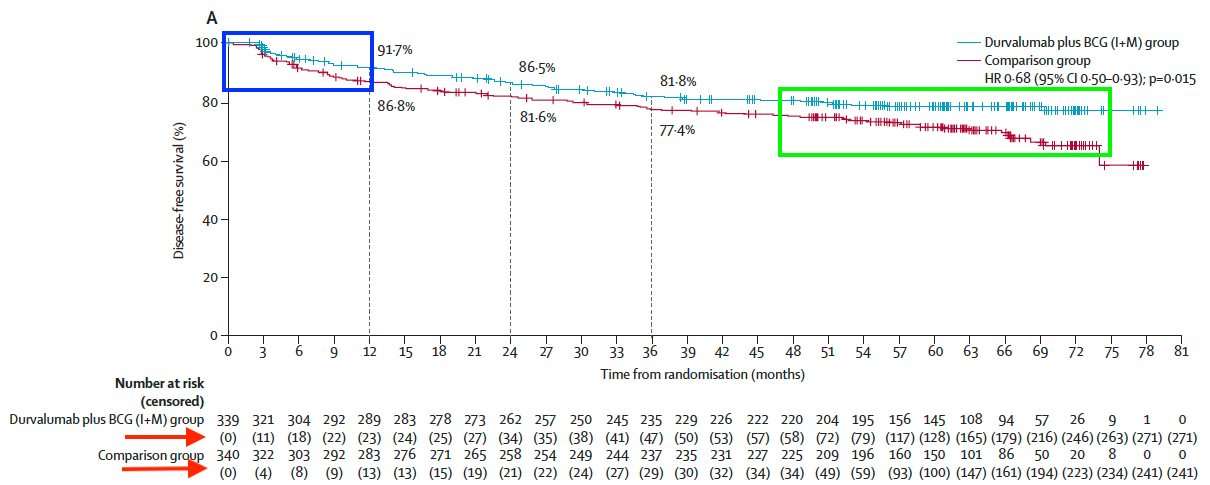
Red arrows: numbers between brackets, they represent the number of patients being censored.
Green square: lots of censoring here (vertical ticks), which is normal and what we call “late censoring”. Basically, there is a lot of censoring near the end of the curve (or follow-up period) because a significant number of patients joined the trial later, meaning they are still in the trial without having presented the event of interest (disease recurrence). In other words, they are censored because we don’t know what will happen to them later in the curve.
Blue square: In the early part of the curve (where the lines split), there appear to be more censoring events in the Durvalumab arm.
This is confirmed by the numbers at the red arrows: significantly more early censoring in the Durvalumab group.
Why does this matter?
Early censoring often reflects patients who drop out due to toxicity. Frail patients are more likely to discontinue the treatment or skip follow-up cystoscopies and CT scans. That means the healthier patients remain in the Durvalumab arm’s analysis, introducing bias and artificially improving DFS results.
You can see a similar pattern in early censoring in the Durvalumab + BCG induction only vs. control curves, confirming the hypothesis that there is increased censoring due to toxicity.
Spinning the OS Result
The authors frame the absence of an overall survival difference as good news:
“There is no detriment to overall survival with the addition of Durvalumab to BCG.”
Let’s be clear — being happy that a drug didn’t kill more patients is not a win.
Durvalumab causes more side effects, carries a significant financial burden, and does not improve overall survival. That’s the real takeaway.
Unanswered Questions
The paper provides no details on:
What happened to patients after progression
Whether there were differences in radical cystectomy rates
Any delay in progression to metastatic disease
Subsequent treatments — particularly whether patients who received Durvalumab (a PD-L1 inhibitor) were later treated with another checkpoint inhibitor
These post-progression details are crucial to understanding the broader impact of Durvalumab on overall survival.
Conclusion
Durvalumab + BCG induction and maintenance increases DFS modestly compared to BCG alone — but the effect size is likely inflated by early censoring due to toxicity.
Importantly, there is no overall survival benefit, despite increased toxicity and cost.
And remember: the trial only included ECOG 0–1 patients — in real life, the toxicity bias could be even more pronounced.
So while AstraZeneca celebrates that Durvalumab didn’t increase mortality, we should ask the tougher question:
Why expose patients to a toxic, expensive drug that doesn’t help them live longer?
Thanks for reading Beyond The Abstract: Urology! Subscribe for free to receive new posts and support my work.
Comments
Nothing yet. Say the first thing.
Sign in to join the conversation.