
1. Background and clinical need
High-risk non–muscle-invasive bladder cancer (NMIBC) is treated with Bacillus Calmette–Guérin (BCG) induction followed by BCG maintenance. This approach lowers recurrence, delays progression, and is required by all major guidelines. Event-Free Survival (EFS) is an appropriate clinical endpoint because high-grade recurrence and persistent carcinoma in situ often lead to cystectomy.
CREST investigated whether adding subcutaneous sasanlimab (a programmed cell death protein 1 inhibitor) to BCG could improve outcomes in BCG-naive patients with high-risk NMIBC.
Thanks for reading Beyond The Abstract: Urology! This remains an independent platform. To support it, please Subscribe!
2. Trial design (brief overview)
CREST was a randomized, open-label phase 3 trial that assigned patients 1:1:1 to three treatment strategies:
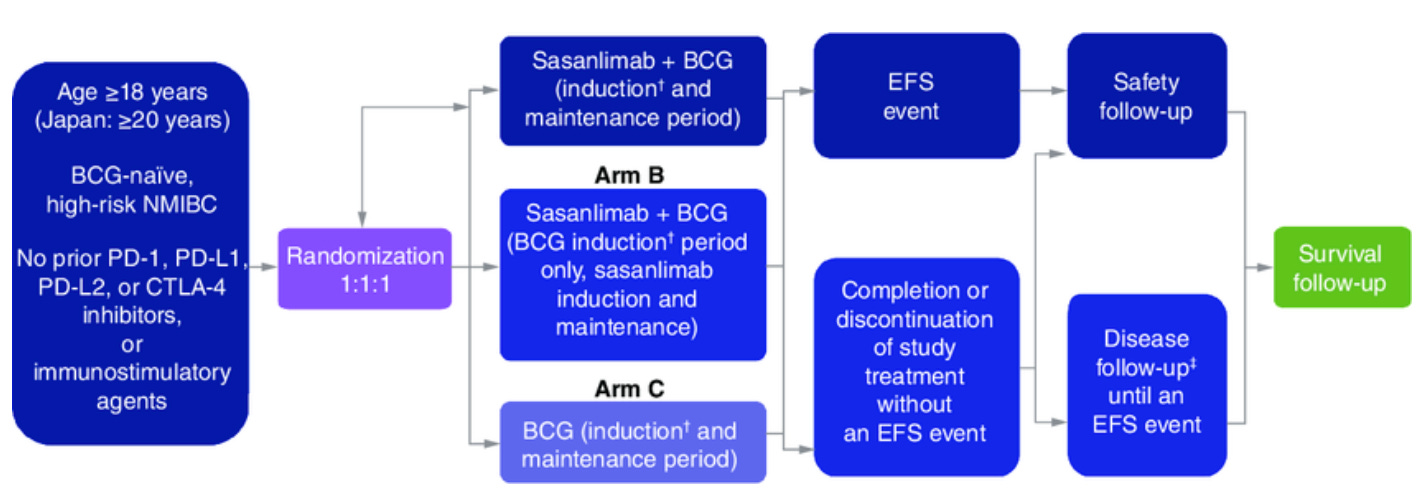
Arm A: Sasanlimab + full BCG
Sasanlimab combined with BCG induction and BCG maintenance per standard-of-care schedules.Arm B: Sasanlimab + BCG induction only
Sasanlimab combined with BCG induction without BCG maintenanceArm C: Full BCG alone
The control arm receiving BCG induction and BCG maintenance, representing established standard of care.
The protocol originally defined two co-primary endpoints:
Event-Free Survival (EFS) for Arm A versus Arm C, and
Event-Free Survival (EFS) for Arm B versus Arm C.
Later in trial conduct, the Arm B comparison was downgraded to a secondary endpoint without explanation. Investigator-assessed EFS became the sole primary endpoint.
3. Understanding what it means to call CREST “a positive trial”
On the surface, CREST is labeled positive because the revised primary endpoint—investigator-assessed EFS for sasanlimab + full BCG (Arm A) versus full BCG alone (Arm C)—met statistical significance.
However, this interpretation fails to consider two fundamental issues.
A. The original protocol specified two co-primary endpoints, and no reason for demotion was provided
The protocol lists both:
Event-Free Survival (EFS) for Arm A versus Arm C, and
Event-Free Survival (EFS) for Arm B versus Arm C
as co-primary endpoints.
Only later was the Arm B comparison demoted to a key secondary endpoint.
The manuscript gives no explanation for this change—no methodological, operational, or statistical justification. This silence is important because:
Arm B uses an induction-only BCG regimen, which is below standard of care.
Arm B ultimately fails to show benefit (hazard ratio 1.16; 95% CI 0.87–1.55).
Under a co-primary framework, failure of either comparison means the trial is not positive.
Thus, CREST is “positive” only under the revised analysis plan, not the one originally used to justify the study.
B. Blinded Independent Central Review (BICR) does not confirm significance
The primary endpoint relies on unblinded investigator assessment in an open-label setting. When independently assessed through Blinded Independent Central Review (BICR):
The hazard ratio remains similar (0.75),
But the confidence interval crosses 1 (95% CI 0.52–1.06),
And significance is not achieved (one-sided P = 0.0517).
If central review had been the primary analytic method, CREST would again be negative.
4. Open-label design and vulnerability to bias in carcinoma in situ
Carcinoma in situ (CIS) assessments depend on cystoscopy interpretation, cytology, and biopsy decisions. After the scheduled post-induction confirmation biopsy, further biopsies are performed only at investigator discretion.
Inflammation and BCG-related erythema are common and visually indistinguishable from CIS. In an unblinded setting, subconscious bias is plausible:
In patients receiving sasanlimab, ambiguous findings may be attributed to inflammation, leading to delayed biopsy, thus elongating EFS.
In patients receiving standard BCG, the same findings may trigger earlier biopsy.
Because biopsy timing determines the recording of EFS events, such subconscious differences could modestly delay events in Arm A or accelerate them in Arm C. The reported difference in CIS complete response is only about 5%, easily within the range of bias introduced by small variations in biopsy decisions. I want to highlight that this is a hypothetical problem that I cannot prove, and that it is a structural limitation of an open-label design, not investigator misconduct.
5. Toxicity, treatment discontinuation, and the possibility of informative censoring
Sasanlimab markedly increases toxicity:
Grade ≥3 treatment-related adverse events: 29.1% (Arm A) and 21.8% (Arm B) vs 6.3% (Arm C).
Any-grade immune-related adverse events: ~43–47% in sasanlimab-containing arms vs 1.4% in Arm C.
Treatment withdrawal due to adverse events was highly imbalanced:
131 patients discontinued treatment for toxicity in Arm A versus 37 patients in Arm C.
Although treatment discontinuation does not automatically censor EFS, the Statistical Analysis Plan (SAP) anticipates “informative censoring due to imbalanced dropouts” and requires a sensitivity analysis for this scenario. That analysis is not reported. Given the magnitude of toxicity-driven withdrawal, non-random censoring is a legitimate concern and could subtly inflate the EFS benefit.
6. Ethical and scientific concerns related to omission of BCG maintenance
Guidelines universally mandate BCG induction followed by BCG maintenance for high-risk NMIBC. The CREST protocol acknowledges this. Maintenance reduces recurrence and progression compared with induction alone.
Despite this, one-third of participants were randomized to a regimen lacking maintenance. No compelling rationale is provided. The protocol cites only an “expected improvement” with sasanlimab; the article cites a desire to “reduce the burden of BCG treatment.” Neither is acceptable justification in a phase 3 trial intended to support regulatory approval.
A valid development sequence would involve:
First demonstrating that sasanlimab improves outcomes on top of full BCG standard of care, then
Testing whether BCG maintenance can be safely reduced in a separate study.
CREST reverses this sequence. The results confirm that omission of BCG maintenance is harmful: Arm B performed worse than standard-of-care BCG alone.
7. Sponsor-controlled classification of immune-related adverse events
While investigators record all adverse events, immune-related adverse events (irAEs) are identified by a combination of prespecified terms and sponsor-led medical review. The final classification—whether an AE is considered immune-mediated—rests with sponsor clinicians.
Given the high rates of immune-related toxicity and the regulatory relevance of irAEs, sponsor-controlled adjudication weakens transparency in the assessment of safety.
8. Missing endpoints essential for clinical interpretation
Several clinically meaningful outcomes are absent from the report:
Number and timing of radical cystectomies
Disease-specific survival
Patterns of post-progression therapy
Without these data, it is unclear whether the modest improvement in EFS corresponds to meaningful bladder preservation or simply delayed detection of events or altered timing of cystectomy. Overall survival is neutral at the current follow-up.
9. Conclusion
CREST shows a modest improvement in Event-Free Survival for sasanlimab added to full BCG, but this signal is not confirmed by blinded review and depends on a mid-trial endpoint change whose rationale is not provided.
The trial’s open-label design, subjective biopsy pathways, substantial toxicity, and missing analyses of informative censoring further weaken confidence in the result.
Most importantly, CREST knowingly randomized patients to a regimen lacking guideline-required BCG maintenance, exposing them to inferior treatment without a compelling scientific justification.
In its current form, CREST does not offer sufficiently robust, ethical, or clinically meaningful evidence to support the routine use of sasanlimab in high-risk non–muscle-invasive bladder cancer.
Comments
Nothing yet. Say the first thing.
Sign in to join the conversation.